

Reputation management strategies differ based on target assets (reviews, rankings, press) and whether interventions emphasise suppression or enhancement. Online reputation control methods are evaluated through reputation signals, search ranking influence, sentiment distribution, and entity credibility metrics.
Content creation is the proactive generation of authoritative assets that enhance entity credibility; content removal is the reactive elimination or deindexing of damaging assets. Content creation operates by producing optimised webpages, authoritative thought-leadership, FAQs, and local profiles that inject positive reputation signals into search ecosystems. Content removal operates by issuing takedown requests, legal notices, platform disputes, and search engine deindexing requests to reduce visibility of specific negative assets.
Content creation’s mechanism in search ecosystems relies on publishing topology, internal linking, schema markup, and consistent NAP data to increase search ranking influence for target queries and dilute negative sentiment distribution. Content removal’s mechanism relies on platform governance policies, copyright or defamation law pathways, and search engine webmaster tools to lower indexation or surface-level visibility of particular URLs.
Content creation strengths include scalability, sustainability, and direct control of entity credibility through owned assets. Limitations include slower time-to-impact, resource intensity for high-quality content, and the possibility that new content does not outrank entrenched negative pages. Content removal strengths include immediate reduction of specific reputation signals and clear risk exposure mitigation for egregious false content. Limitations include legal thresholds, platform policy variability, potential collateral publicity, and inability to remove third-party commentary in many jurisdictions.
How do organic reputation-building approaches compare with reactive mitigation in terms of effectiveness for law firms?
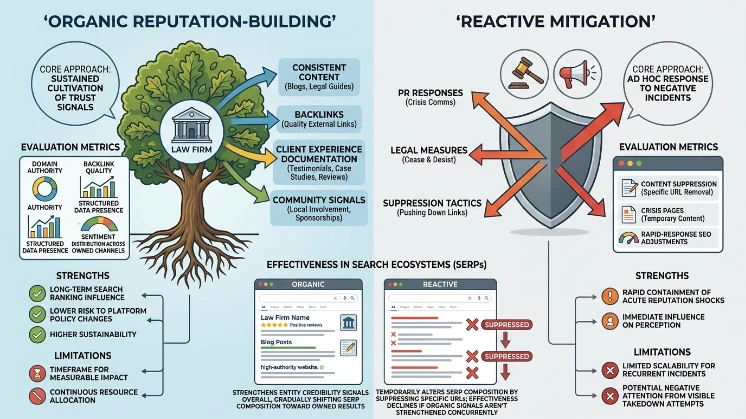
Organic reputation-building is the sustained cultivation of trust signals through consistent content, backlinks, client experience documentation, and community signals; reactive mitigation is the ad hoc response to negative incidents using PR responses, legal measures, and suppression tactics. Organic reputation-building operates by establishing a network of positive reputation signals that search engines interpret as stable indicators of authority and relevance for entity-related queries. Reactive mitigation operates by altering or removing discrete reputation signals when negative content emerges.
Organic methods evaluate entity credibility through persistent metrics domain authority, backlink quality, structured data presence, and sentiment distribution across owned channels. Reactive methods evaluate immediate signal correction—content suppression, crisis pages, and rapid-response SEO adjustments. Organic strengths include long-term search ranking influence, lower risk exposure to platform policy changes, and higher sustainability. Reactive strengths include rapid containment of acute reputation shocks and immediate influence on perception.
Organic limitations include the timeframe for measurable impact and the need for continuous resource allocation. Reactive limitations include limited scalability for recurrent incidents and potential negative attention from visible takedown attempts. In search ecosystems, organic strategies shift SERP composition gradually toward owned and authoritative results, improving entity credibility signals across query intents. Reactive strategies temporarily alter SERP composition by suppressing specific URLs, but effectiveness declines if organic signals are not concurrently strengthened.
How do review management systems compare with press monitoring and media relations for controlling professional perception?
Review management systems are operational tools and processes that collect, monitor, and respond to client feedback across review platforms; press monitoring and media relations are editorial-focused tactics that track earned media and engage journalists to shape public narratives. Review management operates by feeding structured signals—ratings, review content, response frequency—into platform algorithms and local search ranking factors. Press monitoring operates by identifying mentions, sentiment trends, and publication authority to inform engagement strategies that alter broader public perception.
Review management mechanisms in search ecosystems influence local search ranking influence, map pack prominence, and snippet sentiment signals. Media relations mechanisms influence branded search results, authoritative press mentions, and potentially high-authority backlinks that alter domain-level reputation signals. Review management strengths include measurable sentiment distribution control at the local level and direct influence on conversion drivers for prospective clients. Limitations include platform policy restrictions on soliciting reviews and the inability to remove negative but authentic feedback.
Press monitoring strengths include reach amplification, establishment of thought-leadership, and the potential to generate authoritative backlinks that enhance search ranking influence. Limitations include editorial independence, slower turnaround, and limited direct control over sentiment. Comparative analysis shows review management delivers immediate, granular adjustments to local reputation signals; press strategies change SERP composition at the domain and knowledge panel level through authoritative third-party coverage.
Effectiveness differs by objective: to improve conversion from local search, review management measures higher impact on local ranking influence; to shift public narratives and long-form perceptions, media relations measures higher impact on entity credibility. For scalability, review systems scale operationally with automation and templates; press relations scale less predictably due to editorial gatekeepers. Risk exposure: review management risks regulatory scrutiny if incentives are used improperly; press relations risk unintended amplification of negative stories.
How do content suppression strategies compare with content enhancement strategies for SERP control?
Content suppression is the targeted lowering of negative URLs through deindexing, legal notices, or demotion requests; content enhancement is the proactive enrichment of positive or neutral assets to outrank negative content. Content suppression operates by removing or downgrading specific reputation signals so that negative sentiment presence in the SERP decreases. Content enhancement operates by creating high-quality assets and optimising them for relevant queries so that search ranking influence shifts in favour of those assets.
Suppression mechanisms include court orders, DMCA takedowns, platform dispute processes, and technical deindexing requests. Enhancement mechanisms include SEO optimisation, semantic content networks, schema implementation, and authoritative backlink acquisition. Suppression strengths include the potential for rapid removal of defamatory or illegal content and a clear short-term reduction in negative exposure. Suppression limitations include high legal costs, jurisdictional complexity, and risk of Streisand-effect amplification.
Enhancement strengths include durability of positive assets and improved entity credibility metrics; limitations include the time investment and competitive search environments where negative content already benefits from historical backlinks. In search ecosystems, suppression reduces the immediate presence of negative reputation signals but does not create new positive signals; enhancement increases the volume and quality of positive signals that search engines interpret when calculating ranking influence and sentiment distribution.
Strategically, suppression serves as an acute intervention for non-compliant content; enhancement provides sustainable SERP control through repeated positive signal creation. For law firms, prioritise suppression for illegal or clearly false content and invest in enhancement to maintain search visibility and long-term trust.
How do short-term interventions compare with long-term reputation investments in terms of sustainability and risk?
Short-term interventions are discrete actions aimed at immediate signal correction: rapid responses, takedown requests, and emergency content updates. Long-term investments are ongoing activities: content programmes, backlink cultivation, client experience systems, and brand architecture. Short-term interventions operate by temporarily altering reputation signals to limit immediate damage; long-term investments operate by building durable entity credibility that search engines interpret as consistent authority.
Short-term mechanisms influence ephemeral changes in SERP composition and sentiment distribution but provide limited improvement to entity credibility metrics. Long-term mechanisms influence domain-level ranking factors, semantic relevance, and sustained sentiment distribution across owned and earned channels. Short-term strengths include speed and focus; limitations include short-lived impact and recurring cost. Long-term strengths include scalability, reduced risk exposure over time, and higher sustainability; limitations include resource commitment and delayed measurable ROI.
Build lasting public trust with professional Celebrity Reputation Management that combines rapid reputation protection with long-term authority and credibility building. A balanced reputation strategy helps public figures manage immediate challenges while creating sustainable search visibility, stronger trust signals, and enduring brand value.
How do automated reputation tools compare with bespoke human-led strategies for accuracy and risk control?
Automated reputation tools are software systems that monitor sentiment distribution, aggregate reviews, and execute templated responses; human-led strategies rely on expert analysis, bespoke content creation, and legal or PR judgement. Automated tools operate by extracting structured data from platforms, applying sentiment analysis, and triggering predefined actions. Human-led strategies operate by qualitative assessment of entity credibility, contextual judgement, and tailored interventions.

Automated mechanisms provide scale, consistent monitoring, and rapid detection of signal changes, improving measurement of sentiment distribution and enabling quick templated responses. Human mechanisms provide nuanced interpretation of complex incidents, bespoke messaging for sensitive issues, and legal judgement when suppression pathways are necessary. Automated strengths include efficiency and cost-effectiveness for routine tasks; limitations include false positives/negatives in sentiment analysis and inability to assess reputational nuance. Human strengths include contextual accuracy, risk assessment, and strategic integration with media relations; limitations include higher cost and slower execution.
In search ecosystems, automation supports measurement of search ranking influence and detection of shifts in SERP composition. Human-led actions better manage entity credibility when complex legal, ethical, or regulatory considerations are present. For law firms, combine automation for monitoring and reporting with human strategy for high-risk decisions that affect professional reputation.
Explore More Useful Information:
Protect Your Practice With Specialist Law Firm Reputation Management in the UK
Answers to Key Questions
What is celebrity reputation management and how does it work?
Celebrity reputation management is the strategic process of protecting and enhancing a public figure’s digital trust through review control, press monitoring, and search result optimisation. It works by building entity credibility, managing sentiment distribution, and using content enhancement strategies to influence how search engines interpret reputation signals.
How long does it take to see results from celebrity reputation management services?
Results from celebrity reputation management typically begin showing within 3–6 weeks for reactive measures like content suppression, while long-term entity credibility builds over 6–12 months through sustained content creation and backlink acquisition. Short-term interventions address acute incidents quickly, but sustainable search ranking influence requires ongoing investment.
What techniques are used in celebrity reputation management for controlling search results?
Celebrity reputation management uses content suppression (deindexing, legal takedowns) and content enhancement (SEO-optimised pages, authoritative backlinks) to control SERP composition. These techniques influence sentiment distribution and search ranking influence by increasing owned asset visibility while reducing negative reputation signals.
How does celebrity reputation management differ from standard business reputation management?
Celebrity reputation management focuses on high-visibility public figures where sentiment distribution impacts career opportunities and media narratives, requiring faster response times and broader press monitoring. Standard business reputation management targets local or domain-level entity credibility with emphasis on review systems and conversion-focused local search ranking influence.