

Reputation management strategies differ based on the balance between content suppression and content enhancement and the choice between proactive visibility-building and reactive remediation. Online reputation control methods are evaluated through their influence on search ranking, sentiment distribution, and demonstrable shifts in entity credibility.
How do content creation and content removal strategies compare for solicitors’ online reviews and trust?
Content creation is the proactive production of relevant positive or neutral assets; content removal is the targeted elimination or demotion of damaging assets. Content creation operates by increasing the volume, relevance, and authority of owned and earned assets that signal credibility to search engines; content removal operates by legal, platform-based, or SEO-driven mechanisms to reduce the visibility or existence of specific negative items.
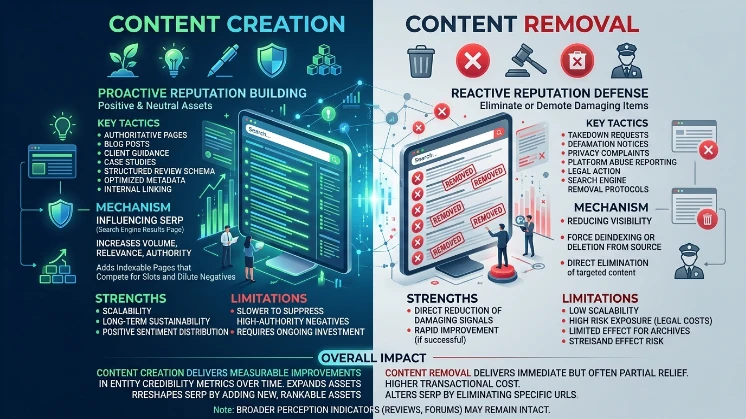
Create authoritative pages, blog posts, client guidance, case studies, and structured review schema; optimise metadata and internal linking to align entity signals (name variations, practice areas, credentials). Content creation increases search ranking influence by adding indexable, relevant pages that compete for SERP slots and dilute negative items. Strengths: scalability, long-term sustainability, positive sentiment distribution across owned properties. Limitations: slower to suppress high-authority negatives, requires ongoing content investment and governance.
Deploy takedown requests, defamation notices, privacy complaints, and platform abuse reporting; implement legal action for unlawful content; use search-engine removal protocols for personal data where applicable. Content removal reduces search visibility of target items either by deletion from source or by forcing deindexing. Strengths: direct reduction of damaging signals when successful, rapid improvement in perception for removed items. Limitations: low scalability, high risk exposure (legal costs, counter-notices), limited effectiveness for archived or syndicated copies, and potential for increased attention through reporting (the Streisand effect).
Content creation delivers measurable improvements in entity credibility metrics over time by expanding authoritative assets and improving sentiment distribution, while removal delivers immediate but often partial relief with higher transactional cost. Impact on SERP composition: content creation reshapes SERP by adding new, rankable assets that occupy high-visibility positions; removal alters SERP by eliminating specific URLs but leaves broader perception indicators (review aggregates, forum mentions) intact if not also addressed.
Which is more effective: organic reputation-building or reactive review remediation?
Organic reputation-building is the deliberate cultivation of trust signals over time through consistent content, authoritative citations, and verified client feedback; reactive review remediation is the targeted response to negative reviews and sudden reputation shocks. Organic reputation-building operates by establishing persistent signals—structured data, authoritativeness, and citation networks—that search algorithms and users interpret as stable entity credibility. Reactive remediation operates by addressing or removing negative inputs, rebutting inaccurate claims on-platform, and using rapid SEO techniques to demote negative items.
Implement a content calendar, verified review solicitation workflows, structured review schema, backlink acquisition from legal directories, and consistent NAP (name, address, phone) signals across directories. Reactive mechanism: submit review disputes, publish corrective statements, request platform mediation, and deploy rapid content assets to occupy SERP real estate. Comparative analysis: organic building evaluates more favourably on sustainability and lower risk exposure because it strengthens core reputation signals and search ranking influence. Reactive remediation evaluates better for immediate damage control but has limits in scalability and in altering overall sentiment distribution if underlying service issues persist.
Organic approaches increase schema-driven review counts, citation authority, and consistent entity references, thereby improving click-through benchmarks and perceived credibility. Reactive approaches influence short-term search visibility by altering top results but leave longer-tail mentions and sentiment distribution unaffected unless followed by systemic remediation.
How do domain-level SEO adjustments compare with platform-level review management for solicitors?
Domain-level SEO adjustment is the optimisation of a solicitor’s owned website and associated domains to improve search ranking influence; platform-level review management is the governance of third-party review systems (Google Business Profile, Trustpilot, legal directories). Domain-level operations function by improving on-page signals, technical SEO, structured data, content relevance, and backlink profiles that feed search algorithms’ assessment of entity credibility. Platform-level operations function by managing review volume, response cadence, dispute resolution, and review acquisition policies that determine aggregate sentiment distribution.
Optimise H1/H2 structure, schema markup for legal services, mobile performance, canonicalisation, and authority-building backlinks from legal organisations. Platform-level mechanism: monitor review streams, respond with regulated compliance language, escalate violations to platform support, and run verified review requests. Comparative analysis: domain-level work increases long-term search ranking influence and provides controlled presentation of firm credentials; it scales across service pages and practice areas. Platform-level management directly affects aggregated reputation signals presented in SERPs (review snippets, star ratings) and influences click-through rates and user trust more immediately.
Strengthen digital visibility with professional Celebrity Reputation Management that combines authority-building SEO with strategic reputation monitoring across key platforms. By improving search visibility, review perception, and trust signals, public figures can enhance credibility and maintain greater control over their online reputation.
What are the trade-offs between suppression-focused tactics and enhancement-focused tactics in search ecosystems?
Suppression-focused tactics are tactical efforts to reduce the visibility of specific negative URLs through deindexing requests, legal takedowns, or negative SEO countermeasures; enhancement-focused tactics are strategic efforts to publish high-quality, authoritative content and verified reviews that strengthen entity credibility. Suppression operates by removing or demoting negative signals; enhancement operates by reinforcing positive signals and expanding the pool of authoritative assets.
Use digital forensics to identify content sources, issue DMCA/defamation takedowns, request deindexing via privacy rules, and use legal letters. Enhancement mechanism: publish evidence-based legal guides, client testimonials with verified schema, third-party citations, and expert commentary to increase entity authority. Comparative analysis: suppression reduces immediate harm but creates risk exposure (legal costs, public attention) and lacks sustainability when content replicates. Enhancement delivers sustainable shifts in sentiment distribution and search ranking influence but requires investment and time to scale.
Suppression reduces negative signals visible to search engines but leaves impression gaps where trust must be rebuilt; enhancement increases positive trust signals and shifts sentiment distribution toward neutrality or favourability. Search ranking influence differs: suppression can clear SERP positions temporarily, while enhancement builds durable ranking influence across multiple SERP features.
Dive Deeper With Our Expert Guides and Related Blog Posts:
How Law Firm Reputation Management Works Across Reviews Rankings and Press
How do algorithmic SEO tactics compare with legal/regulatory interventions for reputation control?
Algorithmic SEO tactics are technical and content-based interventions designed to align with search engines’ ranking criteria; legal/regulatory interventions are formal actions invoking statutes, data protection rights, or court orders. Algorithmic tactics operate by manipulating indexable signals content relevance, backlinks, on-page schema, and structured citations—to influence search ranking behaviour. Legal interventions operate by removing content at the source or compelling platforms to alter indexing or visibility.
Implement targeted content hubs, entity-optimised schema, link acquisition from high-authority legal resources, and negative-URL demotion via outranking with authoritative pages. Legal mechanism: issue defamation notices, invoke data protection rights (where applicable), obtain court orders for removal, or engage regulators to enforce platform policy. Comparative analysis: algorithmic tactics evaluate better for scalability and lower immediate risk exposure, creating progressive improvements in entity credibility and search ranking influence. Legal interventions evaluate better for definitive removal of unlawful content but carry high cost, binary outcomes, jurisdictional constraints, and potential escalation.
Algorithmic tactics adjust the balance of visible assets and sentiment distribution across the SERP, fostering incremental entity credibility. Legal tactics nullify illegal signals but generate metadata (court records, press) that search engines index, which can introduce secondary visibility issues.
How do short-term remediation tactics compare with long-term reputation architecture for solicitors?
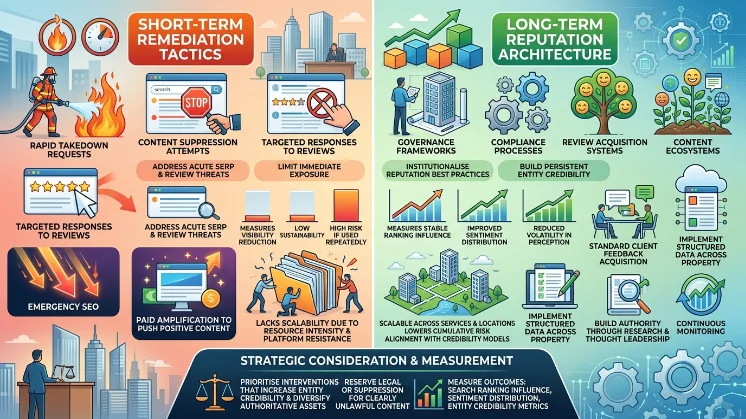
Short-term remediation is the deployment of rapid-response measures content suppression attempts, targeted responses to reviews, emergency SEO—to limit immediate exposure; long-term reputation architecture is the establishment of governance frameworks, content ecosystems, review acquisition systems, and compliance processes that sustain reputation signals. Short-term mechanisms operate by addressing acute threats in the SERP and review platforms; long-term mechanisms operate by institutionalising reputation best practices and building persistent entity credibility.
Execute rapid takedowns, publish corrective pages, deploy paid amplification to push positive content, and file urgent platform disputes. Long-term mechanism: standardise client feedback acquisition, implement structured data across property, build authority through research or thought leadership, and maintain continuous monitoring. Comparative analysis: short-term tactics measure effectiveness in immediate visibility reduction but have low sustainability and high risk exposure if used repeatedly. Long-term architecture measures effectiveness through stable increases in search ranking influence, improved sentiment distribution, and reduced volatility in perception metrics.
Short-term remediation lacks scalability due to resource intensity and platform resistance; long-term architecture scales across services and locations and lowers cumulative risk exposure by aligning signals with search engines’ credibility models.
For strategic consideration, prioritise interventions that increase entity credibility and diversify authoritative assets while reserving legal or suppression tactics for clearly unlawful content. Measure outcomes across search ranking influence, sentiment distribution, and entity credibility metrics to evaluate effectiveness, scalability, risk exposure, and sustainability.
Read the Full Blog Here:
Get Confidential Solicitor Reputation Management From a UK Specialist Team
Answers to Key Questions
What is celebrity reputation management and how does it work?
Celebrity reputation management is the strategic process of protecting, repairing, and enhancing a public figure’s digital image through coordinated PR, SEO, and content tactics. It works by monitoring sentiment, suppressing negative search results, publishing authoritative positive content, and managing online reviews to shape entity credibility.
How long does it take to repair a damaged celebrity reputation online?
Repair timelines vary by damage severity, but most celebrity reputation management projects show measurable SERP improvements within 3–6 months. Long-term trust recovery and sustained sentiment distribution often require 12+ months of continuous content enhancement and review governance.
What services are included in professional celebrity reputation management?
Core services include negative content suppression, SEO-driven content creation, review acquisition and moderation, legal takedown support, social media monitoring, and crisis PR response. A full celebrity reputation management program also covers entity validation, structured data implementation, and ongoing sentiment analysis.
How does celebrity reputation management differ from standard business reputation management?
Celebrity reputation management addresses higher public scrutiny, faster viral spread of negative content, and cross-platform visibility (news, social, video, search). It requires faster response times, stricter legal coordination, and more aggressive SERP control strategies compared to standard business reputation management for companies.