

An online reputation audit measures how search engines, review platforms, news sources, and indexed content represent an entity across digital touchpoints. The audit process identifies reputation signals, sentiment distribution, entity associations, and search ranking influence within branded search ecosystems.
Reputation management strategies differ based on search visibility exposure, platform dependency, and the durability of indexed content. Online reputation control methods are evaluated through sentiment analysis, SERP composition, authority distribution, review velocity, and the balance between content suppression vs content enhancement.
What Is an Online Reputation Audit and How Does It Measure Digital Trust?
An online reputation audit is a structured evaluation of how an entity appears across search engines, review platforms, social profiles, media publications, and indexed third-party content. The audit measures entity credibility through observable search signals rather than subjective perception. Search engines interpret consistent entity associations, authoritative citations, and positive sentiment distribution as indicators of trustworthiness. Negative search results, review imbalance, and inconsistent entity references weaken perceived reliability within search ecosystems. The audit process compares owned assets against third-party references to determine control over branded SERP composition. Healthcare Reputation Management audits place additional emphasis on compliance-sensitive trust signals, patient reviews, and professional credibility indicators.
The measurement process operates by categorising digital assets according to authority, visibility, and sentiment polarity. High-ranking pages receive greater analytical weight because search visibility amplifies perception influence. Review platforms contribute structured reputation signals through rating averages, review recency, and response behaviour. News articles, forum discussions, and complaint pages influence entity associations by reinforcing recurring narratives within indexed ecosystems. Search engines analyse contextual relationships between entities and topical sentiment to evaluate relevance and authority. The audit framework therefore combines technical SEO analysis with perception-based evaluation metrics.
A comprehensive audit compares three core categories of digital presence:
- Evaluate branded SERP composition by analysing positive, neutral, and negative ranking positions
- Measure review sentiment distribution through platform-specific ratings and review velocity
- Analyse entity consistency across directories, media mentions, and structured profiles
Each category reveals a different layer of search perception analysis. SERP visibility reflects discoverability, review sentiment reflects public trust indicators, and entity consistency reflects algorithmic confidence in identity verification. Together, these factors determine the strength or weakness of digital trust systems.
Which Reputation Signals Carry the Greatest Search Ranking Influence?
Authoritative third-party content carries the strongest search ranking influence because search engines prioritise independent validation over self-published claims. Review platforms, media publications, government databases, and trusted directories contribute high-authority reputation signals. Search algorithms compare these sources against owned content to determine entity credibility. Negative coverage from authoritative domains therefore creates stronger visibility persistence than criticism on low-authority platforms. Positive mentions from trusted sources strengthen topical authority and entity validation simultaneously. Search ranking influence depends on both authority concentration and contextual relevance.
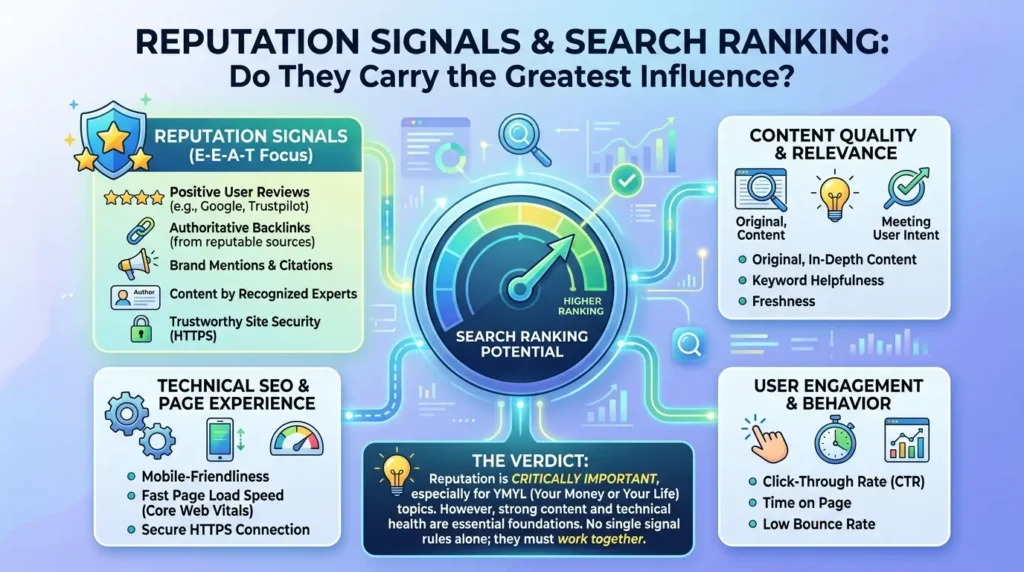
Review-based signals operate differently from content-based signals because they generate structured data. Star ratings, review frequency, reviewer diversity, and recency patterns create measurable trust indicators. Search engines interpret irregular review spikes or duplicated sentiment as manipulative behaviour, reducing credibility signals. Balanced review distributions appear more authentic than artificially uniform positive ratings. Healthcare-related searches place additional emphasis on expertise, authority, and trust evaluation due to the sensitivity of medical decision-making contexts. This increases the visibility impact of review ecosystems within healthcare reputation management environments.
Content-based reputation signals derive influence from topical relevance and backlink authority. News articles, interviews, educational resources, and professional profiles strengthen entity associations through semantic reinforcement. Complaint articles and negative forum discussions create persistent ranking influence when supported by backlinks and engagement signals. Search engines evaluate how frequently an entity appears alongside specific sentiment patterns. Repeated negative associations influence perception even when individual articles receive limited traffic. The relationship between entity references and sentiment context therefore becomes a critical audit metric.
How Do Organic Reputation Strategies Compare With Reactive Reputation Approaches?
Organic reputation strategies focus on long-term authority development through content enhancement, entity optimisation, and trust signal expansion. Reactive reputation approaches focus on immediate visibility control following negative publicity, review spikes, or search perception deterioration. Organic methods operate by strengthening positive entity associations before reputational disruption occurs. Reactive methods operate by addressing existing visibility problems after negative content gains search traction. The distinction between proactive and reactive mechanisms affects sustainability, scalability, and risk exposure. Search ecosystems reward long-term consistency more effectively than abrupt reputation intervention patterns.
Organic strategies rely heavily on authoritative content production and entity reinforcement. Educational resources, expert commentary, structured profile optimisation, and topical content clusters strengthen semantic relevance over time. Search engines interpret sustained topical authority as evidence of credibility and expertise. This approach gradually improves sentiment distribution by increasing the visibility of positive and neutral assets. Organic methods require extended indexing periods before measurable SERP changes occur. The advantage lies in long-term stability and reduced dependency on crisis intervention tactics.
Reactive approaches prioritise speed and visibility management. Negative review responses, crisis communication pages, and suppression campaigns aim to reduce the prominence of damaging search results. Content suppression operates by introducing higher-authority competing assets to displace negative rankings. Removal strategies operate through policy violations, defamation claims, or platform moderation mechanisms. Reactive approaches deliver faster visibility shifts but create higher sustainability risks because search algorithms continuously reassess ranking authority. Short-term suppression without authority reinforcement often results in negative content re-emergence.
The comparison between both strategies reveals distinct operational trade-offs:
- Strengthen entity authority through organic content enhancement for long-term ranking resilience
- Reduce immediate visibility exposure through reactive suppression or removal mechanisms
- Measure sustainability through indexing persistence and sentiment stability over time
Organic approaches provide stronger long-term scalability, while reactive approaches address urgent perception threats more directly. Effective audit interpretation therefore depends on identifying whether visibility issues originate from authority gaps or active reputational disruption.
How Does Content Suppression Compare With Content Enhancement Strategies?
Content suppression focuses on reducing the visibility of negative search results, while content enhancement focuses on increasing the prominence of authoritative positive assets. Both strategies influence SERP composition differently. Suppression strategies operate competitively by attempting to displace existing rankings through higher-authority content creation. Enhancement strategies operate cumulatively by strengthening topical relevance and entity trust signals without directly targeting negative assets. Search engines interpret these mechanisms according to authority distribution and user engagement patterns. The effectiveness of each method depends on the authority strength of competing content.
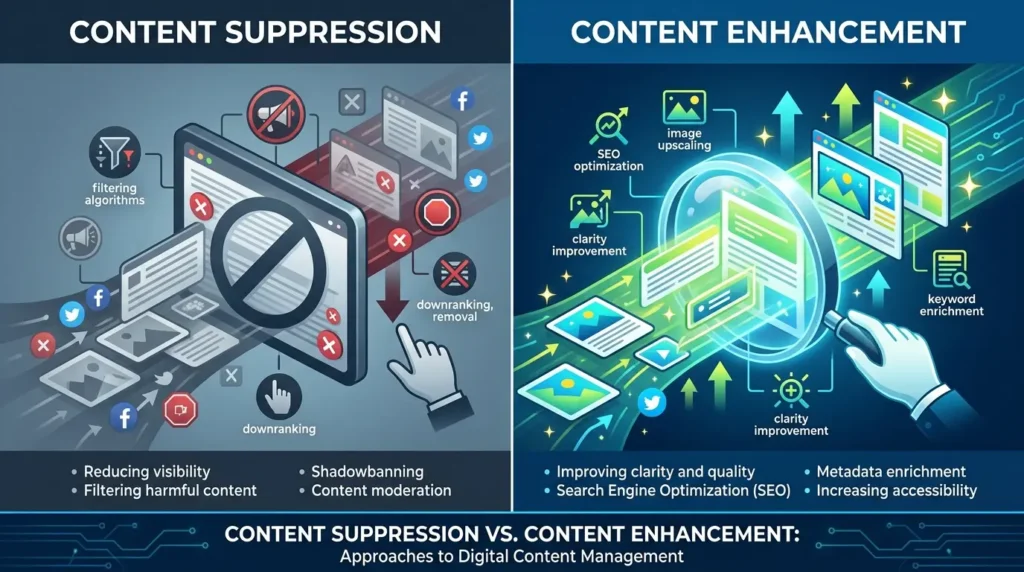
Suppression strategies typically involve publishing optimised assets across high-authority domains, directories, media platforms, and social channels. The objective is ranking displacement rather than sentiment correction. Negative pages remain indexed but lose visibility as competing pages occupy higher positions. This approach works effectively against low-authority complaint pages and outdated forum discussions. High-authority investigative articles and established media coverage resist suppression because backlink authority and historical engagement reinforce ranking persistence. Suppression campaigns therefore require continuous authority acquisition to maintain visibility displacement.
Content enhancement strategies strengthen positive search ecosystems by improving semantic coverage and trust signal density. Authoritative informational content expands entity relevance across related search queries. Structured profiles, educational resources, expert commentary, and third-party mentions contribute to broader positive entity associations. Search engines reward comprehensive topical coverage because it improves contextual understanding. Enhancement approaches therefore influence perception indirectly through authority expansion rather than competitive displacement. This method provides stronger long-term sustainability but slower short-term visibility impact.
The comparison between suppression and enhancement highlights different strategic outcomes. Suppression addresses visibility problems directly but requires continuous maintenance against authoritative negative rankings. Enhancement improves entity credibility more sustainably but delivers slower perception shifts in crisis scenarios. Online reputation audits evaluate which approach aligns with the authority structure of existing search results.
Get Deep Insight:
Which Tools Help You Monitor Online Reputation Before Problems Get Out of Hand
How businesses bury negative search results using proven digital tactics
Which Audit Findings Require Immediate Action and Which Require Long-Term Monitoring?
High-visibility negative assets require immediate action because search prominence amplifies perception exposure. First-page rankings, featured snippets, review platform warnings, and authoritative complaint pages create direct search trust deterioration. Immediate intervention focuses on limiting visibility escalation and stabilising sentiment distribution. Search engines interpret engagement signals rapidly during active reputation events, increasing ranking volatility. Delayed response allows negative narratives to strengthen through backlinks, user engagement, and citation repetition. Priority assessment therefore depends on visibility concentration and authority strength.
Long-term monitoring applies to low-visibility issues, inconsistent entity references, and gradual sentiment decline. These signals influence search perception progressively rather than immediately. Review recency imbalance, incomplete profiles, and declining positive content velocity weaken entity credibility over time. Search engines evaluate these patterns cumulatively through repeated indexing cycles. Long-term monitoring therefore focuses on trend analysis rather than immediate suppression. Sustainable reputation management depends on detecting gradual authority erosion before it becomes visible within branded SERPs.
Immediate action categories typically include:
- Remove inaccurate or policy-violating content through platform moderation processes
- Respond to high-visibility reviews to stabilise sentiment interpretation
- Publish authoritative assets to reduce negative ranking concentration
Long-term monitoring categories include:
- Track review sentiment distribution across indexed platforms
- Measure entity consistency across citations and structured profiles
- Analyse branded search composition changes through periodic SERP reviews
This distinction improves resource allocation within reputation management systems. Urgent intervention addresses visibility risk, while long-term monitoring preserves authority continuity and search ecosystem stability.
How Do Review Management Systems Compare With Search-Focused Reputation Strategies?
Review management systems focus on structured consumer feedback platforms, while search-focused reputation strategies address broader SERP composition and entity associations. Reviews contribute direct trust signals through ratings, recency, and response behaviour. Search-focused strategies influence perception through content authority, semantic relevance, and ranking distribution. Both approaches overlap because review platforms often rank prominently for branded queries. The distinction lies in operational focus and visibility mechanisms. Review systems prioritise sentiment management, while search-focused strategies prioritise visibility architecture.
Review management operates by influencing structured platform signals. Response timing, review diversity, and verified feedback patterns affect trust interpretation within platform algorithms. Search engines frequently display review ratings within local search results, increasing their influence on click behaviour and credibility perception. Negative review concentration reduces trust signals even when broader search visibility remains positive. Healthcare-related reviews carry additional weight because users evaluate reliability, safety, and professional competence simultaneously. Review management therefore functions as both a perception mechanism and a search visibility factor.
Search-focused strategies extend beyond review ecosystems into broader content networks. These strategies analyse media mentions, directory consistency, social visibility, and topical authority distribution. Search engines evaluate how entities appear across interconnected digital environments rather than isolated platforms. Positive review profiles cannot fully offset authoritative negative media coverage if broader entity associations remain unfavourable. Search-focused strategies therefore require semantic ecosystem analysis rather than isolated platform management. This broader framework improves scalability across multiple search environments.
The comparison reveals that review management provides measurable sentiment indicators, while search-focused strategies influence broader perception architecture. Effective audits evaluate both dimensions because search engines integrate structured review signals with contextual entity analysis during ranking evaluation.
How Does an Online Reputation Audit Influence Strategic Decision-Making?
An online reputation audit influences strategic decision-making by converting perception patterns into measurable search visibility data. The audit identifies authority gaps, sentiment imbalance, and ranking vulnerabilities that affect digital trust systems. Search ecosystems reward entities with consistent authority signals, balanced sentiment distribution, and stable topical relevance. Audit findings therefore determine whether intervention requires suppression, enhancement, monitoring, or structural optimisation. Strategic planning depends on identifying which signals create the greatest search ranking influence.
The evaluation process compares short-term visibility threats against long-term authority sustainability. Reactive strategies address urgent ranking risks, while organic strategies strengthen future resilience. Content suppression compares differently from content enhancement because each mechanism influences search ecosystems through separate ranking behaviours. Review management systems provide structured sentiment signals, while broader search-focused strategies influence entity associations across interconnected digital environments. Effective decision-making therefore requires analysing both platform-specific and ecosystem-wide reputation signals.
Online reputation audits function as analytical frameworks rather than promotional tools. The audit process measures how search engines interpret trust, authority, and credibility across indexed content environments. Strategic effectiveness depends on aligning intervention methods with authority structure, sentiment distribution, and ranking persistence. Sustainable reputation management therefore relies on continuous evaluation rather than isolated visibility correction.
A deeper evaluation of audit findings often connects with broader investigation frameworks such as Request a Free Online Reputation Audit and Find Out Where You Stand Today, particularly when organisations compare visibility risks, sentiment exposure, and SERP control strategies across competitive search environments.
What does an online reputation audit actually check?
An online reputation audit checks how your name or brand appears across Google search results, review sites, news articles, forums, and social profiles. It evaluates negative search results, review sentiment, branded SERP visibility, and whether positive or harmful content dominates your online presence.
Why do negative Google search results stay visible for so long?
Negative Google results often remain visible because high-authority websites, news domains, and complaint platforms have strong SEO signals and backlinks. Search engines consider these pages trustworthy, which makes reputation management strategies like content suppression and authority-building necessary to reduce their visibility.
Is content suppression better than removing negative search results?
Content suppression and content removal serve different purposes in reputation management. Removal works when content violates policies or contains false information, while suppression pushes negative search results lower by ranking stronger, positive content higher in Google.
How do review platforms affect personal online reputation?
Review platforms influence online reputation because Google uses ratings, review recency, and response activity as trust signals. Negative reviews on visible platforms can impact branded search results, credibility, and how people perceive an individual or business online.
What are the biggest warning signs found during a reputation audit?
Common warning signs include first-page negative Google results, high-authority complaint pages, declining review ratings, inconsistent personal profiles, and negative autocomplete suggestions. These signals indicate weak control over branded search visibility and may require immediate reputation management action.