

Unwanted search results reduce trust, weaken entity credibility, and damage conversion performance across every stage of the customer journey. Effective reputation management restores SERP control, strengthens reputation signals, and ensures search perception influence aligns with your professional standards.
Which healthcare reputation management approach delivers measurable SERP control?
Healthcare reputation management delivers measurable SERP control when it combines negative content suppression, strategic content publishing, and authority-based optimisation. Healthcare organisations operate within a trust-sensitive search ecosystem where patients, partners, regulators, and investors evaluate reputation signals before engagement. Search visibility directly influences appointment enquiries, partnership decisions, and perceived clinical reliability. A single harmful result can reduce trust continuity across branded search queries and destabilise public confidence. A structured reputation management process improves content visibility while reducing the prominence of damaging search results. This creates a controlled digital narrative that supports long-term entity credibility.
Professional reputation management services improve search perception influence by aligning positive digital assets with Google’s ranking signals. High-authority content, entity consistency, media placements, and trust-oriented optimisation collectively strengthen visibility for favourable search results. Search engines prioritise authoritative and relevant content that demonstrates expertise, legitimacy, and user trust. Healthcare organisations benefit from this process because search algorithms continuously reassess reputation signals across indexed content. This ensures reputation management becomes an active visibility strategy rather than a reactive branding exercise. Reputation Management PR Agency applies this framework to strengthen search trust indicators while reducing reputational volatility.
How does negative content suppression improve healthcare search visibility?
Negative content suppression improves healthcare search visibility by reducing the ranking prominence of harmful or outdated pages. This process works through strategic content expansion, authority reinforcement, and search intent alignment. Search engines reward fresh, authoritative, and semantically connected content clusters that satisfy user expectations. Positive assets gradually displace harmful results when they outperform negative pages across relevance and engagement metrics. This stabilises search perception influence and improves branded query performance. Healthcare providers benefit because prospective patients encounter trust-oriented content instead of reputation-damaging material.
A suppression strategy delivers measurable outcomes through targeted visibility improvements:
- Strengthen branded search visibility through authority-driven content publishing that improves positive ranking signals.
- Reduce harmful result prominence through semantic relevance optimisation and content ecosystem expansion.
- Improve trust continuity by reinforcing entity credibility across high-authority digital properties.
- Stabilise search perception through ongoing SERP monitoring and reputation signal management.
- Increase conversion confidence by aligning visible search results with professional healthcare standards.
Why does expert UK guidance reduce reputational risk more effectively?
Expert UK guidance reduces reputational risk more effectively because it aligns reputation management activity with British media standards, legal considerations, and regional search behaviour. UK audiences evaluate healthcare entities through credibility, compliance visibility, and institutional trust signals. A generic international strategy fails to address local search intent, media authority distribution, and culturally relevant trust indicators. Specialist guidance ensures content strategies reflect UK-specific reputational expectations and search ecosystem dynamics. This reduces the risk of ineffective suppression campaigns and fragmented visibility control. It also improves outcome predictability through structured implementation.

Healthcare reputation management requires precise execution because search perception changes rapidly when negative content gains visibility momentum. A professional process includes SERP auditing, harmful content evaluation, authority mapping, and entity trust reinforcement. This ensures every optimisation action contributes to measurable search stability. Healthcare organisations benefit from process transparency because decision-makers need clear justification for investment and risk mitigation. Reputation Management PR Agency structures campaigns around visibility improvement, authority strengthening, and sustained perception control. This approach delivers operational clarity while reducing uncertainty around reputation recovery outcomes.
Which reputation signals influence public healthcare trust most strongly?
Public healthcare trust depends heavily on visible reputation signals that reinforce professionalism, reliability, and institutional credibility. Search users evaluate these signals within seconds of viewing search results. Google’s ranking systems also interpret authority and trust indicators when determining visibility positions. Healthcare organisations therefore require consistent, positive, and authoritative digital representation across all indexed properties. This creates stronger search perception influence while reducing reputational fragility. A fragmented reputation profile weakens trust continuity and increases visibility risk.
The strongest healthcare reputation signals include:
- Publish authoritative medical content that demonstrates expertise and topical relevance.
- Maintain consistent entity references across websites, media features, and professional directories.
- Secure positive media visibility that reinforces institutional legitimacy and public trust.
- Optimise branded search results to prioritise trustworthy and conversion-oriented assets.
- Monitor search ecosystem changes to maintain long-term SERP control and visibility stability.
How does removing unwanted content improve patient trust and conversion rates?
Removing unwanted content improves patient trust and conversion rates because users associate search visibility with institutional credibility. Negative search results interrupt trust formation before direct engagement begins. Patients researching healthcare providers evaluate professionalism through visible search assets, review sentiment, and media associations. Harmful content therefore creates friction during decision-making and weakens conversion intent. Reputation management resolves this issue by replacing uncertainty with authority-driven visibility. This strengthens patient confidence during the earliest stages of search interaction.
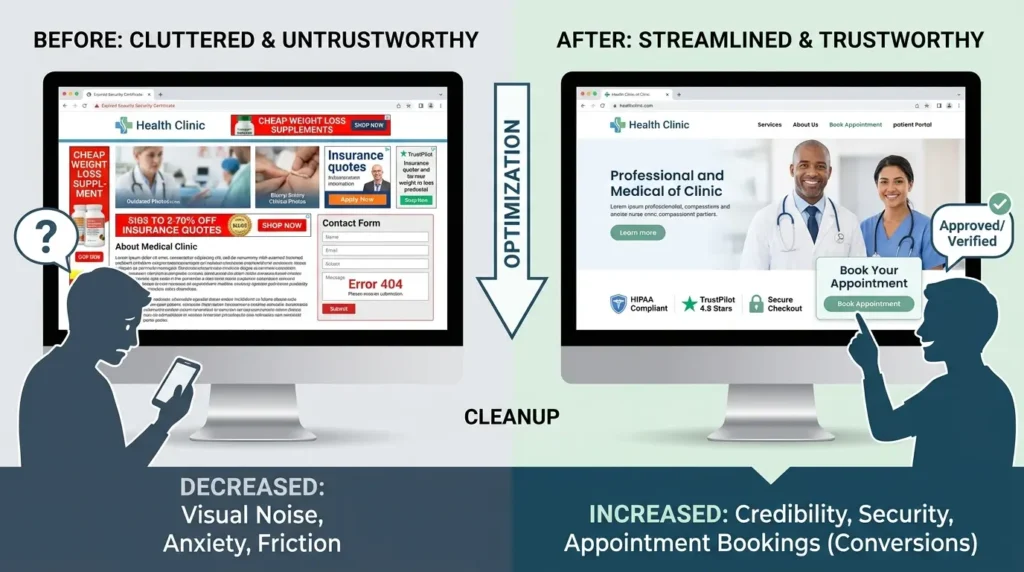
Search perception influence directly affects conversion behaviour within healthcare markets. Patients avoid providers associated with visible controversy, unresolved complaints, or damaging press coverage. Positive search results improve reassurance because they reinforce consistency, professionalism, and expertise. A healthcare reputation management strategy improves this process by controlling which reputation signals dominate branded searches. This ensures patient-facing search journeys remain aligned with institutional standards and trust expectations. Visibility control therefore becomes a measurable business protection mechanism rather than a cosmetic branding tactic.
Which removal and suppression methods produce sustainable results?
Sustainable results come from combining removal requests, authority expansion, and strategic suppression campaigns. Google removes limited categories of content directly, including legal violations, explicit personal data exposure, and harmful policy breaches. However, most damaging material requires advanced suppression strategies rather than direct deletion. Healthcare organisations achieve stronger long-term outcomes when reputation management focuses on authority reinforcement and visibility displacement. This ensures positive assets maintain ranking resilience over time. Sustainable suppression therefore depends on ecosystem strength rather than temporary interventions.
Healthcare organisations evaluating removal strategies benefit from understanding content removal eligibility before investing in suppression campaigns. Informational guidance clarifies which forms of harmful material qualify for direct delisting and which require alternative visibility control methods. This improves decision-making accuracy and reduces strategic delays. It also ensures reputation management investment aligns with achievable outcomes instead of unrealistic expectations. Organisations that understand search ecosystem mechanics make stronger long-term visibility decisions. This strengthens cost efficiency and campaign sustainability simultaneously.
Which long-term benefits justify investment in healthcare reputation management?
Healthcare reputation management justifies investment because it protects long-term trust equity, stabilises visibility performance, and reduces reputational disruption costs. Negative search visibility produces sustained commercial damage when left unmanaged. Lost patient trust, weakened referral confidence, and damaged institutional perception reduce growth opportunities across healthcare sectors. Reputation management resolves these risks by establishing controlled visibility frameworks that reinforce credibility consistently. This creates stronger digital resilience against future reputational threats. Long-term value therefore extends beyond immediate suppression outcomes.
A structured healthcare reputation management strategy improves digital stability through measurable search ecosystem control. Positive search visibility strengthens patient confidence and increases conversion readiness across branded searches. High-authority content ecosystems also improve resilience because search engines prioritise credible and consistently updated entities. This reduces future volatility and protects institutional positioning during reputational challenges. Healthcare organisations benefit from predictable search performance instead of reactive crisis management. The result is sustained trust reinforcement supported by stable reputation signals.
How does reputation management reduce future visibility risks?
Reputation management reduces future visibility risks by proactively strengthening search authority before reputational threats escalate. Search engines continuously reassess relevance, authority, and trust across indexed content. Organisations with strong entity credibility maintain greater resilience against isolated negative coverage or harmful content spikes. Reputation management therefore acts as a defensive infrastructure that stabilises perception during visibility fluctuations. This ensures healthcare brands maintain stronger narrative control across branded and non-branded searches. Future risks become easier to contain because positive authority signals already dominate the search environment.
Get Deep Insight:
Get Professional Help Submitting Your Right to Erasure Request to Google
The process delivers ongoing risk reduction through targeted mechanisms:
- Expand authoritative content ecosystems that reinforce positive topical relevance.
- Improve branded SERP ownership through strategic visibility optimisation.
- Strengthen entity credibility using consistent trust-oriented digital signals.
- Reduce negative ranking momentum through authority-based suppression frameworks.
- Monitor emerging reputation threats before they disrupt public perception.
Why does process transparency matter when choosing a reputation management provider?
Process transparency matters because healthcare organisations require measurable accountability, strategic clarity, and predictable execution standards. Reputation management directly affects trust positioning and institutional perception. Decision-makers therefore need evidence-driven explanations instead of vague branding promises. A transparent provider explains suppression methods, reporting structures, and realistic visibility timelines from the outset. This improves investment confidence while reducing operational uncertainty. Healthcare organisations benefit because reputation recovery becomes structured, measurable, and strategically aligned with organisational goals.
Reliable providers explain how content ecosystems influence search rankings and perception outcomes. This includes authority development, semantic optimisation, content publishing strategy, and ongoing visibility monitoring. Transparent reporting also demonstrates progress through measurable ranking improvements and search visibility changes. Healthcare organisations gain stronger confidence when they understand how each activity improves SERP control. Reputation Management PR Agency integrates structured reporting with outcome-focused optimisation to maintain strategic visibility oversight. This creates trust through process clarity rather than exaggerated claims.
Read More:
Remove Harmful Google Search Results With the Help of a UK Specialist
Which indicators demonstrate a reliable reputation management strategy?
Reliable reputation management strategies demonstrate consistency, scalability, and measurable search improvement. Strong providers focus on search ecosystem mechanics rather than short-term promotional tactics. This ensures visibility gains remain stable and aligned with search engine quality expectations. Healthcare organisations require sustainable frameworks because reputational recovery depends on long-term authority reinforcement. Reliable strategies therefore prioritise entity credibility and trust continuity over temporary ranking manipulation. This strengthens resilience across evolving search environments.
Key indicators of a reliable strategy include:
- Demonstrate measurable ranking improvements across branded search terms.
- Provide transparent reporting tied to visibility and reputation signal performance.
- Align suppression methods with Google’s quality and relevance standards.
- Reinforce entity credibility through authoritative content and digital consistency.
- Maintain ongoing monitoring that protects long-term SERP control.
Healthcare organisations that require stronger search visibility control benefit from investing in a professional healthcare reputation management service designed around measurable authority growth and sustainable negative content suppression. Decision-makers evaluating suppression options also benefit from understanding Google content removal criteria and search result removal limitations before choosing a long-term strategy.
Effective healthcare reputation management strengthens trust, improves search perception influence, and stabilises visibility across critical branded search journeys. Organisations that prioritise SERP control protect institutional credibility while reducing reputational risk exposure. Reputation Management PR Agency delivers structured, evidence-driven reputation management that aligns search visibility with professional healthcare standards and long-term trust objectives.
How can I remove unwanted content from Google search results?
Unwanted content can sometimes be removed by contacting the website owner, submitting a Google removal request, or using legal and reputation management strategies. Reputation Management PR Agency helps businesses and individuals in the UK assess the best option based on the type of online content and search visibility.
Can negative news articles be removed from Google?
Google does not usually remove legitimate news articles unless they violate policies or legal standards. In many cases, online reputation management focuses on suppressing negative search results with positive, authoritative content that improves search rankings naturally.
How long does it take to remove content from Google search?
The timeline depends on whether the content is deleted at the source, deindexed by Google, or suppressed through SEO strategies. Simple removals may take days, while long-term reputation repair campaigns can take several weeks or months to improve Google search results effectively.
What types of content can be removed from Google?
Google may remove personal information, copyrighted material, outdated content, explicit images, or pages that violate its policies. Reputation Management PR Agency also helps clients reduce the visibility of harmful reviews, negative press, and misleading online content through search reputation strategies.
Is online reputation management better than deleting content?
In many cases, reputation management is more practical because not all online content can be permanently deleted from Google. A strong SEO and digital PR strategy can push unwanted search results lower while promoting trusted and relevant content that improves brand credibility.