
Small Business Reputation Management
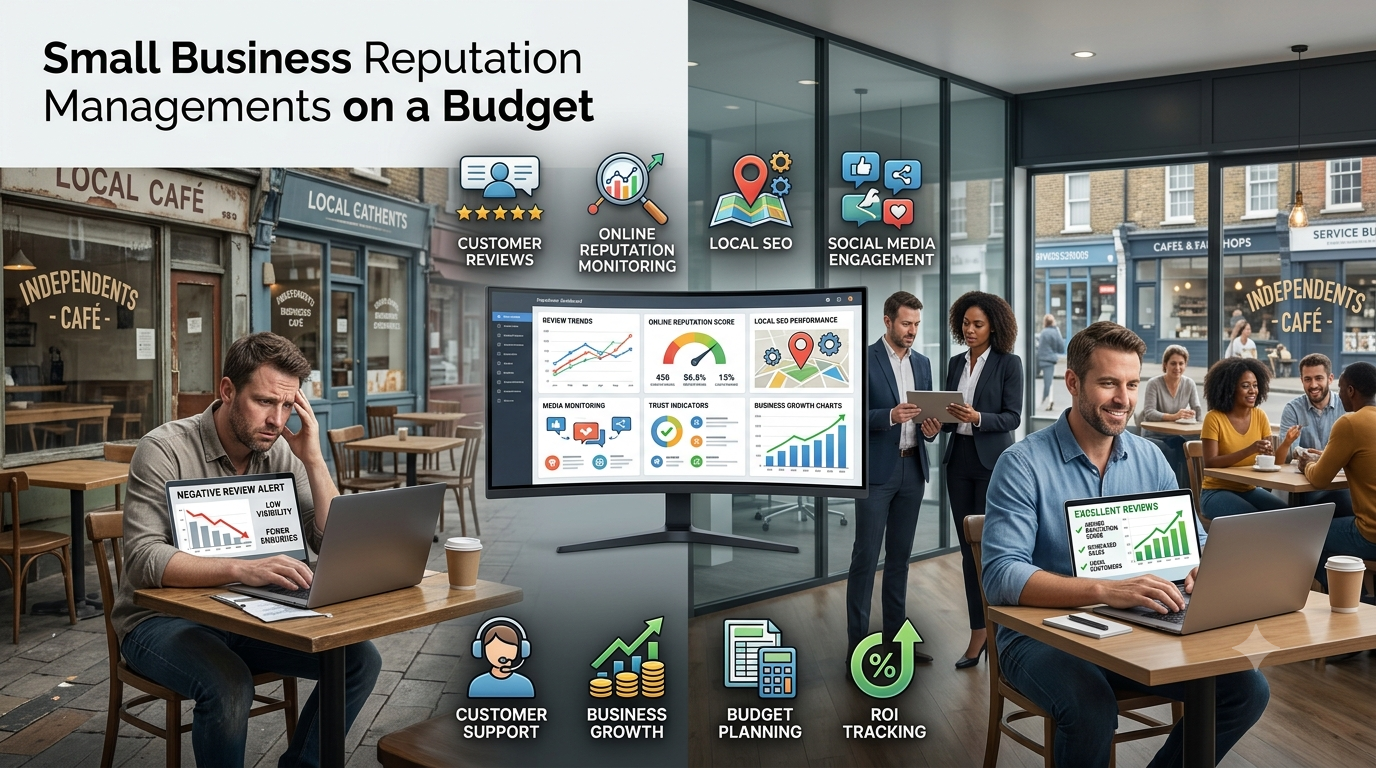
Small business reputation management on a budget starts with free, high impact actions, claiming your Google Business Profile, responding to every review personally, and actively requesting feedback from happy customers, before spending anything on paid tools or services. Most small businesses can meaningfully improve their reputation using free tactics alone, reserving paid support for situations that genuinely exceed what time and effort can fix directly.
Running a small business means every hour and every pound gets scrutinised. Small business reputation management doesn’t have to mean expensive agency retainers, and we work with both individual business owners and agencies supporting multiple small business clients to prove exactly that.
Free Actions to Take Today
Before spending a penny, these steps genuinely move the needle:
- Claim and complete your Google Business Profile. An incomplete or unclaimed profile is invisible to the customers actively searching for you right now, and completing it takes under an hour.
- Respond to every existing review, positive and negative. This costs nothing but time and signals to every future reader that a real person is actively managing the business.
- Ask three recent happy customers for a review directly. A short, personal message asking for feedback consistently outperforms a passive hope that reviews accumulate on their own.
- Search your own business name and note what appears. This costs nothing and immediately shows you whether you’re dealing with a review problem, a content problem, or simply an absence of any presence at all.
- Update inconsistent business details across every free listing. Mismatched phone numbers, addresses, or hours across Google, Facebook, and directories quietly undermine trust and cost nothing to fix.
Low Cost Additions Worth Considering
Once the free foundation is in place, a few modest investments deliver strong value:
- A basic review monitoring tool. Free-tier versions of several monitoring tools alert you to new reviews and mentions without requiring a paid subscription, saving the time of manually checking multiple platforms.
- A simple review request system. Low cost text or email tools that prompt customers for feedback shortly after a purchase or visit meaningfully increase review volume without ongoing manual effort.
- A few hours of professional guidance, rather than an ongoing retainer. A single consultation to review your current situation and build a specific action plan can be far more cost effective than committing to a full monthly package before you know what you actually need.
Common Budget Mistakes Small Businesses Make
A few patterns consistently waste money or time for small businesses trying to manage reputation affordably:
- Paying for a broad package before addressing free fixes first. Spending on paid tools or agency support before completing your Google profile or responding to existing reviews means paying for work that free effort would have covered.
- Chasing every platform at once instead of prioritising. Small business reputation management works best when focused on the two or three platforms your actual customers use, not spread thin across every possible review site.
- Incentivising or requesting only positive reviews. This risks platform penalties and can do more damage than the original reputation gap ever would.
- Treating a single bad review as an emergency requiring paid intervention. One negative review rarely needs professional help, a calm, personal response is usually all that’s required.
How We Support Small Businesses and the Agencies Serving Them
We work directly with small business owners who want practical, right sized support, and with agencies managing multiple small business clients who need a reliable specialist partner for reputation-specific work without building that expertise in-house themselves. Our affordable reputation management guide breaks down what genuinely reasonable pricing looks like at different service tiers, useful context whether you’re a business owner comparing options directly or an agency scoping work for a client.
For businesses already dealing with a cluster of negative reviews rather than starting from a clean slate, our practical recovery guide for small business owners covers the specific steps for turning that situation around.
When to Move Beyond DIY
A few signals suggest it’s time to bring in dedicated support rather than continuing entirely alone:
- Negative reviews are appearing faster than you can respond to them
- A viral complaint or crisis has spread beyond what a personal response can contain
- You’re spending hours weekly on reputation tasks that are pulling you away from running the business itself
- A legal or regulatory dimension has entered the situation, requiring expertise beyond standard review management
Recognising this transition point early tends to cost less overall than waiting until the situation has already escalated significantly, and it’s precisely the judgement call effective small business reputation management depends on getting right.

Measuring Whether Your Budget Approach Is Actually Working
Small business reputation management on a tight budget only makes sense if you can actually tell whether it’s working, and a few simple checks cost nothing to track. Watch your average review rating and total review count monthly, note how quickly you’re responding to new reviews, and periodically re search your own business name to see whether the picture has genuinely improved or simply stayed static. These checks take minutes but prevent months of effort going into an approach that isn’t actually moving the needle, letting you adjust course early rather than discovering a gap only once it’s become a bigger problem.
A simple spreadsheet tracking these numbers month to month, even a basic one, gives small business owners the same kind of visibility a paid reporting dashboard would provide, just without the monthly cost attached.
Frequently Asked Questions
Can small business reputation management really be handled without paying for anything?
For many businesses starting from a reasonably clean position, yes, free actions like completing your Google profile and responding to reviews personally cover the majority of what’s needed early on.
What’s the single highest impact free action a small business can take?
Completing and actively maintaining your Google Business Profile, since it directly affects local search visibility and is often the first thing a prospective customer actually sees.
Should agencies handle reputation management in house or bring in a specialist?
Many agencies find it more cost effective to partner with a reputation specialist for this specific work rather than building the expertise internally, particularly for clients whose needs go beyond basic review monitoring.
How do I know if my situation still counts as “on a budget” or needs real investment?
If free and low-cost actions aren’t keeping pace with what’s happening, mounting negative reviews, a spreading complaint, a legal dimension, that’s the signal your situation has outgrown a budget approach.
Is it risky to rely entirely on free tools for reputation monitoring?
Not for most small businesses starting out, though free tools typically offer less frequent monitoring and fewer platforms covered than paid options, worth upgrading once your reputation needs become more active or complex.