

False or outdated information about you can stay in search results for years, shaping how employers, clients, and the public interpret your credibility. In the UK, the Right to Be Forgotten gives individuals a legal route to request removal of certain personal data from search‑engine results, but it is not an automatic “delete everything” tool. Understanding how it works in 2026 under UK‑adapted GDPR‑style rules is essential for managing digital‑reputation risk and data‑protection exposure.
What is the Right to Be Forgotten in the UK?
The Right to Be Forgotten is a data‑protection mechanism that allows individuals to request the removal or de‑indexing of personal data from search‑engine results when specific criteria are met, such as inaccuracy, irrelevance, or lack of necessity; it does not guarantee deletion of the underlying web page.
The Right to Be Forgotten is often used as shorthand for the “right to erasure” under Article 17 of the General Data Protection Regulation (GDPR), later adapted into UK‑specific data‑protection law after Brexit. In the UK context, it applies when search engines index personal information that is no longer justified, creating a reputational or privacy‑related risk for the data subject.
Historical context and legal framing
The principle emerged from the 2014 European Court of Justice ruling in Google Spain SL, Google Inc v Agencia Española de Protección de Datos, Mario Costeja González, which held that search‑engine operators must treat search links as personal data subject to data‑protection rules. This decision established that individuals can challenge the ongoing visibility of links tied to their name when the information is inadequate, irrelevant, or excessive relative to the original purpose of processing.
In the UK, the 2016 GDPR‑style framework was retained in national law through the UK‑General Data Protection Regulation (UK‑GDPR) and the Data Protection Act 2018, enforced by the Information Commissioner’s Office (ICO). The ICO has since issued guidance emphasising that search‑engine results must be assessed under the same balancing‑of‑interests test as other forms of personal‑data processing.
Core conceptual distinction
The Right to Be Forgotten operates at the level of search‑index links, not the underlying content. Removing a link means that typing a person’s name into a search bar will no longer surface that specific URL, but the article or page may remain accessible via direct navigation or other search terms. This distinction is critical for reputation‑management strategy: it rebalances SERP evaluation and entity perception without altering the broader web‑publishing landscape.
How does the Right to Be Forgotten work legally under UK‑post‑Brexit law?
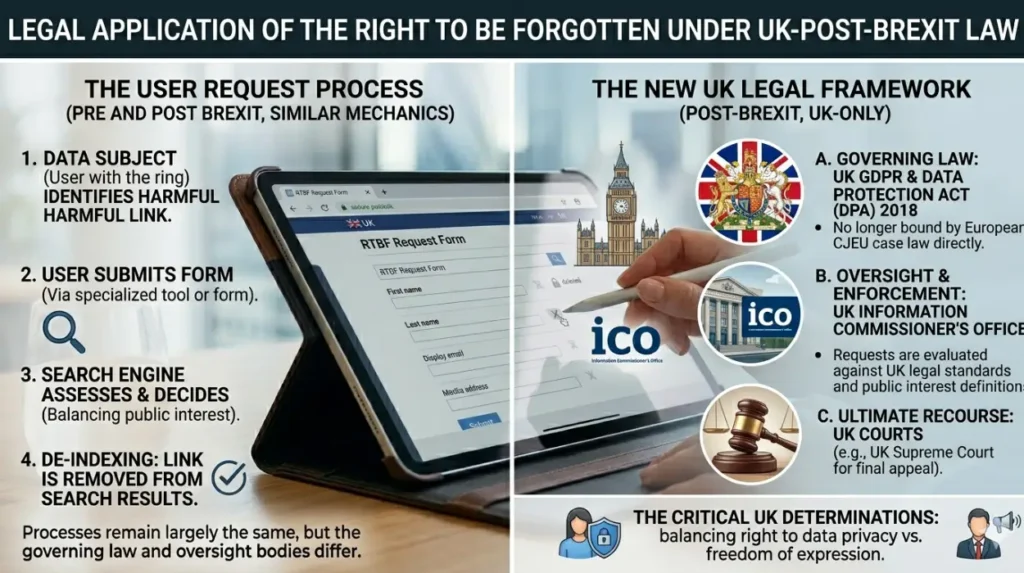
Under UK‑post‑Brexit data‑protection law, the Right to Be Forgotten functions as a right to erasure (Article 17‑style) against search‑engine operators when personal data is no longer necessary, is inaccurate, or infringes data‑subject rights, subject to a proportionality test that balances privacy against public‑interest‑in‑information.
The legal basis sits in the UK‑General Data Protection Regulation (UK‑GDPR), which mirrors the wording of the EU GDPR, including Article 17 “Right to erasure (‘right to be forgotten’)”. The UK‑GDPR preserves the same grounds for erasure, such as data no longer necessary, withdrawal of consent, or unlawful processing, and applies them to controllers processing personal data relating to UK‑residents. The ICO oversees enforcement and issues non‑binding guidance that search‑engine operators must consider when assessing removal‑related requests.
Balancing privacy and public interest
The key analytical step under UK‑law‑derived rules is whether the continued visibility of the information is proportionate. The ICO has emphasised that links may be removed if the data is “inadequate, irrelevant or no longer relevant, or excessive” in relation to the purpose of processing, particularly for historical or minor events. At the same time, major public‑interest reporting such as serious criminal conduct, ongoing legal‑proceedings, or matters of clear public‑safety relevance typically remains protected because the public‑interest‑in‑information outweighs the individual’s right to erasure.
Territorial and practical scope
After Brexit, the UK‑GDPR operates independently of the EU‑GDPR, but the conceptual framework and the Costeja‑derived case‑law logic remain structurally similar. Search‑engine operators must therefore apply comparable de‑indexing criteria within the UK‑digital‑environment, even though the UK‑ICO does not control the EU‑wide web index. This means that UK‑aligned removals usually affect UK‑Google and regional‑search‑engine versions, not the global web index.
What types of content qualify for removal under the Right to Be Forgotten?
Content that is inaccurate, outdated, irrelevant, or excessive in relation to the original purpose of processing is most likely to qualify for removal under the Right to Be Forgotten; this includes spent‑conviction records, clearly false allegations, and minor historical incidents that no longer serve a legitimate public‑interest function.
UK‑post‑Brexit guidance and case‑law point to several categories of content that often meet the erasure threshold:
- Outdated or no‑longer‑relevant information: For example, criminal‑conviction records that have become spent under the UK’s Rehabilitation of Offenders Act 1974, or small‑scale historical events that no longer have bearing on current professional or social standing.
- Inaccurate or misleading data: False allegations, misattributed events, or clearly incorrect biographical details can trigger removal if the inaccuracy is demonstrable and causes reputational‑harm.
- Excessive or disproportionate references: Where multiple low‑value articles amplify a minor incident or out‑of‑context fact, the combined effect may be judged excessive relative to the original purpose of processing.
Limitations and public‑interest counter‑weights
Content that falls under clear public‑interest reporting usually does not qualify. This includes:
- Ongoing criminal investigations or serious‑crime‑related reporting.
- Matters of corruption, abuse of power, or significant public‑figure misconduct.
- Information that remains relevant to professional or regulatory‑oversight contexts, such as current‑sanction or disciplinary‑action records.
Empirical evidence from ICO‑enforcement cases and Google‑removal statistics shows that only a minority of requests succeed outright, especially when the material is linked to serious public‑interest topics. The ICO’s 2015 enforcement notice against Google over nine search‑results links to a historic‑conviction record illustrates how spent‑conviction‑status can shift the balance toward removal, but only when the continued exposure is shown to be harmful and disproportionate.
How do you submit a Right to Be Forgotten request to Google from the UK in 2026?
Submitting a Right to Be Forgotten request to Google from the UK in 2026 involves completing Google’s online removal form, attaching identity verification, and justifying the request under UK‑GDPR‑style grounds such as inaccuracy, irrelevance, or excessive processing, after which Google evaluates the links against a proportionality test.
The process is structured as follows:
- Identify the URLs and search terms: Pinpoint the exact web addresses that appear when searching your name and note which terms trigger the harmful results.
- Complete the removal‑request form: Access Google’s “remove outdated results about you” tool, choose “United Kingdom” as country of residence, and supply identity‑verification documents (for example, passport or driving‑licence scans) where required.
- Specify legal grounds: Indicate whether the request is based on inaccuracy, outdated status, irrelevance, or one of the other Article 17‑style erasure criteria, and attach supporting evidence such as court orders, spent‑conviction certificates, or official corrections.
Timing and evidentiary demands
Google typically processes UK‑aligned requests within several weeks, with a decision communicated via email. The company frames its internal‑assessment around the same privacy‑versus‑public‑interest balance seen in ICO‑practice, weighing factors such as the nature of the information, the time elapsed, and the relevance to current‑public‑interest‑needs. Appeals are possible if new evidence becomes available, such as a subsequent court ruling or a change in legal‑status, but repeated submissions without new documentation are unlikely to alter the outcome.
From a search‑reputation‑management perspective, a well‑structured request improves the odds that specific, harmful links are de‑indexed while preserving journalistically‑justified references that remain proportionate and relevant.
What can you do if Google refuses your Right to Be Forgotten request?
If Google refuses your Right to Be Forgotten request, the content usually remains visible in search‑engine results; you can then appeal with new evidence, escalate the issue to the UK’s Information Commissioner’s Office, or pursue alternative legal or editorial channels for the underlying article.
Google’s refusals often rest on assessments that:
- The information is still accurate, relevant, and justified in terms of public‑interest reporting.
- The evidence of inaccuracy or irrelevance is insufficient to meet the UK‑GDPR‑style threshold.
- The request is overly broad or not clearly linked to a specific, GDPR‑Article‑17‑compatible ground.
In those circumstances, claimants can:
- Resubmit with stronger evidence: For example, attaching court rulings, rehabilitation‑certificates, or official corrections that demonstrate inaccuracy or spent‑conviction‑status.
- Escalate to the ICO: The ICO can review whether Google’s refusal aligns with UK‑GDPR‑style proportionality principles and issue enforcement notices where appropriate, as it did in the 2015 case ordering removal of nine search‑results links to a historic‑conviction record.
- Target the publisher directly: If the underlying article is demonstrably false or defamatory, separate legal avenues such as defamation claims, privacy‑claims, or direct takedown‑requests to the publisher may be necessary, since the Right to Be Forgotten only affects search‑engine links, not the source content.
This multi‑track approach reflects the limits of the Right to Be Forgotten as a removal‑tool and highlights the need for an integrated strategy combining data‑protection‑requests, legal‑enforcement, and reputation‑management‑driven content‑balancing.
When does it make sense to involve professional help with a Right to Be Forgotten case?
It makes sense to involve professional help with a Right to Be Forgotten case when the situation is legally complex, involves multiple URLs, or carries significant reputational or professional risk, and when prior removal‑requests have been refused or inadequately supported.
Professional support can be useful in the following scenarios:
- Complex or multi‑link cases: Where dozens of search‑results fragments create a diffuse reputational‑risk profile, systematic mapping of the digital‑footprint and targeted‑link‑selection improves the odds of success.
- Ongoing legal or regulatory exposure: Where content is tied to defamation, regulatory‑sanctions, or criminal‑cases, legal‑technical framing of GDPR‑Article‑17‑style grounds becomes critical.
- After refusals: A professional can analyse why the previous request failed, source new evidence, and structure a more persuasive appeal or ICO‑complaint aligned with UK‑GDPR‑style criteria.
Critically, external assistance functions as a coordination and evidence‑optimisation layer, not a guaranteed‑removal‑tool. The final decision still lies with the search‑engine operator and, in some cases, the ICO, which must apply the same balancing‑of‑rights test as defined in the UK‑GDPR‑derived framework.
FAQs:
Does the Right to Be Forgotten delete content from the internet?
No. The Right to Be Forgotten typically removes or de‑indexes links from search‑engine results tied to your name; it does not delete the underlying article or webpage from the publisher’s site, which may require separate legal or editorial action.
Can companies or businesses use the Right to Be Forgotten?
The Right to Be Forgotten is primarily framed for individuals, not corporate entities. Businesses must usually rely on other mechanisms, such as defamation law, contractual‑removal‑agreements, or editorial‑takedown‑requests, depending on how the information is processed and published.
How long does a Right to Be Forgotten request take in the UK?
UK‑aligned requests submitted to major search‑engine operators are typically reviewed within several weeks, though complex cases or ICO escalations can extend the timeline, particularly if additional evidence or enforcement‑steps are required.
What happens if the same content reappears after a removal?
If de‑indexed content reappears, it may reflect URL changes, republication, or a reassessment of the original removal decision. In such cases, you can submit a new request or appeal, usually referencing the prior decision and any updated evidence of inaccuracy or irrelevance.
Is the Right to Be Forgotten guaranteed to succeed in the UK in 2026?
No. Success depends on whether the information is demonstrably inaccurate, outdated, or excessive under UK‑GDPR‑style standards and whether the public‑interest‑in‑the information is outweighed by the individual’s data‑protection‑rights, as assessed by the search‑engine operator and, where relevant, the ICO.