

A PR crisis in the UK can escalate within hours, and the first 24 hours determine whether the damage is contained or amplified. The golden hour within the first 60 minutes of a crisis breaking sets the tone for media coverage, public perception, and regulatory scrutiny. During this period, organisations must activate a structured response, secure evidence, communicate transparently, and coordinate internal and external stakeholders. This UK‑focused playbook explains what to do in THE first 24 hours of a PR crisis, using clear steps, definitions, and evidence‑based reasoning rather than generic advice.
Why are the first 24 hours so important in a UK PR crisis?
The first 24 hours matter because search engines, social media, and broadcast news lock in early narratives that shape public understanding and long‑term reputation.
In the UK, breaking news often spreads through outlets such as the BBC, Sky News, and major newspapers, alongside social platforms like X (formerly Twitter) and LinkedIn. Within minutes, a story can reach national audiences and be cited in later coverage. Once a narrative is indexed and shared, it is extremely difficult to remove or fully correct, even if later reporting is more balanced.
Historical examples show the impact of rapid response. During the 2010 Deepwater Horizon oil spill, BP’s early statements were later criticised for downplaying the scale of the disaster, which prolonged reputational damage. In contrast, organisations that acknowledge issues quickly for example, NHS England during certain data‑breach incidents tend to retain more public trust. Evidence from UK media‑analysis studies indicates that companies that respond within the first hour face lower long‑term reputational costs than those that delay.
For UK businesses, the legal and regulatory environment also accelerates timelines. The UK’s Information Commissioner’s Office (ICO) expects timely communication during data‑protection incidents, and the Financial Conduct Authority (FCA) requires listed firms to disclose market‑sensitive information promptly. Delayed responses can lead to fines, regulatory censure, and secondary media cycles that worsen the crisis.
What should you do in the first 60 minutes of a crisis?
In the first 60 minutes, the priority is to activate a crisis team, confirm basic facts, secure digital and physical evidence, and prepare an initial holding statement.
Within the first 10–15 minutes, designate a crisis‑response team. This unit should include PR, legal, senior leadership, and operational leads responsible for the area where the issue occurred. The team should meet in a designated command centre physical or virtual where all communications are logged and decisions recorded. In UK corporate practice, this mirrors the “incident response” structure used by regulated firms under FCA handbooks and ICO guidance.
In the next 20–30 minutes, gather evidence. This includes internal emails, chats, documents, CCTV or system logs, and screenshots of social‑media or website content. Evidence‑preservation aligns with UK legal standards for potential litigation or regulatory investigations. For example, the Civil Procedure Rules (CPR) require organisations to preserve relevant electronic data once a dispute is reasonably foreseeable.
By the 45–60 minute mark, draft a brief holding statement. This is not a detailed explanation but a short, factual acknowledgment that the organisation is aware of the issue and is taking steps to investigate. Keeping the first message short and factual avoids speculation and reduces the risk of inadvertently admitting liability before facts are clear.
How should you respond to the media in the first 24 hours?
In the first 24 hours, the media response must be coordinated, consistent, and limited to verified facts, with a single designated spokesperson.
Appoint a spokesperson early often a senior executive or a senior communications lead so journalists have one clear point of contact. This practice is standard in UK corporate governance, as seen in crisis‑communications frameworks adopted by FTSE‑listed companies. A single voice reduces the risk of contradictory statements that can be framed as “mixed messages” in later coverage.
Prepare a short media statement that acknowledges the issue, expresses concern, and explains the next steps. For example, a bank facing a system outage might state: “We are aware of disruptions to our online services and are working with our technical partners to restore functionality. We apologise for the inconvenience and will provide updates on our website.”
Avoid off‑the‑record comments or speculative remarks. UK media, including regional press and national broadcasters, often treat any quote as “on the record,” even if delivered informally. Quick, informal comments can be turned into headlines that outlast the organisation’s controlled narrative. Monitoring media coverage using tools such as Meltwater or Cision helps track how the story is framed and allows for rapid correction of factual errors without further escalation.
Who needs to be notified in the first 24 hours in the UK?
In the first 24 hours, UK organisations must notify internal stakeholders, affected customers, relevant regulators, and, where necessary, investors, using clear, compliant channels.
Start with internal stakeholders: inform employees via a brief internal message that explains the situation, emphasises the importance of not speculating publicly, and directs all external inquiries to the PR team. Employee confusion can fuel social‑media rumours and off‑the‑record leaks, which UK regulators such as the FCA and ICO view as part of corporate risk management.
Next, notify affected customers or users. For data‑related incidents, UK law under the General Data Protection Regulation (GDPR) and the Data Protection Act 2018 requires organisations to report certain personal‑data breaches to the ICO within 72 hours and, in high‑risk cases, to affected individuals. Early communication—sent via email, SMS, or in‑app notifications—demonstrates transparency and can reduce backlash.
Externally, inform regulators if the incident involves regulated sectors such as finance, health, or telecoms. For example, financial services firms must report serious incidents to the FCA promptly, typically within 72 hours. Late reporting can lead to enforcement actions, as seen in FCA fines against firms for delayed breach notifications.
Finally, notify investors and key partners if the crisis has material financial or contractual implications. Listed companies must comply with FCA Disclosure Guidance and Transparency Rules, which require prompt disclosure of inside information that could affect share prices. Delayed or inconsistent disclosures can trigger regulatory scrutiny and secondary media cycles.
What should you avoid doing in the first 24 hours of a crisis?
In the first 24 hours, avoid delaying responses, speculating, blaming individuals, overreacting, or ignoring social‑media channels.
Delaying the initial response signals disengagement. In the UK, where news cycles move fast, even a few hours can allow rival narratives to dominate. During the 2013 horse‑meat scandal in the UK food industry, some retailers delayed acknowledging product contamination, which led to sustained negative coverage and long‑term reputational harm.
Speculation is equally dangerous. Statements that contain assumptions such as “we believe this was an isolated incident” or “we don’t think customers are at risk” can be disproven later and framed as denial. UK regulators and courts often treat early statements as part of the organisation’s duty of care and transparency.
Avoid publicly blaming individuals or departments. Internal accountability can be addressed later through proper processes, but public blame undermines staff morale and can be perceived as a deflection tactic. In regulated sectors, this can also attract criticism from regulators and trade unions.
Overreaction such as issuing overly dramatic apologies or implementing sweeping changes before the facts are clear can create legal and contractual risks. For example, an unconditional apology may be interpreted as an admission of liability in later proceedings.
Finally, ignoring social media is a critical mistake. X, Facebook, and other platforms often drive narrative formation in the UK. Unaddressed comments, misinformation, and viral posts can shape public perception more than official statements. A structured social‑media response plan monitoring, correcting inaccuracies, and highlighting official updates is essential.
How do you monitor a crisis and adjust your response in real time?
Crisis monitoring requires real‑time tracking of media reports, social‑media mentions, and stakeholder feedback, with regular briefings to the crisis team.
Use media‑monitoring tools to track news articles, broadcast mentions, and press releases. Many UK organisations use platforms such as Meltwater, Cision, or LexisNexis to aggregate coverage and flag emerging themes. These tools can detect shifts in tone, identify key influencers, and highlight factual inaccuracies that need correction.
Simultaneously, monitor social‑media channels. Set up keyword alerts for the organisation’s name, key executives, and crisis‑related terms. This helps detect misinformation, emerging narratives, and customer complaints. Automated tools can flag spikes in volume or sentiment, allowing the team to respond quickly without being overwhelmed.
Internally, conduct regular briefings ideally every 2–4 hours during the first 24 hours. Each briefing should review:
- What has changed in media coverage
- What new factual information is available
- What stakeholder feedback is emerging
- Any legal or regulatory developments
Adjust the communication strategy based on this evidence. For example, if customers are asking similar questions not addressed in the initial statement, issue a follow‑up clarification. If regulators release new guidance, update internal and external messaging accordingly. This iterative approach ensures the response remains aligned with facts and stakeholder expectations.
How do you move from crisis mode to recovery and long‑term resilience?
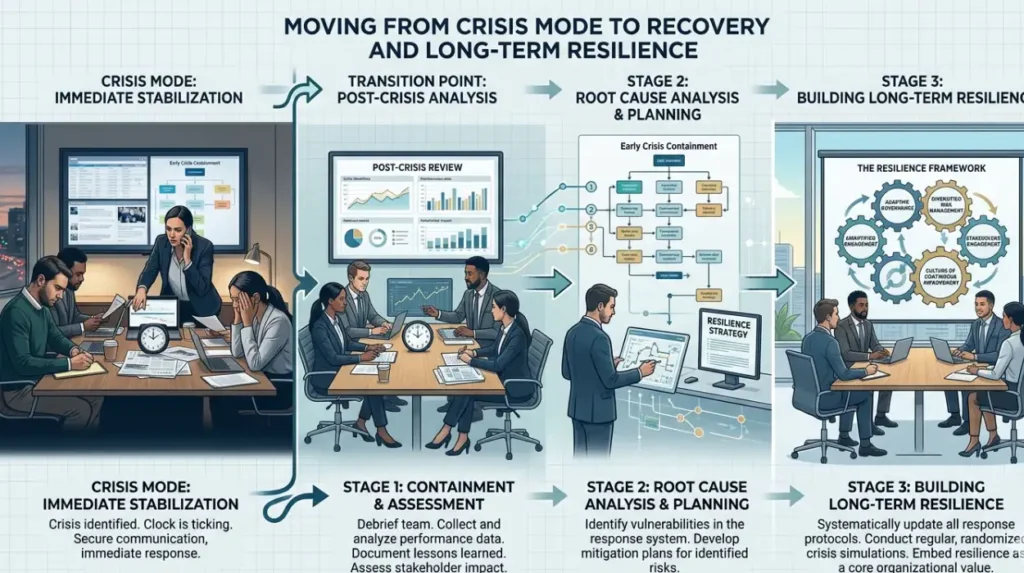
Recovery begins once the immediate issue is stabilised and continues through structured review, transparent communication, and policy reform.
Once the crisis is under control whether that means a technical fix, a regulatory agreement, or a legal settlement conduct a post‑incident review. This review should examine: what happened, how the organisation responded, what worked well, and where processes failed. Many UK organisations follow frameworks similar to those used in incident‑response plans under ISO 27001 (information security) or ISO 22301 (business continuity).
Share key lessons with stakeholders. For customers, this might take the form of a public update explaining what caused the issue and what safeguards have been implemented. For employees, it can involve internal briefings and training sessions. Transparent communication during this phase helps rebuild trust and demonstrates organisational learning.
Implement structural changes. These may include updating internal policies, enhancing staff training, or revising crisis‑response plans. For example, banks that have faced cyber‑attacks in recent years have strengthened incident‑response protocols, introduced mandatory crisis‑simulation exercises, and expanded cybersecurity budgets. Such measures reduce the likelihood of similar incidents and improve readiness if they occur.
Finally, integrate crisis management into long‑term planning. Regulated UK firms often include crisis‑response objectives in their annual risk‑management and governance frameworks. This ensures that crisis preparedness is not treated as a one‑off exercise but as a continuous process that evolves with emerging threats and regulatory expectations.
What template language can you use in the first 24 hours?
Using pre‑approved statement templates helps ensure consistency, accuracy, and compliance without improvisation under pressure.
Templates should be concise, fact‑based, and legally vetted. For example:
- Holding statement: “We are aware of reports regarding [issue]. We take these concerns seriously and are conducting a full investigation. We will provide updates as more information becomes available.”
- Update statement: “Our investigation into [issue] is ongoing. We are working with relevant authorities and experts to ensure a thorough assessment. We will communicate any significant developments promptly.”
- Closing statement: “We have concluded our investigation into [issue]. We have taken corrective actions and updated our processes to prevent recurrence. We thank our stakeholders for their patience during this period.”
These templates can be adapted to specific sectors financial services, healthcare, retail, or public bodies while still aligning with UK regulatory expectations for transparency and proportionality. Crucially, they should be reviewed by legal and compliance teams in advance to ensure they do not imply liability or make unqualified promises.
By embedding these templates into a broader crisis‑response playbook, UK organisations can respond to the first 24 hours of a PR crisis with clarity, coherence, and evidence‑based discipline rather than improvisation or delay.