

Reputation management is the set of organised activities that define and control how an entity is perceived within search ecosystems. Online reputation refers to the aggregated signals, indexed content, review data and authoritative references that form an entity’s public profile on search engine results pages (SERPs).
Law firm reputation is the composite of digital footprint elements that signal credibility, authority and trust to search engines and users. Law firm reputation is the sum of content assets, review signals, structured data, backlinks and entity descriptors that search engines index and associate with a legal entity. Search engines create an entity profile by crawling and indexing firm-owned pages, third-party directory entries, press mentions and user-generated reviews, then linking those records via entity graphs and knowledge panels. A coherent, consistent set of reputation signals increases the likelihood that search engines present the firm higher in relevant SERPs and surface accurate entity descriptions during SERP evaluation.
How do review signals influence client instructions?
Review signals are structured and unstructured feedback items that search systems quantify and integrate into ranking heuristics. Review signals refer to aggregated star ratings, review volume, review recency and sentiment content within reviews that search algorithms parse and index.
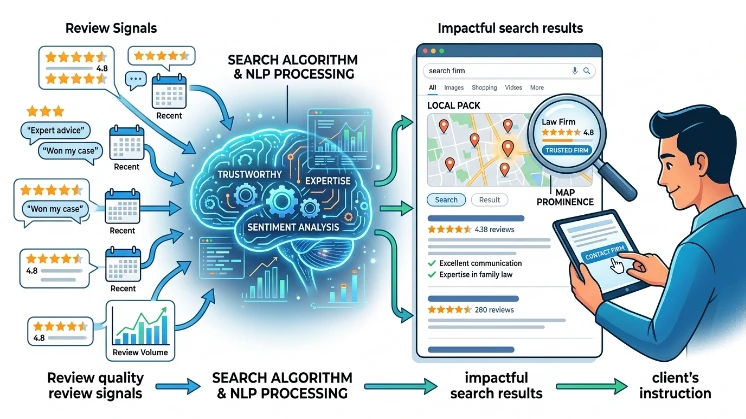
Algorithms parse review metadata (schema markup and aggregateRating) and apply natural language processing to extract sentiment, named entities and service-specific keywords higher-quality, consistent reviews raise the perceived relevance and trustworthiness of a firm for query intents related to legal help. Elevated review signals increase local pack inclusion, map prominence and snippet attribution in SERPs, shaping the client’s first impression and increasing the probability of instruction.
Why does content indexing determine perceived competence?
Content indexing is the process by which search engines analyse and store textual, visual and structured data tied to an entity. ‘Content indexing’ refers to the classification and storage of a firm’s online content (cases, articles, advisor bios, FAQs) within search engine indices.
Access content, evaluate topical relevance through semantic analysis (entity co-occurrence, topic modelling), and assign subject-matter weight via internal algorithms that consider on-page signals and cross-references. Well-indexed, semantically rich content maps a firm to specific legal queries, improving SERP coverage for expertise-related intents and guiding potential clients toward instruction via perceived competence.
How do authority and trust signals affect client decision-making?
Authority and trust signals are measurable indicators that a search system uses to evaluate an entity’s reliability for a given query. ‘Authority signals’ refer to backlink profiles, citation networks and recognised references. ‘Trust signals’ refer to HTTPS usage, verified business profiles, professional accreditations and explicit trust markers in metadata.
Link analysis attributes authority via domain-level metrics and contextual relevance trust signals integrate technical verification and third-party endorsements into the entity score. Strong authority and trust signals increase ranking weight for high-intent legal queries, and search engines prioritise these firms in SERP features that influence client selection, such as knowledge panels and featured snippets.
What role does sentiment interpretation play in search reputation?
Sentiment interpretation is the algorithmic extraction and weighting of positive, neutral and negative indicators from textual data. ‘Sentiment interpretation’ refers to the process by which search systems analyse review text, press excerpts and social content to assign valence scores to an entity.
Machine learning classifiers and lexicon-based models evaluate polarity, intensity and topic-specific sentiment, then normalise scores across sources to reduce manipulation risks. Aggregated sentiment scores feed into relevance heuristics and influence snippet framing, altering the perceived risk and suitability of instructing a firm.
How does entity perception form from fragmented digital signals?
Entity perception is the unified mental and algorithmic representation of a firm constructed from disparate online data points. ‘Entity perception’ refers to the consolidated identity that search engines and users infer from the firm’s combination of structured data, content, links and reviews.
Knowledge graph construction links identifiers (business name, registration numbers, and addresses) with content nodes and external mentions; disambiguation algorithms resolve similar names and map attributes to a single entity node. A consistent entity perception reduces fragmentation-related ranking penalties, increases SERP feature eligibility and improves the fidelity of information presented to potential clients, affecting instruction choices.
How do SERP evaluation processes prioritise reputation signals?
SERP evaluation is the internal ordering and feature selection process search engines apply to satisfy a query intent while balancing relevance and credibility. SERP evaluation refers to the algorithmic assessment that ranks pages and selects SERP features (local pack, knowledge panel, featured snippets) based on query intent and entity signals.
Ranking algorithms combine relevance scoring, authority weighting and trust metrics; they incorporate user engagement signals and freshness rules to adjust ordering dynamically. SERP evaluation privileges entities with robust reputation signals, making those firms more visible and more likely to receive client instructions.
How do review management and indexing practices interact with algorithms?
Review management and indexing practices are operational controls that influence how review content is discovered and interpreted by search engines. Management refers to the governance of review generation, schema markup usage and response strategies; indexing practices refer to technical measures that ensure review content is crawlable and structured for machine consumption.
Applying review-specific schema improves how search engines parse aggregate ratings; responses to reviews add context and keywords that algorithms index, while canonicalisation prevents duplicate-content penalties. Disciplined review management and correct indexing increase the prominence of positive review snippets in SERPs and enhance the entity’s credibility signals during algorithmic assessment.
How does digital footprint consolidation reduce reputational friction?
Digital footprint consolidation is the deliberate alignment of an entity’s online records to create consistent signals across sources. Digital footprint consolidation refers to synchronising contact information, service descriptions and identity markers across owned and third-party platforms.
Entity reconciliation updates directory listings, legal directories and professional profiles while maintaining structured data consistency (schema.org markup, business structured data). Consolidation reduces conflicting signals that dilute entity perception, improves local search coherence and increases the probability of favourable SERP placements that influence client decision-making.
How do content quality signals connect to legal expertise perception?
Content quality signals are measurable attributes search engines use to infer topical authority and usefulness. Content quality signals refer to indicators such as topical depth, authoritativeness, originality, internal cross-linking and schema usage.
Enhance public trust with professional Celebrity Reputation Management that strengthens authority signals, expert content, and digital credibility across search ecosystems. High-quality, authoritative content helps public figures improve search visibility, reinforce expertise perception, and maintain a stronger reputation in competitive online environments.
How does reputation risk manifest in search environments?

Reputation risk is the potential for online signals to degrade an entity’s perceived competence and trustworthiness. ‘Reputation risk’ refers to the probability and impact of adverse content, negative reviews or contradictory data reducing an entity’s search visibility and credibility.
Negative signals feed into sentiment interpretation models and may trigger manual or algorithmic de-ranking if patterns indicate manipulation, malpractice or safety concerns. Cross-source proliferation amplifies risk through repeated indexing. Elevated reputation risk results in reduced SERP prominence, suppression from feature placements and altered snippet framing that lowers the likelihood of client instruction.
This analysis defines how reputation systems operate across search ecosystems and clarifies the mechanisms by which reputation signals shape client instructions for UK law firms. Reputation management establishes entity perception through content indexing, review signals, authority markers and technical verification; search engines evaluate these inputs via sentiment interpretation, knowledge graphing and SERP evaluation. Firms with consolidated digital footprints, structured review data and high-quality content generate stronger reputation signals, which increases search visibility and the probability that potential clients progress to instruction.
Get the Full Insights Here:
How Law Firm Reputation Management Works Across Reviews Rankings and Press
Answers to Key Questions
What is celebrity reputation management, and how does it work?
Celebrity reputation management is the strategic process of protecting and shaping a public figure’s online reputation through PR, content, and monitoring. At Reputation Management PR Agency, we implement proactive measures like press coverage, review management, and crisis response to maintain positive entity perception across search ecosystems.
Why is healthcare reputation management important for medical practices?
Healthcare Reputation Management helps maintain patient trust by ensuring accurate and positive information appears in search results. A strong online reputation can improve patient acquisition, retention, and overall brand credibility.
How does healthcare reputation management improve Google search results?
Healthcare Reputation Management uses content optimisation, SEO strategies, and reputation monitoring to strengthen positive reputation signals. This can increase the visibility of authoritative content while reducing the prominence of negative search results.
Can negative patient reviews be removed through healthcare reputation management?
Legitimate patient reviews generally cannot be removed unless they violate platform guidelines. Healthcare Reputation Management focuses on responding professionally, improving patient experience, and increasing positive content visibility to balance online perception.