

Personal reputation management for UK professionals involves evaluating search results, digital footprint quality, content visibility, review sentiment, and trust signals linked to a person’s name.
Reputation management strategies differ based on whether the main objective is visibility improvement, reputation repair, risk reduction, or long-term entity credibility.
Online reputation control methods are evaluated through search ranking influence, SERP composition, sentiment distribution, content authority, and the sustainability of reputation signals. For professionals, reputation is not limited to social presence or public opinion. It is a structured search ecosystem in which indexed content, third-party mentions, professional profiles, reviews, media records, and authority indicators shape how a person is understood.
The macro topic of this blog is digital footprint optimisation for professional reputation control. This topic compares the approaches used to influence how a professional appears in search results and how trust is interpreted by search engines and users. It analyses content creation, content suppression, removal requests, profile optimisation, review management, and risk monitoring. The focus is not on promotion. The focus is on how different reputation management methods operate, where they are effective, and where their limitations appear.
What Does Personal Reputation Management Involve for UK Professionals?
Personal reputation management involves analysing, improving, and monitoring the digital signals that define a professional’s credibility online. It includes search result evaluation, content quality assessment, entity profile consistency, sentiment analysis, review visibility, and risk identification. Each element contributes to the way a person is interpreted in search ecosystems.
The first approach is digital footprint assessment. This process reviews the visible and indexed material connected to a professional’s name. It evaluates professional profiles, articles, interviews, public records, social media pages, directory listings, review platforms, images, and older web references. The aim is to understand which results dominate the first page and which signals influence perception.
The second approach is reputation signal improvement. Reputation signals are indicators that search engines and users use to evaluate trust. These include source authority, content relevance, consistency of information, positive sentiment, profile completeness, publication quality, backlinks, and engagement. A strong signal environment supports entity credibility because the same professional identity is confirmed across reliable sources.
The main limitation is that reputation management cannot change search perception instantly. Search ecosystems require crawl time, indexing time, ranking recalculation, and authority development. Content that already ranks strongly retains visibility until stronger, more relevant, or more authoritative content competes with it. This means professional reputation management requires both technical analysis and long-term content structure.
How Do Content Creation and Content Removal Compare?
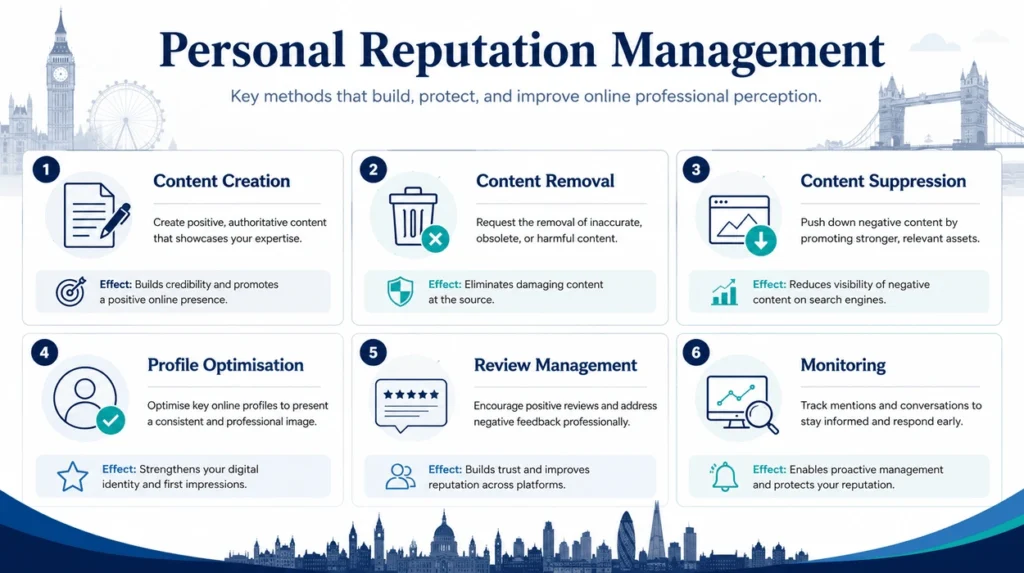
Content creation is the process of publishing accurate, relevant, and authoritative material that strengthens positive reputation signals. Content removal is the process of attempting to reduce or eliminate harmful, inaccurate, outdated, or unlawful content from online visibility. These approaches operate differently and produce different effects on search perception.
Content creation operates by increasing the volume and quality of favourable indexed assets. These assets include professional biographies, expert articles, interviews, portfolio pages, profile pages, case-neutral publications, and knowledge-based content. Search engines evaluate these pages through relevance, authority, freshness, and entity connection. When these assets gain ranking strength, they influence SERP composition by occupying visible positions.
Content removal operates through legal, platform, editorial, or policy-based mechanisms. A removal request targets content that breaches privacy, defamation standards, platform rules, copyright rules, data protection principles, or factual accuracy requirements. If removal succeeds, the content no longer contributes to search visibility. If removal fails, the content remains part of the search ecosystem and requires a different method of management.
The comparison shows a clear difference in control and scalability. Content creation is scalable because new assets can be developed across multiple relevant platforms. Its limitation is that ranking influence takes time and depends on authority. Content removal is direct when the legal or policy basis is strong. Its limitation is that it applies only to eligible content and does not build long-term entity credibility.
How Do Content Suppression and Content Enhancement Differ?
Content suppression is the strategy of reducing the visibility of unfavourable results by improving the ranking strength of more relevant and credible content. Content enhancement is the strategy of improving the quality, relevance, and authority of existing positive or neutral assets. Both methods influence SERP composition, but they operate through different mechanisms.
Content suppression operates by competing for search ranking positions. Search engines rank pages according to relevance, authority, user satisfaction, freshness, and semantic fit. If high-quality assets become more relevant to the person’s name, profession, and expertise, they gain the ability to outrank weaker or less relevant pages. This does not delete negative material. It changes the visible search environment by shifting stronger assets into more prominent positions.
Content enhancement operates by improving assets that already exist. A professional profile can be made clearer through complete role information, structured biography, updated achievements, accurate location data, and consistent naming. An article can be strengthened through better topical relevance, internal linking, author information, and clearer expertise signals. These improvements help search engines understand the asset more accurately.
The strength of suppression is its ability to change the first-page perception without depending on removal. The limitation is that highly authoritative negative content remains difficult to displace. The strength of enhancement is efficiency because it uses existing indexed assets. Its limitation is that weak platforms or low-authority pages have limited ranking potential even after optimisation.
Explore Our Expert Guides:
What Factors Determine the True Cost of Managing Your Reputation Online
Understanding UK Reputation Management Cost Ranges Before You Budget
How Do Organic and Reactive Reputation Approaches Compare?
Organic reputation management is a planned approach that develops a strong digital footprint before reputational risk becomes visible. Reactive reputation management is a response-based approach used after negative, inaccurate, or damaging information affects search visibility. Both approaches influence reputation signals, but their timing creates different outcomes.
Organic reputation management operates through preventive signal building. It creates authoritative content, consistent professional profiles, stable entity data, thought leadership assets, and positive search associations. Search engines receive repeated evidence about the professional’s expertise, identity, and credibility. This creates a stronger baseline before reputational pressure appears.
Reactive reputation management operates after a visibility issue has already entered the search environment. It includes SERP analysis, harmful content assessment, review sentiment review, removal evaluation, response planning, suppression activity, and crisis monitoring. The priority is to reduce risk exposure and stabilise perception. Reactive work usually faces more pressure because the damaging material has already gained attention or ranking strength.
The comparison shows that organic approaches produce greater sustainability, while reactive approaches address immediate risk. Organic work supports long-term entity credibility and reduces the chance that weak or negative content dominates search results. Reactive work is essential when reputational risk already exists, but it operates within tighter time constraints. The limitation of organic management is slower visible return. The limitation of reactive management is higher complexity and greater dependence on existing SERP conditions.
How Do Short-Term and Long-Term Reputation Strategies Differ?
Short-term reputation strategies focus on immediate visibility issues, urgent risk signals, review spikes, negative articles, or sudden changes in SERP composition. Long-term reputation strategies focus on durable entity credibility, authority building, profile consistency, content depth, and ongoing monitoring. These strategies differ in scope, mechanism, and measurement.
Short-term strategies operate through rapid assessment and prioritised intervention. They identify the most visible harmful results, the strongest ranking threats, and the reputation signals causing immediate perception risk. Common actions include correcting inaccurate information, requesting eligible removals, improving key profiles, addressing review patterns, and publishing high-relevance assets. The purpose is to reduce exposure in the shortest possible search cycle.
Long-term strategies operate through reputation infrastructure. This includes a consistent professional identity across platforms, authoritative content assets, recurring publication signals, high-quality mentions, structured entity data, and stable sentiment distribution. Search engines use these signals to build a stronger understanding of the professional. Over time, the SERP becomes less vulnerable to isolated negative or irrelevant results.
The comparative advantage of short-term work is speed of focus. It identifies and prioritises the visible issues that affect current perception. Its limitation is that emergency actions rarely create a complete reputation foundation. The comparative advantage of long-term work is sustainability. Its limitation is that authority, indexing, and ranking influence develop through repeated and consistent signals.
How Do Search Engines Interpret Professional Reputation Signals?
Search engines interpret professional reputation signals by analysing the relationship between a person, the content connected to them, and the authority of the sources that mention them. A professional identity becomes a search entity when algorithms connect a name with occupation, location, organisation, expertise, publications, and external references. This entity understanding influences which results appear and how they are ordered.
The mechanism begins with content discovery. Search engines crawl pages, identify names and contextual terms, classify topics, and store relevant documents in the index. They then evaluate whether each page matches the searcher’s intent. For name-based searches, the intent usually includes verification, background assessment, professional credibility, and trust evaluation.
Authority signals influence ranking strength. A profile on a recognised professional platform, an article on an authoritative domain, or a citation in a trusted publication carries greater search ranking influence than a low-quality directory. Search engines compare signals across sources. Consistent information increases confidence, while conflicting data creates ambiguity around entity credibility.
The limitation is that search engines do not evaluate reputation in the same way as humans. Algorithms interpret patterns rather than moral character. They measure source authority, content relevance, freshness, links, engagement, and topical fit. Human users then interpret the output as trust, risk, credibility, or concern. This makes professional reputation both algorithmic and perceptual.
How Do Review Management and Search Result Management Compare?
Review management focuses on the visibility, sentiment, volume, freshness, and credibility of public feedback. Search result management focuses on the ranking and presentation of web pages that appear for a professional’s name or related queries. Both influence trust signals, but they affect different parts of the reputation environment.
Review management operates through sentiment distribution. It analyses whether feedback is positive, neutral, or negative and whether repeated themes appear across platforms. Review signals include ratings, review text, response patterns, date frequency, reviewer credibility, and platform authority. Search engines use this information when review pages rank, when snippets appear, or when sentiment is connected to the person’s professional entity.
Search result management operates through SERP composition. It evaluates which pages appear, which sources dominate, which snippets influence judgement, and which content types shape perception. A first-page result can include professional profiles, news articles, images, videos, public records, review platforms, interviews, or social accounts. Each result contributes differently to entity credibility.
The strength of review management is its direct relationship with trust. Reviews provide visible user sentiment and often affect decision-making quickly. Its limitation is that reviews are platform-dependent and sometimes difficult to contextualise. The strength of search result management is its broader control over the search environment. Its limitation is that ranking movement depends on algorithmic conditions and source authority.
Get More Insights:
Transparent Reputation Management Pricing Built Around Your UK Goals
How Can Professionals Evaluate Reputation Strategy Effectiveness?
Professionals can evaluate reputation strategy effectiveness by measuring search visibility, sentiment distribution, entity credibility, content authority, and risk exposure. Effectiveness is not measured only by the presence of positive content. It is measured by how visible, credible, and sustainable the reputation signals are within search ecosystems.
A practical evaluation framework compares both visibility and quality. Visibility shows whether important assets appear on the first page for name-based and profession-related queries. Quality shows whether those assets communicate accurate, consistent, and authoritative information. A result that ranks but lacks credibility has limited reputation value. A credible result that does not rank has limited visibility value.
The following evaluation points help compare strategic options:
- Measure search ranking influence by tracking which assets move into higher SERP positions for name-based searches and profession-related searches.
- Analyse sentiment distribution by reviewing whether positive, neutral, and negative signals are balanced across review platforms and visible content.
- Evaluate source authority by comparing whether trusted profiles, media references, publications, and professional pages outrank weak or irrelevant sources.
- Assess entity consistency by checking whether names, roles, locations, credentials, and professional descriptions match across indexed platforms.
- Monitor risk exposure by identifying whether negative, outdated, inaccurate, or irrelevant content gains new visibility.
This framework demonstrates that the most effective strategy combines short-term risk control with long-term authority development. A strategy focused only on removal has limited scalability. A strategy focused only on content creation leaves urgent threats unaddressed. A balanced approach evaluates what the SERP currently shows, what search engines trust, and which signals require strengthening.
How Does Personal Reputation Management Differ from Brand Reputation Management?
Personal reputation management focuses on the digital identity, credibility, and search perception of an individual. Brand reputation management focuses on the perception, trust signals, and search visibility of a business, product, or organisational entity. Both operate through reputation signals, but the entity being evaluated is different.
Personal reputation operates around a named individual. Search engines connect that name with professional roles, qualifications, public mentions, social profiles, media coverage, reviews, and personal digital footprint. The search intent is often identity verification. Users want to know who the person is, what they are known for, and whether they appear credible.
Brand reputation management operates around a commercial or organisational entity. Search engines connect the brand with reviews, products, services, news, customer sentiment, corporate information, market visibility, and public trust signals. The search intent often includes comparison, purchase investigation, service evaluation, or risk review. This creates a broader content ecosystem than personal reputation.
The overlap appears in trust evaluation. Both personal and brand entities depend on authority, consistency, sentiment, and visibility. The difference is that personal reputation carries identity-specific risk, while brand reputation carries organisational and market-level risk. For UK professionals, the personal search environment often intersects with employer reputation, executive reputation, and sector credibility.
What Strategic Options Matter Most for UK Professionals?
The most important strategic options for UK professionals are search result assessment, profile optimisation, authoritative content development, review signal evaluation, removal eligibility review, and continuous monitoring. These options matter because they influence both immediate perception and long-term entity credibility.
Search result assessment defines the current reputation environment. It compares positive, neutral, negative, outdated, and irrelevant results. It also measures which sources control the first page and which content types shape interpretation. Without this assessment, reputation activity lacks a clear SERP baseline.
Profile optimisation strengthens identity consistency. Professional profiles, biographies, directories, publication pages, and social platforms require accurate naming, role descriptions, location references, and expertise signals. This helps search engines connect the right content to the right person. It also reduces confusion caused by duplicate names or fragmented information.
Authority development creates long-term search stability. Articles, interviews, professional publications, citations, and high-quality mentions build a stronger entity profile. Review evaluation supports trust signal balance. Removal review addresses content that qualifies under legal, platform, or accuracy rules. Monitoring identifies ranking movement, sentiment shifts, and emerging risk. Within this strategic environment, tailored UK strategy functions as a useful BOFU concept because UK professionals operate within a specific legal, search, and professional trust context.
Conclusion
Personal reputation management for UK professionals involves comparing methods that influence search visibility, trust signals, sentiment distribution, and entity credibility. Content creation builds scalable authority, while removal addresses eligible harmful material. Content suppression changes SERP composition, while content enhancement improves existing assets. Organic approaches create long-term stability, while reactive approaches control immediate risk.
The key strategic difference is between temporary visibility correction and durable reputation infrastructure. Short-term methods address urgent ranking or sentiment issues. Long-term methods strengthen the professional’s digital footprint, authority signals, and entity consistency. Both have value when evaluated through effectiveness, scalability, risk exposure, and sustainability.
Search engines interpret professional reputation through indexed content, source authority, semantic relevance, sentiment signals, and consistency. Human users interpret those algorithmic outputs as credibility or risk. This makes personal reputation management a search-based discipline that requires comparison of mechanisms, limitations, and strategic outcomes.
FAQs
1. What does personal reputation management involve for professionals in the UK?
Personal reputation management involves analysing search results, digital footprint, professional profiles, online reviews, media mentions, and trust signals linked to a person’s name. For UK professionals, it focuses on how search visibility and online credibility influence employers, clients, partners, and public perception.
2. Why is personal reputation management important for UK professionals?
Personal reputation management is important because decision-makers often search a professional’s name before offering opportunities, partnerships, interviews, or appointments. Search results, reviews, and online content can shape early judgement about credibility, expertise, and reliability.
3. How do search engines affect a professional’s online reputation?
Search engines affect online reputation by ranking indexed content such as profiles, articles, reviews, images, and public mentions. The results that appear first create strong reputation signals and influence how a professional is perceived online.
4. What is the difference between personal reputation management and brand reputation management?
Personal reputation management focuses on an individual’s online identity, credibility, and search visibility. Brand Reputation Management focuses on a company, product, or organisation, while Reputation Management PR Agency explains that both rely on trust signals, sentiment, and search result control.
5. What methods are used in personal reputation management?
Common methods include content creation, profile optimisation, review management, content removal requests, content suppression, and reputation monitoring. These methods help improve search visibility, manage negative content, and strengthen online credibility for professionals.