

A tailored UK strategy gives professionals control over how their name appears in search results, review spaces, media records, and public digital profiles.
Search visibility control matters because decision-makers use reputation signals to judge trust, credibility, risk, and professional reliability before direct contact.
Reputation signals define how search engines and users interpret a person’s digital identity. These signals include ranked search results, professional profiles, sentiment patterns, content authority, review visibility, media mentions, and consistency across indexed platforms. Personal Reputation Management works by improving these signals, reducing damaging visibility, and strengthening entity credibility across search ecosystems.
The macro topic of this article is personal reputation repair and SERP control for UK professionals. This topic focuses on how a structured reputation strategy improves search perception, stabilises public credibility, and reduces professional risk. It also explains why decision-stage users compare cost, speed, process clarity, sustainability, and measurable outcomes before choosing a solution.
Which Personal Reputation Management Strategy Delivers Measurable Control?
A tailored strategy delivers measurable control by targeting the exact search results, content assets, and trust signals affecting a professional’s name. Generic reputation activity treats every case the same, while a tailored strategy evaluates the current SERP composition, negative content strength, positive asset gaps, and authority levels. This gives the process a clear baseline before any corrective action begins.
Personal Reputation Management operates through search audit, risk mapping, content development, negative content suppression, review signal evaluation, profile optimisation, and ongoing monitoring. Each action connects to a measurable reputation objective. Search audits identify what appears for name-based searches. Content development creates stronger positive assets. Suppression reduces the prominence of harmful results by increasing the ranking strength of more credible content.
The value of control comes from structured visibility improvement. A professional does not need only more content. They need the right content to rank in the right positions for the right search queries. Reputation Management PR Agency applies this logic by focusing on search perception influence, entity credibility, and risk reduction rather than isolated content publishing. The result is a controlled digital environment where stronger trust signals occupy more visible positions.
Measurable outcomes include improved first-page search quality, reduced visibility of damaging results, stronger professional profile consistency, clearer search snippets, and more stable entity associations. These outcomes matter because users rarely inspect the full web. They evaluate the visible search environment first. A tailored strategy therefore improves the part of the reputation ecosystem that affects decisions most directly.
Why Is SERP Control Essential for UK Professionals?
SERP control is essential because search engine results pages act as the first reputation checkpoint for professionals in the UK. Employers, clients, investors, partners, journalists, and institutions search names to verify credibility and identify risk. The results they see influence whether the person appears reliable, established, relevant, and trustworthy.
SERP control refers to the structured improvement of what appears in search results for a person’s name and related professional queries. It operates by increasing the authority of accurate content, strengthening trusted profiles, improving entity consistency, and reducing the visibility of harmful or irrelevant results. It does not depend on hiding information. It depends on creating a stronger, more credible search environment.
Search engines rank content based on relevance, authority, freshness, engagement, and entity connection. A damaging article, review page, or outdated profile can rank if it has stronger authority than a professional’s own positive assets. A tailored reputation strategy corrects this imbalance by creating and enhancing content that search engines can understand, index, and rank.
The outcome is improved search perception influence. When the first page shows accurate profiles, trusted references, professional content, and balanced sentiment, users receive stronger reputation signals. When the first page shows negative, outdated, or incomplete material, perceived risk increases. SERP control reduces that risk by shaping the visible evidence users rely on during evaluation.
Explore Our Expert Guides:
What Factors Determine the True Cost of Managing Your Reputation Online
Understanding UK Reputation Management Cost Ranges Before You Budget
How Does a Professional Reputation Management Service Work?
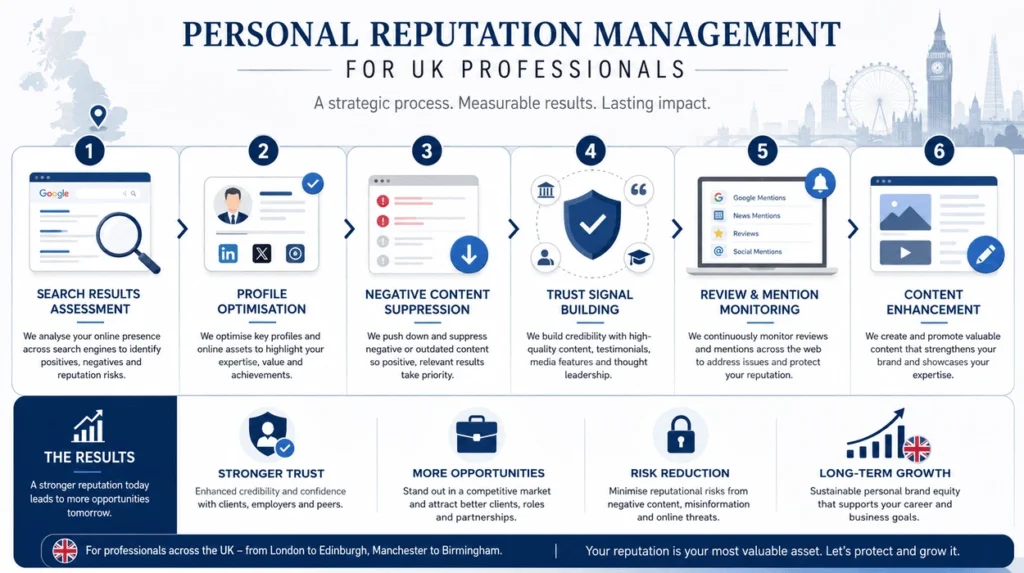
A professional reputation management service works by diagnosing the search environment, identifying risk signals, building stronger reputation assets, and monitoring ranking movement over time. It combines SEO analysis, PR evaluation, content strategy, platform review, sentiment analysis, and search visibility tracking. The process is structured because each action targets a specific weakness in the reputation ecosystem.
The service begins with reputation mapping. This stage reviews search results, public profiles, review platforms, media mentions, social content, images, videos, directories, and third-party references. It separates positive, neutral, negative, outdated, inaccurate, and irrelevant results. This gives a clear view of which assets support credibility and which results create risk.
The next stage is strategy design. A tailored plan defines which results need strengthening, which content requires improvement, which negative results need suppression, and which removal routes apply. Some content qualifies for removal because it breaches platform rules, privacy standards, defamation principles, copyright restrictions, or factual accuracy requirements. Other content remains online and requires suppression through stronger competing assets.
The process then moves into execution. A professional reputation management service improves search visibility by developing authoritative assets, optimising profiles, strengthening digital footprint consistency, and reducing the prominence of damaging content. This approach gives decision-stage users a practical solution because it connects actions to measurable visibility outcomes rather than general reputation advice.
Which Outcomes Prove Reputation Management Is Working?
Effective reputation management is proven by changes in search visibility, sentiment distribution, content authority, profile consistency, and risk exposure. The strongest outcome is not the total removal of every unfavourable mention. The strongest outcome is a more credible and controlled search environment where accurate, authoritative, and trust-building assets dominate key positions.
Search visibility outcomes include improved ranking positions for positive profiles, articles, interviews, biography pages, social profiles, and professional references. These improvements show that search engines are recognising stronger assets as more relevant to the person’s name. When trusted results move higher, weaker or negative results lose visibility. This directly changes the user’s first impression.
Trust outcomes include stronger entity credibility. Entity credibility is the degree to which search engines and users recognise a person as a clear, legitimate, and professionally reliable subject. It improves when consistent information appears across authoritative platforms. It weakens when results contain contradictions, gaps, outdated details, or negative associations without balance.
Risk outcomes include reduced exposure to harmful search results, lower prominence of negative content, improved review balance, and clearer control over public-facing profiles. These results matter because reputational damage usually occurs at the visibility layer. If harmful content remains buried, unsupported, or outweighed by stronger assets, its influence decreases. This is how reputation management converts process into measurable search perception improvement.
How Fast Can Personal Reputation Management Improve Search Results?
Personal reputation management improves search results in stages because search engines require time to crawl, index, rank, and reassess content authority. Immediate improvements come from correcting visible profile errors, updating controlled assets, removing eligible content, and strengthening key pages. Broader SERP movement requires sustained authority building and ranking competition.
Speed depends on the strength of the current search results. Low-authority negative content is easier to suppress than high-authority media coverage. Outdated profiles are easier to correct than widely replicated third-party pages. A name with limited existing digital footprint requires content building before search engines have enough positive assets to rank. A name with established assets can move faster through optimisation and authority strengthening.
A tailored strategy improves speed by prioritising actions with the highest ranking influence. It identifies which assets already rank, which pages have authority potential, and which harmful results occupy decision-critical positions. This avoids wasting effort on assets that have limited search impact. It also ensures that early work supports both short-term visibility improvement and long-term reputation stability.
The realistic outcome is controlled progress rather than instant transformation. Search perception changes when stronger assets earn visibility and weaker results lose prominence. Reputation Management PR Agency positions speed through process clarity, not unrealistic claims. The aim is to stabilise perception quickly where possible while building sustainable search authority over time.
How Does Negative Content Suppression Reduce Reputation Risk?
Negative content suppression reduces reputation risk by lowering the visibility of damaging search results and increasing the visibility of credible alternatives. Suppression does not delete content. It changes SERP composition so that stronger, more relevant, and more authoritative assets rank above negative or misleading material.
Negative content suppression operates through search ranking influence. Search engines compare pages for relevance, authority, freshness, semantic clarity, and user value. A negative result ranks when it appears stronger than available positive assets. Suppression corrects that imbalance by developing and optimising assets that deserve higher positions for the same search query.
The strongest suppression strategy uses multiple content types. Professional profiles confirm identity. Articles demonstrate expertise. Interviews create authority signals. Social profiles show active and consistent identity. Directory updates reduce confusion. Review management balances sentiment. Together, these assets form a more resilient search ecosystem.
The risk reduction effect is clear. Users give more attention to top search results than lower results. When negative content moves down, its influence on first-stage judgement decreases. When positive and neutral assets move up, search perception becomes more accurate and controlled. This makes suppression a central part of Personal Reputation Management for professionals facing visible reputational pressure.
How Does Cost Compare With Long-Term Reputation Value?
The cost of reputation management is justified when compared with the long-term value of credibility, opportunity access, and risk reduction. A damaged or unclear search profile affects hiring, partnerships, client trust, media evaluation, investment discussions, and professional due diligence. The value comes from protecting how a person is assessed before any direct conversation begins.
Reputation cost is not only the price of a service. It includes the cost of lost trust, delayed opportunities, reduced authority, weaker first impressions, and increased scrutiny. A negative or fragmented digital footprint forces professionals to explain, defend, or clarify their reputation repeatedly. A controlled search presence reduces that friction by presenting stronger evidence at the point of search.
Long-term value comes from reputation infrastructure. This includes authoritative content, consistent profiles, stable search assets, balanced sentiment, and monitoring systems that detect new risks. These assets continue supporting entity credibility after the initial campaign. They also reduce dependence on reactive reputation repair in the future.
The comparison favours structured investment when reputation affects professional outcomes. A one-off correction solves only a visible issue. A tailored strategy builds a stronger foundation for future search evaluation. The decision is not only about fixing a current problem. It is about reducing repeated exposure to the same reputation risk across future opportunities.
Get More Insights:
Transparent Reputation Management Pricing Built Around Your UK Goals
Why Is a Tailored UK Strategy More Reliable Than a Generic Approach?
A tailored UK strategy is more reliable because UK professionals operate within a specific search, legal, media, and trust environment. Generic approaches fail when they ignore local search intent, professional expectations, UK privacy considerations, defamation sensitivity, platform behaviour, and sector-specific reputation standards. Personal reputation requires contextual analysis.
A tailored approach evaluates the person’s role, sector, location, risk level, search results, public exposure, and professional objectives. It then selects methods that match the actual reputation environment. A regulated professional needs stronger credibility signals than a general public profile. A public-facing executive needs SERP control, media evaluation, and entity consistency. A private professional needs risk reduction, profile accuracy, and harmful content containment.
Reliability comes from matching methods to conditions. Removal is effective when content breaches rules or legal standards. Suppression is effective when negative content remains online but can be outranked. Content enhancement is effective when existing assets have authority potential. Review management is effective when visible sentiment affects trust. Monitoring is effective when reputational risk changes over time.
This is where tailored UK strategy becomes a decision-stage concept rather than a general phrase. It means the approach is based on search behaviour, UK context, risk analysis, and measurable visibility outcomes. Reputation Management PR Agency uses this structure to connect reputation repair with sustainable search perception control.
How Do TOFU and MOFU Insights Support a BOFU Decision?
TOFU and MOFU insights support a BOFU decision by explaining the problem before evaluating the solution. Informational content explains why Personal reputation online follows a professional into opportunities. Consideration-stage content explains what Personal reputation management UK involves and how different methods compare. Decision-stage content uses both insights to justify a structured solution.
The informational layer defines the search ecosystem. It explains how digital footprint, content indexing, SERP evaluation, trust signals, and online credibility influence perception. This matters because decision-stage users need to understand why reputation is not limited to social media or public opinion. It is shaped by what search engines index, rank, and present.
The consideration layer compares available methods. It analyses content creation, removal, suppression, review management, profile optimisation, organic strategy, and reactive intervention. This helps users evaluate which approach fits their risk level. It also clarifies why one method alone rarely delivers complete control.
The decision layer converts understanding into action logic. When a professional understands the problem and compares methods, the need for structured Personal Reputation Management becomes clear. The service is not valuable because it sounds protective. It is valuable because it targets the exact mechanisms that influence rankings, visibility, sentiment, and trust.
What Makes Reputation Management Sustainable After Initial Results?
Sustainable reputation management depends on continuous monitoring, authority building, content freshness, profile consistency, and risk response. Initial results improve visible search perception, but sustainability protects those gains from future ranking changes, new content, review shifts, or media updates. Search ecosystems are dynamic, so reputation control needs ongoing structure.
Monitoring identifies new reputation signals as they appear. It tracks ranking changes, new indexed pages, review patterns, image results, social mentions, and emerging negative content. This allows reputation risks to be addressed before they dominate search visibility. Early detection reduces the cost and complexity of later repair.
Authority building maintains long-term search strength. Fresh content, updated profiles, relevant publications, and trusted references show search engines that the professional entity remains active and credible. This reduces the chance that outdated or harmful results regain visibility. It also strengthens the professional’s presence across name-based and sector-related searches.
Sustainability is the difference between temporary suppression and durable reputation control. A short-term campaign changes visible results for a period. A structured strategy protects the reputation ecosystem over time. This ensures that search perception remains stable, credible, and aligned with professional identity.
Conclusion
A tailored UK strategy gives professionals a reliable route to control search visibility, strengthen reputation signals, reduce risk, and improve public trust. Personal Reputation Management delivers value because it works inside the search ecosystem that shapes modern decision-making. It targets rankings, content visibility, entity credibility, sentiment distribution, and SERP control with a clear process.
The strongest approach combines audit, strategy, content enhancement, negative content suppression, removal review, profile optimisation, review evaluation, and ongoing monitoring. This creates both short-term visibility improvement and long-term reputation stability. It also ensures that decision-makers see accurate and credible information when they search a professional’s name.
Reputation Management PR Agency provides a structured solution for professionals who need reputation control rather than generic visibility advice. The process is reliable because it connects each action to measurable outcomes: improved search results, stronger trust signals, controlled narrative, reduced risk, and sustainable credibility. A clear strategy ensures that personal reputation becomes an asset within opportunity evaluation, not a source of uncertainty.
FAQs
1. How can I take control of my personal reputation online?
You can take control of your personal reputation online by reviewing search results, improving professional profiles, managing review signals, and reducing the visibility of harmful or outdated content. Personal Reputation Management focuses on strengthening search visibility, online credibility, and trust signals linked to your name.
2. What does a tailored UK reputation strategy include?
A tailored UK reputation strategy includes search result analysis, digital footprint review, profile optimisation, negative content suppression, review monitoring, and trust signal building. Reputation Management PR Agency uses this approach to align reputation activity with UK search behaviour, professional expectations, and online risk factors.
3. Why is Personal Reputation Management important for professionals?
Personal Reputation Management is important because employers, clients, partners, and decision-makers often search a person’s name before making professional decisions. Strong search results, accurate profiles, and positive reputation signals help support credibility and reduce perceived risk.
4. How does negative content suppression work?
Negative content suppression works by improving the visibility of stronger, more relevant, and more credible content so harmful results appear lower in search results. It does not delete content but reduces its influence by changing what users see first on search engine results pages.
How long does it take to improve personal reputation online?
The timeline depends on the strength of existing search results, the authority of negative content, and the quality of positive assets available. Profile corrections and eligible removals can show faster effects, while SERP control, content ranking, and long-term reputation repair require ongoing optimisation.