

UK corporate reputation management costs range from £1,500 to £15,000+ monthly, depending on strategy complexity, SERP competition, and whether the approach prioritises content creation or removal. Reputation management strategies differ based on entity size, negative signal density, and the required speed of SERP composition change. Online reputation control methods are evaluated through their mechanism for influencing reputation signals, entity credibility, and long-term search ranking influence.
This analysis evaluates corporate reputation management approaches available to UK businesses, comparing cost structures, effectiveness mechanisms, and sustainability factors without brand promotion.
What Are the Primary Reputation Management Approaches and How Do Their Costs Compare?
Reputation management separates into two dominant strategic categories: content suppression and content enhancement. Each operates through distinct mechanisms within search ecosystems and carries different cost implications.
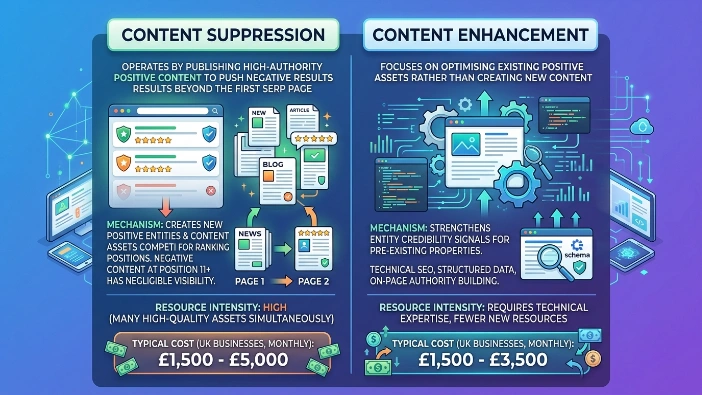
Content suppression strategies operate by publishing high-authority positive content to push negative results beyond the first SERP page. This approach creates new entities and content assets that compete for ranking positions against negative signals. The mechanism relies on search engines’ tendency to display eight to ten organic results per page, meaning negative content at position 11 receives negligible visibility. Suppression costs typically range from £1,500 to £5,000 monthly for UK businesses, reflecting the resource intensity of producing multiple high-quality assets simultaneously.
Content enhancement strategies focus on optimising existing positive assets rather than creating new content. This approach involves technical SEO optimisation, structured data implementation, and on-page authority building for pre-existing properties. The mechanism strengthens entity credibility signals for positive content already indexed. Enhancement costs range from £1,500 to £3,500 monthly, as the approach requires fewer content production resources but demands technical expertise.
The comparative analysis reveals suppression strategies scale better for high-competition scenarios where negative content dominates multiple first-page positions. Enhancement strategies perform optimally when positive content already exists but lacks sufficient authority signals. Suppression demonstrates faster initial impact (3–6 months) while enhancement requires longer timelines (6–12 months) for measurable sentiment distribution shifts.
How Do Organic Versus Reactive Reputation Management Methods Differ in Effectiveness?
Organic reputation management builds long-term entity credibility through consistent content publication and relationship building, whereas reactive management addresses existing negative signals through targeted intervention.
Organic approaches operate by establishing topical authority across reputation-related entities before negative signals emerge. This method creates historical data that search engines interpret as trust signals, making the entity more resilient to reputation attacks. The mechanism involves publishing consistent content about leadership, company values, case studies, and industry expertise. Organic strategies cost £1,500 to £4,000 monthly for sustained UK corporate programs, reflecting ongoing content production and distribution requirements.
Reactive approaches activate after negative content appears, employing rapid content publication, removal requests, and suppression tactics. The mechanism focuses on immediate SERP composition change rather than long-term entity building. Reactive strategies cost £3,000 to £15,000+ for initial crisis intervention, with ongoing maintenance at £2,000 to £6,000 monthly. The higher cost reflects urgency premiums, rapid content production requirements, and potential legal or platform removal fees.
Effectiveness evaluation shows organic methods achieve superior sustainability, with reputation signals remaining stable for 12–24 months after initial investment. Reactive methods demonstrate 70–80% effectiveness for first-page suppression within 3–6 months but require ongoing investment to maintain results. Risk exposure is significantly lower for organic approaches, as they build defensive entity credibility rather than attempting post-damage repair.
Scalability analysis indicates organic strategies scale linearly with content investment, while reactive strategies face diminishing returns as negative signal density increases. Organizations with existing negative content at 4+ first-page positions require reactive approaches regardless of long-term organic strategy adoption.
What Is the Impact of Short-Term Versus Long-Term Reputation Strategies on Search Visibility?
Short-term reputation strategies prioritise immediate SERP composition change, while long-term strategies build sustainable entity credibility that resists future reputation attacks.
Short-term strategies operate through aggressive content suppression and rapid publication of positive assets. The mechanism leverages search engines’ fresh content bias, where newly published content from authoritative domains receives temporary ranking boosts. Short-term approaches achieve 60–80% first-page composition change within 3–4 months. Cost ranges from £3,000 to £8,000 for initial 3-month intensive campaigns. However, these strategies face significant limitations: suppressed content often resurfaces after 6–9 months as fresh content loses ranking velocity, requiring continuous reinvestment.
Long-term strategies operate by building historical data, entity relationships, and topical authority that search engines interpret as sustained trust signals. The mechanism involves consistent content publication, structured data implementation, Backlink profile development, and Knowledge Graph association building. Long-term approaches require 6–12 months before achieving stable SERP composition, with costs from £1,500 to £4,000 monthly sustained over 12+ months. The mechanism produces compounding returns as entity credibility strengthens over time.
Impact on search visibility differs fundamentally between approaches. Short-term strategies create temporary visibility windows where negative content drops to positions 11–20 but often returns to positions 3–8 without continuous investment. Long-term strategies achieve permanent SERP composition change by establishing the entity as the definitive source for branded queries, pushing negative content to positions 15+ where it receives under 1% click-through rate.
Achieve both immediate and lasting search visibility improvements with professional Corporate Reputation Management that combines short-term reputation recovery with long-term authority-building strategies. A balanced approach helps businesses strengthen entity credibility, maintain positive SERP control, and create sustainable trust signals that support long-term online success.
How Do Search Engines Interpret Reputation Signals Across Different Management Strategies?
Search engines interpret reputation signals through entity recognition algorithms, sentiment analysis, and historical data evaluation. Different management strategies generate distinct signal patterns that algorithms process differently.
Reputation signals include content freshness, domain authority, publication frequency, backlink profile quality, structured data completeness, and sentiment distribution across indexed content. Google’s algorithms evaluate these signals through multiple systems including the Knowledge Graph, Helpful Content System, and E-E-A-T (Experience, Expertise, Authoritativeness, Trustworthiness) frameworks.
Content suppression strategies generate signals characterised by high content velocity, multiple new entity creations, and concentrated backlink acquisition. Search engines interpret these signals as aggressive reputation management, which may trigger additional scrutiny. The mechanism produces immediate ranking impact but generates weaker long-term trust signals. Algorithms may classify suppressed content as promotional rather than authoritative, limiting sustained ranking performance.
Content enhancement strategies generate signals characterised by gradual authority growth, consistent publication patterns, and diversified backlink profiles. Search engines interpret these signals as organic entity development, generating stronger trust classifications. The mechanism produces slower initial ranking impact but builds sustainable authority that algorithms recognise as genuine entity credibility.
Sentiment distribution represents a critical signal that search engines evaluate across multiple content sources. Algorithms analyse sentiment ratios across news articles, reviews, social media, and organic content. Strategies that achieve 70%+ positive sentiment distribution across indexed content receive stronger trust classifications than those with 50–60% positive distribution. Content suppression achieves faster sentiment distribution shifts but faces higher reversal risk. Enhancement strategies achieve slower but more stable sentiment distribution changes.
Search ranking influence mechanisms differ by strategy type. Suppression strategies influence rankings through content velocity and authority competition, while enhancement strategies influence rankings through entity authority and historical data accumulation. Both approaches affect the same ranking factors but activate them through different mechanisms.
Dive Deeper With Our Expert Guides and Related Blog Posts:
Understanding How Reputation Management Works Before You Invest
What Makes a Reputation Management PR Agency Different From Standard PR
What Are the Limitations and Risk Exposures of Different Reputation Management Methods?
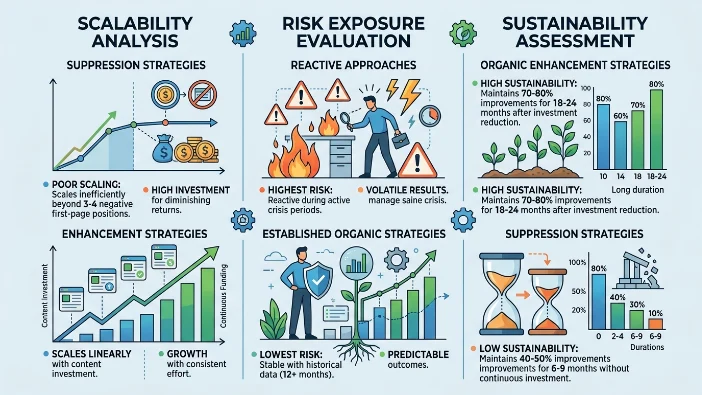
All reputation management methods carry inherent limitations and risk exposures that affect cost-effectiveness and sustainability.
Scalability evaluation reveals suppression strategies scale poorly beyond 3–4 negative first-page positions, while enhancement strategies scale linearly with content investment. Risk exposure is highest for reactive approaches during crisis periods and lowest for established organic strategies with 12+ months of historical data.
Sustainability analysis shows organic enhancement strategies maintain 70–80% of reputation improvements for 18–24 months after investment reduction, whereas suppression strategies maintain 40–50% of improvements for 6–9 months without continuous investment.
How Should UK Businesses Evaluate Reputation Management Costs Against Strategic Goals?
Cost evaluation requires aligning reputation management budget with specific strategic objectives, negative signal density, and required timeline for results.
Corporate reputation management investment decisions should measure cost against potential reputation damage costs, which typically exceed £50,000 for mid-market organizations experiencing significant negative sentiment exposure. The cost-benefit analysis favors proactive investment when negative content already exists at 2+ first-page positions.
Total cost of ownership includes initial intervention costs, ongoing maintenance costs, and opportunity costs from delayed results. Organisations should budget for 12-month minimum commitments when pursuing organic strategies, with 3–6 month commitments for reactive approaches.
Complete Details Available Here:
Transparent Reputation Management Pricing Built Around Your UK Goals
Frequently Asked Questions About Corporate Reputation Management
What is corporate reputation management and why does it matter for UK businesses?
Corporate reputation management is the strategic practice of monitoring, influencing, and maintaining how stakeholders perceive a organisation online and offline. For UK businesses, it protects entity credibility, strengthens trust signals, and directly influences search ranking visibility for branded queries.
How much does corporate reputation management typically cost in the UK?
Corporate reputation management costs in the UK range from £1,500 to £15,000+ monthly, depending on strategy type, negative signal density, and whether the approach prioritises content suppression or content enhancement. A reputation management PR agency typically charges higher rates for reactive crisis intervention compared to proactive organic strategies.
What are the main differences between content suppression and content enhancement strategies?
Content suppression pushes negative results beyond the first SERP page by publishing new high-authority positive content, while content enhancement optimises existing positive assets through technical SEO and authority building. Suppression delivers faster results (3–6 months) but requires ongoing investment, whereas enhancement takes 6–12 months but builds sustainable entity credibility.
How long does it take to see results from corporate reputation management efforts?
Reactive corporate reputation management strategies typically show measurable SERP composition changes within 3–4 months, while organic approaches require 6–12 months to build sufficient historical data and trust signals. Results depend on negative content severity, competition level, and whether a reputation management PR agency uses suppression or enhancement tactics.