

A reputation management PR agency differs because it is optimised for search visibility, sentiment distribution, and entity credibility, not just media coverage. Reputation management strategies differ based on how they influence search ranking signals, owned asset visibility, and the composition of branded SERPs. Online reputation control methods are evaluated through the relationship between publicity, search engine interpretation, and long-term trust signals, rather than through awareness alone.
How does reputation management PR differ from standard PR?
Reputation management PR is a search-aware communication discipline, while standard PR is a broader influence practice focused on awareness, relationships, and narrative placement. Standard PR operates by earning coverage, shaping public messaging, and maintaining visibility in editorial or broadcast channels, whereas reputation management PR operates by aligning that coverage with branded search queries and perception-sensitive outcomes.
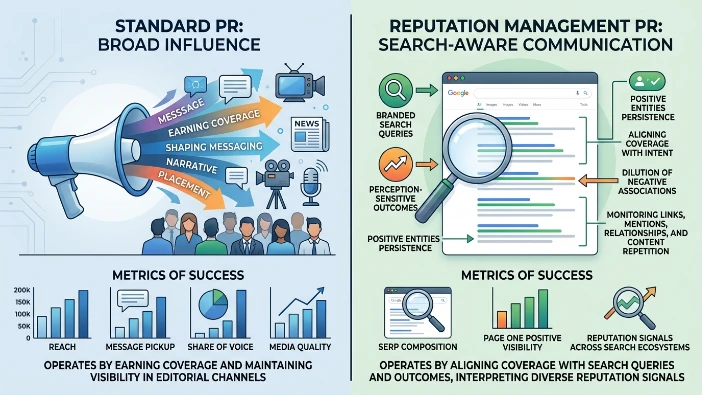
Standard PR measures success through reach, message pickup, share of voice, and media quality. Reputation management PR measures success through SERP composition, the persistence of positive entities on page one, and the dilution of negative associations within search ecosystems. This difference matters because search engines interpret reputation signals across links, mentions, entity relationships, and content repetition, not merely through publicity volume.
What standard PR optimises
- Earning coverage in relevant media outlets to build awareness and third-party validation.
- Framing the organisation through announcements, thought leadership, and issue response.
- Reinforcing broad brand familiarity in audiences that consume news, industry media, or broadcast channels.
What reputation PR optimises
- Publishing or amplifying assets that rank for branded searches and preserve favourable first-page results.
- Redirecting relevance away from negative topics by shifting topic density and entity associations.
- Strengthening trust signals across owned, earned, and review-based properties that search engines surface for reputation-sensitive queries.
Which approach works better for search visibility?
Search-aware reputation management works better for branded search visibility because it treats the SERP as the primary reputation surface. Standard PR affects perception indirectly, but it does not automatically control which pages appear when users search a company, executive, or product name.
Reputation management PR operates by increasing the presence of favourable results across owned websites, profiles, media coverage, and supporting content. Search engines then read these assets as competing entities and signals, which influences whether positive or negative content dominates the query landscape. Standard PR produces reputational lift only when the coverage also earns visibility, indexed persistence, and relevance for the target query.
The limitation of standard PR is that it can generate strong awareness without reshaping the SERP. Positive coverage that fails to rank has limited value for users who inspect search results before forming an opinion. The limitation of reputation-focused PR is that it requires more technical coordination, because content structure, internal linking, indexing, and topical alignment all affect whether the message actually appears in search.
How do content creation and content removal strategies compare?
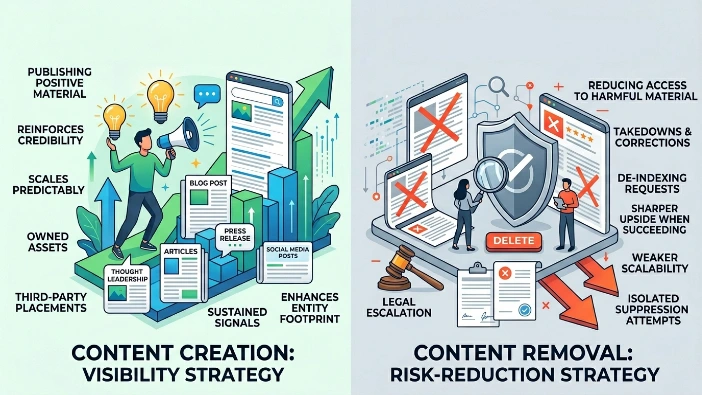
Content creation is a visibility strategy, while content removal is a risk-reduction strategy. Content creation operates by publishing positive, relevant, indexable material that occupies search space and reinforces credibility; content removal operates by reducing access to harmful material through takedowns, corrections, de-indexing requests, or legal escalation where applicable.
Content creation scales more predictably because it can be repeated across owned assets, thought leadership, press placements, social profiles, and third-party pages. It is also structurally safer because it does not depend on proving that a negative item qualifies for removal. Content removal has sharper upside when it succeeds, but it has weaker scalability because each case depends on the source, jurisdiction, publication policy, and the nature of the disputed content.
The strategic trade-off is clear. Content creation improves reputation signals by expanding the positive asset base, while content removal reduces exposure by targeting the source of harm. In practice, search engines react more consistently to sustained content enhancement than to isolated suppression attempts, because recurring positive signals create a stronger entity footprint over time.
How do short-term and long-term tactics compare?
Short-term tactics include press amplification, rapid-response statements, profile optimisation, and targeted content publication around a reputational event. Long-term tactics include authority-building content, review ecosystem management, internal linking architecture, and entity-based topical coverage.
Short-term tactics work by filling immediate information gaps. They are effective when users search during a crisis window and need alternative, current, and credible content to counterbalance negative narratives. Their limitation is fragility: once the campaign stops, the visibility effect decays unless the content continues earning relevance.
Long-term tactics work by building a cumulative trust profile. Search engines reward repeated trust signals more than one-off optimisation, so a steady cadence of positive content and engagement produces more durable visibility. This is where reputation management PR differs most from standard PR: standard PR can generate a burst of attention, but reputation management creates a structural advantage in how the brand is interpreted across time.
Strengthen brand credibility with professional Corporate Reputation Management that combines rapid-response reputation tactics with long-term authority-building strategies. A balanced reputation approach helps businesses control immediate SERP perception while creating lasting trust, visibility, and digital resilience across search ecosystems.
What mechanisms shape SERP composition?
SERP composition is shaped by relevance, authority, freshness, entity relationships, and user intent alignment. A reputation management PR agency works at the intersection of these signals by selecting what content exists, where it appears, and how strongly it connects to the brand entity. Standard PR contributes coverage, but reputation management coordinates coverage with search behaviour.
Search engines interpret reputation signals through repeated associations. If a brand appears in positive editorial coverage, authoritative profiles, review platforms, and owned pages, those assets reinforce one another and occupy more of the result set. If negative coverage is left unchallenged, the SERP can concentrate around crisis content, especially when the topic density around the negative event remains high.
This is why SERP control is less about one article and more about ecosystem design. Reputation management uses content enhancement, profile optimisation, review management, and internal linking to shape which entity signals dominate the query landscape. Standard PR lacks that search-layer orchestration unless it is paired with SEO-aware execution.
Dive Deeper Into This Topic:
Partner With a Dedicated Reputation Management PR Agency in the UK
What evaluation framework applies in practice?
A useful evaluation framework compares each approach against effectiveness, scalability, risk exposure, and sustainability. Effectiveness measures whether the tactic changes what users see and believe. Scalability measures whether the tactic extends across many pages, queries, or locations without losing quality. Risk exposure measures whether the tactic creates compliance, editorial, or search volatility problems.
Evaluate effectiveness
- Measure branded SERP share across page-one results, not just media mentions.
- Track sentiment distribution across reviews, news, and owned content.
- Compare how quickly negative items lose prominence after new positive content is published.
Evaluate scalability
- Assess whether the tactic works across executives, subsidiaries, products, and local markets.
- Determine whether the method requires case-by-case intervention or repeatable content systems.
- Examine whether the content model supports ongoing expansion without brand drift.
Dive Deeper With Our Expert Guides and Related Blog Posts:
How to Evaluate Whether a UK ORM Agency Is Right for Your Situation
A Breakdown of Online Reputation Management Services and Their Results
Evaluate risk exposure
- Review whether removal tactics depend on third-party cooperation.
- Check whether reactive tactics create reputational over-correction or message inconsistency.
- Identify whether heavy suppression activity introduces visibility gaps in search coverage.
Evaluate sustainability
- Analyse whether the tactic creates durable trust signals.
- Compare whether the method strengthens owned assets or only temporary placements.
- Test whether the reputation effect persists after the campaign ends.
A reputation management PR agency differs from standard PR because it works on reputation signals inside search ecosystems, not only on public messaging. Standard PR builds awareness and narrative reach, while reputation management prioritises SERP composition, entity credibility, and long-term trust distribution. Content creation outperforms content removal on scalability, reactive methods outperform organic methods on speed, and long-term systems outperform short-term bursts on sustainability.
The strategic decision depends on whether the objective is visibility, suppression, correction, or resilience. For a UK audience evaluating corporate reputation management, the most effective model is the one that combines media influence with search-aware content architecture, because reputation now forms where public relations and search perception overlap.
What is corporate reputation management?
Corporate reputation management is the process of shaping how a business is perceived across search results, reviews, media coverage, and owned content. It focuses on trust signals, brand credibility, and the visibility of positive or negative information online.
How does a reputation management PR agency help a business?
A reputation management PR agency manages public perception by combining PR, content, and search visibility tactics. It helps influence branded search results, strengthen trust signals, and reduce the impact of negative content.
What is the difference between standard PR and reputation management?
Standard PR focuses on awareness, media relations, and message placement, while reputation management focuses on search perception and entity credibility. Reputation management is more concerned with what people see when they search a company name online.
Why is online reputation important for businesses?
Online reputation affects how customers, partners, and investors judge a business before contacting it. Strong reputation signals can improve trust, search visibility, and conversion intent across digital channels.
How do search results affect corporate reputation?
Search results often shape first impressions because users review page one before making decisions. If branded results show credible, positive content, the business gains trust; if they show negative content, perception can weaken quickly.