
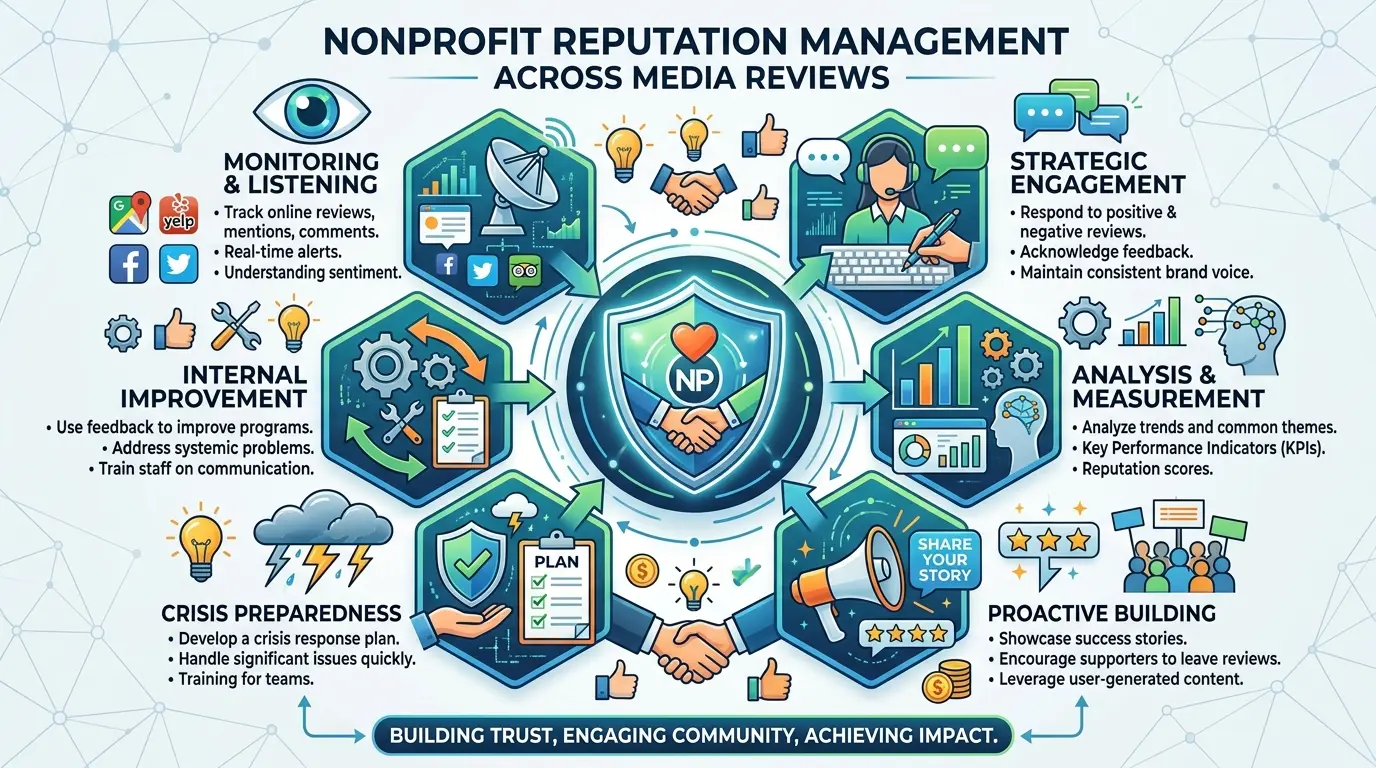
Nonprofit reputation management involves monitoring, analysing, and influencing reputation signals across media coverage, review platforms, search results, and other indexed digital assets. Its primary function is to evaluate how information shapes entity credibility, search visibility, and stakeholder perception within search ecosystems.
Reputation management strategies differ based on information sources, search visibility objectives, sentiment distribution, and risk exposure. Online reputation control methods are evaluated through their influence on search ranking signals, entity understanding, SERP composition, and long-term credibility development.
What Approaches Are Used in Nonprofit Reputation Management Across Media, Reviews, and Search?
A nonprofit reputation management approach is a structured method for influencing how organisational information appears and is interpreted across digital environments.
The three primary approaches are content enhancement, reputation monitoring, and reputation remediation. Content enhancement focuses on publishing authoritative information that strengthens entity credibility. Reputation monitoring focuses on tracking reputation signals across media outlets, review platforms, and search results. Reputation remediation focuses on addressing visibility issues created by negative, inaccurate, or outdated information.

Each approach operates through different mechanisms. Content enhancement influences search ranking influence by increasing the volume and quality of indexable assets. Monitoring improves visibility into emerging reputation risks before they affect perception. Remediation focuses on correcting information imbalances that influence sentiment distribution. Search engines interpret these activities through content indexing, source authority evaluation, and entity relationship analysis.
The approaches differ in sustainability and scalability. Content enhancement supports long-term visibility growth because search engines continuously evaluate authoritative content. Monitoring supports risk detection but does not directly alter SERP composition. Remediation addresses immediate reputation concerns but often requires continuous management due to changing search environments. Effective reputation analysis therefore evaluates each method according to its specific objective rather than treating all approaches as interchangeable.
How Does Content Enhancement Compare With Content Removal Strategies?
Content enhancement and content removal represent two distinct reputation management methods that influence search ecosystems in different ways.
Content enhancement is the creation and optimisation of positive, authoritative, and relevant information. Content removal is the elimination or deindexing of information that negatively affects reputation signals. Both methods influence search visibility, but they operate through different mechanisms. Search engines reward authoritative content through ranking systems, while content removal relies on legal, policy, or platform-based processes.
How Does Content Enhancement Operate?
Content enhancement operates by increasing the presence of trusted information within search ecosystems.
This method focuses on publishing assets that improve entity understanding. Search engines evaluate relevance, authority, and quality when determining rankings. Strong content creates additional entry points into SERPs and contributes to a more complete digital footprint. The result is increased visibility for information that supports entity credibility.
The primary strength of content enhancement is sustainability. Indexed assets continue contributing reputation signals over time. The limitation is time dependency because search indexing, ranking evaluation, and authority development require ongoing content production and optimisation.
How Does Content Removal Operate?
Content removal operates by reducing the visibility of information that negatively affects reputation signals.
Removal mechanisms include policy enforcement requests, legal interventions, platform moderation processes, and content corrections. The objective is to eliminate information that introduces misinformation, inaccuracies, or reputational distortion. Search engines subsequently adjust indexed content availability when removal actions are successful.
The strength of removal strategies is immediate impact when removal is approved. The limitation is restricted applicability because not all content qualifies for removal. Search ecosystems prioritise information accessibility, meaning removal opportunities remain limited compared with content enhancement strategies.
Which Method Creates Greater Search Ranking Influence?
Content enhancement generally creates stronger search ranking influence because it aligns with search engine objectives focused on relevance and information quality.
Removal strategies affect availability but do not inherently increase authority signals. Content enhancement contributes new reputation signals that search engines can evaluate positively. As a result, content suppression vs content enhancement comparisons often demonstrate greater long-term sustainability for enhancement-focused approaches.
How Does Review Management Compare With Media Management?
Review management and media management address different categories of reputation signals within search ecosystems.
Review management focuses on user-generated sentiment indicators. Media management focuses on editorial and journalistic references. Both influence entity credibility, but search engines interpret their signals differently. Reviews contribute direct sentiment data, while media coverage contributes authority and trust evaluation signals.
Review platforms generate continuous feedback loops. Search engines analyse review frequency, sentiment distribution, recency, and engagement indicators. These signals contribute to local visibility, entity understanding, and trust assessment. Positive sentiment strengthens credibility indicators, while negative sentiment alters perception through publicly visible evaluations.
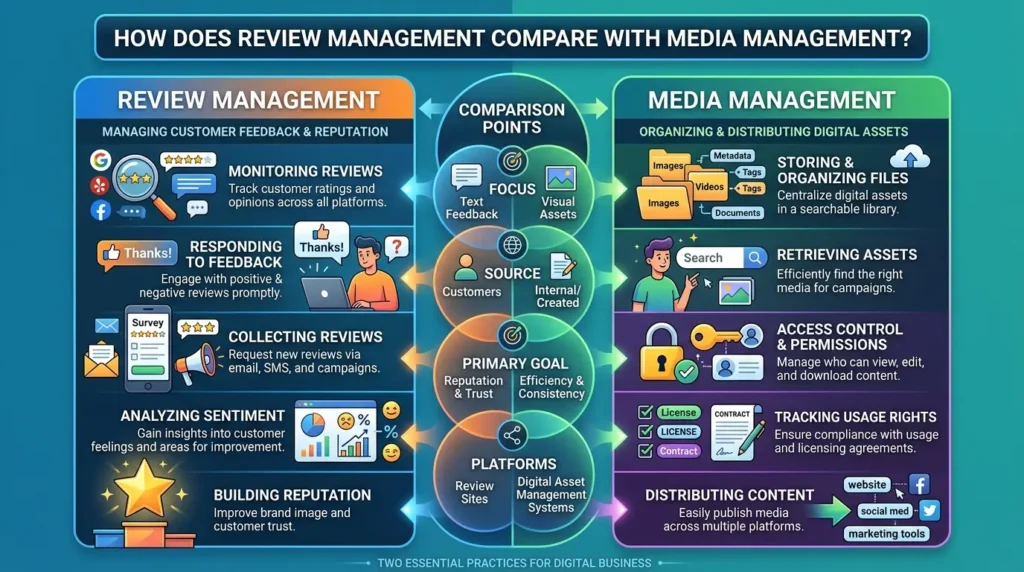
Media coverage operates through authority transfer mechanisms. Journalistic references often carry stronger credibility associations because editorial processes influence publication standards. Search engines evaluate these references as evidence of relevance and legitimacy. As a result, media visibility often affects entity credibility more directly than review volume.
The comparison demonstrates that reviews primarily influence sentiment interpretation, while media references primarily influence authority assessment. Effective reputation analysis evaluates both categories because search engines incorporate sentiment and authority into broader entity evaluation frameworks.
How Do Organic Reputation Strategies Compare With Reactive Reputation Strategies?
Organic and reactive reputation strategies differ according to timing, objectives, and sustainability.
Organic reputation management is the proactive development of positive reputation signals before visibility issues emerge. Reactive reputation management is the response to an existing reputation challenge that affects perception or search visibility. Both approaches influence SERP composition, but they operate under different conditions.
Organic strategies focus on continuous content development, entity consistency, and authority building. Search engines reward these signals through improved understanding and stronger ranking potential. The approach creates a stable digital footprint that supports long-term credibility growth. Because reputation signals accumulate over time, organic strategies often demonstrate greater sustainability.
Reactive strategies operate after negative sentiment, misinformation, or visibility issues become prominent. The objective is to rebalance sentiment distribution and improve information accuracy. Reactive measures often involve content correction, review response processes, or visibility adjustments. These methods address immediate concerns but frequently require ongoing intervention.
From an evaluation perspective, organic approaches reduce risk exposure because they establish reputation resilience before disruption occurs. Reactive approaches address existing problems effectively but operate within a higher-risk environment where negative signals already influence perception.
Which Reputation Signals Have the Strongest Influence on Search Perception?
Authority signals, sentiment signals, and consistency signals exert the strongest influence on search perception.
Search engines evaluate reputation through observable indicators rather than subjective opinion. Authority signals originate from trusted sources that reference an entity. Sentiment signals originate from reviews, comments, and public evaluations. Consistency signals originate from aligned information across platforms and publications.
How Do Authority Signals Affect Entity Credibility?
Authority signals affect entity credibility by strengthening trust relationships within search ecosystems.
Search engines analyse source reputation when evaluating references and citations. A trusted publication contributes stronger credibility indicators than an unknown source. These relationships improve confidence in entity identification and topical relevance. As authority accumulates, search ranking influence increases.
The strength of authority signals lies in their scalability. Authoritative references continue contributing value over extended periods. The limitation is acquisition difficulty because authority development requires consistent visibility and recognition.
How Do Sentiment Signals Affect Search Evaluation?
Sentiment signals affect search evaluation through positive, neutral, and negative interpretation patterns.
Search systems analyse language, review ratings, and contextual feedback. Positive sentiment supports trust indicators, while negative sentiment introduces risk indicators. Sentiment distribution provides search engines with additional context regarding public perception.
The strength of sentiment analysis is immediacy because new feedback influences perception quickly. The limitation is volatility because sentiment can change rapidly in response to emerging information.
How Do Consistency Signals Influence Search Understanding?
Consistency signals influence search understanding by reducing ambiguity.
Consistent organisational descriptions, mission statements, contact details, and entity references improve search engine confidence. Reduced ambiguity strengthens entity recognition and supports clearer SERP representation. The result is improved search perception and more accurate information retrieval.
How Does SERP Composition Change Under Different Reputation Management Methods?
SERP composition changes according to the type of reputation signals introduced into search ecosystems.
A search engine results page is a structured representation of indexed information ranked by relevance and quality. Reputation management methods influence which assets occupy visible positions. Different approaches therefore produce different search outcomes.
Content enhancement expands the volume of positive and authoritative assets eligible for ranking. Review management alters sentiment-related visibility signals. Media management increases authority-based references within search results. Content removal reduces the presence of unwanted assets when eligibility criteria are satisfied.
Search engines continuously reassess ranking relationships. As new reputation signals enter the ecosystem, SERP composition evolves. Visibility improvements occur when authoritative assets outperform competing content. Conversely, negative or conflicting information can gain prominence when stronger signals are absent. Reputation management therefore influences search perception through ongoing changes in result composition.
What Are the Limitations of Reputation Management Across Media Reviews and Search?
Every reputation management method contains operational limitations that affect effectiveness and scalability.
Content enhancement depends on indexing and ranking timelines. Search engines require time to discover, evaluate, and position new content. Immediate visibility changes are uncommon because ranking systems prioritise evidence-based authority development. This limitation affects short-term performance expectations.
Review management depends on stakeholder participation. Sentiment distribution cannot be controlled directly because reviews originate from external contributors. Reputation analysis therefore focuses on monitoring patterns rather than predicting outcomes. This introduces variability into reputation evaluation processes.
Media management depends on editorial independence. Organisations cannot directly control journalistic publication decisions. Authority signals emerge through editorial judgement rather than direct influence. This limitation affects predictability and visibility planning.
Content removal depends on platform policies and legal frameworks. Eligibility requirements restrict removal opportunities. As a result, removal strategies provide targeted solutions rather than universal reputation controls. Effective evaluation therefore requires understanding the limitations inherent within each method.
How Can Reputation Management Methods Be Evaluated Systematically?
Reputation management methods are evaluated through effectiveness, sustainability, scalability, and risk exposure metrics.
A structured evaluation framework provides clearer analysis than isolated performance observations. The following framework demonstrates how different approaches can be compared:
- Measure search visibility by analysing ranking positions, indexed asset growth, and SERP composition changes over time.
- Evaluate entity credibility by examining authority references, citation quality, and source trust indicators.
- Analyse sentiment distribution by monitoring review trends, media tone, and public evaluation patterns.
- Assess scalability by determining whether reputation improvements continue contributing value without constant intervention.
- Review risk exposure by identifying dependency on external platforms, editorial decisions, or user-generated content.
This framework focuses on measurable outcomes rather than subjective impressions. Search ecosystems operate through observable signals, making evidence-based evaluation essential for understanding reputation performance.
How Does Nonprofit Reputation Management Relate to Long-Term Trust Development?
Nonprofit reputation management relates to long-term trust development because credibility accumulates through consistent reputation signals over time.
Trust development is a cumulative process rather than a single event. Search engines continuously reassess entities using newly indexed information. Consistent authority signals, balanced sentiment distribution, and accurate content strengthen entity credibility. These factors contribute to stable search perception and predictable visibility outcomes.
Long-term trust differs from short-term visibility improvements. Short-term strategies often influence isolated reputation indicators. Long-term approaches influence the broader information environment surrounding an entity. Search engines recognise this broader context through entity relationship analysis and authority evaluation mechanisms.
This distinction explains why reputation management is frequently analysed as an ongoing system rather than a discrete activity. The principles underlying Strengthen Donor Trust With a Dedicated Nonprofit Reputation Management Plan reflect the importance of maintaining coherent reputation signals across media, reviews, and search environments over extended periods.
Nonprofit reputation management involves the evaluation and management of reputation signals across media coverage, reviews, search results, and other digital assets. Different methods influence search ecosystems through distinct mechanisms, creating different outcomes for visibility, trust signals, and entity credibility.
Content enhancement and content removal differ in sustainability and operational scope. Review management and media management influence separate categories of reputation signals. Organic strategies prioritise long-term resilience, while reactive strategies address existing visibility challenges. Search engines interpret these approaches through authority assessment, sentiment analysis, consistency evaluation, and ranking algorithms.
Effective reputation analysis therefore requires comparing methods according to effectiveness, scalability, sustainability, and risk exposure. Understanding these differences provides a clearer framework for evaluating how reputation management influences search perception and entity credibility across digital ecosystems.
How can negative news articles affect a nonprofit’s search reputation?
Negative news articles often rank highly in search results and can shape public perception before donors or volunteers visit a nonprofit’s website. Nonprofit reputation management focuses on monitoring media coverage and improving the visibility of accurate, relevant content across search engines.
Why should nonprofits monitor review platforms if they do not sell products?
Reviews on platforms such as Google, Facebook, and charity-rating websites influence donor trust and stakeholder confidence. Monitoring feedback helps nonprofits identify concerns early and respond to questions about transparency, impact, and accountability.
What is the connection between media coverage and donor confidence?
Media coverage can significantly influence how donors evaluate a nonprofit’s credibility and effectiveness. Consistent positive coverage and timely responses to inaccurate reporting help maintain trust among supporters and funding partners.
How do search engines influence a nonprofit’s public image?
Search engines often serve as the first source of information for potential donors, volunteers, and grant providers. The content that appears on the first page of search results can affect perceptions of the nonprofit’s leadership, mission, and performance.
What does nonprofit reputation management involve beyond crisis response?
Nonprofit reputation management includes ongoing monitoring of media mentions, online reviews, search results, and public sentiment. Organizations use these insights to address emerging issues, strengthen credibility, and maintain a positive digital presence over time.