
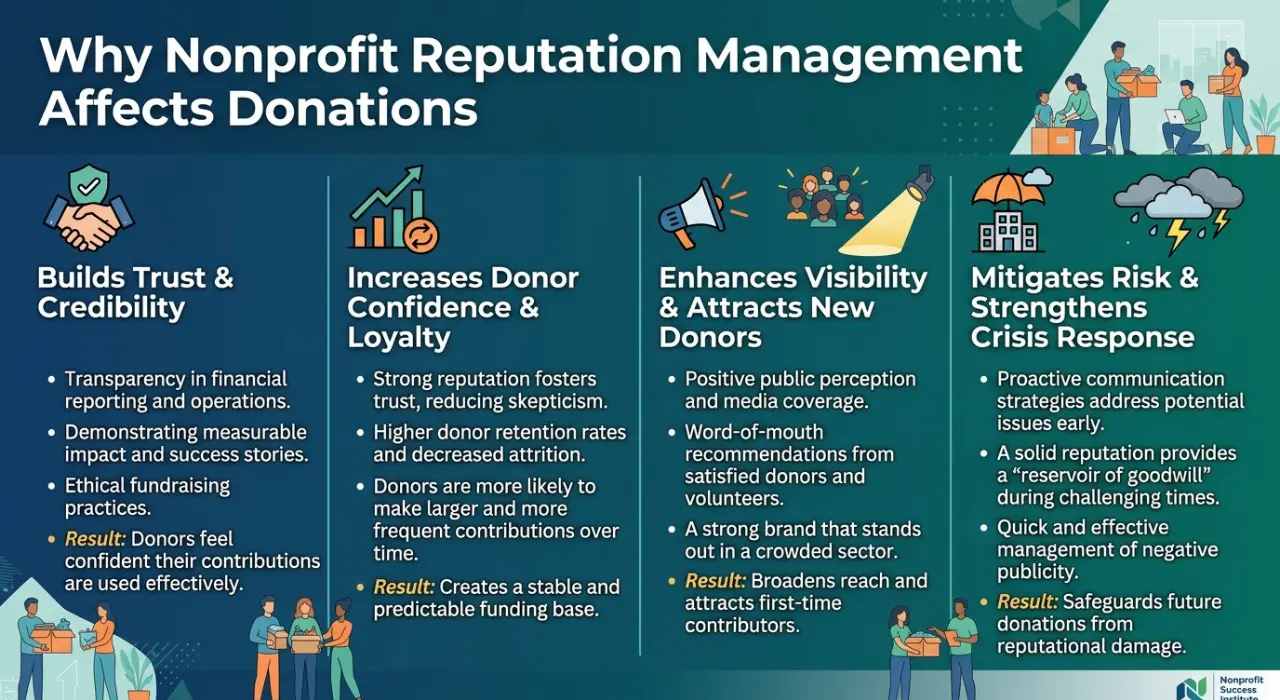
Nonprofit reputation management affects donations, volunteers, and partnerships because public perception influences how stakeholders evaluate trust, credibility, and organisational legitimacy across digital environments.
Reputation management is the process of monitoring, analysing, and influencing reputation signals that shape public perception. Online reputation refers to the collection of indexed content, reviews, mentions, media coverage, and search results that define how an organisation is interpreted within search ecosystems.
What Is Nonprofit Reputation Management?
Nonprofit reputation management is the systematic evaluation and maintenance of reputation signals that influence how a nonprofit entity is perceived online and offline.
Within search ecosystems, reputation management refers to the process through which information becomes discoverable, indexable, and interpretable across search engines, review platforms, media publications, and social channels. Every published asset contributes to an organisation’s digital footprint. Search engines analyse these assets as part of broader entity understanding processes. The resulting perception influences stakeholder confidence because users often assess credibility through visible information before engaging directly with an organisation.
The concept extends beyond public relations. Reputation management includes content indexing, sentiment analysis, review visibility, authority signals, and entity association. Search engines evaluate relationships between content sources, references, mentions, and user engagement indicators. These signals contribute to entity perception and influence how an organisation appears across search engine results pages (SERPs). As a result, reputation becomes a measurable digital asset rather than a purely subjective opinion.
Why Does Nonprofit Reputation Influence Donations?
Nonprofit reputation influences donations because trust evaluation occurs before financial commitment.
Donors analyse credibility through accessible information. Search results often function as the first evaluation environment. News articles, organisational websites, reviews, directory listings, and public discussions form a perception framework that influences trust assessment. Search engines organise this information according to relevance, authority, and contextual relationships. The visibility of positive, neutral, or negative information therefore affects donor interpretation.
Reputation signals define expectations regarding transparency, accountability, and operational effectiveness. When search ecosystems present consistent information, entity understanding becomes stronger. Consistency across content sources reinforces credibility signals. Conversely, conflicting information introduces ambiguity into the evaluation process. Ambiguity weakens trust signals because search users encounter uncertainty regarding organisational identity and reliability.
Donation behaviour is closely connected to information quality. Search visibility determines which content receives attention first. High-ranking content shapes perception before deeper research occurs. Reputation management therefore affects donations by influencing how information is discovered, interpreted, and prioritised within search environments.
How Does Reputation Affect Volunteer Recruitment?
Reputation affects volunteer recruitment because volunteers evaluate organisational legitimacy before investing time and effort.
Volunteer decisions often begin with information gathering. Search engines, review platforms, and social profiles provide immediate access to organisational information. These sources contribute to an entity’s digital footprint and influence first impressions. Search visibility determines which narratives become prominent during the evaluation process.
Online reputation refers to the collective interpretation of available information. Positive sentiment indicators, transparent communication, and authoritative content contribute to stronger credibility assessment. Search algorithms identify signals associated with expertise, trustworthiness, and relevance. These signals influence content ranking and determine which information becomes most visible.
Volunteer engagement depends on confidence in organisational purpose and governance. Reputation management supports confidence by reducing informational inconsistencies. Consistent messaging across indexed assets strengthens entity perception. Strong entity perception improves clarity, making it easier for potential volunteers to understand organisational goals and operational standards.
Why Do Partnerships Depend on Reputation Signals?
Partnerships depend on reputation signals because organisations assess risk before establishing formal relationships.
Partnership evaluation involves analysing publicly available information. Search ecosystems provide a broad collection of signals that contribute to organisational assessment. Media coverage, reviews, citations, publications, and industry references all participate in reputation formation. Search engines aggregate and organise these signals to create a searchable entity profile.

Reputation signals function as indicators of reliability. Authority-based references from recognised sources strengthen perceived legitimacy. Consistent information across independent platforms reinforces trust evaluation. Search algorithms recognise these relationships and incorporate them into entity understanding frameworks. The result is a more coherent representation of organisational identity.
Partnership decisions often rely on perceived stability and credibility. When search visibility highlights authoritative content and positive sentiment, trust signals become stronger. When search visibility highlights controversy, inconsistency, or negative sentiment, risk perception increases. Reputation management therefore affects partnerships by influencing how organisational information is presented and interpreted.
How Is Nonprofit Reputation Formed Across Search Ecosystems?
Nonprofit reputation is formed through the interaction of content creation, content indexing, content ranking, and user interpretation.
Every piece of published information becomes part of a larger reputation network. Search engines discover content through crawling and indexing processes. Indexed content is categorised according to relevance, topic association, authority, and quality signals. These classifications influence ranking positions within SERPs.
Reputation formation occurs through cumulative signal analysis. Search engines evaluate mentions, links, citations, reviews, structured data, and content consistency. Each signal contributes to entity understanding. Strong alignment across signals improves confidence in entity identification and topic relevance. Weak alignment creates uncertainty and reduces clarity.
User interpretation also plays a role in reputation formation. Search users evaluate visible information based on source credibility, sentiment, recency, and contextual relevance. Search rankings determine exposure, while content quality determines interpretation. Reputation therefore emerges from both algorithmic evaluation and human perception.
What Role Do Reviews Play in Nonprofit Reputation Management?
Reviews play a significant role because they function as public reputation signals within search ecosystems.
A review is a user-generated evaluation that communicates sentiment and experience. Search engines analyse review content alongside numerical ratings, review frequency, and source authority. These signals contribute to broader assessments of credibility and trustworthiness. Reviews therefore affect both perception and visibility.
Review sentiment influences entity perception. Positive sentiment reinforces trust indicators, while negative sentiment introduces risk indicators. Search algorithms increasingly analyse semantic meaning rather than relying solely on numerical ratings. Contextual interpretation enables search systems to evaluate patterns within review language. This process improves sentiment classification and reputation assessment.
Reviews also contribute to content diversity. Search ecosystems value multiple perspectives because they provide additional context regarding an entity. A larger volume of credible review content increases informational depth. Increased depth improves search engines’ ability to understand organisational reputation and stakeholder perception.
How Do Search Engines Interpret Trust and Credibility?
Search engines interpret trust and credibility through observable reputation signals rather than subjective judgement.
Trust refers to confidence derived from verifiable information. Credibility refers to perceived reliability based on evidence and consistency. Search engines evaluate these concepts through measurable indicators. These indicators include authoritative references, content quality, citation patterns, entity consistency, and user engagement metrics.
Algorithms analyse relationships between sources. Independent corroboration strengthens trust evaluation because multiple sources confirm similar information. Consistent entity attributes across platforms improve confidence in organisational identification. Structured information helps search engines validate these relationships more efficiently.
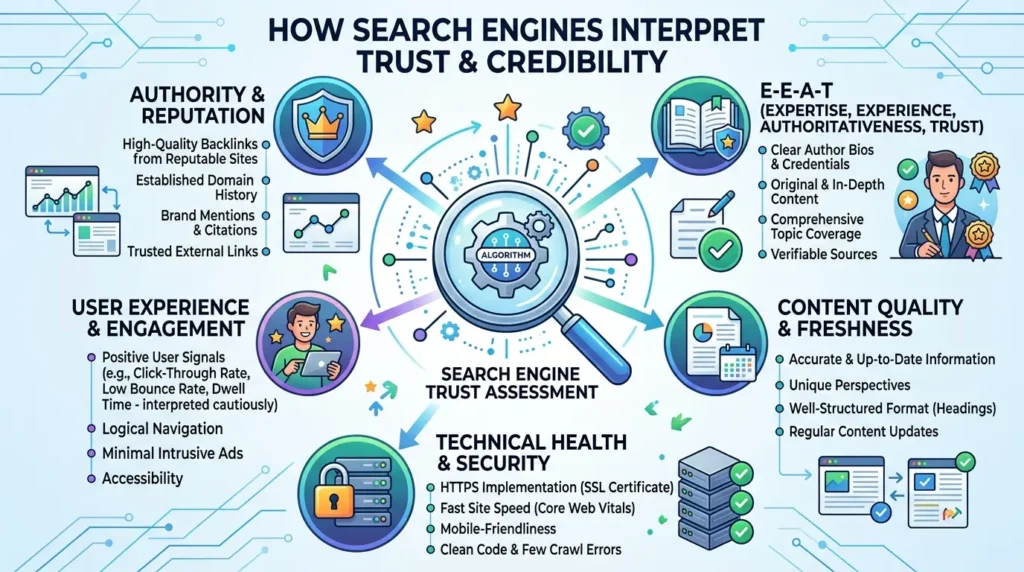
Credibility assessment also involves content quality evaluation. Search systems analyse topical relevance, expertise indicators, factual consistency, and semantic completeness. These signals influence ranking decisions because search engines aim to present reliable information. As a result, trust and credibility become important factors in SERP evaluation and search visibility.
How Does Content Influence Nonprofit Reputation?
Content influences nonprofit reputation because it defines how an entity is represented across digital environments.
Content includes website pages, articles, reports, media mentions, reviews, directory profiles, and social publications. Each asset contributes information that search engines can index and evaluate. Collectively, these assets form a digital footprint. The digital footprint becomes a primary source of entity understanding.
Content quality affects perception. Accurate, comprehensive, and consistent information strengthens credibility signals. Search engines analyse content relevance and contextual relationships when determining rankings. Higher-quality content improves understanding and supports stronger entity associations.
Content also influences narrative visibility. Search rankings determine which information receives the greatest exposure. Content that ranks prominently shapes perception more effectively than content with limited visibility. Reputation management therefore involves understanding how content creation, indexing, and ranking influence public interpretation.
What Is the Relationship Between Digital Footprint and Reputation?
A digital footprint is the collection of discoverable information associated with an entity across digital platforms.
The digital footprint includes owned, earned, and user-generated content. Search engines continuously analyse this information to develop entity understanding. Every indexed asset contributes to the broader perception framework. Reputation emerges from the collective interpretation of these assets.
Digital footprint size alone does not determine reputation quality. Search ecosystems evaluate information according to relevance, authority, consistency, and sentiment. A large volume of conflicting information creates ambiguity. A coherent collection of consistent information strengthens entity perception and credibility.
Reputation management involves analysing the structure and composition of the digital footprint. Understanding which assets dominate search visibility helps explain how perception is formed. This analytical approach connects content performance with reputation outcomes.
How Do SERPs Shape Public Perception of Nonprofits?
SERPs shape public perception because they determine information hierarchy during the evaluation process.
A search engine results page functions as an information prioritisation system. Search algorithms decide which content appears first based on relevance and quality signals. Users often interpret highly visible information as more authoritative because ranking implies contextual importance. This relationship gives SERPs significant influence over perception formation.
SERP evaluation involves analysing titles, descriptions, reviews, media references, and featured content. These elements create immediate impressions before deeper engagement occurs. Search users frequently make preliminary trust assessments based on visible search results. As a result, ranking positions affect perception independently of content quality.
The composition of a SERP also influences entity understanding. Diverse, authoritative sources strengthen credibility. Contradictory or negative results alter perception by introducing uncertainty. Reputation management therefore includes analysing how search visibility shapes stakeholder interpretation.
What Does Nonprofit Reputation Management Involve Across Media Reviews and Search?
Nonprofit reputation management involves monitoring and analysing information across media coverage, review platforms, search results, and digital content ecosystems.
Media coverage contributes authority signals because journalistic sources often influence public trust evaluation. Reviews contribute sentiment signals because they reflect stakeholder interpretation. Search results contribute visibility signals because they determine information exposure. Together, these elements form a comprehensive reputation framework.
Effective analysis examines how information moves between platforms. A media publication can influence search visibility. A review trend can influence entity perception. Search engines evaluate these relationships through indexing and ranking processes. Understanding these interactions explains how reputation evolves over time.
The concept described in What Nonprofit Reputation Management Involves Across Media Reviews and Search focuses on understanding interconnected reputation signals rather than evaluating isolated content assets. This perspective aligns reputation analysis with modern search ecosystem behaviour, where entity perception emerges from multiple interconnected information sources.
Nonprofit reputation management is fundamentally connected to how information is created, indexed, ranked, and interpreted across search ecosystems. Donations, volunteer engagement, and partnerships are influenced by reputation because stakeholders evaluate trust and credibility through visible information before making decisions.
Search engines analyse reputation signals such as content quality, reviews, authority references, sentiment indicators, and entity consistency. These signals contribute to search visibility, SERP evaluation, and entity perception. Digital footprints, media coverage, and user-generated content collectively define how a nonprofit is understood within online environments.
Understanding reputation as an information system provides a clearer framework for analysing public perception. Reputation is not limited to opinion; it is a structured outcome of content indexing, signal interpretation, and search-driven visibility across interconnected digital ecosystems.
Why are donors stopping donations to some nonprofits after seeing negative social media posts?
Donors often research nonprofits on social media before giving. Negative discussions about transparency, leadership decisions, or fund allocation can quickly reduce trust, making nonprofit reputation management essential for maintaining donor confidence and preventing fundraising losses.
Can a viral social media controversy hurt a nonprofit’s donations?
Yes. Viral criticism on platforms like Facebook, X, Instagram, or TikTok can influence public perception and lead to decreased donations, especially if concerns are not addressed promptly. Effective nonprofit reputation management helps organizations respond accurately and protect stakeholder trust.
What do volunteers check online before joining a nonprofit organization?
Many volunteers review social media profiles, online reviews, news coverage, and community discussions before getting involved. A positive digital reputation, active community engagement, and transparent communication can significantly influence volunteer recruitment decisions.
Why are corporate sponsors researching nonprofit reputations more closely in 2025?
Companies want to avoid reputational risks associated with controversial partnerships. Before sponsoring or collaborating with a nonprofit, many businesses evaluate social media sentiment, leadership credibility, governance practices, and public trust signals.
How do online reviews affect a nonprofit’s ability to attract donors and volunteers?
Online reviews often serve as social proof for potential supporters. Positive reviews can reinforce credibility, while unresolved negative feedback may raise concerns about accountability, program effectiveness, or donor stewardship, directly impacting donations and volunteer engagement.