

Harmful Google search results damage trust, influence purchasing decisions, and weaken professional credibility. Effective search visibility control restores reputation signals, improves entity credibility, and strengthens public confidence through structured reputation management.
Google’s search ecosystem evaluates entities through content visibility, authority signals, engagement indicators, and trust-related data. When damaging content dominates branded search results, search perception influence shifts negatively, affecting customer acquisition, stakeholder confidence, and long-term brand value. Healthcare organisations face heightened exposure because patients, regulators, partners, and prospective employees routinely evaluate reputation through search engines before making decisions.
Which healthcare reputation management solution delivers the strongest search result control?
Healthcare Reputation Management delivers the strongest search result control because it combines SERP control, content optimisation, authority development, and reputation signal enhancement within a structured framework.
Search engines evaluate healthcare entities using expertise, authority, trustworthiness, and content relevance. Negative search results create unfavourable associations that influence how users interpret an organisation before visiting its website. A healthcare reputation management strategy addresses these challenges by improving positive asset visibility while reducing the prominence of damaging content through legitimate optimisation methods.
The process focuses on strengthening entity credibility across multiple digital assets. Authoritative content, optimised business profiles, trusted media coverage, and relevant healthcare resources create a stronger search ecosystem around the organisation. As positive signals increase, search engines receive clearer indications regarding relevance and trust.
This approach delivers measurable outcomes:
- Strengthen branded search visibility through authoritative content expansion.
- Improve reputation signals through verified and optimised digital properties.
- Reduce negative result prominence through strategic negative content suppression.
- Increase entity credibility through trust-focused content development.
- Stabilise search perception influence across branded search queries.
When organisations require long-term protection rather than temporary fixes, a professional healthcare reputation management service provides a structured path towards sustainable SERP control.
Why does specialist expertise improve the removal of harmful Google search results?
Specialist expertise improves outcomes because search visibility issues involve legal considerations, technical SEO processes, content ecosystems, and reputation signal management.
Google does not remove content solely because it creates reputational damage. Search engines operate according to established policies, legal obligations, and content quality standards. Successful reputation recovery therefore requires accurate assessment of removal eligibility alongside strategic visibility management.
Healthcare organisations encounter additional complexity because sensitive information, patient-related discussions, review platforms, news articles, and regulatory references often influence branded search results. Each content type requires a different response mechanism.
A specialist team evaluates content origin, authority, indexation status, ranking signals, and removal feasibility. This analysis determines whether legal action, direct removal requests, suppression strategies, or reputation reinforcement produces the strongest outcome.
The value of specialist intervention extends beyond content removal. It creates a repeatable framework that reduces future exposure while maintaining consistent control over search perception influence.
Which approach produces better results: content removal or negative content suppression?
The most effective solution combines content removal and negative content suppression because each method addresses different search ecosystem challenges.
Content removal eliminates visibility when legal grounds, policy violations, or platform-specific requirements support removal requests. However, not all harmful content qualifies for removal. Search engines and publishers often retain content that complies with applicable guidelines.
Negative content suppression addresses this limitation. The strategy promotes stronger, more relevant, and more authoritative content assets that compete directly within search rankings. As positive content gains prominence, harmful results lose visibility and influence.
Healthcare organisations benefit from a blended approach because it delivers broader SERP control. Removal efforts target eligible content while suppression campaigns strengthen favourable reputation signals across the wider search environment.
The process generally includes:
- Identify removal opportunities through legal and platform review.
- Develop authoritative content assets aligned with branded searches.
- Optimise entity-related properties to strengthen ranking signals.
- Expand trusted third-party mentions to increase credibility.
- Monitor search visibility changes to maintain control over results.
This dual framework creates greater sustainability than relying exclusively on either removal or suppression.
How does healthcare reputation management improve public trust?
Healthcare reputation management improves public trust by strengthening the visibility of reliable information and reducing exposure to misleading or outdated content.
Trust is built through information consistency. When patients search for healthcare providers, they assess visible reputation signals before making contact. Search results often become the first stage of trust formation.

Negative content disrupts this process because it creates uncertainty. Even isolated incidents can influence perception when they dominate branded search results. Healthcare reputation management restores balance by ensuring that relevant, accurate, and authoritative information receives stronger visibility.
Positive search environments support stronger decision-making among patients, investors, regulators, and business partners. Consistent visibility of trusted information reinforces professional standards and strengthens entity credibility.
This process also improves brand resilience. Organisations with stronger reputation signals experience less volatility when facing criticism, misinformation, or isolated reputation incidents because their digital presence contains sufficient authority to maintain trust.
How quickly can a UK specialist influence harmful search result visibility?
Search visibility improvements begin when optimisation and reputation strategies are implemented, but sustainable reputation outcomes depend on content authority, competition levels, and search ecosystem dynamics.
Immediate actions often involve content assessments, removal requests, technical optimisation, and reputation signal audits. These activities establish the foundation for visibility improvements. More substantial gains emerge as search engines recrawl, evaluate, and re-rank content assets.
Healthcare organisations benefit from structured timelines because progress can be measured through ranking movement, branded search visibility, sentiment improvement, and content prominence. Each metric provides objective evidence of reputation recovery.
Long-term visibility control remains more valuable than short-term ranking fluctuations. Sustainable search perception influence requires ongoing optimisation, monitoring, and authority development to ensure positive assets maintain their position.
Organisations that prioritise structured reputation programmes achieve greater consistency because search ecosystems reward persistent authority signals rather than isolated corrective actions.
How does the legal and SEO combination reduce reputation risk?
A legal and SEO combination reduces reputation risk because it addresses both content eligibility and search visibility simultaneously.
Legal pathways focus on content that violates regulations, privacy rights, platform policies, or applicable laws. These mechanisms create opportunities for direct removal when evidence supports intervention.
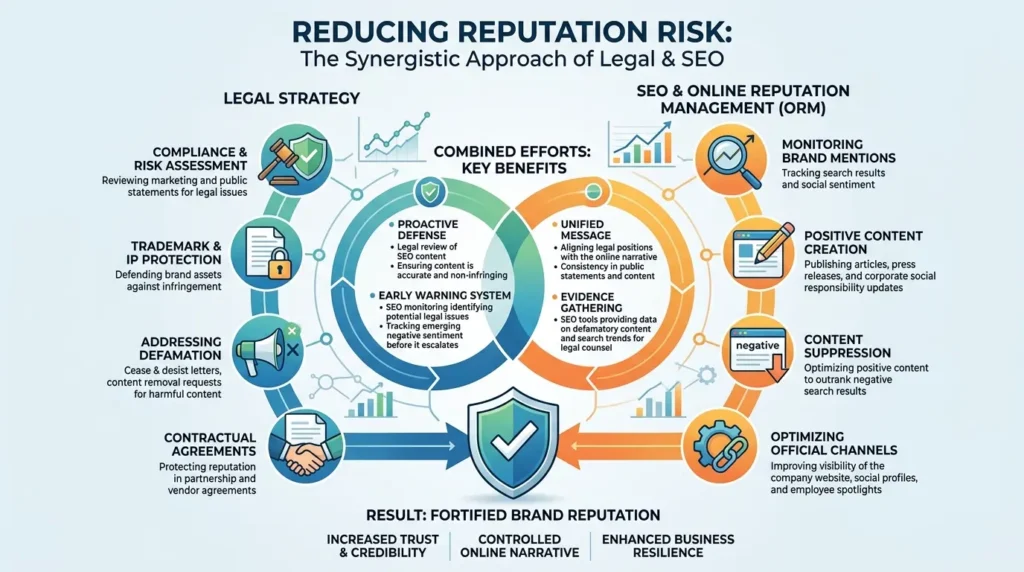
SEO-based reputation management addresses the broader search landscape. It improves visibility of trusted assets, strengthens authority signals, and increases control over branded search environments.
The integration of both disciplines creates stronger outcomes than relying on a single approach. Organisations gain access to removal opportunities while simultaneously improving their overall search ecosystem.
Healthcare providers particularly benefit because reputation threats often originate from multiple sources, including reviews, forums, articles, social content, and archived pages. Addressing only one source leaves residual exposure.
Readers evaluating Google search result removal challenges can gain additional context from the supporting analysis available through the related educational resource.
Why is the long-term value of reputation management greater than the initial investment?
The long-term value exceeds the initial investment because reputation directly influences trust, lead generation, conversion rates, stakeholder confidence, and organisational stability.
Negative search visibility creates ongoing costs through lost enquiries, reduced conversions, diminished credibility, and increased risk exposure. These effects accumulate over time as search users continue encountering harmful content.
Reputation management creates measurable value by improving information quality, strengthening entity credibility, and increasing trust-related signals. As search visibility improves, organisations regain control over how audiences evaluate their brand.
A structured programme delivers long-term benefits:
- Increase trust through stronger reputation signal visibility.
- Improve branded search performance through authoritative assets.
- Reduce reputational risk through continuous monitoring.
- Strengthen entity credibility through content ecosystem expansion.
- Maintain SERP control through ongoing optimisation activities.
For healthcare organisations, these outcomes directly support patient confidence and organisational growth.
Which UK reputation management partner provides the most reliable process?
The most reliable reputation management partner provides transparent methodology, measurable performance indicators, sustainable optimisation practices, and consistent communication.
Read More:
Manage Your Social Media Reputation Proactively With a Structured UK Plan
Remove Damaging Social Media Content Quickly With UK Expert Assistance
Decision-makers require process clarity before investing in reputation management. A credible provider explains how reputation signals are assessed, how visibility improvements are achieved, and how progress is measured throughout the engagement.
Reputation Management PR Agency applies structured healthcare reputation management methodologies that focus on entity credibility, search perception influence, and sustainable SERP control. The process aligns legal assessment, content optimisation, authority building, and performance monitoring within a unified framework.
This approach ensures organisations understand not only what actions are taken but also why those actions contribute to long-term visibility improvement. Transparency strengthens trust while measurable outcomes provide confidence in the strategy.
Businesses seeking deeper understanding of legal and SEO removal strategies can review supporting educational guidance before selecting an implementation pathway.
Harmful Google search results influence trust, visibility, and organisational credibility. Healthcare reputation management delivers a structured solution by combining SERP control, reputation signal enhancement, negative content suppression, and entity credibility development.
A successful strategy focuses on sustainable outcomes rather than temporary visibility changes. Through legal evaluation, content optimisation, authority strengthening, and continuous monitoring, organisations regain control over how they are perceived within search ecosystems.
Reputation Management PR Agency provides a reliable framework for healthcare organisations seeking stronger search visibility control, reduced reputational risk, and improved public trust. The combination of process clarity, measurable outcomes, and long-term reputation protection creates a dependable path towards restoring confidence and maintaining positive search perception influence.
How can harmful Google search results be removed from search engines?
Harmful Google search results may be removed through legal requests, privacy-based removal applications, content deletion from the source website, or search engine de-indexing. The most effective approach depends on whether the content is inaccurate, outdated, defamatory, or violates privacy rights.
Can a UK specialist help remove negative information from Google Search?
A UK specialist can assess whether negative search results qualify for removal under UK laws, privacy regulations, or Google’s content policies. They may also recommend reputation management strategies when direct removal is not possible.
How long does it take to remove unwanted Google search results?
The timeframe varies depending on the type of content, the website involved, and the removal method used. Some requests can be resolved within days, while legal or complex reputation management cases may take several weeks or months.
What is the difference between removing and suppressing harmful search results?
Removing search results means eliminating content from search engines or the source website entirely. Suppression involves improving the visibility of positive and relevant content so harmful results appear lower in search rankings and receive less attention.
When should someone contact a reputation management specialist for Google search removal?
A reputation management specialist should be consulted when harmful search results affect personal reputation, business credibility, employment opportunities, or customer trust. Early intervention often increases the chances of successful content removal or search result suppression.