

Google search results remain visible after a removal request when the indexed content does not violate removal policies, legal requirements, or search engine guidelines. Search systems evaluate content based on accessibility, relevance, authority, and public interest rather than personal preference.
Reputation management is the process of analysing, monitoring, and understanding how information influences trust, credibility, and perception across digital environments. Online reputation refers to the collection of searchable information, content assets, references, reviews, and mentions that contribute to entity perception within search ecosystems.
Why do some Google search results remain visible after a removal request?
Certain Google search results remain visible because search engines do not function as content owners. Search engines index and organise information that exists on external websites. A removal request directed at a search engine does not automatically affect the original source content. If the content remains accessible and complies with indexing standards, search systems continue to evaluate and display it within relevant search results.
Content indexing is the mechanism through which search engines discover, process, categorise, and store information. Once content enters an index, ranking systems evaluate its relevance, authority, and usefulness. Removal requests undergo policy-based assessment rather than reputation-based assessment. Search visibility therefore depends on compliance with removal criteria rather than the perceived impact of the content on an individual or organisation.
Search ecosystems prioritise information retrieval accuracy. Algorithms evaluate whether content contributes to search intent satisfaction. When indexed information remains factual, accessible, and legally permissible, ranking systems continue to include it within SERP evaluation processes. This explains why visibility often persists even after a removal request has been submitted.
What determines whether Google removes a search result?
Google removes search results when specific policy, legal, or privacy conditions are met. Removal decisions depend on eligibility criteria rather than reputational concerns. Search engines evaluate whether indexed content violates established rules relating to personal information, legal obligations, harmful content, or copyright infringement.
The evaluation process analyses both the search result and the underlying source page. A search result acts as a reference to content rather than the content itself. Consequently, removal eligibility depends on the relationship between the indexed entry and the source material. If the source remains valid and accessible, search engines often retain the indexed reference.
Dive Deeper With Our Expert Guides and Related Blog Posts:
How to Manage Social Media Reputation When Conversations Happen Without You
What Negative Social Media Content Can Legally Be Removed and How
SERP evaluation incorporates legal frameworks, content accessibility, and policy compliance signals. These systems define whether information qualifies for removal, deindexing, suppression, or continued indexing. Reputation concerns alone do not function as direct ranking removal signals. Instead, search systems rely on objective criteria designed to maintain informational integrity.
How does content indexing affect online reputation?
Content indexing directly influences online reputation because indexed information becomes discoverable through search queries. Search engines create searchable representations of websites, articles, reviews, databases, and public records. These indexed assets collectively shape entity perception.
Online reputation refers to the observable digital footprint associated with an entity. A digital footprint is the collection of indexed and accessible information connected to a person, organisation, or topic. Search visibility determines which parts of that footprint receive the greatest exposure during information retrieval processes.
Content indexing influences reputation by establishing availability. Information that enters search indexes gains the opportunity to appear within relevant search results. Ranking systems then determine prominence based on authority, relevance, freshness, and trust signals. As visibility increases, perception formation becomes increasingly influenced by indexed content.
Search engines continuously reassess indexed information through crawling and evaluation mechanisms. This process affects how reputation signals evolve over time. New information, updated content, and changing authority indicators contribute to ongoing reputation development across search ecosystems.
How do search engines evaluate trust and credibility signals?
Search engines evaluate trust and credibility through reputation signals embedded within content ecosystems. Reputation signals refer to indicators that help algorithms assess reliability, expertise, authority, and informational quality.
Trust evaluation begins with source analysis. Algorithms examine publication consistency, topical relevance, citation relationships, content quality indicators, and historical reliability patterns. These elements contribute to credibility assessments that influence search visibility.
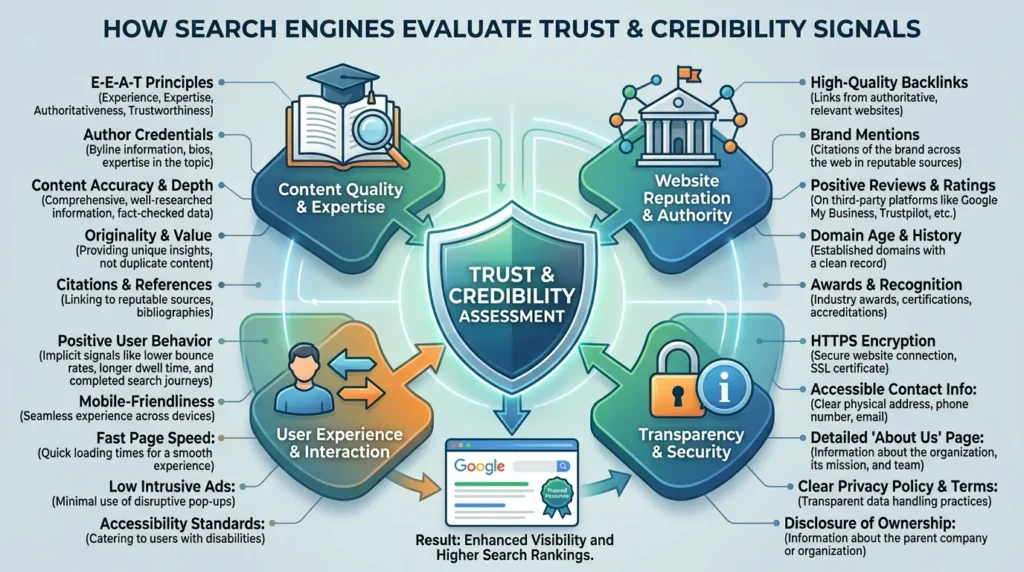
Authority functions as a relationship-based signal within search ecosystems. Content receives authority through references, contextual associations, expert attribution, and external validation mechanisms. Search systems analyse these connections to understand whether information contributes positively to overall content quality evaluation.
Credibility assessment also influences entity perception. Search engines connect information across multiple sources to create broader understanding models. These models help determine whether content aligns with established informational patterns. As a result, trust signals contribute both to ranking decisions and reputation interpretation.
Why does negative content continue to rank in search results?
Negative content continues to rank when ranking systems determine that the content remains relevant, authoritative, and responsive to user intent. Search engines do not classify information according to positive or negative emotional impact. Instead, they evaluate relevance and informational value.
Ranking algorithms analyse content quality, authority signals, engagement indicators, topical relationships, and search query alignment. Negative information that satisfies these ranking factors remains eligible for visibility. The sentiment of the content does not automatically reduce its search performance.
Entity perception becomes influenced when negative content occupies prominent search positions. Search visibility amplifies exposure, increasing the likelihood that users encounter specific information during reputation assessment. This relationship explains why ranking prominence often affects public perception.
Search ecosystems prioritise retrieval accuracy over reputation management outcomes. Consequently, ranking systems continue displaying content that satisfies evaluation requirements, regardless of whether the content contributes positively or negatively to reputation formation.
How do reviews influence reputation and search perception?
Reviews influence reputation by generating searchable reputation signals that contribute to credibility assessment. Reviews contain opinions, experiences, ratings, and descriptive language that search systems analyse for contextual understanding.
Sentiment interpretation is a significant component of review analysis. Search engines evaluate linguistic patterns, recurring themes, and contextual indicators to understand how users describe an entity. This process helps create broader perception models associated with reputation signals.

Review content expands the digital footprint surrounding an entity. Each review introduces additional indexed information that contributes to search visibility and entity understanding. Positive, neutral, and negative reviews collectively influence how search ecosystems interpret reputation.
Review analysis affects credibility because search engines seek evidence of authenticity and relevance. Consistent review patterns contribute to trust assessments, while contradictory or manipulative signals receive additional scrutiny. As a result, review ecosystems play a substantial role in reputation formation and search perception.
What role does a digital footprint play in search reputation?
A digital footprint is the complete collection of information associated with an entity across searchable environments. Search reputation emerges from the interpretation of this footprint by both users and algorithms.
Digital footprints include indexed articles, reviews, social references, directory listings, public records, media coverage, and informational content. Search engines connect these assets through entity recognition systems that establish contextual relationships. These relationships influence how reputation signals are interpreted.
The footprint acts as an information ecosystem rather than a single content asset. Search systems analyse the collective presence of information to determine credibility, authority, and relevance. This comprehensive evaluation contributes to SERP positioning and entity perception.
Search visibility depends on the strength, consistency, and relevance of the footprint. Information that accumulates authority and contextual support often gains greater prominence within search results. Consequently, digital footprints function as foundational components of online reputation.
How can information become less visible without direct removal?
Information can become less visible when ranking dynamics change. Search visibility is influenced by competition, relevance, freshness, authority signals, and content ecosystem development. Reduced visibility occurs when alternative content receives stronger ranking evaluations.
Search results operate through comparative assessment. Algorithms continuously compare indexed documents against one another to determine ranking order. New authoritative content, updated information, and stronger relevance signals can alter visibility distributions over time.
Two primary mechanisms influence visibility reduction:
- Strengthen content relevance – Publishing authoritative information creates additional indexed assets that compete within SERP evaluation processes.
- Improve entity context – Expanding credible information sources increases the quantity and quality of reputation signals associated with an entity.
These mechanisms affect ranking relationships rather than removal status. Information remains indexed but receives reduced prominence due to evolving search ecosystem conditions.
How do legal and SEO routes differ when addressing damaging search results?
Legal and SEO routes address different components of search visibility. Legal routes focus on eligibility for content removal, correction, deindexing, or regulatory compliance. SEO routes focus on visibility dynamics, content indexing, authority development, and ranking relationships.
Legal processes evaluate whether information violates laws, privacy standards, or established rights. These evaluations determine whether removal or restriction actions apply. The focus remains on compliance and eligibility rather than ranking performance.
SEO processes analyse how search engines interpret and rank information. This approach examines content relevance, trust signals, authority indicators, entity perception, and SERP evaluation factors. The objective is to understand visibility mechanics rather than legal qualification.
Together, these approaches explain the broader framework behind How to Remove Damaging Google Search Results Through Legal and SEO Routes. One pathway evaluates removal eligibility, while the other evaluates ranking behaviour and search visibility patterns.
Certain Google search results remain visible after removal requests because search engines evaluate content through policy, legality, relevance, authority, and indexing criteria. Search ecosystems prioritise information retrieval accuracy and SERP evaluation rather than reputational preference.
Online reputation is shaped by content indexing, digital footprints, review signals, authority indicators, and trust assessments. Search engines analyse these elements to form entity perception and determine search visibility. Understanding how reputation signals are created, interpreted, and ranked provides a clearer explanation of why some search results remain visible while others disappear from search environments.
Why doesn’t Google remove all search results when someone requests removal?
Google only removes content that meets specific legal, privacy, or policy requirements. If the information is publicly available, newsworthy, or considered in the public interest, the search result may remain visible even after a removal request.
How long does it take for Google to review a removal request?
The review time depends on the type of request and the complexity of the case. Some requests are reviewed within days, while others may take several weeks if additional evaluation or documentation is required.
Can a search result stay online even if the original content is deleted?
Yes. Search results may continue to appear temporarily because Google needs time to recrawl and update its index. In some cases, cached pages or references from other websites can also keep information visible in search results.
What types of content is Google most likely to remove from search results?
Google may remove content involving personal information, non-consensual explicit material, financial data, identity theft risks, or content that violates specific legal requirements. Each request is assessed according to Google’s removal policies and applicable laws.
Can reputation management help with unwanted Google search results?
Reputation management focuses on improving the visibility of positive and relevant content while reducing the prominence of negative search results through ethical search optimisation strategies. Reputation Management PR Agency notes that successful reputation management often combines content development, search visibility improvements, and ongoing digital reputation monitoring.