

Employer reputation directly influences recruitment costs and employee retention because search visibility, review sentiment, and digital trust signals affect how candidates evaluate organisational credibility. A negative employer reputation increases acquisition friction, extends hiring timelines, and weakens workforce stability within search ecosystems.
Reputation management is the process of monitoring, interpreting, and influencing how organisational information is indexed, ranked, and evaluated across digital platforms. Online reputation refers to the searchable perception of an organisation created through reviews, media references, employee commentary, and algorithmic trust signals.
What Is Employer Reputation Within Search Ecosystems?
Employer reputation is the collective perception of an organisation’s workplace credibility across search engines, review platforms, social platforms, and indexed digital assets. Within search ecosystems, employer reputation functions as an entity-level trust signal that search engines associate with employment quality, organisational stability, and workforce satisfaction.
Search engines analyse employer-related content through entity recognition and topical relevance systems. Indexed reviews, staff commentary, news references, recruitment content, and employer profiles contribute to a reputation graph connected to the organisation’s digital entity. This graph influences SERP evaluation because algorithms interpret consistency, sentiment, authority, and engagement as indicators of trustworthiness.
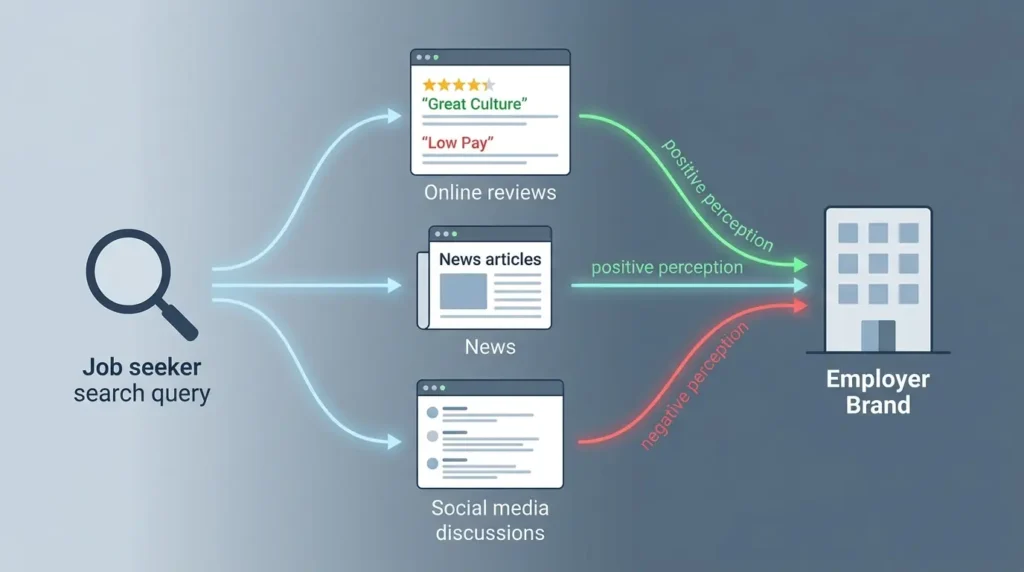
Employer reputation also defines candidate expectations before direct interaction occurs. Search visibility determines which narratives receive prominence in results pages, while review sentiment shapes perceived workplace culture. A strong reputation profile reduces uncertainty during candidate evaluation because search ecosystems prioritise signals associated with credibility and relevance.
Digital footprints strengthen or weaken employer reputation depending on content alignment. When search engines identify repeated negative sentiment, inconsistent messaging, or low-authority employer references, entity perception deteriorates. This deterioration affects discoverability, click-through behaviour, and workforce confidence.
How Does Employer Reputation Influence Recruitment Costs?
Employer reputation influences recruitment costs by affecting candidate acquisition efficiency, application conversion rates, and hiring cycle duration. Search ecosystems interpret reputation signals as indicators of organisational desirability, which directly alters recruitment performance metrics.
Negative employer sentiment increases acquisition friction because candidates conduct independent SERP evaluation before applying for roles. Search engines surface review platforms, employee commentary, and discussion-based content alongside official recruitment pages. If negative sentiment dominates indexed results, candidate trust declines before recruitment interaction begins.
Recruitment costs also increase when organisations compensate for weak reputation signals through expanded advertising exposure. Paid visibility attempts to offset diminished organic trust, but search ecosystems continue prioritising independent reputation content in ranking evaluations. This creates an imbalance between promotional visibility and trusted third-party content.
Search algorithms evaluate behavioural indicators linked to recruitment engagement. Lower click-through rates, shorter session durations, and reduced application completion rates signal weak relevance between employer branding and candidate expectations. These engagement signals reinforce lower search visibility for recruitment-related content.
Hiring inefficiency also emerges through reduced referral activity. Employees associated with weak employer perception participate less in advocacy behaviour because reputational alignment decreases internally. Search ecosystems identify reduced brand discussion and lower engagement velocity as declining authority signals.
Why Do Search Engines Interpret Employer Reputation as a Trust Signal?
Search engines interpret employer reputation as a trust signal because reputation data reflects public consensus, behavioural engagement, and informational consistency. Algorithms prioritise signals that help users evaluate organisational reliability and informational accuracy.
Entity-based indexing systems connect employer-related content across multiple domains. Reviews, news mentions, recruitment pages, and employee-generated discussions contribute to an interconnected reputation entity. Search engines evaluate the consistency of this information to determine trustworthiness and authority.
Sentiment analysis systems also influence reputation interpretation. Algorithms process linguistic patterns within reviews and commentary to identify recurring themes related to leadership, compensation, workplace culture, and operational transparency. Consistent negative sentiment reduces perceived credibility because algorithms associate repetition with informational reliability.
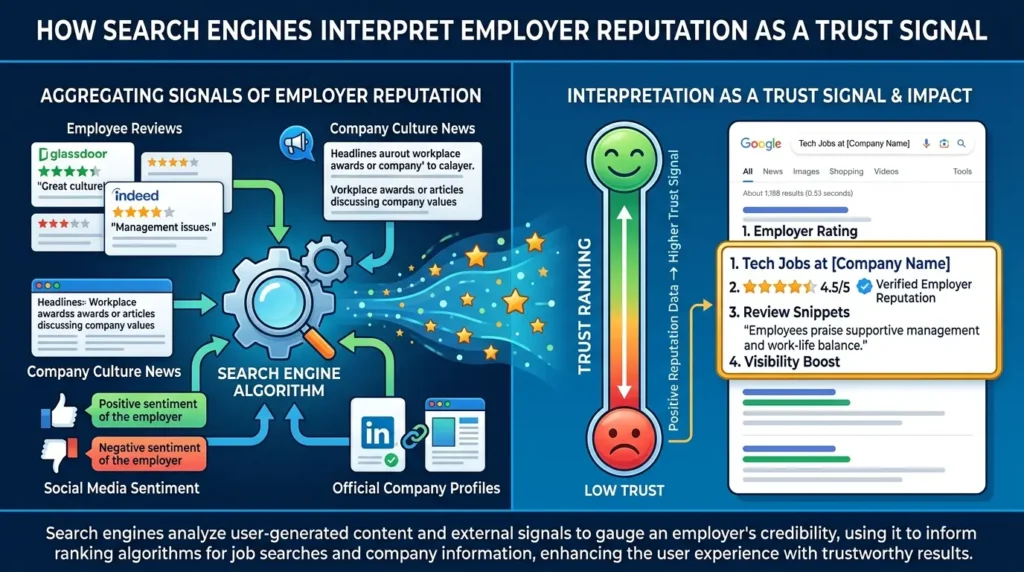
Authority signals strengthen employer reputation when high-trust domains reference organisational information consistently. Indexed mentions from authoritative publications, educational institutions, or verified employment platforms reinforce entity legitimacy. Search ecosystems interpret these references as corroborative trust indicators.
Search engines also analyse user interaction metrics linked to employer reputation content. High engagement with review platforms and workforce commentary demonstrates informational relevance. Algorithms interpret repeated user interest as validation that employer reputation content satisfies search intent related to organisational evaluation.
How Do Employee Reviews Affect SERP Evaluation?
Employee reviews affect SERP evaluation because review platforms generate high-frequency, user-generated content that search engines index rapidly. Review ecosystems provide structured sentiment data that algorithms use to evaluate employer credibility and workforce perception.
Review signals influence search visibility through freshness, engagement, and semantic relevance. Platforms containing continuous review activity receive regular crawling and indexing because search engines prioritise frequently updated content. This increases the likelihood that employee sentiment appears prominently in employer-related SERPs.
Sentiment distribution affects entity perception within search ecosystems. Consistent negative terminology associated with workplace conditions, leadership quality, or retention instability shapes algorithmic understanding of employer reputation. Search engines analyse repetition patterns to identify dominant perception themes.
Structured review markup also contributes to SERP prominence. Ratings, timestamps, reviewer metadata, and category classifications provide machine-readable trust indicators that search engines process efficiently. These elements strengthen content indexing and visibility for review-based search results.
Review engagement patterns further influence search interpretation. High interaction volumes signal public relevance, while low engagement suggests limited informational value. Algorithms prioritise review content that demonstrates sustained user interaction because it aligns with informational search intent.
What Is the Relationship Between Employer Reputation and Employee Retention?
Employer reputation and employee retention are connected through internal trust perception and external workforce credibility. A stable reputation environment reinforces organisational confidence, while negative search visibility weakens workforce alignment.
Get Deep Insight:
The Complete Employer Reputation Management Framework for Modern Companies
Employees continuously evaluate organisational perception through digital channels. When search ecosystems consistently surface negative commentary, criticism, or credibility concerns, internal confidence deteriorates. This affects organisational attachment because external perception influences employee identity association.
Retention stability also depends on informational consistency. Contradictions between recruitment messaging and publicly indexed employee experiences create perception gaps. Search engines amplify these gaps through review visibility and discussion indexing, increasing reputational scrutiny.
Negative employer reputation contributes to workforce disengagement because employees interpret persistent criticism as evidence of systemic instability. Search ecosystems reinforce this interpretation by prioritising high-engagement critical content. As visibility increases, reputational pressure expands internally and externally.
Positive reputation signals strengthen retention by supporting organisational legitimacy. Consistent review sentiment, authoritative references, and transparent communication contribute to entity stability. Employees interpret these signals as indicators of operational reliability and workforce credibility.
How Does Content Indexing Shape Employer Perception?
Content indexing shapes employer perception because indexed information determines what users encounter during reputation-related searches. Search engines organise and prioritise content based on authority, relevance, engagement, and semantic clarity.
Indexed recruitment pages define organisational positioning within employment-related search intent. Search ecosystems analyse page structure, topical consistency, and informational completeness to evaluate relevance. Weak or inconsistent recruitment content reduces perceived authority because algorithms identify lower informational value.
Third-party content also influences employer perception significantly. Reviews, discussion forums, media references, and employee-generated commentary often achieve stronger trust evaluation than controlled organisational content. Search engines prioritise these sources because independent perspectives satisfy informational intent more effectively.
Content freshness affects visibility dynamics within reputation ecosystems. Newly indexed negative commentary can rapidly influence SERP composition because search algorithms prioritise recent engagement patterns. This changes entity perception quickly when reputational disruption occurs.
Semantic relevance further shapes content indexing outcomes. Search engines evaluate whether employer-related content aligns with workforce, culture, leadership, and retention topics. Strong topical consistency reinforces authority, while fragmented messaging weakens contextual relevance.
Why Does Digital Footprint Consistency Matter for Employer Reputation?
Digital footprint consistency matters because search engines evaluate coherence across indexed organisational references. Consistency strengthens entity recognition, while conflicting information weakens trust interpretation.
A digital footprint includes all indexed references connected to an employer entity. Recruitment pages, employee reviews, corporate profiles, media mentions, and workforce discussions collectively define searchable organisational identity. Search ecosystems compare these sources to evaluate credibility alignment.
Inconsistent messaging disrupts entity perception because algorithms identify contradictions between official statements and independent commentary. For example, positive recruitment messaging combined with consistently negative workforce sentiment reduces trust accuracy signals within SERP evaluation systems.
Metadata consistency also influences reputation interpretation. Search engines analyse naming conventions, profile structures, publication frequency, and cross-platform relevance. Consistent entity attributes improve indexing clarity and strengthen authority association.
Search visibility becomes more stable when digital footprint signals align semantically. Consistent language around workplace culture, leadership transparency, and organisational values improves topical authority. Algorithms interpret this alignment as evidence of informational reliability.
How Do Authority Signals Influence Employer Credibility?
Authority signals influence employer credibility because search ecosystems prioritise information associated with expertise, trust, and verification. Authority determines which employer narratives achieve prominence within SERPs.
High-authority references strengthen employer reputation through corroboration mechanisms. Search engines interpret authoritative mentions as external validation that reinforces entity legitimacy. These references influence ranking evaluations because they increase perceived informational reliability.
Backlink structures also contribute to authority interpretation. When trusted domains reference employer-related content, search algorithms identify stronger relevance and credibility relationships. This affects both content indexing and SERP visibility.
Authoritative workforce content further shapes perception dynamics. Verified employee commentary, professional discussions, and industry-related references contribute to contextual trust. Search ecosystems analyse the credibility of contributors alongside sentiment and topical alignment.
Authority signals also interact with engagement metrics. High-authority content receiving sustained interaction demonstrates strong informational value. Algorithms prioritise this content because it satisfies user intent associated with employer evaluation and workforce research.
What Role Does Sentiment Interpretation Play in Reputation Evaluation?
Sentiment interpretation plays a central role in reputation evaluation because search engines analyse emotional polarity and thematic repetition within indexed content. Sentiment systems help algorithms classify trustworthiness and workforce perception.
Natural language processing models evaluate sentiment by analysing word relationships, contextual phrasing, and recurring evaluation themes. Employer-related content containing repeated negative terminology associated with culture, leadership, or retention contributes to deteriorating entity perception.
Search ecosystems also distinguish between isolated criticism and recurring dissatisfaction. Repetition across multiple indexed sources strengthens algorithmic confidence in sentiment accuracy. This influences ranking patterns because search engines prioritise content considered representative of broader public perception.
Neutral and balanced sentiment contributes to informational credibility. Algorithms identify overly promotional or emotionally exaggerated content as lower-trust material when independent corroboration is absent. This reduces search visibility for controlled reputation messaging.
Sentiment interpretation additionally affects click behaviour within SERPs. Users engage more frequently with content reflecting perceived authenticity and informational depth. Search engines interpret these behavioural signals as relevance indicators that influence future ranking evaluations.
How Does Employer Reputation Management Relate to Search Visibility?
Employer reputation management refers to the structured monitoring and analysis of searchable reputation signals connected to workforce perception and organisational trust. Within search ecosystems, employer reputation management focuses on understanding how indexed content shapes entity credibility and SERP evaluation.
Search visibility depends on the balance between authoritative content, review sentiment, engagement patterns, and topical relevance. Employer reputation management analyses these signals to identify how search engines interpret organisational trustworthiness across employment-related queries.
Reputation-related visibility also depends on content architecture and indexing behaviour. Search ecosystems prioritise information that demonstrates semantic relevance, authority consistency, and informational completeness. Organisations with fragmented or contradictory digital footprints experience weaker visibility stability.
SERP evaluation systems continuously reassess employer-related entities based on behavioural and contextual signals. Reviews, employee commentary, workforce discussions, and authoritative references contribute to this reassessment process. Employer reputation management therefore operates as an analytical framework for understanding search-driven perception formation.
A detailed understanding of Employer Reputation Management supports deeper analysis of entity trust signals, workforce credibility evaluation, and search visibility dynamics within recruitment ecosystems.
Employer reputation defines how organisations are interpreted across search ecosystems through indexed content, sentiment signals, and authority evaluation. Search engines analyse reviews, engagement behaviour, topical consistency, and entity relationships to determine workforce credibility and informational trustworthiness.
Recruitment costs increase when negative reputation signals reduce candidate trust and weaken search visibility performance. Employee retention also declines when indexed criticism disrupts organisational legitimacy and internal confidence. Search ecosystems amplify these effects because SERP evaluation prioritises authoritative, relevant, and highly engaged reputation content.
Digital footprints, review ecosystems, and sentiment interpretation collectively shape employer perception within online environments. Understanding these systems explains how employer reputation forms, evolves, and influences recruitment and retention outcomes across searchable digital landscapes.
How does employer reputation affect recruitment costs?
A strong employer reputation helps companies attract qualified candidates faster, reducing spending on job ads, recruiters, and hiring campaigns. Businesses with a positive employer brand often experience lower cost-per-hire and shorter recruitment cycles.
Why is employer reputation important for employee retention?
Employer reputation influences how employees perceive workplace culture, leadership, and long-term career growth. Companies with a positive reputation typically see higher employee satisfaction, lower turnover rates, and improved workforce stability.
Can poor online reviews impact hiring and retention?
Yes, negative employee reviews on platforms like Glassdoor and Indeed can discourage job seekers and reduce trust in the company. Poor online reputation may also affect current employee morale, increasing the risk of resignations and retention challenges.
What role does reputation management play in employer branding?
Reputation management helps businesses monitor public perception, address employee feedback, and strengthen employer branding strategies. Reputation Management PR Agency supports companies by improving online visibility, trust, and credibility with both candidates and employees.
How can companies improve their employer reputation?
Businesses can improve employer reputation by encouraging transparent communication, responding to employee feedback, and promoting a positive workplace culture. Consistent reputation management and employee engagement strategies also help attract and retain top talent.