

Reputation management is the process of defining, analysing, and influencing how organisations are interpreted across digital environments and search ecosystems.
Online reputation refers to the collection of indexed signals, sentiment indicators, entity associations, and search results that shape public perception of an employer.
What Is Employer Reputation Management?
Employer reputation management is the structured evaluation and governance of how an organisation is perceived as a workplace across search engines, review platforms, social networks, and indexed digital content. Within search ecosystems, employer reputation refers to the credibility and trust signals attached to an employer entity through publicly accessible information.
Search engines interpret employer reputation through entity relationships, review sentiment, content consistency, engagement signals, and authority references. Algorithms analyse how frequently an organisation is associated with employment-related topics such as workplace culture, leadership quality, staff retention, recruitment transparency, and employee satisfaction. These associations contribute to entity perception within search engine results pages (SERPs).
Employer reputation management also defines how content is prioritised and interpreted by users during recruitment-related searches. Search visibility directly influences employer perception because users evaluate rankings as indicators of relevance and trustworthiness. Indexed employee reviews, news coverage, discussion forums, and corporate communications collectively contribute to reputation signals that shape search interpretation.
A structured reputation framework separates controlled content from uncontrolled content. Controlled content includes official career pages, policy documentation, and published organisational statements. Uncontrolled content includes employee reviews, third-party commentary, media analysis, and discussion-based platforms. Search engines evaluate both categories simultaneously when forming entity understanding.
How Do Search Engines Interpret Employer Reputation?
Search engines interpret employer reputation by analysing relevance, authority, sentiment, engagement, and consistency across indexed content. Reputation signals become measurable through semantic relationships attached to the employer entity.
Algorithms evaluate whether an organisation demonstrates topical consistency across employment-related subjects. Consistent references to recruitment standards, organisational ethics, workforce transparency, and employee experiences strengthen entity clarity. Inconsistent or contradictory information weakens trust evaluation and creates fragmented entity perception.
Content indexing plays a central role in employer reputation interpretation. Search engines continuously crawl career pages, employee reviews, employer directories, news publications, and social media references. Indexed content becomes part of the organisation’s searchable reputation footprint. Search ranking systems then evaluate which sources provide the strongest contextual relevance and authority.
Sentiment analysis also contributes to SERP evaluation. Natural language processing systems identify positive, neutral, and negative sentiment patterns across reviews and discussions. Repeated negative language associated with employment practices creates stronger negative entity associations over time. Repeated positive references to transparency, career progression, and leadership credibility reinforce favourable reputation signals.
Search engines additionally analyse behavioural data connected to reputation content. High click-through rates, extended dwell time, and recurring branded searches indicate user interest and relevance. These behavioural indicators contribute to content prioritisation within search visibility systems.
Why Does Employer Reputation Influence Search Visibility?
Employer reputation influences search visibility because search engines prioritise authoritative and trustworthy entities within competitive result environments. Reputation signals contribute directly to ranking evaluation and content prominence.
Search systems interpret trusted organisations as more reliable information sources. Strong employer reputation signals improve the likelihood of career pages, organisational profiles, and recruitment content appearing prominently within SERPs. Weak reputation signals reduce perceived authority and limit visibility across employment-related queries.
Entity trust also affects knowledge graph interpretation. Search engines connect organisations with related attributes such as industry expertise, employee sentiment, leadership references, and workplace credibility. These associations influence how search engines categorise and display employer entities within search interfaces.
Review sentiment contributes to search ranking dynamics through perceived reliability. Consistent negative reviews increase the prominence of criticism-oriented search results because algorithms prioritise content receiving high engagement and relevance signals. Positive review ecosystems support broader visibility for authoritative employer-controlled content.
Search visibility additionally shapes perception independently from content quality. Users often interpret highly ranked results as indicators of legitimacy and organisational trust. SERP positioning therefore functions as both a technical ranking outcome and a perception mechanism within employer reputation systems.
What Are Employer Reputation Signals Within Search Ecosystems?
Employer reputation signals are measurable indicators that search engines use to evaluate organisational credibility, authority, and trustworthiness. These signals originate from indexed content, user behaviour, structured data, and external references.
How Do Review Signals Affect Employer Reputation?
Review signals define how employee sentiment becomes quantifiable within search ecosystems. Search engines evaluate review frequency, sentiment consistency, reviewer credibility, and topical relevance.
Large volumes of negative reviews associated with recurring employment issues create persistent negative entity associations. Algorithms interpret repetition as evidence of credibility because consistent themes strengthen semantic relevance. Positive reviews associated with transparent recruitment processes and workplace stability reinforce trust-oriented signals.
Review recency also affects search interpretation. Newly indexed reviews receive stronger relevance weighting because search engines prioritise freshness in employment-related queries. Outdated reviews contribute less influence unless they remain strongly linked through engagement and citation patterns.
Structured review data additionally improves algorithmic interpretation. Platforms using schema markup provide search engines with clearer contextual understanding regarding ratings, employment categories, and review topics. Structured data enhances indexing accuracy and entity relationship mapping.
How Do Authority Signals Define Employer Credibility?
Authority signals refer to indicators demonstrating organisational legitimacy and expertise across digital environments. Search engines analyse backlinks, citations, media references, and authoritative mentions when evaluating employer entities.
High-authority references strengthen employer credibility because search algorithms interpret external validation as evidence of trustworthiness. Repeated citations from respected industry publications improve entity confidence scores within search ecosystems. Weak or irrelevant references reduce contextual relevance and dilute authority perception.
Topical authority also influences employer reputation interpretation. Organisations consistently associated with workforce development, professional standards, and recruitment transparency demonstrate stronger semantic alignment within employment-related search categories. Search engines prioritise entities demonstrating subject-matter consistency over fragmented or inconsistent content ecosystems.
Authority signals further contribute to reputation resilience. Strong authoritative associations reduce the visibility impact of isolated negative content because search engines interpret established entities as more contextually reliable.
How Does Content Shape Employer Perception Online?
Content shapes employer perception by controlling how organisational information is indexed, ranked, and interpreted across search ecosystems. Every indexed page contributes to entity understanding and reputation construction.
Search engines analyse semantic consistency across published content. Career pages, recruitment policies, leadership communications, and organisational documentation collectively define employment-related entity perception. Contradictory messaging weakens trust evaluation because algorithms prioritise coherence and contextual alignment.
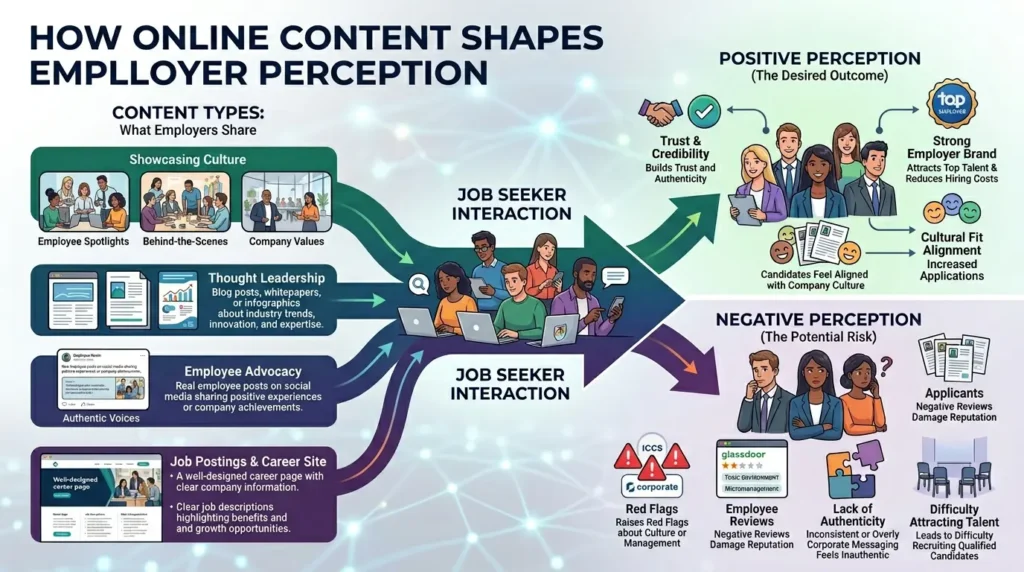
Content hierarchy also influences reputation interpretation. High-authority pages receiving substantial engagement gain stronger search visibility and greater influence over employer perception. Low-quality or duplicated content weakens indexing efficiency and reduces entity clarity.
Search ecosystems interpret language patterns as reputation indicators. Frequent associations with transparency, accountability, professional development, and workforce stability reinforce positive trust signals. Repeated references to disputes, turnover, or operational inconsistency strengthen negative semantic associations.
Content freshness additionally affects reputation evaluation. Recently updated organisational information demonstrates active maintenance and relevance. Stagnant or outdated employment content weakens perceived reliability because search engines prioritise updated information environments.
What Is the Relationship Between SERPs and Employer Trust?
SERPs function as reputation evaluation environments where users interpret search rankings as indicators of credibility and legitimacy. Employer trust is heavily influenced by which content appears most prominently within search results.
Search engines rank content according to relevance, authority, engagement, and trust signals. Users subsequently interpret these rankings as external validation mechanisms. High-ranking criticism-oriented content creates immediate negative perception because visibility amplifies reputational exposure.
Branded search queries particularly influence employer trust formation. Searches involving organisational names combined with employment-related modifiers such as “reviews”, “culture”, or “salary” produce reputation-sensitive SERPs. Search engines prioritise content demonstrating strong engagement and relevance within these query categories.

SERP composition also shapes perception through content diversity. Search results containing balanced authoritative content create stronger trust evaluation than fragmented results dominated by discussion forums or isolated complaints. Search ecosystems therefore influence not only visibility but also interpretative credibility.
Featured snippets, review panels, and indexed summaries further affect reputation interpretation. These search features condense information into highly visible interfaces that users evaluate rapidly. Search engines effectively transform reputation signals into visible perception frameworks through SERP architecture.
How Does Digital Footprint Affect Employer Reputation?
Digital footprint refers to the cumulative collection of indexed organisational information distributed across digital environments. Employer reputation becomes measurable through the scale, consistency, and sentiment of this footprint.
Every indexed interaction contributes to digital footprint expansion. Recruitment posts, employee reviews, press coverage, policy documentation, and social media discussions collectively define the searchable presence of an employer entity. Search engines aggregate these signals into broader reputation analysis models.
A fragmented digital footprint weakens entity clarity because search systems struggle to establish consistent contextual relationships. Consistent messaging across platforms improves semantic understanding and strengthens search visibility. Inconsistent information generates ambiguity within entity evaluation systems.
Digital permanence also influences employer reputation management. Indexed content remains searchable long after publication because search engines preserve archived and linked references. Negative sentiment therefore retains influence when connected through backlinks, citations, or recurring search behaviour.
Search ecosystems additionally evaluate digital footprint breadth. Organisations with comprehensive and structured informational ecosystems demonstrate stronger credibility than entities with limited indexed presence. Depth of indexed information contributes directly to search engine trust interpretation.
Why Does Sentiment Analysis Matter in Employer Reputation?
Sentiment analysis matters because search engines use linguistic interpretation systems to evaluate emotional polarity and contextual meaning within indexed content. Employer reputation is strongly influenced by aggregated sentiment patterns.
Natural language processing systems identify recurring positive or negative associations connected to employer entities. Positive terminology linked to workplace conditions, organisational transparency, and employee experience reinforces favourable perception signals. Negative terminology linked to disputes, dissatisfaction, or instability strengthens adverse reputation associations.
Sentiment consistency influences algorithmic confidence. Repeated negative sentiment across multiple independent sources creates stronger credibility weighting than isolated criticism. Search engines prioritise patterns demonstrating semantic repetition and contextual reliability.
Contextual sentiment interpretation also affects content ranking. High-engagement negative discussions frequently achieve stronger search visibility because algorithms prioritise relevance and interaction metrics. Search systems interpret user engagement as evidence of informational value within reputation-related queries.
Sentiment analysis further contributes to entity relationship mapping. Search engines associate organisations with recurring emotional themes, which then influence future SERP evaluation and content categorisation. Reputation therefore becomes both a linguistic and algorithmic construct within digital ecosystems.
How Do Search Ecosystems Define Organisational Trust?
Search ecosystems define organisational trust through the aggregation of authority signals, content consistency, engagement metrics, sentiment analysis, and entity relationships. Trust becomes measurable through observable digital behaviour and indexed informational structures.
Algorithms evaluate whether organisational information demonstrates transparency, consistency, and contextual reliability. Contradictory or misleading information weakens trust interpretation because search systems prioritise coherence across indexed sources. Consistent informational ecosystems strengthen entity confidence.
Engagement metrics also contribute to trust evaluation. Users interacting positively with organisational content indicate relevance and informational value. Search engines interpret prolonged engagement and recurring branded searches as indicators of credibility and user trust.
Technical optimisation further affects trust perception. Structured data, secure website architecture, and accurate indexing improve search engine interpretation efficiency. Technical clarity supports stronger entity understanding within reputation frameworks.
Search ecosystems ultimately define trust through cumulative evidence rather than isolated signals. Employer reputation emerges from interconnected digital references, semantic consistency, and sustained authority evaluation across indexed environments.
Employer reputation management defines how organisations are interpreted within search ecosystems through indexed content, authority signals, sentiment analysis, and SERP visibility. Search engines evaluate employer entities using measurable indicators connected to credibility, consistency, engagement, and contextual trust.
Digital reputation systems function through continuous content indexing and semantic interpretation. Review signals, authority references, digital footprint consistency, and sentiment patterns collectively shape employer perception within search results. SERPs therefore operate as both information retrieval systems and reputation evaluation environments.
Understanding employer reputation requires analysing how algorithms process trust signals and how users interpret visible search content. Employer perception is formed through the interaction between indexed information, search visibility, and entity-based credibility assessment within modern digital ecosystems.
What is employer reputation management, and why is it important?
Employer reputation management is the process of monitoring, improving, and protecting how a company is perceived by employees, job seekers, and the public. A strong employer reputation helps businesses attract top talent, improve employee retention, and build long-term trust in competitive industries.
How can companies improve their employer brand reputation?
Companies can improve their employer brand reputation by encouraging employee feedback, responding to online reviews, maintaining transparent communication, and promoting a positive workplace culture. Consistent employer branding across job platforms and social media also strengthens credibility with potential candidates.
Why do online employee reviews affect hiring success?
Online employee reviews on platforms like Glassdoor and Indeed influence how candidates evaluate workplace culture, leadership, and employee satisfaction. Negative reviews can reduce applicant trust, while positive feedback can increase recruitment success and employer credibility.
What are the key components of an employer reputation management framework?
An employer reputation management framework typically includes online review monitoring, employee engagement strategies, crisis communication planning, employer branding, and reputation analysis. These elements help companies maintain a consistent and trustworthy employer image across digital channels.
How does employer reputation management support business growth?
Effective employer reputation management supports business growth by improving talent acquisition, reducing turnover costs, and increasing employee productivity. Reputation Management PR Agency emphasizes that companies with strong workplace reputations often experience better customer trust and stronger overall brand performance.