

Google content removal requests achieve higher acceptance rates when the request aligns with documented policy categories, includes verifiable evidence, and demonstrates measurable reputational harm linked to search visibility. Weak requests fail because they rely on opinion, incomplete evidence, or reputation concerns that fall outside search engine policy thresholds.
Reputation management strategies differ based on the type of harmful content, the authority of the publishing source, and the persistence of indexed search results. Online reputation control methods are evaluated through search ranking influence, sentiment distribution, entity credibility, and the long-term sustainability of SERP composition changes.
Which Reputation Management Approaches Compare Most Effectively With Google Content Removal Requests?
Google content removal requests operate as a reactive reputation management mechanism, while content enhancement and suppression strategies operate as proactive visibility control systems. These approaches differ in speed, policy dependence, and search ecosystem impact.
Content removal is the process of requesting deindexation or restriction of content based on legal, privacy, policy, or harmful-content criteria. The mechanism operates by evaluating whether indexed material violates Google’s published removal standards, including personally identifiable information, explicit exploitation content, defamation thresholds in specific jurisdictions, or outdated legal records. Acceptance depends on evidence quality, policy alignment, and the authority of supporting documentation. The primary advantage is immediate visibility reduction when approval occurs. The limitation is low scalability because each URL requires separate policy qualification.
Content suppression is the process of reducing harmful search visibility through stronger competing assets. The mechanism operates by increasing the ranking authority of positive or neutral content to displace negative search results lower within the SERP. This strategy strengthens entity credibility because search engines interpret consistent positive mentions, authoritative citations, and structured digital assets as stronger reputation signals. Suppression achieves broader long-term influence than isolated removals. However, suppression does not eliminate source content and requires sustained publishing activity.
Content enhancement focuses on improving sentiment distribution rather than removing negative material. The method operates through authoritative publishing, structured entity optimisation, schema implementation, and trust-focused informational assets. Search engines interpret this activity as evidence of topical relevance and entity stability. Enhancement strategies influence brand perception indirectly because users encounter a more balanced search environment. The limitation is slower measurable impact compared with direct removal actions.
The effectiveness comparison depends on the severity of reputational exposure. Removal strategies perform effectively against privacy violations or inaccurate indexed content. Suppression strategies perform effectively against isolated negative press or criticism that lacks dominant authority. Enhancement strategies perform effectively when long-term trust reconstruction becomes the primary objective.
Read More:
Which Types of Content Google Will Remove and Which It Will Not
How to Remove Damaging Google Search Results Through Legal and SEO Routes
How Do Search Engines Evaluate Google Content Removal Requests?
Search engines evaluate removal requests through policy interpretation, evidence validation, and risk assessment relating to information integrity. The process prioritises compliance over reputational preference.
Google evaluates removal eligibility using defined categories rather than subjective reputation concerns. The mechanism compares submitted evidence against policy frameworks that include personal data exposure, financial fraud risk, copyright violations, explicit non-consensual imagery, and court-verified legal outcomes. Requests that lack direct policy alignment experience rejection because search engines prioritise informational accuracy and public accessibility. Reputation damage alone does not function as sufficient removal criteria.
Entity credibility influences assessment quality because search ecosystems analyse consistency across external references, authoritative citations, and supporting documentation. A request supported by legal documentation, verified identity evidence, and timestamped source analysis demonstrates stronger evidential reliability. Weak submissions containing emotional language or unsupported accusations reduce trustworthiness signals within the review process.
Search engines also evaluate content context. Indexed pages connected to public interest, journalism, professional regulation, or legal reporting receive stronger retention protection. This evaluation framework explains why healthcare-related complaints, disciplinary records, or investigative reporting maintain persistent search visibility. Healthcare reputation management requires stricter evidential alignment because search engines interpret healthcare-related information as high-trust public-interest material within YMYL evaluation systems.
Algorithmic interpretation further influences removal feasibility. Search engines classify content according to relevance, authority, freshness, and user utility. Removal requests targeting highly authoritative domains face lower approval likelihood because those domains contribute strong trust signals within search ecosystems. Requests targeting duplicated or low-authority content achieve higher success rates because removal introduces lower informational disruption.
What Evidence Strengthens a Google Content Removal Request Most Effectively?
Structured evidence improves acceptance rates because search engines evaluate factual validation rather than reputational discomfort. Evidence quality directly affects policy qualification.
Identity verification is the foundational evidence layer. The mechanism operates by proving the affected entity possesses legitimate authority to request removal. Government-issued identification, legal representation documentation, or verified organisational ownership establishes authenticity. Requests lacking verified identity increase rejection risk because search engines require clear accountability within policy enforcement systems.

Legal evidence provides stronger authority weighting than descriptive explanations. Court orders, settlement documentation, regulatory findings, and privacy law references establish measurable policy alignment. Search engines interpret legal evidence as externally validated factual confirmation rather than subjective interpretation. This distinction strengthens removal eligibility significantly.
Technical evidence also influences evaluation quality. Screenshots, indexed URL copies, cached search result references, and archived publication timestamps establish verifiable traceability. Search engines compare these elements against live indexed data to assess consistency. Inaccurate URL submissions or incomplete indexing evidence weaken request reliability because the review system cannot validate the precise harmful content location.
Contextual explanation strengthens interpretation accuracy when it remains factual and policy-focused. Effective requests explain the direct relationship between the content and the applicable removal category. Weak requests focus on emotional impact or general reputational concerns without establishing policy relevance. Search systems evaluate structured factual reasoning more effectively than persuasive language.
A stronger evidence framework includes:
- Identify the exact indexed URL and cached search result reference to improve traceability validation.
- Provide legal or regulatory documentation that confirms policy category alignment.
- Demonstrate factual inaccuracies using timestamped contradictory evidence from authoritative sources.
- Explain measurable privacy or reputational harm through objective search visibility analysis.
- Attach identity verification documents that confirm ownership or representation authority.
How Does Content Removal Compare With Content Suppression in Long-Term Reputation Management?
Content removal delivers direct visibility reduction, while content suppression delivers broader SERP restructuring over time. These strategies differ in sustainability, scalability, and dependency on external approval.
Removal strategies operate through search engine intervention. The mechanism depends on successful policy interpretation and administrative approval. When approval occurs, harmful visibility decreases rapidly because indexed pages lose discoverability. The strategic limitation is instability because publishers retain the ability to republish modified versions of removed material. Removal therefore functions as an interruption mechanism rather than a permanent reputation reconstruction system.
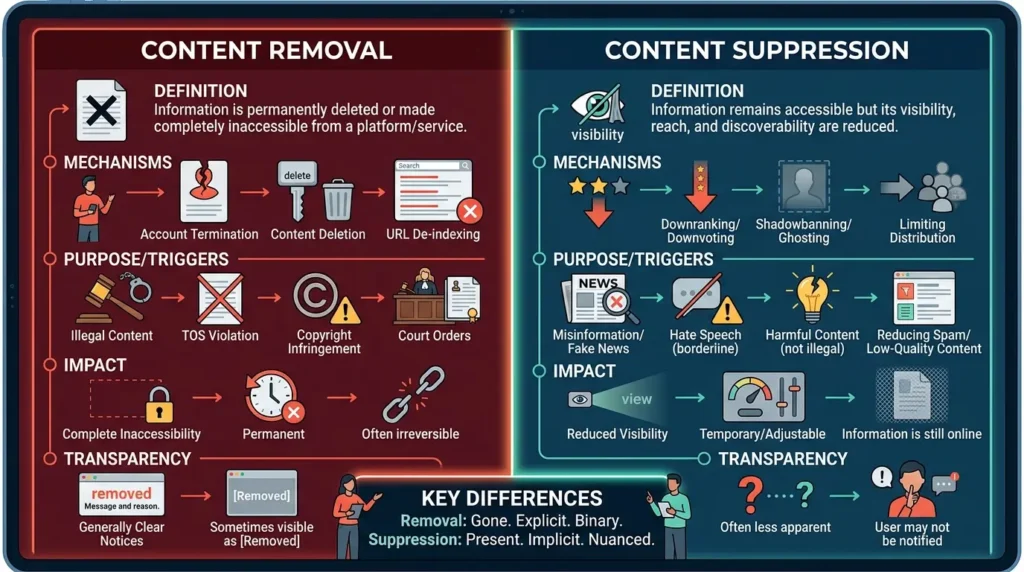
Suppression strategies operate through ranking displacement. The mechanism strengthens positive or neutral content authority until harmful pages lose first-page visibility. Search engines interpret frequent authoritative publishing, structured entity consistency, and external citation growth as indicators of relevance and trust. This process changes sentiment distribution across branded search queries.
Suppression demonstrates stronger long-term sustainability because it does not depend on policy enforcement. Organisations maintain direct control over publishing activity, technical optimisation, and authority-building strategies. The limitation is resource intensity because suppression requires continuous content production, technical SEO alignment, and authority acquisition.
Search ranking influence differs substantially between both approaches. Removal eliminates indexed exposure directly when successful. Suppression changes user interaction probability by reducing harmful content prominence. Studies in click-through behaviour consistently show that lower-ranking negative results receive substantially reduced engagement compared with top-three search placements. This behavioural shift explains why suppression remains a central component within reputation management frameworks.
Healthcare reputation management environments often require combined implementation. Healthcare-related criticism frequently remains protected under public-interest standards, making direct removal difficult. Suppression and entity enhancement therefore operate as more sustainable long-term reputation stabilisation mechanisms within healthcare SERPs.
Which Limitations Reduce Google Content Removal Acceptance Rates?
Policy mismatch represents the most common limitation because reputation concerns alone do not satisfy removal standards. Search engines prioritise informational legitimacy over image control.
Requests fail when users misunderstand the distinction between harmful content and policy-violating content. Negative reviews, professional criticism, investigative reporting, and legally accurate commentary often remain protected within search ecosystems. Google evaluates whether content breaches explicit removal standards rather than whether the content damages perception. This structural limitation reduces approval rates for reputation-focused requests lacking legal or privacy foundations.
Insufficient evidence weakens request authority. Search systems evaluate documentation quality, URL precision, and factual consistency during manual review processes. Missing screenshots, incorrect indexed links, or unsupported claims reduce credibility signals. Weak evidence increases administrative uncertainty, which leads to rejection because search engines avoid erroneous deindexation.
Jurisdictional inconsistencies also influence outcomes. Privacy regulations differ across regions, affecting legal interpretation standards. European data protection frameworks support broader removal eligibility under specific conditions, while other jurisdictions prioritise public accessibility and press freedom. International organisations therefore experience inconsistent outcomes across regional search ecosystems.
Authority imbalance further limits success rates. Highly authoritative publishers maintain stronger trust signals within search algorithms and manual review frameworks. Content published by established news organisations, government databases, or regulatory institutions receives stronger retention protection because search engines interpret those domains as high-value informational assets.
Scalability limitations affect operational efficiency. Manual removal requests require individual assessment for each indexed URL. Large-scale reputational crises involving syndicated content, duplicated reporting, or multi-platform distribution therefore exceed the practical efficiency of isolated removal workflows. Broader reputation management systems become necessary to address distributed visibility exposure.
How Do Reactive and Organic Reputation Strategies Influence Search Perception Differently?
Reactive strategies reduce immediate reputational threats, while organic strategies strengthen long-term entity trust and informational authority. Search perception changes according to consistency, authority, and sentiment stability.
Reactive reputation management focuses on rapid visibility control. The mechanism includes removal requests, legal notices, emergency suppression campaigns, and crisis-response publishing. Search engines interpret reactive activity as abrupt changes within the information environment. These strategies reduce short-term reputational volatility effectively, especially during high-visibility incidents or viral search exposure.
Organic reputation management operates through sustained authority development. The mechanism includes structured informational publishing, expert content creation, digital footprint optimisation, and authoritative citation acquisition. Search engines interpret this activity as long-term entity consistency. Organic strategies therefore strengthen entity credibility more effectively than reactive interventions alone.
Search perception differs because user interaction patterns respond to SERP composition. Reactive systems reduce exposure to harmful results quickly when successful. Organic systems improve the overall balance of visible reputation signals across search environments. This distinction matters because users evaluate trust through cumulative informational exposure rather than isolated search results.
Sentiment distribution analysis demonstrates the structural difference clearly. Reactive strategies reduce negative sentiment concentration. Organic strategies expand positive and neutral sentiment representation. Search ecosystems reward balanced, authoritative informational environments because algorithmic systems prioritise expertise, trustworthiness, and relevance consistency.
The comparative limitation of reactive systems is dependency on external triggers. Organisations act only after reputational exposure becomes visible. Organic systems reduce vulnerability proactively because stronger digital footprints dilute future negative search influence more effectively.
What Strategic Factors Determine the Most Sustainable Reputation Management Approach?
Sustainable reputation management depends on authority diversification, entity consistency, and controlled sentiment distribution across searchable digital assets. Short-term tactical actions alone fail to stabilise long-term search perception.
Search ecosystems evaluate entities continuously through linked references, topical authority, user engagement signals, and publication consistency. Sustainable strategies therefore integrate technical SEO, digital PR, structured content optimisation, and selective removal interventions into a unified visibility framework. Isolated tactics produce fragmented outcomes because search engines assess overall informational reliability rather than individual reputation actions.
Risk exposure analysis determines strategic selection. Removal-heavy strategies create dependency on policy interpretation and external approval systems. Suppression-heavy strategies require ongoing authority investment. Enhancement-heavy strategies demand sustained editorial consistency and technical optimisation. Effective frameworks balance these mechanisms according to reputational severity, legal exposure, and search visibility concentration.
Scalability also determines sustainability. Manual removals operate effectively for isolated incidents but perform poorly during distributed reputational crises. Entity enhancement scales more efficiently because authoritative assets influence broader SERP composition across multiple queries simultaneously. Search engines reward this consistency through stronger topical relevance and entity association signals.
Measurement frameworks remain essential for evaluating effectiveness. Reputation management systems are evaluated through branded query sentiment, visibility share, ranking displacement, entity association changes, and authority distribution across indexed assets. These metrics provide measurable evidence of perception shifts within search ecosystems.
Strategic comparison therefore demonstrates that removal requests function most effectively as targeted interventions within broader reputation management systems. Long-term search stability depends on sustained authority building, structured content ecosystems, and balanced sentiment representation rather than isolated deindexation efforts alone.
Conclusion
Google content removal requests achieve stronger acceptance rates when supported by policy-aligned evidence, verified documentation, and precise indexed URL analysis. Search engines evaluate removal eligibility through legal relevance, entity credibility, and informational integrity rather than reputational preference alone.
The comparison between removal, suppression, and enhancement strategies demonstrates significant differences in sustainability, scalability, and search ranking influence. Removal provides direct visibility reduction but depends on external approval systems. Suppression reshapes SERP composition through ranking displacement. Enhancement strengthens long-term entity credibility through authoritative digital footprint optimisation.
Reactive and organic reputation management systems also influence search perception differently. Reactive strategies reduce immediate visibility threats, while organic strategies stabilise sentiment distribution and strengthen trust signals over time. Sustainable reputation management therefore depends on integrating removal mechanisms with broader authority-building and search ecosystem optimisation frameworks.
Within evaluation-driven reputation analysis, Let a Professional Handle Your Google Content Removal Request Correctly represents a BOFU-oriented topic connected to procedural execution and risk mitigation within complex removal workflows.
How can I improve the chances of a Google content removal request being approved?
To improve approval rates, provide clear evidence that the content violates Google’s policies, includes sensitive personal information, or causes reputational harm. A detailed Google removal request with supporting URLs, screenshots, and legal documentation can strengthen the review process.
What types of content will Google remove from search results?
Google may remove content that includes personal data, non-consensual explicit images, financial information, doxxing content, or copyright violations. In some cases, outdated or defamatory content may qualify for de-indexing if it violates Google’s removal policies.
How long does a Google content removal request take?
Google content removal reviews can take anywhere from a few days to several weeks depending on the complexity of the case. Requests with complete documentation and accurate policy references are generally processed faster.
Can negative news articles be removed from Google search results?
Google usually does not remove legitimate news articles unless they violate specific policies or legal requirements. Many businesses work with Reputation Management PR Agency to explore content suppression, de-indexing strategies, and reputation repair alternatives when direct removal is not possible.
What should be included in a Google removal request submission?
A strong Google removal request should include the exact URLs, search queries involved, screenshots, proof of harm, and a clear explanation of the policy violation. Accurate and well-organized submissions help improve content removal acceptance rates.