

A Google content removal request triggers an evaluation process that analyses legal validity, indexing status, policy alignment, and public-interest relevance before any search visibility changes occur. The request enters a review workflow where search systems and policy reviewers assess whether the indexed content violates removal standards or remains eligible for continued indexing.
Reputation management is the process of monitoring, interpreting, and influencing how entities are represented across search ecosystems. Online reputation refers to the collection of indexed content, authority signals, user interactions, and sentiment indicators that define entity perception within search engine results pages (SERPs).
What does a Google content removal request actually do?
A Google content removal request is a formal submission that asks search systems to evaluate whether specific indexed URLs qualify for removal, de-indexing, suppression, or restricted visibility. The request does not automatically delete content from the internet because search engines operate as indexing systems rather than hosting platforms. The process primarily affects search visibility, cached representations, and discoverability within SERPs. Content remains accessible through the original source unless the publisher removes it directly. This distinction defines the relationship between indexing control and content ownership within search ecosystems.
The removal request initiates a review mechanism that evaluates policy relevance, content classification, and legal applicability. Search engines analyse whether the request aligns with categories such as privacy exposure, outdated content, explicit imagery, legal violations, or sensitive personal information. Each category corresponds to predefined indexing policies that determine eligibility thresholds. Algorithms evaluate the indexed URL, while human reviewers interpret contextual and policy-based relevance. This dual-layer evaluation system defines how search ecosystems manage trust, safety, and information integrity.
The outcome directly influences digital footprint visibility and entity perception. If approved, the indexed content loses visibility in selected search environments or disappears entirely from search results. If rejected, the content retains ranking eligibility and continues contributing to reputation signals. This evaluation process demonstrates how content indexing affects long-term credibility assessment and search reputation stability. Search engines interpret indexed information as part of an entity’s publicly accessible information architecture.
Why do search engines evaluate reputation-related content differently?
Search engines evaluate reputation-related content differently because reputation signals influence trust interpretation, authority assessment, and search quality evaluation. Reputation-related content includes reviews, complaints, allegations, legal references, editorial coverage, and public discussion pages. These content types contribute directly to entity perception and affect how algorithms interpret credibility within SERPs. Search systems categorise such information as high-impact content because it shapes public interpretation of organisations, professionals, and individuals. This classification increases the scrutiny applied during indexing and removal evaluations.
Algorithms analyse authority signals to determine whether reputation-related content deserves persistent visibility. Authority signals include publisher trust, backlink structures, domain credibility, historical indexing reliability, and engagement consistency. Search ecosystems interpret authoritative content as a higher-confidence representation of factual or publicly relevant information. This mechanism explains why established media domains, government databases, and legal archives retain strong SERP persistence. High-authority indexing structures reduce the likelihood of successful removal unless policy violations exist.
Search engines also evaluate contextual relevance and public-interest significance. Public-interest analysis measures whether indexed information contributes to transparency, consumer awareness, or informational accountability. Search systems define certain categories of content as socially relevant, particularly when the information concerns professional conduct, healthcare, financial safety, or public welfare. This evaluation framework directly affects Healthcare Reputation Management because healthcare-related information carries elevated trust expectations and heightened scrutiny within search ecosystems. Algorithms interpret healthcare entities through expertise, authority, and trust-oriented reputation signals.
How does Google determine whether content qualifies for removal?
Google determines removal eligibility through policy classification, technical validation, and contextual analysis. The first stage identifies whether the indexed content falls under an eligible removal category. These categories include personally identifiable information, explicit imagery, non-consensual content, financial exposure data, legal compliance requests, and outdated information requests. The system compares submitted evidence against existing indexing and policy frameworks. This classification process establishes the foundation for further review.

The second stage evaluates indexing status and technical accessibility. Search systems verify whether the URL remains crawlable, indexed, cached, or duplicated across multiple locations. If content already lacks indexation, the request loses operational relevance because search visibility no longer exists. Technical analysis also identifies canonical structures, redirects, and syndicated content relationships. These mechanisms explain why removal outcomes sometimes vary across duplicate URLs or mirrored content locations.
Get Deep Insight:
How to Remove Content From Google and What Qualifies for Delisting
Why Certain Google Search Results Stay Up Even When You Request Removal
The final stage analyses contextual legitimacy and public relevance. Human reviewers assess whether removal creates informational gaps that conflict with transparency standards or public-interest principles. Search ecosystems prioritise information reliability and access integrity alongside privacy considerations. This balancing mechanism defines how search engines maintain credibility while managing harmful or sensitive content exposure. The evaluation process demonstrates that content removal operates as an information-governance system rather than a purely technical deletion process.
How do rejected removal requests affect online reputation?
Rejected removal requests preserve existing search visibility and maintain the indexed content’s influence over reputation signals. The rejected URL continues contributing to entity perception through keyword association, user engagement, and topical relevance. Search engines interpret persistent indexing as continued informational eligibility within the SERP environment. This persistence reinforces visibility patterns that affect digital trust evaluation. Rejected requests therefore sustain existing search narratives rather than neutralising them.
The rejection outcome also influences content hierarchy and SERP evaluation dynamics. Search engines rank indexed pages according to authority, engagement, freshness, and relevance signals. If negative or sensitive content maintains strong authority alignment, it preserves ranking stability despite removal attempts. This ranking persistence affects click behaviour, user interpretation, and search perception consistency. Search ecosystems evaluate repeated visibility as a credibility indicator because sustained ranking implies informational relevance.
Rejection outcomes additionally shape future reputation-management strategies within search ecosystems. Entities often respond by strengthening positive authority signals, improving informational completeness, or expanding authoritative content coverage. Search systems interpret newer, higher-quality information as part of evolving entity relevance. This process demonstrates how reputation ecosystems depend on content balance rather than isolated content suppression. Search visibility changes emerge from broader indexing relationships and authority redistribution mechanisms.
How do content indexing and digital footprints influence perception?
Content indexing defines how search engines collect, organise, and present publicly accessible information. Indexed content becomes searchable, rankable, and contextually associated with entities through semantic relationships. A digital footprint refers to the total collection of indexed references, mentions, interactions, and publicly accessible data connected to an entity. Search ecosystems continuously analyse these data points to construct entity-level trust profiles. This process defines how perception forms across search environments.
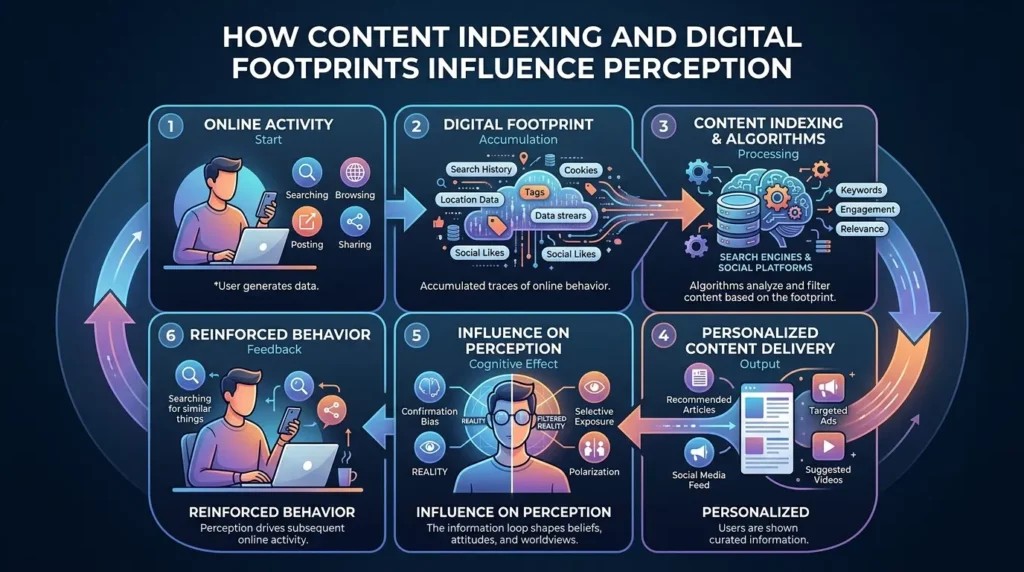
Search systems interpret indexed content through entity association and topical relevance analysis. Algorithms connect names, organisations, industries, and recurring themes to establish semantic identity structures. If reputation-related content repeatedly appears within the same contextual framework, search systems strengthen those associations. Persistent thematic repetition increases visibility consistency and shapes SERP perception patterns. This mechanism explains why recurring negative coverage creates long-term reputation persistence.
Digital footprints also influence predictive trust evaluation. Search ecosystems analyse historical content patterns to determine credibility consistency and authority reliability. Stable informational ecosystems reinforce trust signals, while fragmented or contradictory information weakens entity coherence. Algorithms evaluate consistency across reviews, mentions, citations, and authoritative references. This integrated analysis demonstrates how search visibility extends beyond individual URLs into broader reputation architecture.
What role do review signals play in search reputation?
Review signals are behavioural and sentiment-based indicators that contribute to trust interpretation within search ecosystems. Search engines analyse review frequency, sentiment distribution, language consistency, and reviewer credibility to assess reputation quality. These signals affect local visibility, entity perception, and SERP prominence. Reviews function as publicly indexed trust indicators that shape user interpretation before direct engagement occurs. This indexing relationship connects review ecosystems to broader reputation management structures.
Search algorithms evaluate sentiment patterns to identify credibility alignment and authenticity. Consistent positive or negative sentiment establishes thematic reputation signals that influence search interpretation. Systems also detect manipulation indicators such as repetitive phrasing, unnatural frequency patterns, or coordinated submission behaviour. Authenticity analysis protects the integrity of review ecosystems and prevents artificial perception inflation. This mechanism explains why review trustworthiness affects long-term visibility stability.
Review signals additionally interact with authority and engagement metrics. High-authority review platforms transfer trust associations through indexing relationships and semantic relevance. Search engines interpret engagement depth, response consistency, and review recency as indicators of ongoing reputation activity. Fresh review activity contributes to dynamic reputation modelling because search ecosystems prioritise updated trust signals. This process demonstrates how review indexing contributes to continuous entity evaluation.
How do authority signals shape content visibility in SERPs?
Authority signals are ranking indicators that define the perceived reliability and credibility of indexed content. Search ecosystems evaluate authority through backlinks, publisher reputation, historical reliability, topical expertise, and semantic relevance. Strong authority signals increase ranking stability and reinforce search visibility persistence. This mechanism explains why authoritative domains dominate high-competition reputation queries. Search engines interpret authority as an informational confidence metric.
Authority analysis operates through interconnected semantic relationships. Search systems evaluate whether content aligns with recognised expertise areas and trusted informational ecosystems. Healthcare-related content receives elevated scrutiny because search algorithms classify health information as high-impact content. This classification increases the importance of expertise, accuracy, and institutional credibility. Search visibility within healthcare-related SERPs therefore depends heavily on trust-oriented authority evaluation.
Authority signals also influence removal resistance and indexing durability. Highly authoritative pages retain stronger ranking persistence because search systems interpret them as valuable informational assets. Removal requests involving authoritative sources face more extensive contextual evaluation due to transparency considerations. This relationship demonstrates how authority affects both ranking dynamics and removal decision frameworks. Search ecosystems prioritise information reliability alongside privacy governance.
How does search perception change after content removal?
Search perception changes after content removal because indexed information directly shapes entity interpretation within SERPs. Removing content alters the informational balance presented to users during search evaluation. The absence of previously visible information changes keyword associations, click behaviour, and topical prominence. Search ecosystems continuously recalibrate ranking relationships after de-indexing events. This recalibration affects entity perception over time rather than instantaneously.
Algorithms reassess remaining indexed content to determine relevance redistribution and ranking hierarchy adjustments. If authoritative positive content exists, search systems strengthen its visibility due to reduced competition within the topical cluster. If informational gaps emerge, newer content sources gain indexing opportunities. This mechanism demonstrates how content ecosystems reorganise after visibility changes occur. Reputation dynamics therefore depend on broader semantic relationships rather than isolated URLs.
Search perception also evolves through behavioural feedback signals. User interaction patterns, engagement depth, and search refinement behaviour influence future SERP configurations. Search ecosystems interpret engagement changes as indicators of informational usefulness and trust relevance. Over time, altered behavioural patterns contribute to updated entity evaluation models. This adaptive mechanism explains how reputation evolves through continuous indexing and interaction analysis.
What improves the acceptance rate of a content removal request?
Strong removal requests align precisely with indexing policies, evidential standards, and contextual clarity requirements. Search systems evaluate requests according to structured relevance and policy compatibility rather than emotional framing. Effective submissions clearly identify the affected URL, explain the policy category, and provide verifiable supporting evidence. Precision strengthens reviewer interpretation because structured submissions reduce ambiguity within the evaluation process. Clear categorisation improves processing efficiency and contextual alignment.
The request also benefits from accurate documentation of reputational harm and indexing relevance. Evidence demonstrating outdated information, privacy exposure, or policy conflict increases contextual legitimacy. Search systems analyse whether the indexed content creates disproportional visibility impact relative to informational value. Structured evidence improves evaluation consistency because it supports policy-based interpretation. This analytical framework defines How to Strengthen a Google Content Removal Request to Improve Acceptance Rates within search ecosystems.
Technical accuracy further improves evaluation outcomes. Correct URL formatting, cache identification, and indexing verification reduce processing inconsistencies. Search engines evaluate whether the content remains searchable and whether duplicate indexing structures exist across related URLs. Technical completeness strengthens reviewer confidence because it demonstrates informational precision. This process highlights the relationship between structured evidence and reputation-focused search governance.
Google content removal requests operate as structured evaluations within search ecosystems rather than direct deletion mechanisms. Search engines analyse policy relevance, indexing status, authority signals, and public-interest factors before adjusting search visibility. These evaluation systems define how online reputation forms, evolves, and persists across SERPs.
Reputation management depends on understanding how algorithms interpret trust, credibility, authority, and sentiment through indexed information. Digital footprints, review signals, content authority, and semantic relevance collectively shape entity perception within search environments. Search visibility therefore reflects the broader interaction between information governance, indexing systems, and reputation signals.
How long does a Google content removal request take to process?
A Google content removal request can take anywhere from a few hours to several weeks, depending on the type of content and the complexity of the review. Google typically prioritizes sensitive issues such as personal information, copyright violations, or explicit content.
What happens after you submit a Google removal request?
After submission, Google reviews the request to determine whether the content violates its policies or legal guidelines. You may receive status updates by email, and the content could be removed from Google Search results if approved.
Can Google remove negative search results about my business?
Google generally does not remove legitimate negative reviews or news articles unless they violate content policies. However, false, defamatory, or privacy-violating content may qualify for removal through a formal content removal request.
Why was my Google content removal request denied?
Google may deny a removal request if the content does not violate its policies or if there is insufficient evidence supporting the claim. In many cases, users need to provide additional documentation or explore alternative reputation management solutions.
Does removing content from Google delete it from the internet?
No, removing content from Google Search only limits its visibility in search results. The original content usually remains live on the source website unless the site owner also deletes or updates it.