

Reputation management is the systematic monitoring, evaluation and modification of an organisation’s presence and signals within search ecosystems. Online reputation refers to the aggregate of indexed content, review signals and algorithmic interpretations that define an entity’s standing in search visibility.
Brand reputation is the composite of indexed content and reputation signals that search engines use to form an entity perception. Brand reputation is the set of discoverable digital artefacts and associated metadata that defines an organisation’s entity within search ecosystems. Search engines construct entity graphs by crawling and indexing content, extracting structured data, canonical URLs, author signals and co-occurrence relationships; they map these inputs to an entity profile that includes name variants, attributes and linked resources.
Reputation signals include backlinks, structured markup (for organisations and reviews), review volume and velocity, content freshness, authoritativeness indicators and user engagement metrics captured by SERP evaluation systems.
How is reputation formed in search engines?
Reputation formation refers to the algorithmic process that combines trust, authority and sentiment signals into a ranking-relevant metric. Crawlers index content and feed features (textual relevance, link GraphRank, structured data, review metadata, click-through patterns) into ranking models; models evaluate both document-level relevance and entity-level consistency.
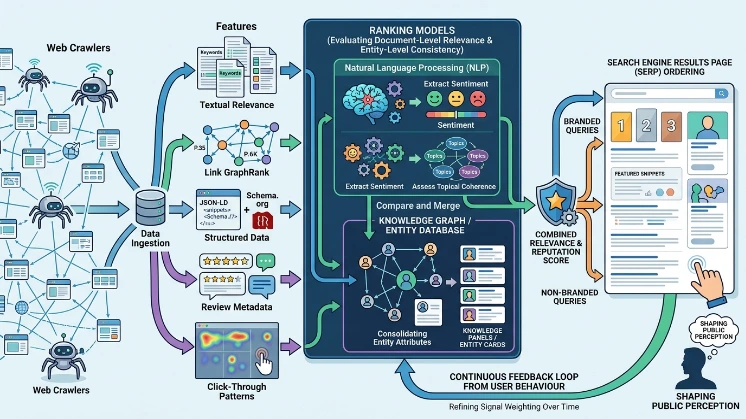
Natural language processing layers extract sentiment and topical coherence knowledge panels or entity cards (where available) further consolidate entity attributes. Continuous feedback loops from user behaviour refine the weighting of individual signals over time. Search engines prioritise pages that maximise combined relevance and reputation scores; thus reputation formation directly affects which pages surface for branded and non-branded queries, shaping public perception through SERP ordering and featured snippets.
How do algorithms interpret trust and credibility signals?
Algorithms interpret trust and credibility by quantifying provenance, endorsement and behavioural reliability into ranking features. Provenance signals include domain authority proxies (link profiles, domain age, TLS adoption, WHOIS stability), structured markup (schema.org organisation and review schemas) and publisher reputation derived from topical backlink context. Endorsement signals include anchor text distribution and co-citation patterns.
Behavioural reliability uses click-through rate, pogo-sticking, dwell time proxies and query reformulation metrics. Machine learning models integrate these features with supervised labels from human raters to calibrate trust thresholds. Higher measured trust increases the probability of higher SERP positions and the inclusion of enhanced SERP features (rich snippets, knowledge panels). Low trust reduces visibility and increases the chance that review or negative content outranks official communications.
What role does content indexing play in reputation visibility?
Content indexing is the process that converts web resources into searchable representations that contribute to entity perception. Indexers parse HTML, extract text, metadata, structured data and media cues; they normalise duplicate content via canonical tags and segment content into topical shards used for retrieval models. Indexing pipelines tag content with language, geographical signals and entity identifiers that feed into retrieval and ranking stages. Timely re-indexing for updated content and canonical resolution affects which version of content is used for SERP evaluation.
Accurate indexing of updated authoritative content raises the chances that corrective or clarifying pages will appear in SERPs quickly. Mis-indexing, slow re-crawl or canonical confusion can allow outdated or negative content to persist at high ranks, skewing public perception.
How do review signals and sentiment influence search perception?
Review signals and sentiment form explicit reputation inputs that search systems use to quantify public evaluation of an entity. Review data captured via aggregated schema, platform APIs or third-party review sites is normalised into features such as average rating, review velocity, review diversity and reviewer credibility. Sentiment analysis applies NLP to review text to derive polarity scores, topical sentiment and phrase-level cues.
Ranking models incorporate these features directly or via secondary systems (local pack ranking, review snippets) to influence SERP placement for transactional and local queries. Positive, high-velocity, diverse reviews with verified provenance increase the likelihood of rich review snippets and higher placement in local and product SERPs. Negative sentiment concentrated in authoritative review sources or verified accounts raises negative reputation signals that degrade entity perception and can reduce conversion signals from SERPs.
How do authority and trust signals differ and interact?
Authority and trust are distinct but interlinked reputation constructs used by algorithms to evaluate entity credibility. Authority features use link analysis (quality-weighted backlinks, contextual anchor relevance, citation networks) and topicality measures (semantic similarity across authoritative content). Trust features use provenance markers (TLS adoption, structured data verification, known publisher lists) and behavioural indicators (consistent traffic patterns, low bounce in trusted contexts).
Ranking models fuse authority and trust to compute final ranking influence; high authority with low trust results in constrained ranking, while moderate authority with high trust can achieve steady visibility. Combined authority and trust elevation increases SERP penetration for competitive queries and produces richer knowledge panel representation in entity-aware results. Discrepancies between the two generate mixed signals that confuse retrieval models and lead to inconsistent rankings.
How does entity perception affect SERP evaluation?
Entity perception is the modelled understanding of an organisation that search engines use when evaluating query-document relevance. Entity resolution systems aggregate structured data, knowledge graph links, co-occurrence statistics and authoritative references to form an entity vector. SERP evaluation uses this vector to bias ranking for queries with entity intent, prioritising documents that align with stored attributes and known authoritative sources.
Entity perception updates when corroborative or corrective evidence shifts the entity vector through high-quality indexed signals. Strong, coherent entity perception increases the selection probability of official pages for entity-intent queries and favours content that matches known attributes. Fragmented or conflicting entity perceptions dilute official content’s relevance score and allow third-party narratives to occupy prime SERP positions.
Strengthen online credibility with professional Brand Reputation Management that improves entity perception, search visibility, and trust across digital ecosystems. By reinforcing authoritative signals and consistent brand narratives, businesses can increase the prominence of official content and maintain stronger control over SERP outcomes.
How does the digital footprint create long-term reputation signals?
A digital footprint is the persistent set of digital traces that inform long-term reputation assessment within search ecosystems. Footprint elements accumulate over time through published content, historical backlinks, archived pages and metadata. Search systems use temporal features (age, recency, trend) alongside footprint breadth (distribution across domains, media types, and geographic TLDs) to evaluate reputation stability.
Persistent negative signals embedded in authoritative sources or in archived snapshots elevate negative weighting during model training. A broad, high-quality footprint produces durable reputation signals that stabilise search visibility across algorithm updates. Sparse or inconsistent footprints increase susceptibility to short-term volatility and allow transient negative content to affect long-term perception.
How does content quality shape credibility and ranking?
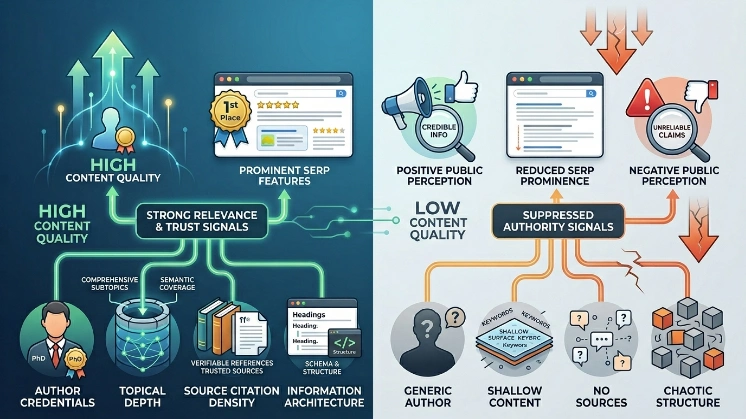
Content quality is the set of measurable attributes that signal authoritativeness and topical relevance to ranking systems. Quality assessment extracts features such as topical depth (semantic coverage across subtopics), source citation density, authoritativeness markers (byline and credentials), and information architecture (schema, headings). Models also compute user-engagement proxies and cross-check claims via knowledge graph and third-party authoritative sources.
High-quality content improves retrieval ranking through stronger relevance and trust signals. Content that satisfies quality metrics ranks higher for informational and navigational queries, shaping public perception by surfacing comprehensive, verifiable information. Low-quality content suppresses authority signals and reduces the chance of achieving prominent SERP features.
How should organisations align monitoring with search ecosystem mechanics?
Organisational monitoring must map observable signals to ranking mechanics to inform corrective actions and content prioritisation. Implement monitoring that tracks indexed pages, backlink quality, review metadata, structured data validity, canonicalisation issues and SERP feature presence.
Translate each tracked metric into ranking-relevant features (for example, backlink domain authority maps to authority score review velocity maps to review signal features). Use change detection and archival monitoring to detect indexation regressions and entity vector shifts. Alignment enables rapid mitigation of signal decay, targeted content updates to reclaim SERP real estate and prioritised remediation of indexing or canonical errors that adversely affect entity perception.
Learn More Here:
How Brand Reputation Management Strategies Differ for B2B and B2C
The mechanics of reputation in search ecosystems involve the structured aggregation of indexed content, review metadata, authority and trust signals into entity perceptions that drive SERP evaluation. Clear definitions of reputation formation, trust interpretation, content indexing, review signals, authority and digital footprint explain how algorithms translate disparate inputs into measurable search visibility outcomes. Organisations that map their monitoring to these ranking mechanics understand which signals influence entity perception and which interventions change SERP behaviour.
Answers to Key Questions
What is brand reputation management and how does it affect search visibility?
Brand reputation management is the practice of monitoring and shaping an organisation’s discoverable content, review signals and authority indicators within search ecosystems. It affects search visibility by influencing SERP evaluation through indexed content, backlinks, review metadata and entity perception.
How long does it take for reputation improvements to appear in search results?
Visibility changes depend on indexing frequency, backlink acquisition and review velocity, typically appearing within weeks for content updates and months for sustained backlink or review signals. Monitor re-crawl logs, SERP feature changes and changes in entity perception to evaluate progress.
Which signals most directly influence brand credibility in search engines?
Signals that directly influence credibility include high-quality inbound links, structured data (organisation and review schema), verified review volume and consistent entity metadata. Search models also weigh behavioural proxies such as click-through rates and dwell-time as secondary credibility indicators.
How does review sentiment impact local and product search rankings?
Review sentiment contributes quantified polarity and topical sentiment features that ranking systems use for local pack and product SERP features. Positive, verified reviews with high velocity increase the chance of review snippets and higher local/product placement; negative sentiment raises negative reputation weighting.
What monitoring metrics should businesses prioritise for reputation control?
Prioritise indexed page coverage, authoritative backlink quality, review counts/average rating, structured data validity and SERP feature presence. Map each metric to ranking mechanics (for example, backlink quality to authority score) and set alerting for indexation regressions or rapid sentiment shifts.