

Reputation management strategies differ based on whether the target audience is business decision-makers (B2B) or individual consumers (B2C). Online reputation control methods are evaluated through their impact on reputation signals, entity credibility, and search ranking influence within each market type.
Reputation management strategies differ based on stakeholder complexity, purchase-cycle length, and the primary trust mechanisms that drive conversion. Online reputation control methods are evaluated through how they shape sentiment distribution, influence SERP composition, and sustain entity credibility over time. B2B reputation management centres on credibility, thought leadership, and multi-stakeholder validation, while B2C reputation management relies on review volume, emotional brand connections, and rapid sentiment response.
What core mechanisms distinguish B2B from B2C reputation management approaches?
B2B reputation management operates by building entity credibility through authoritative content, third-party validation, and executive thought leadership. B2C reputation management operates by generating high-volume reviews, managing sentiment distribution across consumer platforms, and creating emotional brand narratives.
B2B reputation management defines credibility as the primary reputation signal. The mechanism involves publishing white papers, research reports, case studies with named individuals, and expert opinions that demonstrate rational ROI. Search engines interpret these assets as signals of authoritativeness and trustworthiness, particularly when they include named employees engaging rather than anonymous brand accounts.
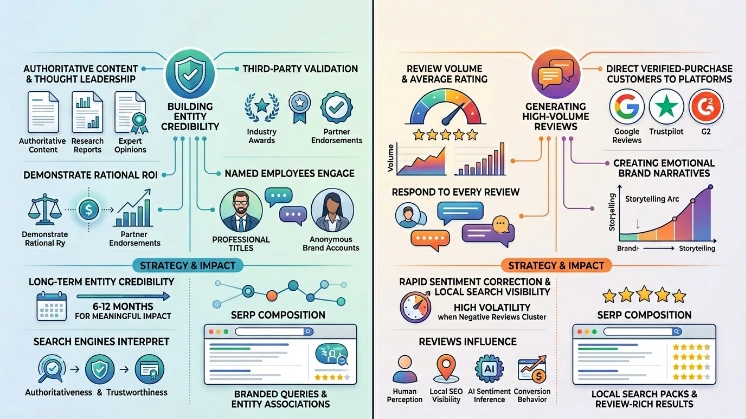
B2C reputation management defines review volume and average rating as the primary reputation signals. The mechanism involves directing verified-purchase customers to primary review platforms (Google Reviews for local businesses, Trustpilot or G2 for ecommerce and SaaS) and responding to every review. Reviews influence human perception, local SEO visibility, AI sentiment inference, and conversion behavior simultaneously.
Comparative analysis shows B2B strategies excel in building long-term entity credibility but require 6–12 months for meaningful impact. B2C strategies excel in rapid sentiment correction and local search visibility but face higher volatility when negative reviews cluster around specific issues. B2B reputation management influences SERP composition through branded queries and entity associations, while B2C reputation management influences SERP composition through local search packs and review-rich results.
How do content creation and content removal strategies compare in effectiveness?
Content creation strategies evaluate effectiveness through content enhancement that displaces negative results over time. Content removal strategies evaluate effectiveness through actual deletion at the source via legal routes or outdated content tools.
Content creation operates by building authoritative, well-optimised assets around the branded query to displace negative results. This is content enhancement that addresses the surface of search results. B2B content creation focuses on thought leadership content such as white papers and research reports that demonstrate expertise. B2C content creation focuses on storytelling and engaging content that resonates on a personal level with individual consumers.
Content removal operates through layered systems including outdated content tools, legal removal requests for defamation or copyright, and GDPR “right to be forgotten” claims. The outdated content tool only accelerates deindexing when content has already been removed or changed at the source. Legal removal requests cover different evidentiary demands with realistic timelines measured in weeks to months, not days.
Comparative analysis reveals content creation offers superior scalability and sustainability but requires 3–6 months for proactive strategies and 6–12 months for suppressing established negative content. Content removal offers faster immediate results for specific damaging content but faces limited scalability due to varying criteria across Google, Bing, Yahoo, and DuckDuckGo, each requiring separate submission paths. B2B brands benefit more from content creation due to longer sales cycles and multiple stakeholder validation needs. B2C brands benefit from combining both approaches due to faster, impulse-driven buying decisions.
Risk exposure differs significantly: content creation carries low risk exposure with stable long-term results. Content removal carries higher risk exposure due to uncertain success thresholds and potential for content to reappear if source changes revert. Content creation influences search visibility through domain authority, link strength, and content relevance. Content removal influences search visibility only when deindexing succeeds.
What are the limitations of organic versus reactive reputation management approaches?
Organic (proactive) reputation management limitations include delayed impact requiring 3–6 months for meaningful improvements and higher initial resource investment. Reactive reputation management limitations include damage control costs exceeding proactive investment and vulnerability to recurring issues when used alone.
Organic reputation management defines as building and strengthening online presence before crises occur through creating authoritative content, claiming and optimising digital profiles, generating positive review volume, and establishing thought leadership. The mechanism operates by establishing resilience where one negative review won’t tank profiles with 200 positive ones. For B2B, organic approaches involve deep one-on-one relationships with account managers nurturing leads through emails, calls, and personalised demos over months. For B2C, organic approaches involve one-to-many communication through automated email sequences and targeted ads reaching thousands simultaneously.
Reactive reputation management defines as responding to reputational threats that have already materialised including negative press coverage, viral social media incidents, bad reviews, or damaging search results. The mechanism operates through crisis response beginning immediately but requiring sustained effort for lasting results. For B2B, reactive approaches involve addressing immediate threats to reputation when crises occur. For B2C, reactive approaches involve responding after negative reviews, social media comments, or poor survey results appear.
Comparative analysis shows organic approaches provide superior sustainability and build trust through verified reviews from real customers rather than anonymous accounts. Reactive approaches provide necessary crisis management but relying solely on reactive tactics leaves businesses vulnerable. B2B organic strategies prioritise rational ROI messaging focusing on efficiency, scalability, and long-term support. B2C organic strategies prioritise emotional connection through social media, influencer partnerships, and high-energy advertising campaigns.
Effectiveness measurements show meaningful improvements in search results typically take 3–6 months for organic strategies and 6–12 months for suppressing established negative content through reactive approaches. Scalability differs: organic approaches scale through automated systems for B2C but require flexible systems for complex B2B relationships. Risk exposure shows proactive investment is almost always less costly than reactive damage control.
How do short-term and long-term reputation management strategies differ in impact and sustainability?
Short-term reputation management strategies focus on immediate concerns with limited results from engagements lasting few months. Long-term reputation management strategies cultivate sustained credibility with 6–12 month commitments usually recommended for effective ORM.
Short-term reputation management defines as addressing immediate reputation threats through quick wins and rapid response mechanisms. The mechanism operates through crisis response, review response to individual negative feedback, and temporary content suppression. B2B short-term approaches focus on addressing immediate stakeholder concerns during crises. B2C short-term approaches focus on rapid sentiment correction through review responses and social media engagement.
Long-term reputation management defines as continuous process requiring balancing immediate needs and planning for future sustained credibility. The mechanism operates through sustained positive review pipelines across multiple platforms, structural fixes to underlying customer problems, and primary-source content addition including case studies and customer testimonials with named individuals. B2B long-term approaches involve cultivating loyal audiences and maintaining positive reputation over time through proactive strategies. B2C long-term approaches involve building brand loyalty through consistent emotional connections and peer opinion management.
Comparative analysis reveals short-term strategies yield quick wins that are short-lived with limited results. Long-term strategies lead to sustainable growth through structural reputation building. B2B long-term strategies excel due to longer sales cycles requiring multiple stakeholder trust building over months. B2C strategies benefit from combining short-term rapid response with long-term review volume building due to faster impulse-driven decisions.
Impact measurements show short-term engagements often yield limited results while 6–12 month commitments are usually recommended for effective ORM. Sustainability differs: short-term strategies face high volatility when negative reviews cluster, while long-term strategies build resilience against single negative incidents. Risk exposure shows short-term approaches carry higher recurring risk while long-term approaches reduce vulnerability through sustained credibility.
How do search engines interpret reputation signals differently for B2B and B2C entities?
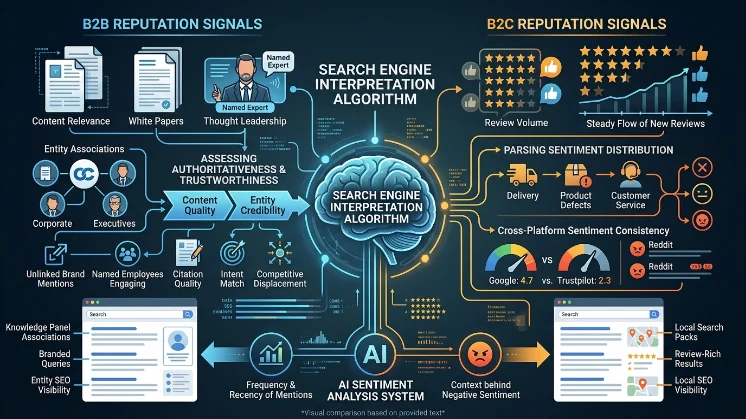
Search engines interpret B2B reputation signals through entity associations, domain authority, and content relevance demonstrating thought leadership. Search engines interpret B2C reputation signals through review volume, star ratings, and cross-platform sentiment consistency.
Search engine interpretation of B2B reputation signals operates by assessing authoritativeness and trustworthiness through content quality and entity credibility behind the content. Algorithms assess not just content quality but the credibility of the entity behind the content, with reputation directly affecting authoritativeness and trustworthiness elements. Unlinked brand mentions serve as signals of authority and relevance for B2B entities.
Search engine interpretation of B2C reputation signals operates by parsing sentiment distribution to identify whether negative reviews cluster around specific issues like delivery, product defects, or customer service. Higher average ratings and steady flow of new reviews improve visibility in local search packs for B2C businesses. Cross-platform consistency matters: engines surface inconsistencies when brands have 4.7 stars on Google but 2.3 on Trustpilot with angry threads on Reddit.
Comparative analysis shows B2B reputation signals influence SERP composition through branded queries and Knowledge Panel associations requiring entity SEO. B2C reputation signals influence SERP composition through local search packs and review-rich results affecting local SEO visibility. B2B signals weigh intent match, sentiment, citation quality, and competitive displacement. B2C signals weigh recency, sentiment distribution, and cross-platform consistency.
Trust evaluation differs: B2B entities require named employees engaging rather than anonymous brand accounts for credible signals. B2C entities require verified-purchase customers directed to primary review platforms appropriate to category. AI systems analyze sentiment distribution and behavior over time for both, looking at frequency of positive versus negative mentions, recency of feedback, and context behind negative sentiment.
What strategic considerations determine which reputation management approach suits B2B versus B2C?
Strategic considerations for B2B include longer sales cycles requiring multiple stakeholder validation, heavy focus on credibility and thought leadership, and rational ROI messaging. Strategic considerations for B2C include faster impulse-driven buying decisions, greater reliance on volumes of reviews, and emotional brand connections.
B2B strategic considerations define stakeholder complexity as the primary factor. The mechanism involves convincing committees of managers, IT specialists, and finance leads rather than individual buyers. B2B needs highly flexible systems allowing tailored records for specific business models showing how different companies and people link. B2B prioritise tactics capturing qualified leads, providing continuous answers in sales funnel, and offering dedicated support.
B2C strategic considerations define volume and speed as primary factors. The mechanism involves systems automatically transforming unstructured data into structured insights for larger customer bases. B2C communication is generally one-to-many using automated email sequences and targeted ads reaching thousands. B2C prioritise tactics capturing active consumers, encouraging quick purchases, and offering efficient customer service solutions.
Comparative analysis shows B2B strategies excel in building long-term entity credibility through thought leadership but require 6–12 months for meaningful impact. B2C strategies excel in rapid sentiment correction through review management but face higher volatility. B2B emotional connection is secondary to rational ROI while B2C emotional connection drives purchasing decisions.
Effectiveness measurements show balanced approaches integrating reactive crisis management with proactive reputation-building maintain positive reputation over time for both. Scalability differs: B2B requires flexible relationship systems while B2C requires volume-speed systems. Risk exposure shows B2B faces lower volatility from single incidents while B2C faces higher volatility from review clustering.
Sustainability considerations show B2B long-term strategies cultivate sustained credibility through continuous thought leadership. B2C sustainability requires structural fixes addressing underlying customer problems with sustained positive review pipelines across multiple platforms. Brand reputation management planning must account for these fundamental differences in stakeholder dynamics, trust mechanisms, and search ecosystem interpretation.
Discover More Insights:
Strengthen Your Brand Reputation With a Management Plan That Delivers
Answers to Key Questions
What is brand reputation management and why is it important for businesses?
Brand reputation management is the practice of monitoring, influencing, and maintaining how your business is perceived online across search engines, review platforms, and social media. It protects entity credibility, strengthens reputation signals, and influences search ranking influence by ensuring positive sentiment distribution reaches decision-makers.
How does Reputation Management PR Agency help improve brand reputation management strategies?
Reputation Management PR Agency provides expert guidance on content enhancement strategies, review management systems, and SERP control techniques to build long-term entity credibility. The agency analyses reputation signals and implements both proactive reputation-building and reactive crisis management approaches tailored to B2B or B2C needs.
What are the key differences between B2B and B2C brand reputation management approaches?
B2B brand reputation management focuses on thought leadership, credibility, and multi-stakeholder validation through white papers and case studies. B2C brand reputation management relies on review volume, emotional brand connections, and rapid sentiment response through consumer platforms like Google Reviews and Trustpilot.
How long does it take to see results from a brand reputation management strategy?
Meaningful improvements in search results typically take 3–6 months for organic proactive strategies, while suppressing established negative content requires 6–12 months. Effective ORMusually recommends 6–12 month commitments to build sustained credibility and resilience against reputation threats.