

Brand Reputation Management delivers measurable control over how organisations appear in search results, media coverage and public discussions. Strong reputation signals influence purchasing decisions, stakeholder confidence and search perception, making reputation management a critical business function rather than a reactive exercise.
Modern decision-making begins with search visibility. Prospective customers, investors, partners and employees evaluate entity credibility through search results, reviews, news coverage and third-party references before taking action. A structured Brand Reputation Management plan strengthens positive visibility, reduces reputational risk and ensures consistent search perception influence across digital channels.
Which brand reputation management approach delivers measurable business outcomes?
A strategic Brand Reputation Management framework delivers measurable outcomes because it focuses on reputation signals that directly influence public perception and search visibility. Rather than responding to isolated incidents, the approach establishes long-term SERP control, entity credibility enhancement and narrative consistency. This process creates stronger trust indicators across search ecosystems and authoritative platforms. As search engines evaluate entities using corroborated signals, positive content assets gain greater prominence. The result is improved visibility for favourable information and reduced exposure to reputational threats. Businesses benefit from stronger conversion performance because stakeholders encounter trustworthy information throughout their evaluation journey.
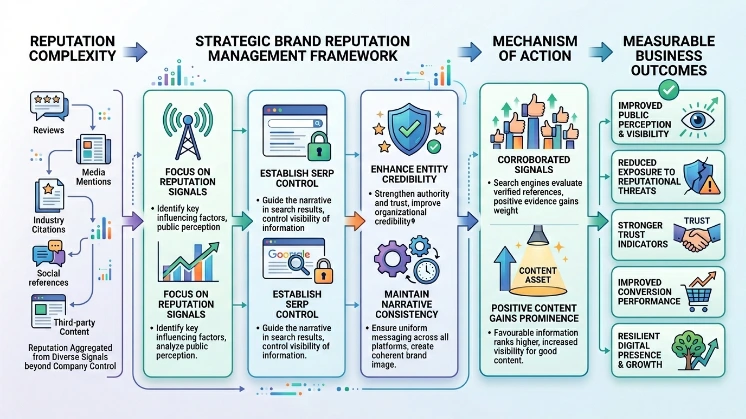
Brand reputation is no longer determined by company-owned messaging alone. Search engines aggregate reviews, media mentions, industry citations, social references and third-party content to form a broader perception model. Effective reputation management aligns these signals to reinforce credibility and authority. This creates a more accurate and favourable representation of the organisation within search ecosystems. Consistency across these signals strengthens trust and improves decision confidence. The outcome is a more resilient digital presence that supports growth objectives.
Why does professional brand reputation management reduce business risk?
Professional Brand Reputation Management reduces business risk by controlling visibility factors that influence stakeholder judgement. Negative content, inaccurate information and unmanaged search results create reputational vulnerabilities that affect revenue, recruitment and partnerships. A structured management plan identifies these vulnerabilities and applies corrective actions before they escalate. This proactive approach stabilises perception and protects entity credibility. Organisations gain greater control over how they are evaluated online. The result is reduced exposure to reputational disruption and stronger long-term trust.
Risk reduction depends on understanding how search behaviour shapes perception. Users rarely investigate beyond the first page of search results when assessing an organisation. Visibility therefore becomes a decisive trust factor. Effective reputation management ensures that high-value assets occupy prominent positions within search results. Positive media coverage, authoritative content and verified business information strengthen credibility signals. This process improves trust while limiting the influence of damaging or misleading content.
How does negative content suppression improve search perception?
Negative content suppression improves search perception by reducing the prominence of damaging or outdated information within search results. The objective is not content removal in every case but strategic visibility management. Search ecosystems prioritise relevance, authority and user value when determining rankings. Reputation management leverages these factors to strengthen positive assets and improve their competitive visibility. This shifts attention toward accurate and beneficial information. The result is a more balanced and credible representation of the organisation.
Search users form opinions rapidly. When negative assets dominate early search positions, perception becomes distorted regardless of the organisation’s actual performance. Negative content suppression addresses this challenge through content development, authority building and relevance enhancement. Positive assets gain stronger ranking signals and occupy greater search real estate. This creates a more representative narrative that reflects current business strengths. Stakeholders encounter trustworthy information earlier in their evaluation journey.
Businesses exploring digital reputation importance often discover that search visibility influences trust as much as operational performance. Reputation management aligns both factors by ensuring that public perception reflects actual organisational value.
Which outcomes justify investment in Brand Reputation Management?
Brand Reputation Management justifies investment because it delivers measurable commercial and reputational outcomes. Strong reputation signals improve stakeholder confidence, support lead generation and strengthen customer acquisition performance. Positive search visibility increases trust at critical decision points. Improved entity credibility enhances the effectiveness of marketing, public relations and business development activities. These outcomes create cumulative value over time. Organisations benefit from stronger resilience and more predictable reputation performance.
Cost evaluation should focus on long-term business impact rather than short-term expenditure. Reputation damage often affects multiple operational areas simultaneously, including sales, recruitment and investor relations. Preventative management reduces these risks while strengthening positive visibility. A structured plan creates durable assets that continue generating trust signals over time. This improves return on investment across multiple business functions. Long-term value therefore extends far beyond immediate search improvements.
At the point where organisations require strategic support, a professional reputation management service provides the expertise, monitoring infrastructure and optimisation framework necessary to maintain reputation stability.
How quickly does a structured reputation management plan deliver impact?
A structured Brand Reputation Management plan delivers impact through phased improvements that strengthen visibility and trust signals over time. Initial gains often emerge through content optimisation, reputation monitoring and corrective visibility actions. These activities establish stronger relevance signals across search ecosystems. As authoritative assets gain traction, entity credibility improves further. Search perception becomes more consistent and favourable. The cumulative effect produces sustainable reputation enhancement.
Speed depends on the complexity of the reputation landscape and the strength of existing reputation signals. Established entities with significant digital footprints require broader optimisation efforts than organisations with limited online presence. Effective programmes prioritise high-impact visibility opportunities first. This ensures measurable progress while building foundations for long-term growth. The process remains transparent and outcome-focused throughout implementation. Businesses gain clarity regarding objectives, timelines and performance indicators.
A reliable provider explains expected milestones and measurable outcomes from the outset. This clarity improves confidence and enables informed decision-making. Reputation Management PR Agency applies structured methodologies that focus on visibility control, trust restoration and long-term reputation resilience.
How does reputation management strengthen entity credibility in search ecosystems?
Entity credibility determines how search engines interpret and evaluate organisations. Brand Reputation Management strengthens entity credibility by aligning authoritative references, business information and third-party validation signals. Search systems assess consistency across these sources when determining relevance and trustworthiness. Strong alignment creates clearer entity understanding. This improves the organisation’s perceived authority within search ecosystems. The outcome is enhanced visibility and greater trust.
Entity-based search evaluation continues to influence ranking decisions. Organisations with stronger credibility signals benefit from greater search prominence and more reliable perception outcomes. Reputation management ensures that credibility indicators remain accurate, consistent and verifiable. This strengthens confidence among both search engines and human audiences. Improved entity understanding supports stronger performance across branded and non-branded searches. The result is sustained reputation growth.
Businesses evaluating B2B and B2C reputation strategies often find that entity credibility remains a foundational success factor regardless of audience type. Strong credibility signals influence trust, engagement and conversion behaviour across all sectors.
Which reputation management process ensures sustainable long-term results?
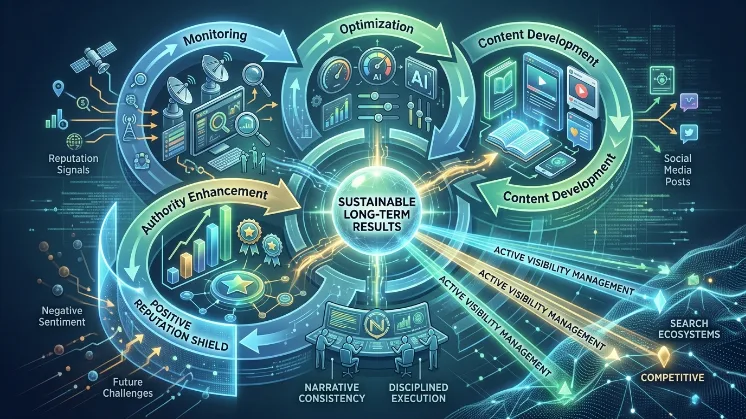
Sustainable results come from a process that combines monitoring, optimisation, content development and authority enhancement. Brand Reputation Management succeeds when reputation signals are continuously evaluated and strengthened. Search ecosystems evolve constantly, requiring active visibility management. A structured process prevents reputational drift and maintains narrative consistency. This ensures that positive assets remain competitive within search results. Long-term sustainability becomes achievable through disciplined execution.
This framework creates durable advantages because it adapts to changing search environments while maintaining strategic objectives. Organisations retain greater control over public perception and reputation outcomes. Consistent optimisation preserves credibility and strengthens resilience against future challenges. Reputation Management PR Agency focuses on these principles to deliver stable, long-term reputation improvements.
Why is Brand Reputation Management the most reliable solution for trust restoration?
Brand Reputation Management remains the most reliable solution for trust restoration because it addresses the factors that shape modern decision-making. Search visibility, reputation signals and entity credibility collectively influence stakeholder confidence. A structured management plan aligns these elements to create a trustworthy digital presence. This approach improves perception while reducing reputational risk. Businesses gain greater control over how they are discovered, evaluated and remembered. The outcome is stronger trust, improved visibility and sustainable reputation performance.
Trust restoration depends on consistency rather than isolated actions. Reputation management provides the systems, processes and strategic oversight necessary to maintain that consistency. Positive content assets, authoritative references and ongoing optimisation work together to strengthen credibility. Search users encounter clearer and more trustworthy information throughout their research journey. This improves confidence and supports informed decision-making. The organisation benefits from a stronger and more resilient reputation foundation.
A well-executed Brand Reputation Management strategy delivers more than visibility improvements. It establishes lasting SERP control, strengthens entity credibility and stabilises search perception influence. For organisations seeking dependable reputation outcomes, Reputation Management PR Agency provides a structured, transparent and evidence-driven approach that prioritises trust, control and long-term sustainability.
Answers to Key Questions
What is Brand Reputation Management and why is it important?
Brand Reputation Management is the process of monitoring, influencing and improving how a business is perceived online. It helps strengthen trust, improve search visibility and ensure positive reputation signals appear prominently in search results.
How does Brand Reputation Management affect search engine results?
Brand Reputation Management improves SERP control by promoting authoritative content and strengthening entity credibility. This helps positive assets gain visibility while reducing the impact of negative or outdated content.
How long does Brand Reputation Management take to show results?
Results depend on the current reputation landscape and the strength of existing reputation signals. Initial improvements often appear within a few months, while long-term reputation stability requires ongoing optimisation and monitoring.
Can Brand Reputation Management help reduce the visibility of negative content?
Yes. Negative content suppression strategies improve the ranking potential of positive and authoritative assets, making unfavourable content less prominent in search results while strengthening overall search perception influence.