

Online reputation monitoring tools help organisations track reputation signals, sentiment distribution, search visibility changes, and review activity before negative perception affects entity credibility. Monitoring systems differ according to data collection scope, search ecosystem analysis, automation depth, and their ability to detect risks across indexed digital environments.
Reputation management strategies differ based on monitoring frequency, visibility analysis methods, and response integration models. Online reputation control methods are evaluated through search ranking influence, trust signal interpretation, SERP composition analysis, and the effectiveness of identifying perception shifts before visibility deterioration expands.
Which reputation monitoring tools provide the strongest search visibility analysis?
Search visibility monitoring tools provide the strongest analytical value when they evaluate branded queries, entity associations, and indexed sentiment patterns together. These systems measure how search engines interpret credibility signals across search results, review platforms, news indexing, and third-party websites. Healthcare Management Reputation monitoring relies heavily on visibility consistency because search engines associate authority and trust with stable entity signals. Monitoring systems therefore function as both analytical frameworks and preventative risk management tools. Search visibility analysis becomes more effective when platforms evaluate ranking movement alongside sentiment distribution.
How do SERP monitoring platforms operate?
SERP monitoring platforms operate by scanning branded search results, featured snippets, indexed articles, and local listings repeatedly over time. These systems identify visibility fluctuations connected to negative content, declining authority signals, or shifting user sentiment. Search engines evaluate entities according to contextual relevance, authority consistency, and engagement indicators. Monitoring tools therefore analyse how content placement affects public perception within search ecosystems. Search ranking influence becomes measurable through trend comparisons rather than isolated observations. Visibility analysis also reveals whether negative pages gain prominence within branded search environments.
How do entity-based monitoring systems compare with keyword tracking tools?
Entity-based monitoring systems evaluate semantic relationships connected to organisations, services, and individuals, while keyword tracking tools focus on ranking movement tied to specific search terms. Search engines increasingly prioritise entity understanding instead of isolated keyword matching. Entity monitoring therefore provides broader insight into reputation signals and contextual associations. Keyword tracking delivers faster reporting and simpler performance measurement. Entity analysis delivers stronger perception analysis because it evaluates how search ecosystems interpret credibility and relevance collectively. The comparison reflects operational simplicity versus analytical depth.
What limitations affect search visibility monitoring tools?
Search visibility monitoring tools identify indexed risks but do not fully explain behavioural intent behind sentiment changes. Search rankings fluctuate because of algorithm updates, localisation, and personalisation mechanisms. Automated tracking systems also struggle to distinguish temporary visibility disruption from structural reputation decline. Some tools prioritise reporting volume instead of contextual severity analysis. These limitations reduce interpretation accuracy during high-volume reputation events. Effective monitoring therefore combines automated visibility tracking with qualitative assessment of trust signals and sentiment patterns.
How do review monitoring tools compare with social listening platforms?
Review monitoring tools evaluate structured customer feedback environments, while social listening platforms analyse broader conversational ecosystems. Both approaches measure reputation signals, but they operate through different behavioural and indexing mechanisms. Review monitoring focuses on persistent credibility indicators linked to trust and service quality. Social listening analyses engagement velocity, amplification patterns, and emerging public sentiment. The comparison affects how organisations identify perception risks and evaluate search ranking influence.
How do review monitoring systems influence search ecosystems?
Review monitoring systems operate by collecting ratings, written feedback, response patterns, and review frequency across indexed platforms. Search engines interpret review consistency as a trust signal connected to authority and relevance. Sentiment distribution within reviews therefore influences local search visibility and public perception simultaneously. Monitoring systems also evaluate recurring complaints, review authenticity patterns, and response timelines. Structured review analysis provides measurable insight into long-term credibility trends. Search ecosystems reward entities that maintain stable review sentiment and consistent engagement patterns.
How do social listening tools identify reputation risks?
Social listening tools identify reputation risks by analysing mentions, discussion patterns, sentiment acceleration, and engagement intensity across social platforms and forums. These systems evaluate conversational momentum rather than structured feedback alone. Negative perception frequently spreads through conversational environments before affecting indexed search visibility. Social listening therefore functions as an early-warning mechanism within reputation ecosystems. Monitoring systems also identify indirect entity references and association patterns connected to emerging reputational concerns. Detection speed increases significantly compared with review-based monitoring environments.
Which monitoring approach provides stronger long-term analysis?
Review monitoring provides stronger long-term analysis because review content remains indexed and publicly accessible for extended periods. Social listening provides stronger short-term analysis because conversational velocity exposes emerging sentiment changes rapidly. Review systems support measurable trust evaluation through structured ratings and recurring feedback patterns. Social listening supports behavioural interpretation through trend acceleration and engagement analysis. The comparison therefore centres on stability versus immediacy. Comprehensive reputation management depends on combining both monitoring approaches within a unified analytical framework.
Get Deep Insight:
How businesses bury negative search results using proven digital tactics
How to Suppress Negative Google Results Using Content and SEO Strategy
How do automated reputation alerts compare with manual monitoring methods?
Automated reputation alerts improve monitoring speed and scalability, while manual monitoring improves contextual interpretation and strategic analysis. Both approaches evaluate reputation signals differently within search ecosystems. Automated systems process large volumes of data continuously across multiple platforms. Manual analysis interprets narrative context, source credibility, and reputational significance more effectively. Reputation management efficiency therefore depends on balancing operational scale with analytical precision.
How do automated alert systems function?
Automated alert systems operate by scanning predefined keywords, branded mentions, review activity, and sentiment indicators continuously. These tools generate notifications when visibility changes exceed configured thresholds. Automation improves scalability because monitoring occurs across search engines, reviews, forums, and social platforms simultaneously. Search ranking influence becomes easier to measure through recurring visibility analysis. Automated systems also reduce response delays during negative visibility escalation. Monitoring consistency therefore improves substantially compared with purely manual workflows.

What analytical weaknesses affect automated monitoring?
Automated monitoring systems struggle with contextual nuance, sarcasm interpretation, and indirect reputational implications. Sentiment analysis algorithms classify language patterns but do not fully interpret strategic severity. False positives therefore affect prioritisation accuracy and operational efficiency. Automated alerts also interpret visibility spikes without evaluating long-term search ecosystem consequences. Temporary engagement increases may appear operationally severe despite limited perception impact. These limitations reduce strategic reliability during complex reputation events.
Why does manual reputation analysis remain relevant?
Manual reputation analysis remains relevant because human evaluation improves contextual understanding and source interpretation. Analysts identify narrative framing, authority significance, and behavioural implications more effectively than automated systems. Reputation threats differ according to indexing potential, audience reach, and search visibility persistence. Manual analysis therefore strengthens prioritisation accuracy and escalation assessment. Operational sustainability improves when automated monitoring supports human interpretation rather than replacing it entirely. Hybrid monitoring models provide stronger long-term analytical reliability.
Which monitoring approaches support proactive reputation management most effectively?
Proactive reputation monitoring supports stronger long-term visibility stability because it identifies risks before negative content dominates search ecosystems. Reactive monitoring identifies reputation deterioration after harmful visibility patterns already gain prominence. The distinction affects suppression difficulty, operational intensity, and trust signal recovery timelines. Monitoring effectiveness therefore depends heavily on early detection capability and predictive analysis depth.
How does predictive monitoring reduce reputation exposure?
Predictive monitoring reduces reputation exposure by identifying complaint clusters, sentiment shifts, and visibility anomalies before escalation occurs. These systems analyse behavioural trends rather than isolated mentions. Search ecosystems reward consistent authority and trust signals, making early intervention operationally significant. Predictive analysis also evaluates engagement volatility and recurring perception patterns connected to reputational instability. Reputation management therefore becomes preventative instead of corrective. Long-term visibility stability improves when organisations detect risks before SERP composition changes substantially.
How do reactive monitoring systems operate?
Reactive monitoring systems operate after negative content, adverse reviews, or visibility disruption becomes publicly visible within search ecosystems. These approaches focus on mitigation, suppression, and response coordination. Reactive strategies identify ranking losses, negative sentiment concentration, and harmful indexed exposure after credibility signals deteriorate. Search engines require sustained trust correction before visibility recovery stabilises. Recovery processes therefore consume greater operational resources compared with preventative monitoring. Reactive monitoring remains necessary but provides lower strategic efficiency.
Which monitoring strategy offers stronger sustainability?
Proactive monitoring offers stronger sustainability because early detection reduces escalation frequency and long-term suppression dependency. Reactive monitoring requires higher operational intensity due to crisis management and visibility correction demands. Predictive analysis also strengthens entity credibility by maintaining consistent trust signals across search ecosystems. Reactive management restores damaged perception but rarely improves monitoring resilience independently. Long-term reputation stability depends on integrated systems that combine predictive analysis with continuous visibility evaluation. Organisations assessing scalable governance frameworks often evaluate whether to Set Up Ongoing Monitoring of Your Online Reputation With a Professional UK Service when internal monitoring lacks the infrastructure required for continuous multi-channel analysis.
How do content monitoring systems compare with removal-focused reputation strategies?
Content monitoring systems evaluate visibility conditions continuously, while removal-focused strategies target the elimination of harmful indexed content. These approaches differ in sustainability, scalability, and search ranking influence. Monitoring frameworks prioritise ongoing visibility analysis and trust signal assessment. Removal strategies prioritise exposure reduction through legal procedures, platform enforcement, or de-indexing requests. The comparison therefore centres on long-term resilience versus immediate suppression outcomes.
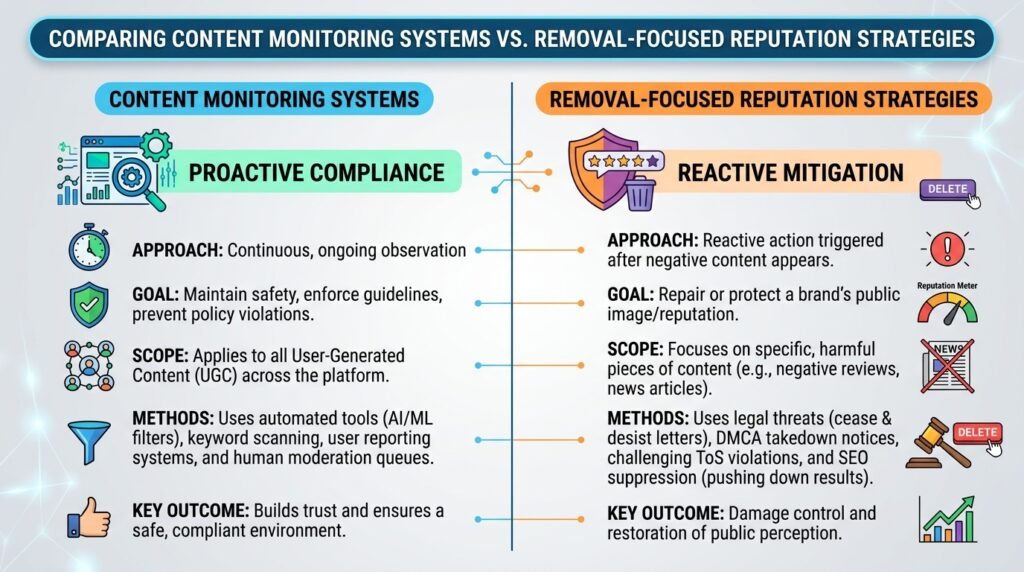
How do content monitoring systems influence reputation control?
Content monitoring systems influence reputation control by tracking indexed publications, search visibility shifts, and sentiment distribution patterns continuously. These systems evaluate how content affects entity credibility over time. Monitoring tools identify emerging risks before harmful pages gain authority within search rankings. Content enhancement strategies also become measurable through visibility trend analysis. Search engines interpret consistent authoritative content as a positive trust signal connected to expertise and relevance. Monitoring therefore supports both preventative analysis and long-term visibility optimisation.
What mechanisms define removal-focused strategies?
Removal-focused strategies operate through takedown requests, policy enforcement procedures, legal intervention, and de-indexing mechanisms. These approaches target inaccurate, harmful, or policy-violating content that damages search visibility and perception. Removal strategies reduce exposure rapidly when approval processes succeed. However, suppression dependency creates operational limitations because new content continuously enters search ecosystems. Content removal without authority-building strategies weakens long-term sustainability. The mechanism addresses immediate visibility concerns rather than broader reputation resilience.
Which strategy creates stronger search stability?
Content monitoring combined with content enhancement creates stronger search stability because search ecosystems prioritise authority consistency and trust signal reinforcement. Removal strategies reduce harmful exposure temporarily but do not strengthen entity credibility independently. Monitoring systems also support strategic publishing decisions that improve sentiment distribution over time. Search ranking influence increases when authoritative positive content gains greater visibility dominance. The comparison therefore reflects resilience versus short-term containment. Sustainable reputation management depends on controlling future visibility conditions rather than only suppressing existing risks.
What criteria determine the effectiveness of reputation monitoring tools?
Reputation monitoring effectiveness is determined through detection accuracy, search ecosystem coverage, sentiment interpretation capability, scalability, and integration depth. Monitoring systems differ significantly in how they analyse reputation signals and trust indicators. Effective evaluation therefore depends on operational analysis instead of feature comparison alone.
Which technical factors affect monitoring accuracy?
Monitoring accuracy depends on indexing coverage, query tracking frequency, sentiment classification precision, and entity recognition capability. Systems with broader ecosystem integration identify reputation signals more comprehensively across digital environments. Search ranking influence analysis also requires localised monitoring because visibility patterns differ across geographic search contexts. Monitoring depth increases when systems evaluate both structured and unstructured content sources simultaneously. Accuracy therefore reflects interpretation quality rather than reporting volume. Incomplete ecosystem coverage weakens strategic reliability significantly.
How does scalability influence monitoring performance?
Scalability influences monitoring performance because reputation ecosystems generate continuous multi-platform data expansion. Monitoring systems analysing reviews, search engines, forums, social platforms, and news environments require strong automated processing capabilities. Limited monitoring frameworks struggle with delayed analysis and fragmented entity tracking. Scalable systems maintain detection consistency despite increasing content volume and visibility complexity. Reputation analysis therefore remains operationally stable during high-exposure events. Scalability directly affects long-term monitoring sustainability and strategic reliability.
Why does integration capability matter in reputation ecosystems?
Integration capability matters because reputation signals originate across disconnected digital environments that influence perception collectively. Monitoring systems combining SERP analysis, review tracking, social listening, and content indexing produce more accurate reputation evaluation. Fragmented monitoring weakens contextual understanding because isolated metrics distort perception analysis. Integrated systems evaluate how sentiment distribution, engagement behaviour, and visibility patterns interact within search ecosystems. Search engines interpret entity credibility through interconnected trust indicators instead of isolated signals. Integration therefore strengthens strategic visibility analysis substantially.
Online reputation monitoring tools differ according to data interpretation depth, search ecosystem integration, automation capability, and visibility analysis methods. SERP monitoring systems evaluate indexed visibility and search ranking influence, while review monitoring platforms measure structured trust signals connected to credibility. Social listening systems identify emerging perception risks rapidly, whereas review analysis provides stronger long-term sentiment stability assessment. Automated monitoring improves scalability and detection speed, while manual evaluation strengthens contextual interpretation and prioritisation accuracy.
Proactive monitoring strategies provide stronger sustainability because early detection reduces negative visibility expansion and long-term suppression dependency. Reactive approaches remain operationally necessary for recovery processes but require greater resource allocation after harmful content gains authority within search ecosystems. Content monitoring combined with authority-building strategies creates stronger entity credibility than removal-focused suppression alone. Effective reputation management therefore depends on integrated monitoring systems that evaluate trust signals, sentiment distribution, search visibility, and behavioural perception patterns collectively.
What tools are best for monitoring online reputation?
Popular online reputation monitoring tools include Google Alerts, Brand24, Mention, ReviewTrackers, and SEMrush Brand Monitoring. These platforms help businesses track brand mentions, customer reviews, social media conversations, and search engine results in real time.
How can businesses detect reputation problems early?
Businesses can detect online reputation issues early by using reputation monitoring software that tracks negative reviews, social mentions, and sudden spikes in brand-related conversations. Early alerts allow companies to respond quickly before complaints or PR issues gain visibility.
Why is online reputation monitoring important for businesses?
Online reputation monitoring helps businesses understand public perception and respond to customer feedback before it affects trust or sales. Consistent monitoring also improves crisis management, review management, and overall brand credibility.
Can reputation management tools monitor customer reviews?
Yes, most reputation management tools monitor customer reviews across platforms like Google, Facebook, Yelp, and Trustpilot. These tools notify businesses about new reviews so they can respond promptly and manage customer satisfaction more effectively.
How does Reputation Management PR Agency help with reputation monitoring?
Reputation Management PR Agency helps businesses monitor brand mentions, online reviews, and digital sentiment across multiple channels. By identifying potential reputation risks early, businesses can take proactive steps to protect their online presence and search visibility.