

Suppressing negative Google results using content and SEO strategy requires prioritising content enhancement and targeted SEO signals to displace adverse pages in the SERPs while simultaneously pursuing removal where policy or legal grounds exist. Reputation management strategies differ based on the balance between content suppression and content enhancement; online reputation control methods are evaluated through search ranking influence, sentiment distribution, and entity credibility metrics.
How do content creation and legal removal compare as methods for suppressing negative Google results?
Content creation is the strategic production of new, optimised assets intended to outrank or demote negative pages; legal removal is the process of securing takedowns or de-indexing through rights enforcement or law. Content creation operates by building authoritative pages (articles, profiles, press releases, long-form resources) that target the same queries or entity references as negative results. Legal removal operates by asserting copyright, defamation, data protection, or platform policy violations to remove the offending content or request de-indexing from search engines.
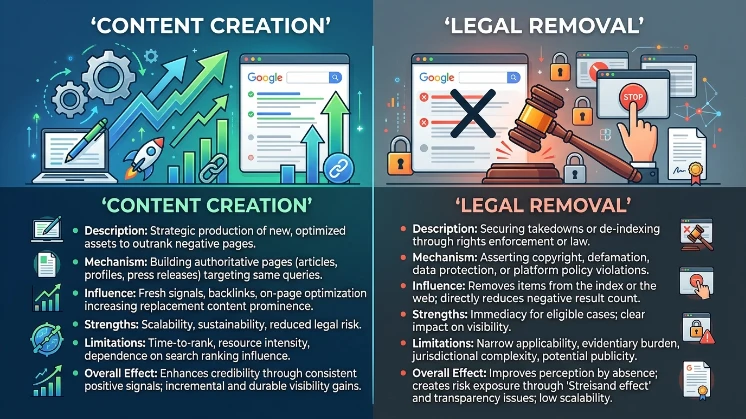
Content creation’s mechanism influences search ecosystems via fresh signals, backlinks, and on-page optimisation that increase the prominence of replacement content in SERP composition. Legal removal’s mechanism removes items from the index or the web, directly reducing negative result count and altering sentiment distribution by elimination.
Content creation strength lies in scalability, sustainability, and reduced legal risk; limitations include time-to-rank, resource intensity, and dependence on search ranking influence of produced assets. Legal removal strength lies in immediacy for eligible cases and clear impact on visibility limitations include narrow applicability, evidentiary burden, jurisdictional complexity, and potential publicity that amplifies the issue. Content creation enhances entity credibility through consistent positive signals, whereas legal removal improves perception by absence but creates risk exposure through “Streisand effect” dynamics and transparency issues. Search visibility gains from content creation are incremental and durable; legal removal yields binary changes but low scalability for broad reputational repair.
How do organic SEO suppression tactics compare with paid promotion or paid suppression tactics?
Organic SEO suppression tactics focus on on-site SEO, targeted content, backlink acquisition, and schema to alter SERP composition; paid promotion uses paid search, sponsored content, or content distribution to surface favourable assets above organic negative entries. Organic SEO operates by signalling relevance and authority to search algorithms via content optimisation and link signals. Paid promotion operates by buying placement or attention that bypasses organic ranking mechanisms and temporarily alters visibility and perception.
Organic tactics’ mechanism increases search ranking influence over time through cumulative signals and improves entity credibility in algorithmic evaluation. Paid promotion’s mechanism provides immediate top-of-page exposure but does not change organic sentiment distribution nor the underlying index. Comparative analysis: organic tactics evaluate higher for sustainability, lower for immediacy; paid promotion evaluates higher for immediacy, lower for long-term SERP composition influence.
Strengthen patient trust with professional Healthcare Reputation Management that combines sustainable SEO-driven visibility improvement with strategic reputation enhancement. By building authoritative healthcare content and credible trust signals, organisations can achieve long-term SERP control, improve patient confidence, and protect their online reputation.
How do reactive removal processes compare with proactive digital footprint optimisation?
Reactive removal processes are targeted takedowns, DMCA notices, defamation complaints, or platform reports executed after negative content appears; proactive digital footprint optimisation is the deliberate construction and governance of digital assets to preemptively shape search results. Reactive removal operates by identifying specific negative items and applying legal, policy, or administrative mechanisms to eliminate or de-index them. Proactive optimisation operates by mapping entity queries, creating canonical assets, applying structured data, and maintaining continuous content publication to control SERP composition.
Reactive removal’s mechanism yields direct reduction in visible negative items and affects perception by reducing negative signals; proactive optimisation’s mechanism builds a resilient constellation of positive assets that occupy search real estate and influence sentiment distribution through positive ranking signals. Comparative analysis: reactive removal is effective for discrete, high-impact items but is limited by legal thresholds and jurisdictional enforcement; proactive optimisation is effective across many queries, scales with content capacity, and offers lower risk exposure but demands sustained investment.
Reactive removal is non-scalable for widespread negative sentiment and creates dependency on third-party platforms; proactive optimisation scales and contributes to entity credibility and search ranking influence over the long term. Search engines interpret proactive footprint signals as stable entity references, whereas removed items produce abrupt index changes that algorithms may treat neutrally but public perception may read as concealment.
How does content suppression via targeted SEO compare with reputation repair through sentiment engineering?
Content suppression via targeted SEO is the tactical use of keyword-targeted pages, internal linking, canonicalisation, and negative-keyword avoidance to reduce the visibility of specific negative URLs. Reputation repair through sentiment engineering is the strategic reshaping of public sentiment by promoting positive narratives across owned, earned, and shared channels and measuring sentiment distribution shifts over time. Targeted SEO operates by aligning on-page signals and link equity to push negative items down the SERP; sentiment engineering operates by increasing favourable mentions, amplifying positive context, and adjusting discovery pathways.
Mechanistically, targeted SEO directly influences search ranking influence for particular queries by improving relevance and authority signals for replacement pages. Sentiment engineering influences third-party content generation and social signals that feed into entity credibility assessments used by search systems and human evaluators. Comparative analysis: content suppression via SEO evaluates as precise and measurable at the query-level but constrained by algorithmic competition and negative page strength; sentiment engineering evaluates as broader, affecting brand perception beyond SERPs but harder to attribute directly to ranking changes. Impact on trust signals: targeted SEO strengthens direct relevance signals; sentiment engineering strengthens indirect credibility signals such as reviews, citations, and social proof. Risk exposure: targeted SEO risks algorithmic penalties if manipulative tactics are used; sentiment engineering risks ethical concerns and transparency expectations if practices appear deceptive. Scalability: targeted SEO scales for prioritised queries; sentiment engineering scales across channels but requires coordination with communications and legal teams.
Dive Deeper With Our Expert Guides and Related Blog Posts:
How to Strengthen a Google Content Removal Request to Improve Acceptance Rates
Which Types of Content Google Will Remove and Which It Will Not
How do short-term suppression tactics compare with long-term reputation-building strategies?
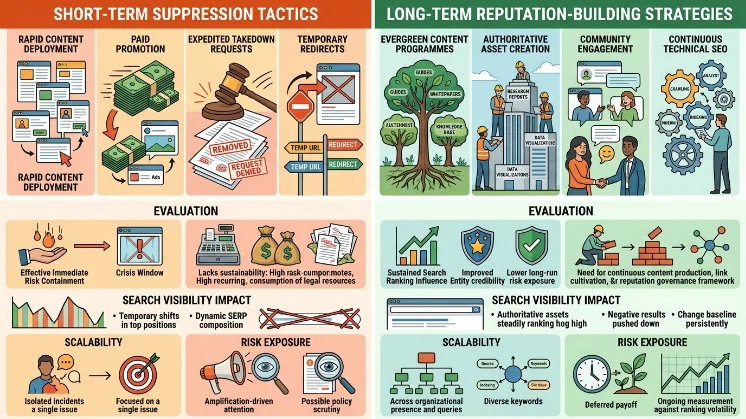
Short-term suppression tactics include rapid content deployment, paid promotion, expedited takedown requests, and temporary redirects; long-term reputation-building strategies include evergreen content programmes, authoritative asset creation, community engagement, and continuous technical SEO. Short-term tactics operate by quickly increasing the prominence of benign or corrective assets or removing specific content to change immediate SERP composition. Long-term strategies operate by establishing sustained positive signals and deep entity credibility that persist through algorithmic updates.
Short-term tactics evaluate as effective for immediate risk containment and crisis windows but lack sustainability and create recurring cost or legal resource consumption. Long-term strategies evaluate as effective for sustained search ranking influence, improved entity credibility, and lower long-run risk exposure but require continuous content production, link cultivation, and reputation governance frameworks. Search visibility impact differs: short-term tactics shift the top positions temporarily long-term strategies change the SERP baseline and sentiment distribution persistently.
Scalability: short-term tactics scale for isolated incidents; long-term strategies scale across organisational presence and queries. Risk exposure: short-term tactics risk attention-driven amplification and possible policy scrutiny; long-term strategies risk deferred payoff and need ongoing measurement against ranking volatility.
How do manual suppression techniques compare with algorithmic or technical SEO suppression techniques?
Manual suppression techniques are human-driven interventions such as outreach to webmasters, content negotiation, and manual takedown requests; algorithmic or technical SEO suppression techniques involve structured data, robots directives, canonical tags, index control, and crawl budget management. Manual techniques operate by negotiating source-level changes, persuading hosts or authors, or using moderation channels. Technical techniques operate by instructing search engine crawlers and indexers on content handling and by optimising on-site signals to prioritise preferred pages.
Comparative analysis: manual techniques evaluate as potentially decisive when the content owner is cooperative and when legal grounds exist; limitations include reliance on third parties and limited scale. Technical techniques evaluate as systematic and scalable across owned property and influence search ranking influence through canonicalisation and crawl directives, but they cannot directly affect third-party-hosted negative pages. Manual techniques impact perception by removing the source; technical techniques impact SERP composition for owned domains and improve entity credibility through structured metadata. Risk exposure for manual techniques includes inconsistent outcomes and reputational disclosure; technical techniques risk misconfiguration causing unintended de-indexing or ranking harm. Effectiveness measurement differs: manual outcomes are binary (removed/unchanged); technical outcomes require ranking and coverage metrics.
Content creation and SEO-based suppression and legal or manual removal represent distinct mechanisms for altering SERP composition and sentiment distribution. Content creation operates by enhancing entity credibility and producing alternative ranking signals; legal and manual removal operate by eliminating negative signals at source but face evidentiary and jurisdictional limits.
Organic SEO, proactive footprint optimisation, and sentiment engineering provide sustainable search ranking influence and scale with resource investment; paid promotion and short-term suppression provide immediate visibility but lack long-term signal transfer. Technical suppression techniques control owned inventory reliably; manual interventions resolve third-party issues selectively. Strategic considerations: prioritise approaches by query impact, evidentiary strength for removal actions, resource availability for sustained content programmes, and acceptable risk exposure for publicity or platform disputes.
Read More to Understand Better:
Suppress Negative Google Results Faster With a Professional UK ORM Team
Answers to Key Questions
What is healthcare reputation management and why is it critical for medical businesses?
Healthcare reputation management is the practice of monitoring, shaping, and protecting a medical organisation’s online reputation through review management, content strategy, and response protocols. It is critical because patient trust, search visibility, and regulatory compliance depend on accurate sentiment distribution and strong entity credibility in digital health ecosystems.
How does online review management improve healthcare reputation and patient acquisition?
Online review management systematically collects, responds to, and analyses patient reviews across platforms like Google, NHS choices, and healthcare-specific directories. It improves reputation by increasing positive sentiment distribution, boosting entity credibility for search ranking influence, and directly supporting patient acquisition through visible trust signals.
What methods are used to suppress negative Google results in healthcare reputation management?
Methods include targeted content creation with SEO optimisation to displace negative results, legal takedowns for defamatory or policy-violating content, and proactive digital footprint optimisation to control SERP composition. These approaches measure effectiveness through sentiment distribution shifts, search ranking influence, and sustained entity credibility improvements.
How do organic SEO strategies compare with reactive removal tactics for healthcare reputation repair?
Organic SEO strategies focus on content enhancement, backlink acquisition, and structured data to build long-term search ranking influence and entity credibility. Reactive removal tactics pursue legal takedowns or platform complaints for immediate negative result reduction but face scalability limits and higher risk exposure from potential publicity.