

Search visibility determines commercial trust before direct contact happens. Reputation signals across Google, review platforms, and social channels influence purchasing decisions, healthcare provider selection, and long-term brand credibility.
A professional monitoring service delivers SERP control, strengthens entity credibility, and reduces the commercial risk attached to unmanaged negative content, inaccurate reviews, and reputation volatility.
Which healthcare reputation management approach delivers measurable search visibility control?
A structured Healthcare Reputation Management strategy delivers measurable improvements in search perception influence by controlling how healthcare organisations appear across search engines, review platforms, and high-authority publisher domains. Decision-makers evaluating private clinics, consultants, care providers, or healthcare groups rely heavily on search reputation signals before initiating contact or booking services. Negative review clusters, outdated press coverage, and unmanaged discussion threads reduce conversion rates and weaken entity credibility within search ecosystems. Professional monitoring and intervention stabilise perception by identifying harmful visibility patterns before they dominate branded search results. This process improves trust consistency across digital touchpoints while reducing the influence of reputation volatility. A professionally managed framework also ensures that positive, authoritative assets strengthen branded SERP ownership over time.
Healthcare organisations face heightened scrutiny because patients associate online perception directly with safety, professionalism, and reliability. Search engines interpret review frequency, sentiment consistency, and publisher authority as trust indicators linked to entity validation. A reputation management service strengthens these signals through continuous monitoring, content optimisation, and negative content suppression strategies. This process ensures that high-authority positive assets maintain stronger ranking visibility than harmful or misleading references. Controlled narrative management also improves click-through behaviour because users engage more confidently with trusted search listings. The result is stronger digital trust positioning that supports enquiries, appointments, and long-term reputation resilience.
Professional services also reduce operational risk by identifying emerging reputation threats early. Monitoring systems track review velocity, social sentiment shifts, branded keyword changes, and publisher-level visibility movement. Early detection prevents negative narratives from gaining ranking authority or wider distribution. This level of control becomes critical for healthcare brands operating in competitive UK search environments where public trust directly affects revenue and patient acquisition. Reputation Management PR Agency structures these monitoring systems around measurable visibility outcomes instead of reactive brand repair alone. This creates a sustainable framework that strengthens perception consistency across search ecosystems.
Why does ongoing online reputation monitoring improve trust and conversion performance?
Ongoing monitoring improves trust because digital audiences evaluate credibility continuously rather than at a single decision point. Search users compare reviews, news coverage, local listings, and social discussions before taking action. Unmanaged reputation signals create inconsistency, which weakens confidence and reduces conversion intent. A professional monitoring service ensures that harmful visibility trends are identified and addressed before they affect search behaviour at scale. This process strengthens trust continuity across all indexed digital assets. Stable perception directly supports stronger commercial performance in healthcare markets where trust influences every stage of the decision journey.
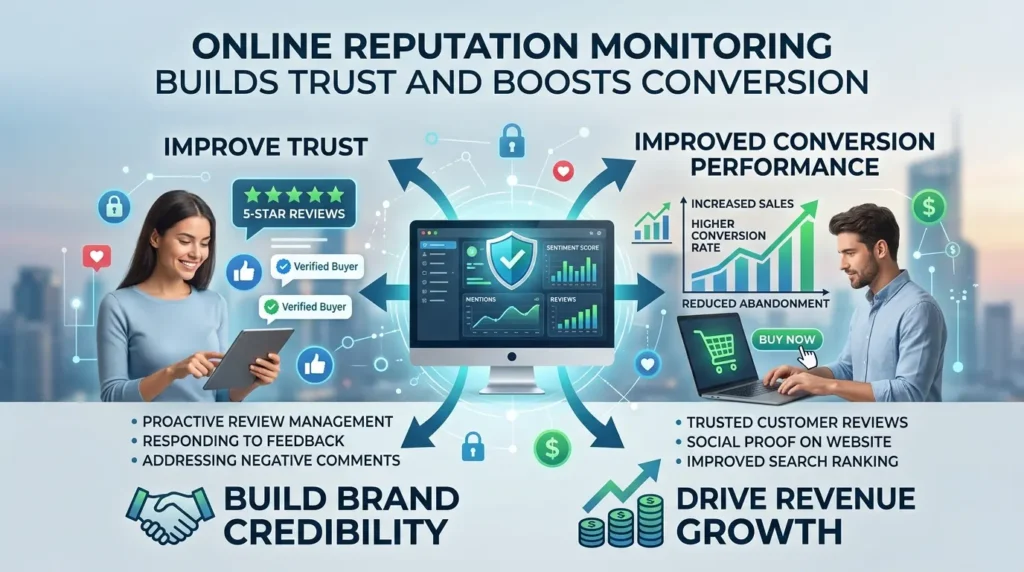
Healthcare-focused monitoring systems evaluate reputation signals across multiple environments simultaneously. Search engines assess behavioural engagement, review freshness, and authority relationships between content sources. Monitoring platforms track these factors continuously to identify visibility shifts that impact branded search performance. When negative sentiment begins influencing search perception, corrective actions restore narrative balance through authoritative content deployment and suppression strategies. This approach reduces the prominence of harmful content while strengthening high-trust assets capable of improving branded rankings. Continuous oversight ensures that reputation recovery remains sustainable rather than temporary.
The commercial value of monitoring extends beyond visibility protection. Reputation stability reduces patient hesitation, improves enquiry confidence, and supports higher conversion efficiency from organic traffic. Organisations with controlled branded SERPs generate stronger trust signals because search users encounter consistent validation instead of conflicting narratives. This consistency strengthens perceived professionalism and operational reliability. Healthcare organisations also gain improved resilience during periods of public scrutiny because monitoring frameworks already exist before reputation threats escalate. Decision-makers therefore achieve stronger risk reduction and greater long-term perception control through professional reputation oversight.
Healthcare providers evaluating long-term protection strategies often benefit from understanding online reputation monitoring across search reviews and social channels because monitoring effectiveness depends on comprehensive ecosystem coverage rather than isolated review management.
Which professional monitoring processes reduce the risk of negative content escalation?
Professional monitoring reduces escalation risk through early detection, authority analysis, and structured response implementation. Harmful content becomes commercially damaging when it gains ranking stability, engagement momentum, or publisher authority. A professional service interrupts this process before negative narratives establish dominant search visibility. This ensures that healthcare brands maintain stronger control over branded SERP composition and public perception. Risk reduction therefore depends on proactive visibility management instead of delayed reaction strategies. Consistent monitoring also improves response speed during sensitive reputation events.
The process typically includes:
- Track branded keyword movement to identify sudden ranking changes affecting search perception influence.
- Analyse review sentiment patterns to detect credibility risks before they spread across platforms.
- Monitor publisher authority signals to assess which negative assets threaten long-term SERP control.
- Deploy authoritative content assets that strengthen entity credibility and improve positive ranking distribution.
- Suppress harmful visibility through strategic optimisation, indexing control, and trust signal reinforcement.
- Strengthen review acquisition systems that improve sentiment balance and local trust indicators.
These mechanisms operate together to create sustainable reputation resilience. Search ecosystems reward consistency, authority, and engagement stability. When healthcare organisations fail to manage these factors, negative assets gain stronger ranking permanence over time. Professional monitoring services therefore focus on preserving visibility balance through continuous optimisation rather than isolated interventions. This structured approach improves narrative control while reducing the likelihood of long-term reputational damage.
Negative content suppression also works more effectively when implemented early. Search engines interpret historical engagement patterns as ranking indicators, meaning harmful content becomes harder to displace once authority strengthens. Professional services reduce this risk by intervening before search momentum consolidates. This improves recovery speed while limiting the long-term commercial impact of negative exposure. Reputation Management PR Agency applies these processes systematically to ensure healthcare organisations maintain stronger control over evolving digital trust environments.
How does professional reputation monitoring influence Google rankings and public perception?
Professional reputation monitoring influences rankings because search engines evaluate reputation signals as indicators of entity reliability and topical trustworthiness. Review quality, publisher mentions, sentiment consistency, and engagement behaviour contribute to how branded search environments develop over time. Positive signals strengthen authority relationships across indexed assets, while unmanaged negative signals weaken perceived credibility. A monitoring service ensures that high-value assets maintain stronger visibility positioning within branded and local search ecosystems. This directly improves how healthcare organisations appear during critical decision-stage searches. Stronger perception consistency also increases click confidence and conversion intent.
Read More:
Bury Negative Search Results Permanently With an Expert-Led UK Campaign
Suppress Negative Google Results Faster With a Professional UK ORM Team
Google prioritises relevance and trust alignment when ranking branded content. Monitoring systems identify visibility gaps that weaken SERP control and create opportunities for negative assets to gain prominence. Professional intervention corrects these weaknesses through structured optimisation and authoritative content reinforcement. This process improves the prominence of trusted assets such as positive reviews, expert commentary, media placements, and verified business information. Enhanced visibility distribution strengthens entity credibility while reducing the ranking influence of harmful or misleading references. Healthcare organisations therefore achieve stronger perception stability across branded searches.
Public perception also changes according to search result composition. Users interpret top-ranking content as evidence of legitimacy and operational quality. If negative articles, unresolved complaints, or inconsistent reviews dominate search results, trust declines immediately. Professional monitoring corrects these imbalances by improving the visibility of authoritative and trust-building assets. This creates stronger perception alignment between the organisation’s actual quality standards and public digital representation. The result is a more controlled, credible, and commercially effective online presence.
Healthcare providers comparing monitoring systems often review tools that help monitor online reputation because technology selection influences reporting accuracy, response speed, and visibility analysis depth.
Which outcomes justify the long-term investment in healthcare reputation management?
Healthcare reputation management delivers long-term value because digital trust compounds over time. Strong branded search environments continue influencing patient acquisition, referral confidence, and commercial credibility long after initial optimisation work begins. Professional monitoring protects this value by preventing negative visibility deterioration that would otherwise reduce trust and conversion performance. Healthcare organisations therefore gain sustained reputation stability instead of recurring recovery costs caused by unmanaged reputation risks. This makes ongoing monitoring commercially efficient as well as strategically necessary. Long-term perception control also strengthens resilience during periods of public scrutiny or operational change.

The measurable outcomes include:
- Improve branded SERP consistency to strengthen trust during high-intent healthcare searches.
- Increase positive review visibility that reinforces entity credibility and patient confidence.
- Reduce negative content prominence through sustained suppression and authority balancing.
- Strengthen local search trust signals that improve engagement with healthcare listings.
- Stabilise reputation sentiment across search engines, review platforms, and social environments.
- Protect commercial credibility during sensitive incidents through early detection and controlled response implementation.
These outcomes create measurable commercial advantages because healthcare decisions rely heavily on perceived trustworthiness. Patients evaluate digital credibility before engaging with clinics, consultants, or healthcare organisations. Search environments therefore function as trust validation systems rather than simple information channels. Professional reputation monitoring ensures these environments reinforce credibility instead of creating uncertainty. This reduces patient hesitation and improves conversion efficiency from branded traffic sources.
Cost concerns also become easier to evaluate when compared against the financial impact of unmanaged reputational decline. Negative visibility reduces enquiry rates, weakens referral confidence, and damages long-term brand authority. Recovery costs increase significantly once harmful narratives establish search dominance. Professional monitoring prevents these escalations while improving operational predictability and trust continuity. Healthcare organisations therefore gain stronger long-term value through sustained perception management instead of reactive crisis response spending.
Why does a professional UK-based service deliver more reliable reputation management results?
A UK-based service delivers stronger results because it operates within the regulatory, cultural, and search behaviour context that shapes British healthcare reputation expectations. Search perception influence depends heavily on local trust standards, review platform relevance, and media ecosystem familiarity. Professional UK services understand how NHS-related discourse, healthcare compliance expectations, and regional search behaviours affect public perception. This knowledge improves strategic decision-making and strengthens the effectiveness of monitoring interventions. Local expertise therefore enhances both visibility control and communication precision. Healthcare organisations gain reputation management aligned with real UK audience expectations instead of generic international strategies.
Professional providers also deliver stronger process clarity. Healthcare organisations require transparent reporting, measurable outcomes, and controlled implementation frameworks. A structured monitoring service provides ongoing visibility analysis, sentiment tracking, and authority reporting tied directly to commercial reputation objectives. This creates accountability while ensuring that decision-makers understand how reputation signals evolve over time. Clear process management improves trust in the service itself while reducing uncertainty around implementation effectiveness. Reliable reporting also supports strategic planning and long-term digital trust optimisation.
The reliability of a specialist provider becomes especially important during periods of reputational pressure. Healthcare brands require rapid intervention, accurate risk assessment, and sustainable recovery execution. A professional service ensures that response strategies align with search ecosystem behaviour rather than relying on isolated PR activity alone. This integrated approach improves negative content suppression outcomes while strengthening entity credibility across high-authority digital environments. Reputation Management PR Agency positions these frameworks around measurable trust restoration and long-term SERP control rather than temporary visibility adjustments.
Healthcare organisations that invest in professional monitoring gain stronger control over search perception, improved trust consistency, and sustainable reputation resilience. Continuous visibility management reduces risk, strengthens branded search performance, and ensures that public-facing reputation signals support commercial credibility rather than undermine it. A structured Healthcare Reputation Management strategy therefore functions as a long-term trust infrastructure instead of a short-term reactive measure. Professional oversight improves process certainty, stabilises perception across search ecosystems, and protects digital authority in highly competitive healthcare markets.
What is ongoing online reputation monitoring?
Ongoing online reputation monitoring is the process of tracking reviews, social media mentions, search engine results, and online discussions about a business or individual. A professional UK reputation management service helps identify negative content early and supports fast response strategies to protect brand credibility.
Why is online reputation monitoring important for businesses in the UK?
Online reputation monitoring helps UK businesses detect harmful reviews, misinformation, and negative press before they impact customer trust. Regular monitoring also improves brand transparency and allows companies to maintain a positive digital presence across search engines and review platforms.
How does a professional reputation management service monitor online mentions?
A professional reputation management agency uses monitoring tools to track brand mentions across Google search results, news sites, review platforms, forums, and social media channels. Reputation Management PR Agency can help businesses receive alerts and insights that support faster reputation response and crisis management.
Can online reputation monitoring improve search engine visibility?
Yes, reputation monitoring can support SEO by identifying negative search results and helping businesses promote positive, relevant content. Consistent reputation management also strengthens brand authority and improves how businesses appear in online searches.
How often should a business monitor its online reputation?
Businesses should monitor their online reputation continuously because customer reviews and online conversations change daily. A professional UK online reputation monitoring service provides ongoing tracking and reporting to help brands respond quickly to potential reputation risks.