

Reputation management is the process of evaluating how entities are interpreted across search engines, review platforms, and social ecosystems. Online reputation refers to the collection of indexed signals, public sentiment indicators, and authority references that influence search visibility and entity perception.
What Is Online Reputation Monitoring?
Online reputation monitoring is the continuous evaluation of reputation signals across search engines, review platforms, social channels, and indexed content sources. The process analyses how search ecosystems interpret trust, credibility, and authority through content indexing and user interaction data. Reputation monitoring defines how entities appear within search engine results pages (SERPs) and how those appearances influence public interpretation. Search algorithms evaluate consistency, recency, sentiment, and authority when ranking reputation-related content. Reviews, social mentions, articles, and forum discussions form interconnected data layers that contribute to entity perception. Monitoring systems identify how these layers influence search visibility over time.
Search engines process reputation-related information through crawling, indexing, and relevance evaluation systems. Review platforms generate structured reputation signals through ratings, keywords, reviewer authority, and engagement frequency. Social platforms contribute behavioural and sentiment signals that reinforce or weaken perceived trust. SERP evaluation combines these sources to determine which content appears prominently for branded and non-branded queries. Reputation monitoring therefore functions as a search intelligence process rather than a simple review-checking activity. The objective is to understand how search ecosystems classify and prioritise information connected to an entity.
How Do Search Engines Interpret Reputation Signals?
Search engines interpret reputation signals through entity analysis, contextual relevance, and authority assessment. Reputation signals refer to measurable indicators that define credibility, trustworthiness, and public evaluation within search ecosystems. Algorithms analyse content structure, semantic relationships, review sentiment, and engagement patterns to determine ranking relevance. Indexed references across multiple platforms strengthen entity recognition and consistency. Negative or contradictory signals reduce perceived authority when semantic alignment weakens across the ecosystem. Reputation interpretation therefore depends on both content quality and signal consistency.
How does entity perception influence search visibility?
Entity perception refers to the algorithmic understanding of a person, organisation, or brand based on indexed information. Search engines construct entity relationships through structured data, co-occurring terms, linked references, and topical consistency. When reputation signals remain aligned across platforms, search systems interpret the entity as reliable and authoritative. Inconsistent descriptions, conflicting reviews, or outdated references weaken search confidence and reduce visibility stability. SERP evaluation systems prioritise entities that demonstrate semantic consistency across trusted sources. Reputation management therefore depends on maintaining coherent informational patterns within indexed ecosystems.
Read More:
What It Means to Bury Negative Search Results and How Long It Takes
Why Suppressing Negative Google Results Is Often More Effective Than Removal
How do review platforms contribute to search evaluation?
Review platforms contribute to search evaluation through sentiment analysis, rating aggregation, and structured metadata. Algorithms process review frequency, language patterns, reviewer credibility, and recency to evaluate relevance and trust. Reviews containing descriptive semantic context provide stronger reputation signals than generic feedback. Search engines also analyse whether review sentiment aligns with broader web references and social discussions. Positive consistency across platforms reinforces authority perception within SERPs. Review ecosystems therefore operate as integrated trust databases that influence ranking interpretation.
Why Do Search Reviews Affect Online Credibility?
Search reviews affect online credibility because they function as publicly indexed trust indicators within search ecosystems. Reviews define how audiences interpret service quality, expertise, and reliability before direct interaction occurs. Search engines evaluate review sentiment alongside content authority to determine entity trustworthiness. High review consistency supports stronger reputation signals and stable SERP positioning. Negative review patterns weaken authority perception and increase visibility of critical content. Credibility therefore becomes a measurable search factor rather than a subjective opinion metric.

Review indexing creates persistent visibility within branded search queries and local search results. Search engines prioritise review-rich entities because structured feedback improves informational relevance for users. Ratings, reviewer activity, and semantic language contribute to algorithmic confidence scores. Sentiment clustering also influences automated knowledge systems that interpret entity reputation. Reviews containing detailed contextual terminology strengthen topical relevance and improve semantic associations. Search ecosystems therefore treat reviews as continuously updated reputation datasets.
How Do Social Channels Shape Reputation Perception?
Social channels shape reputation perception by generating real-time engagement signals and public sentiment references. Social platforms contribute indexed discussions, shared content, and authority interactions that influence entity interpretation. Search engines analyse social relevance indirectly through content amplification, backlink generation, and audience engagement patterns. Viral discussions accelerate reputation signal distribution across the wider web ecosystem. Positive engagement reinforces trust indicators, while negative amplification increases critical content visibility. Social ecosystems therefore influence both perception formation and search indexing behaviour.
How does social engagement influence entity trust?
Social engagement influences entity trust through interaction metrics, semantic discussions, and content distribution velocity. Search ecosystems interpret repeated mentions and consistent topical associations as indicators of relevance and public interest. Engagement patterns also affect secondary content creation across blogs, forums, and news platforms. These secondary references strengthen indexed entity relationships and reinforce reputation narratives. Trust signals increase when authoritative accounts engage with consistent informational themes. Search visibility therefore reflects broader ecosystem participation rather than isolated platform activity.
How do social mentions become searchable reputation signals?
Social mentions become searchable reputation signals when platform content is indexed and semantically connected to entity-related queries. Public posts, profile references, hashtags, and discussions contribute searchable context that algorithms interpret. Search engines evaluate language sentiment, contextual alignment, and engagement authority during indexing. High-volume discussions increase crawl frequency and content discovery speed. Social references also influence autocomplete suggestions and associated search queries within SERPs. Reputation monitoring therefore requires analysis of searchable social content alongside traditional web results.
What Creates a Digital Footprint in Search Ecosystems?
A digital footprint is the accumulated collection of indexed content, behavioural signals, and public references connected to an entity online. The footprint includes websites, reviews, social content, forum discussions, media mentions, and structured business information. Search engines continuously update this footprint through crawling and indexing processes. Every indexed interaction contributes to entity perception and search evaluation. Consistent informational patterns strengthen authority recognition, while fragmented data weakens semantic clarity. Digital footprints therefore define how search systems interpret long-term credibility.
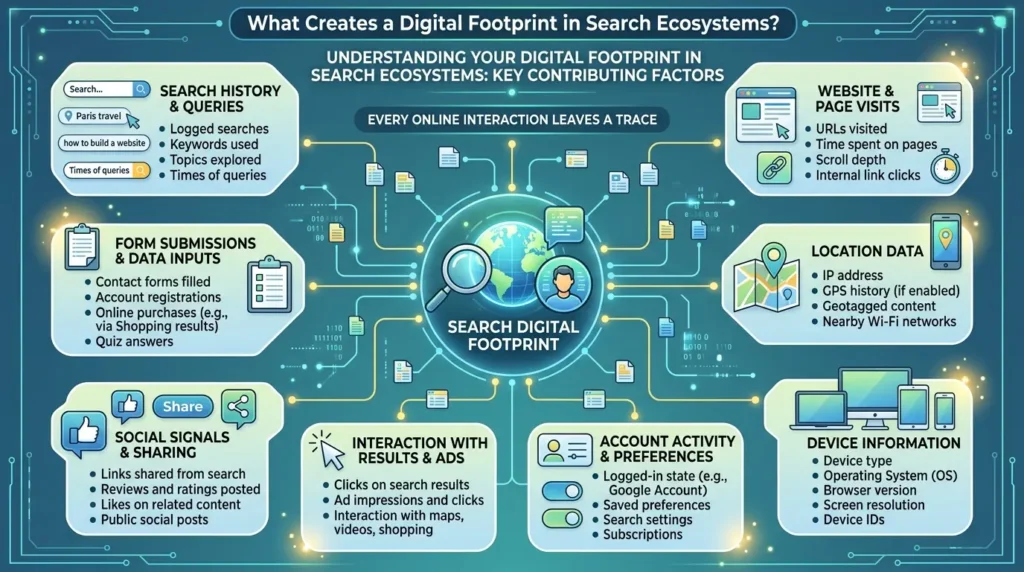
Content persistence plays a central role in digital footprint formation. Indexed pages remain searchable even after visibility declines on the original platform. Archived discussions, cached pages, and syndicated content continue influencing SERP evaluation over time. Search algorithms compare historical and recent signals to determine relevance stability. Persistent negative references therefore continue affecting perception if stronger authority signals fail to replace them. Reputation monitoring analyses this persistence to evaluate long-term visibility trends.
How Does Content Influence Reputation Rankings?
Content influences reputation rankings because search engines prioritise semantically relevant and authoritative information during SERP evaluation. Articles, reviews, videos, and social discussions all contribute to content indexing systems that define visibility. Reputation-related content shapes entity understanding through language patterns, topical relevance, and external references. Search algorithms evaluate whether content aligns with established authority signals and audience engagement metrics. High-authority content sources carry stronger influence over reputation interpretation. Rankings therefore reflect informational trust as well as keyword relevance.
How do authority signals affect content visibility?
Authority signals refer to indicators that demonstrate expertise, reliability, and contextual trust within search ecosystems. Search engines evaluate backlinks, citation consistency, publisher credibility, and engagement behaviour to determine authority strength. Content published on recognised domains receives stronger indexing confidence and improved ranking potential. Authority signals also influence how quickly content is crawled and refreshed within SERPs. Repeated topical relevance strengthens entity association and reinforces trust interpretation. Search visibility therefore depends on sustained authority validation across multiple indexed sources.
How does sentiment analysis influence ranking interpretation?
Sentiment analysis is the algorithmic evaluation of emotional and contextual language within indexed content. Search systems analyse positive, neutral, and negative language patterns to interpret public perception trends. Reviews, social posts, and editorial discussions contribute to aggregated sentiment evaluation. Consistent negative sentiment weakens perceived trustworthiness within entity assessment systems. Positive semantic associations strengthen credibility and reinforce authority signals. Ranking interpretation therefore incorporates sentiment data as part of broader reputation evaluation mechanisms.
Which Reputation Signals Carry the Most Search Value?
Reputation signals with the highest search value are those connected to authority, consistency, and semantic relevance. Search ecosystems prioritise signals that demonstrate reliable entity information across multiple trusted sources. Structured reviews, authoritative mentions, verified profiles, and consistent branding contribute strong trust indicators. Search engines also value recency because current information improves result relevance. Engagement quality carries greater importance than raw interaction volume during perception analysis. High-value signals therefore combine authority strength with semantic consistency.
Search visibility improves when reputation signals reinforce each other across platforms. Positive reviews aligned with authoritative editorial mentions create stronger credibility patterns. Consistent entity naming and factual alignment improve knowledge graph interpretation and entity recognition. Structured metadata also strengthens search clarity by improving machine-readable context. Reputation monitoring systems therefore analyse both isolated signals and their interconnected relationships. Search ecosystems interpret reputation holistically rather than through single-source evaluation.
What Risks Exist When Reputation Monitoring Stops?
Reputation monitoring gaps create delayed visibility into emerging negative signals and indexing changes. Search ecosystems continuously update rankings based on new reviews, discussions, and authority references. Unmonitored negative content gains visibility when competing positive signals weaken or become outdated. Social amplification accelerates indexing speed and increases perception volatility. Reputation instability therefore increases when signal evaluation becomes reactive rather than continuous. Search ecosystems reward informational freshness and active authority reinforcement.
Unmonitored SERP changes also affect entity trust interpretation. Negative autocomplete suggestions, declining review sentiment, or critical discussions alter public perception before direct engagement occurs. Algorithms interpret unresolved criticism as persistent relevance when engagement remains active. Search rankings then reinforce those narratives through increased visibility. Monitoring processes identify these shifts early through sentiment tracking and SERP evaluation analysis. Reputation management therefore depends on continuous informational oversight within evolving search ecosystems.
Which Tools Help You Monitor Online Reputation Before Problems Get Out of Hand?
Online reputation monitoring tools collect, categorise, and analyse reputation signals across search engines, reviews, and social channels. These systems track mentions, sentiment trends, SERP positioning, and authority references through automated indexing analysis. Monitoring platforms evaluate keyword associations, review frequency, engagement spikes, and content visibility changes. Search ecosystems generate large volumes of reputation data, making automated analysis essential for consistent evaluation. Monitoring tools therefore function as reputation intelligence systems rather than passive alert platforms. Their primary role is to identify perception shifts before negative visibility strengthens within SERPs.
How do review monitoring systems analyse reputation data?
Review monitoring systems aggregate ratings, textual feedback, and reviewer metadata from indexed platforms. Algorithms classify sentiment patterns and detect recurring semantic themes connected to trust and credibility. Frequency analysis identifies unusual changes in review activity that affect entity perception. Some systems evaluate reviewer authority and authenticity to distinguish credible signals from manipulative behaviour. Structured dashboards then visualise reputation trends across platforms and time periods. Review monitoring therefore transforms fragmented feedback into measurable search reputation indicators.
How do social listening platforms evaluate perception trends?
Social listening platforms evaluate perception trends by analysing public discussions, hashtags, engagement patterns, and semantic associations. These systems classify sentiment and identify recurring contextual narratives connected to entities. Monitoring tools also detect amplification velocity, which measures how rapidly discussions spread across channels. High amplification increases indexing probability and expands search visibility influence. Social listening therefore provides insight into emerging perception changes before they fully affect SERP evaluation. This analytical process supports broader understanding of Which Tools Help You Monitor Online Reputation Before Problems Get Out of Hand within search ecosystems.
How Does Reputation Management Apply to Healthcare Search Ecosystems?
Healthcare reputation management refers to the evaluation and monitoring of trust signals connected to healthcare entities across search ecosystems. Healthcare-related searches involve heightened algorithmic scrutiny because credibility directly affects information reliability and user safety. Search engines prioritise authoritative medical references, verified reviews, and accurate informational consistency. Patient reviews, directory listings, and professional citations all contribute to healthcare entity perception. Search visibility therefore depends heavily on expertise validation and trust alignment. Healthcare reputation management focuses on maintaining informational credibility within highly sensitive search environments.
Healthcare SERPs also demonstrate stronger reliance on authority signals and review sentiment. Medical entities with inconsistent information experience reduced trust interpretation within search evaluation systems. Review quality, factual consistency, and professional verification strengthen perceived reliability. Search ecosystems analyse healthcare content with stricter standards because misinformation creates higher reputational and informational risk. Monitoring processes therefore evaluate both visibility performance and trust signal integrity. Healthcare reputation management functions as a specialised branch of digital reputation analysis within regulated search environments.
Online reputation monitoring defines how entities are evaluated across search engines, review systems, and social ecosystems. Reputation signals influence search visibility through authority analysis, sentiment interpretation, and semantic consistency. Reviews, indexed content, and social discussions collectively shape entity perception within SERPs. Search algorithms continuously analyse credibility indicators to determine ranking relevance and trustworthiness. Digital footprints therefore operate as evolving informational structures rather than static public impressions.
Reputation management also depends on understanding how search ecosystems interpret authority and trust over time. Content indexing, sentiment analysis, and review aggregation all contribute to search perception control. Monitoring systems provide visibility into evolving reputation signals before negative narratives strengthen within search rankings. Search ecosystems reward entities that maintain consistency, authority, and contextual relevance across indexed platforms. Online reputation therefore reflects the ongoing interaction between public information, algorithmic interpretation, and search visibility dynamics.
How can I monitor my online reputation effectively?
To monitor your online reputation effectively, track brand mentions across Google search results, online reviews, social media platforms, and forums. Businesses often use reputation monitoring tools, Google Alerts, and social listening software to identify negative feedback and respond quickly.
Why is online reputation monitoring important for businesses?
Online reputation monitoring helps businesses understand how customers perceive their brand across reviews, search engines, and social channels. It also allows companies to address negative comments early, improve customer trust, and maintain a positive digital presence.
What tools are commonly used for online reputation management?
Common online reputation management tools include Google Alerts, social listening platforms, review monitoring software, and SEO tracking tools. Reputation Management PR Agency recommends combining review tracking with social media monitoring to get a complete view of brand sentiment.
How often should businesses check online reviews and social media mentions?
Businesses should monitor online reviews and social media mentions daily to respond quickly to customer concerns and protect brand credibility. Frequent monitoring also helps identify reputation risks, trending discussions, and opportunities to improve customer engagement.
Can online reputation monitoring improve search engine visibility?
Yes, consistent online reputation monitoring can support better search engine visibility by helping businesses manage reviews, respond to customer feedback, and maintain accurate brand information online. Positive engagement and high-quality reviews can also strengthen local SEO performance.