

Reputation management is the systematic process of monitoring, influencing and structuring how an entity is perceived across digital ecosystems. Online reputation refers to the aggregated set of digital signals that define an entity’s credibility, trustworthiness and visibility within search engines.
What is the difference between removing and suppressing negative Google results, and why is suppression often more effective?
Suppression is the strategic placement and optimisation of authoritative, relevant content to displace unwanted results in SERPs; removal refers to taking down content from its original source or requesting de-indexing. Suppression is a visibility management tactic operating within search ecosystems; removal is a content control action external to SERP dynamics.
Suppression defines a proactive content and SEO strategy that creates positive or neutral assets which search engines index and rank ahead of negative items. Mechanistically, suppression works by increasing competing pages’ relevance, authority and semantic alignment with target queries so algorithms prefer those pages during SERP evaluation. Removal works by eliminating the source signal that feeds search indexes; however, removal often fails because copies, caches and mirrored content persist, and removal requests are limited by legal and policy thresholds. In terms of search visibility, suppression alters the ranking landscape directly and produces predictable shifts in entity perception; removal can produce gaps in the index but does not guarantee improved SERP evaluation or entity perception.
How does suppression operate within search ecosystems to change entity perception?
Suppression is a content optimisation system that prioritises indexable assets to alter entity perception. Suppression refers to producing and optimising pages, structured data, and authoritative mentions so search engines associate the entity with favourable signals. The mechanism involves content indexing, semantic enrichment and link-authority adjustments to modify ranking scores for specific queries. Algorithms evaluate these new assets against reputation signals—content relevance, topical authority, backlink profile, on-page signals and user engagement metrics—then re-rank results accordingly.
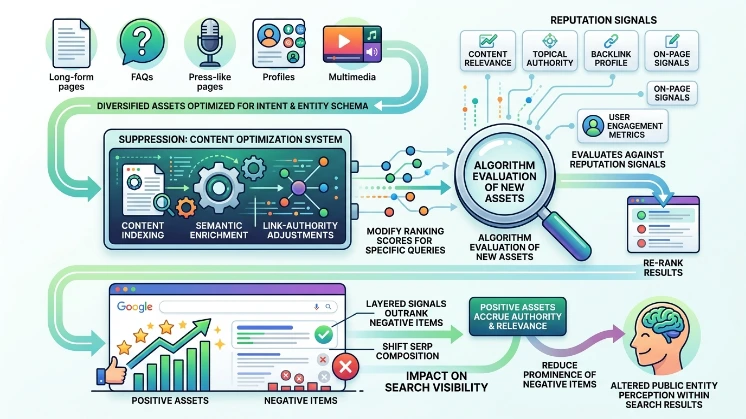
Suppression impacts search visibility by creating layered signals that outrank negative items for target queries. By generating diversified asset types (long-form pages, FAQs, press-like pages, profiles, multimedia) and optimising them for intent and entity schema, suppression shifts the SERP composition. The SERP evaluation process weights these assets against existing negative items; as positive assets accrue authority and relevance, the algorithm reduces the prominence of negative items, thereby altering public entity perception within search results.
What reputation signals do search engines use to evaluate credibility and trust?
Reputation signals are measurable indicators that algorithms use to infer trustworthiness and authority. Reputation signals include domain authority metrics, backlink provenance, content topical depth, structured entity data, user engagement metrics and sentiment patterns across indexed mentions. Each signal defines a different axis of trust: backlinks demonstrate third-party endorsement, topical depth demonstrates subject-matter authority, structured data clarifies entity relationships, and engagement metrics demonstrate user validation.
Mechanistically, algorithms convert these signals into ranking weightings during SERP evaluation. Backlinks from high-authority domains increase link equity and influence content indexing priority. Topical depth and semantic breadth produce richer embeddings and entity vectors that align with query intent. Structured entity data strengthens entity perception by connecting disparate assets under a unified knowledge representation. The impact on search visibility is cumulative: improvement in these reputation signals increases the likelihood that newly created assets outrank legacy negative items.
How does content creation influence ranking dynamics for suppression strategies?
Content creation is the primary mechanism that defines suppression outcomes within search ecosystems. Content refers to pages and assets that provide topical relevance, factual signals and user value. Creation defines targeted keyword coverage, semantic scope and linking frameworks that the algorithm evaluates during indexing and ranking. The mechanism involves drafting pages that satisfy intent, integrating entity signals (schema, author attribution), and establishing inter-asset hierarchies that direct crawling and indexing priority.
Content influences perception by occupying search result real estate with coherent, authoritative narratives that algorithms interpret as preferred matches for target queries. Search visibility improves when content demonstrates relevance (matching queries), authority (backlinks and citations), and engagement (click-through and dwell metrics). As these assets accumulate, ranking dynamics shift: algorithms downgrade lesser relevant or lower-authority items and uplift content that aligns with signal profiles defined by the suppression strategy.
How do review signals and sentiment interpretation affect suppression outcomes?
Review signals are explicit user-generated data points—ratings, review text, recency and reviewer authority—that algorithms incorporate into reputation scoring. Sentiment interpretation refers to natural language processing processes that classify review tone and factual assertions and then map them to reputation metrics. Review signals define direct signals of user satisfaction; sentiment interpretation refines the semantic understanding of those signals.
Mechanistically, search engines aggregate review signals and apply sentiment analysis to evaluate overall polarity and topical toxicity. High volumes of negative sentiment elevate the ranking weight of negative items when queries include reputation-related modifiers. For suppression, strategies must dilute negative review prominence by increasing visibility of neutral or positive reviews and by creating content that contextualises review narratives. The impact on search visibility is quantitative: positive review signals and favourable sentiment reduce the relative ranking strength of negative items for branded and non-branded queries.
How do algorithms interpret authority and trust signals when ranking competing content?
Algorithms interpret authority and trust through combined signal models that include link equity, content provenance, authoritativeness, and structured entity associations. Authority is a computed property derived from link networks, citation contexts and domain history; trust refers to signals such as secure infrastructure, transparency markers and verifiable authorship. Together these inform the algorithm’s entity perception framework.
Mechanistically, ranking models integrate these signals into feature vectors representing each indexed asset. Assets with stronger trust signals (high-quality backlinks, clear author credentials, accurate structured data) receive higher probability scores during SERP evaluation. For suppression, increasing an asset’s authority requires targeted link acquisition from authoritative domains, clear provenance statements, and schema markup that binds the asset to the entity. The resulting impact on search visibility is a reordering of SERP entries where higher-authority assets displace lower-authority negative content.
Build patient trust and strengthen online credibility with professional Healthcare Reputation Management that enhances authority signals, verified credentials, and search visibility. By reinforcing trustworthy content and credible entity associations, healthcare organisations can improve SERP performance and maintain a stronger reputation across digital channels.
What role does entity structuring (schema and knowledge graphs) play in suppressing negative results?
Entity structuring is the explicit representation of the entity across structured data, knowledge graph signals and interconnected content. Entity structuring refers to the use of schema markup, canonicalisation, and consistent NAP (name, address, phone) or organisational descriptors across assets. The mechanism converts unstructured content into machine-readable entity data that search engines link to knowledge graphs and entity resolvers.
Entity structuring influences search visibility by consolidating disparate assets under unified identifiers that algorithms treat as authoritative. Properly structured entities create stronger entity perception signals and reduce ambiguity that allows negative content to claim relevance for branded queries. For suppression, the tactic requires tagging assets with schema types (Organisation, Person, Review, Article) and ensuring consistent entity mentions across high-authority sites. The impact is measurable: improved knowledge panel signals, increased likelihood of rich results for positive assets, and decreased organic space for negative results.
How does content indexing and crawl prioritisation affect the speed and permanence of suppression?
Content indexing is the process by which search engines discover, parse and store content; crawl prioritisation is the algorithmic decision about which assets to crawl frequently and deeply. Indexing defines presence in the search index; crawl prioritisation defines update velocity for ranking features. Both determine suppression speed and persistence.
Mechanistically, assets on crawl-favoured domains with strong internal linking and sitemap signals receive faster indexing and re-evaluation. High-frequency indexing accelerates SERP shifts because algorithms recalculate ranking signals sooner. For suppression, publishing assets on platforms with favourable crawl profiles and ensuring robust internal link architecture increases indexing velocity. The permanence of suppression depends on ongoing signal maintenance: authority signals must be sustained or increased to prevent re-emergence of negative items during subsequent SERP evaluations.
Dive Deeper With Our Expert Guides and Related Blog Posts:
What Happens After You Submit a Google Content Removal Request Online
How to Remove Content From Google and What Qualifies for Delisting
What metrics define successful suppression within SERP-focused reputation strategies?
Successful suppression is defined by measurable shifts in search visibility and entity perception metrics. Key metrics include SERP position displacement of negative items, share of top-10 results occupied by controlled assets, changes in knowledge panel content, sentiment distribution across indexed mentions, and engagement indicators on replacement assets (CTR, dwell time). Each metric defines a different dimension of reputation outcome: position displacement measures visibility change, share-of-SERP measures real-estate control, and engagement metrics measure perceived relevance.
Mechanistically, these metrics feed back into ranking models—improved CTR and dwell time strengthen a page’s relevance signals, while increased backlink quality improves authority metrics. For suppression strategies, tracking these metrics demonstrates effectiveness and guides iterative optimisation. The impact on search visibility is direct: consistent metric improvements correlate with sustained displacement of negative results.
How does a content and SEO strategy specifically suppress negative Google results?

A content and SEO strategy suppresses negative results by creating authoritative, targeted assets and optimising them for ranking features tied to the negative query set. The strategy refers to keyword-mapped asset creation, entity-aligned schema markup, high-quality backlink acquisition, internal linking hierarchies, review management alignment, and performance optimisation for engagement metrics. The mechanism involves aligning these tactics to the specific intent and phrasing that currently surface negative results.
Execution demonstrates the suppression effect through layered assets: authoritative long-form pages define topical depth; FAQ and Q&A pages satisfy common query variants; structured profiles anchor entity identity; and backlink campaigns increase authority. The combined outcome is a reweighted SERP evaluation where these assets rank above negative items.
Get the Full Insights Here:
How to Suppress Negative Google Results Using Content and SEO Strategy
Suppression is a systems-orientated approach to reputation management that operates within search ecosystems to change entity perception. It defines a repeatable set of content, entity and authority signals that algorithms evaluate during SERP assessment. Removal addresses content provenance but does not directly reconfigure ranking dynamics; suppression directly targets search visibility by creating and optimising assets that produce stronger relevance and trust signals. Effective suppression requires deliberate entity structuring, signal acquisition, and measurement of SERP displacement and engagement metrics to ensure durable improvements in online reputation.
Answers to Key Questions
What is healthcare reputation management and why does it matter for patient trust?
Healthcare reputation management is the systematic process of monitoring, influencing and protecting how a healthcare organisation is perceived across digital ecosystems. It matters because patient trust depends on online credibility, review signals and search visibility that directly influence care decisions.
How do negative Google results impact healthcare entity perception and patient acquisition?
Negative Google results degrade entity perception by surfacing distrust signals that algorithms associate with lower credibility during SERP evaluation. This reduces patient acquisition because search visibility for branded and non-branded healthcare queries shifts toward negative content.
What strategies suppress negative healthcare results without removing content?
Suppression strategies create authoritative, optimised assets long-form pages, FAQs, press-like content and structured profiles that outrank negative items through content indexing and authority signals. This approach is more effective than removal because it directly alters SERP dynamics and entity perception
How does Reputation Management PR Agency support healthcare reputation management?
Reputation Management PR Agency provides systematic monitoring, content creation, entity structuring and review management to strengthen healthcare reputation signals. The agency focuses on informational governance rather than promotion, ensuring search ecosystems reflect accurate entity perception.