

Reputation management is the practice of monitoring and shaping how an entity is perceived across digital systems. Online reputation refers to the aggregate of signals, content and indexed entities that search engines present when the entity is queried.
What defines a lawyer’s online reputation in search ecosystems?

A lawyer’s online reputation is the composite set of indexed signals that represent the lawyer’s entity profile within search engines. This definition frames reputation as an information construct that search systems assemble from web pages, structured data, links, reviews, news and social traces.
The mechanism that creates this reputation begins with entity identification: search engines extract a lawyer’s name, location, practice areas and associated identifiers (for example, professional registration numbers and schema.org markup) and link those identifiers to web documents. Search engines then cluster documents and attributes into an entity graph that defines who the lawyer is, what they do and which digital assets belong to them. This entity graph forms the baseline for subsequent SERP evaluation and content indexing.
The impact on search visibility and perception is direct. If the entity graph contains high-authority signals (government sites, legal directories with structured markup, professional publications) the lawyer’s search visibility increases for authoritative queries. Conversely, weak or contradictory entity signals reduce the clarity of the lawyer’s representation in search results and degrade perceived credibility.
How do search engines interpret trust and credibility for a lawyer?
Trust and credibility in search ecosystems are evaluative scores that algorithms compute from quantifiable reputation signals. Trust is an algorithmic metric derived from provenance, linking patterns and content authority. Credibility is an interpretive label applied when content demonstrates consistent expertise, transparency and verifiable facts.
The mechanism uses multiple subsystems: link analysis evaluates provenance and citation networks; content analysis assesses topical cohesion and signals of expertise; structured data and verified profiles supply provenance metadata; review and rating feeds supply sentiment metrics. These subsystems combine into a reputation score that influences ranking and SERP features allocation.
The impact on search visibility and perception appears through ranking adjustments and feature presence. High trust and credibility produce elevated ranking for knowledge panels, rich snippets and entity panels. Low trust yields suppressed organic placement and increased prominence of third-party negative content in the SERP evaluation.
What role does content indexing play in shaping a lawyer’s search reputation?
Content indexing is the process by which search engines crawl, parse and store web content and associated metadata; it is the foundational mechanism that converts documents into retrievable reputation signals. Indexed content defines what information is available for entity perception and SERP construction.
The mechanism includes crawling frequency, canonicalisation, structured data parsing and semantic extraction. Search engines extract named entities, topics, dates and relationship cues from indexed pages, then map those extractions to the entity graph. Index freshness and canonical stability determine which content pieces dominate the entity representation.
The impact on search visibility and perception is substantial: newly indexed authoritative content can shift SERP narratives quickly, while stale or deindexed content creates gaps in the entity profile. Proper indexing of authoritative content improves entity perception by supplying reliable evidence for reputation claims.
How do review signals and sentiment interpretation affect a lawyer’s SERP profile?
Review signals are structured or semi-structured pieces of feedback that quantify user evaluations; sentiment interpretation is the algorithmic classification of those reviews into positive, neutral or negative sentiment. Together they form measurable reputation signals that feed SERP evaluation.
The mechanism reads aggregated star ratings, review frequency, review recency and review source authority. Algorithms weight professional reviews (regulated legal directories) higher than unverified consumer platforms. Sentiment analysis models parse review text for complaint themes and correlate patterns with other reputation signals such as article topics or complaint filings.
Strengthen public perception with professional Celebrity Reputation Management that improves review sentiment, credibility signals, and search visibility across digital platforms. By enhancing positive feedback and reinforcing trusted online assets, celebrities can build stronger authority, protect their reputation, and maintain a favourable SERP presence.
How do authority and trust signals differ and combine within search algorithms?
Authority is a signal that indicates the degree to which other credible entities reference or validate the lawyer’s content. Trust is a signal that indicates provenance certainty and absence of conflicting identity signals. Authority is citation-based; trust is provenance-based.
The mechanism for authority uses link graphs, citation networks and editorial mentions to measure endorsement. The mechanism for trust uses verified identifiers, HTTPS provenance, consistent structured data and authoritative directory presence to verify entity legitimacy. Algorithms combine these through weighted models where provenance inconsistencies reduce the effective weight of authority signals.
The impact on search visibility and perception is multiplicative: high authority without trust results in limited SERP benefits because algorithms apply friction where provenance is uncertain. High trust without authority yields visibility constrained to basic entity results without elevated feature presence. Combined authority-plus-trust generates sustained, high-ranking SERP positions and positive entity perception.
What is the effect of conflicting or duplicate digital footprints on entity perception?
A conflicting or duplicate digital footprint is when multiple web signals present inconsistent or overlapping identity data for the same lawyer. This situation fragments the entity graph and increases uncertainty in the SERP evaluation.
The mechanism occurs when variations in name formatting, incorrect structured data markup, multiple unconnected profiles, or copied content cause search systems to create parallel nodes for the same entity. Algorithms attempt to reconcile duplicates via canonicalisation heuristics and entity resolution; unresolved duplicates introduce noise into ranking models.
The impact on search visibility and perception is dilution of reputation signals. Fragmentation reduces concentrated authority and lowers the clarity of the entity profile, enabling lower-quality content to occupy SERP real estate. This increases the probability that negative or irrelevant content will surface for brand queries.
How do algorithms evaluate negative content and complaint signals about a lawyer?
Algorithms evaluate negative content by scoring source credibility, severity indicators and signal density. Negative content that originates from high-provenance sources (regulatory filings, reputable news outlets) carries greater weight than low-provenance forum posts.
The mechanism relies on source scoring, cross-signal correlation and temporal decay. Algorithms cross-check negative claims against authoritative sources and penalise content when corroborated by high-trust references. They apply temporal decay to older negative items where no corroboration persists, while persistent or frequently cited negative items maintain higher ranking weight.
The impact on search visibility and perception is systematic: corroborated negative items occupy prominent SERP positions and function as high-salience reputation signals. Uncorroborated or low-trust negative content tends to rank lower and has reduced effect on overall entity perception unless it accumulates signal density across multiple sources.
How does entity perception change through content topicality and thematic depth?
Entity perception changes when content demonstrates topical depth and thematic coherence across the entity graph. Topicality is the match between indexed content topics and common user queries; thematic depth is the breadth and depth of content addressing those topics.
The mechanism consists of semantic content networks that link topical nodes through internal linking, metadata and semantically related terms. Search algorithms evaluate topic authority by measuring coverage breadth, depth of explanation, and internal coherence across documents associated with the entity. Entity perception improves when semantic networks present a consistent topical narrative.
The impact on search visibility and perception is that focused topical authority yields stronger relevance signals for niche queries, increased chance of rich result features and a higher entity prominence in professional query contexts. Broad but shallow content produces diluted relevance and lower SERP authority.
How do structured data and verified profiles function as reputation signals?
Structured data and verified profiles are explicit provenance markers that provide machine-readable entity details and verification claims. Structured data is machine-parsable markup on web pages; verified profiles are platform-level attestations of identity.
The mechanism involves search engines parsing schema.org markup, OpenGraph tags and structured contact data to connect pages to the entity graph. Verification mechanisms such as platform verification badges and registry entries serve as cross-reference points that reduce identity ambiguity. Algorithms treat these as high-value trust signals.
The impact on search visibility and perception is direct: pages and profiles with accurate structured data and verified attributes receive stronger entity associations and higher priority in SERP evaluation. These signals also increase the likelihood of generating knowledge panels and authoritative snippets.
Dive Deeper With Our Expert Guides and Related Blog Posts:
Why Solicitor Reputation Management Is Tightly Linked to SRA Compliance
Why Law Firm Reputation Management Influences Client Instructions in the UK
How do link-building and citation practices influence legal entity reputation?
Link-building and citation practices influence reputation by creating endorsement pathways that feed authority measures within search algorithms. Citation practices involve references from reputable legal resources, academic publications and government pages.
The mechanism uses backlink authority metrics, anchor-text relevance and contextual placement to assign weight to endorsements. Algorithms evaluate the provenance of linking sources and penalise manipulative linking patterns. High-value citations from authoritative legal sources propagate authority through the entity graph.
The impact on search visibility and perception is increased topical authority and elevated ranking for queries that rely on external validation. Poorly executed link tactics produce noise and trigger algorithmic corrections that reduce link effectiveness.
How is reputation signal change measured and validated in search ecosystems?
Reputation signal change is measured through quantifiable metrics such as ranking shifts for branded queries, SERP feature presence, review sentiment scores, entity panel updates and backlink profile changes. Validation requires cross-checking indexing status, structured data parsing and source authority evaluations.
The mechanism employs analytics tools for SERP monitoring, indexing diagnostics for crawl and coverage, sentiment analysis for review texts and backlink audits for citation changes. Algorithms provide indirect validation through observed ranking changes and SERP feature adjustments following content or structural updates.
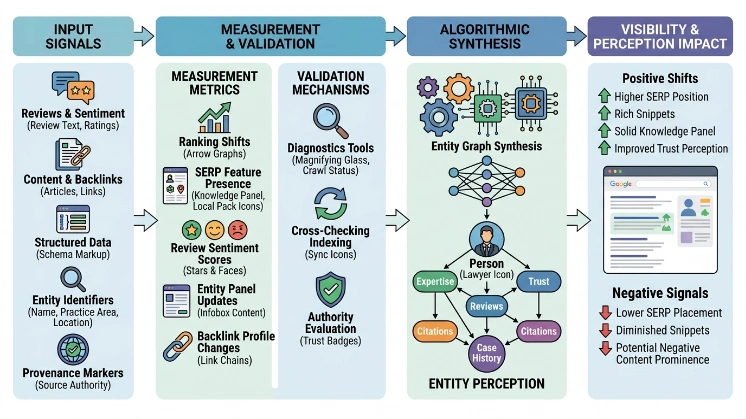
The impact on search visibility and perception is measurable: positive shifts in measured signals correlate with improved entity perception and higher placement in SERP evaluation. Persistent negative signals correlate with decreased visibility and elevated negative content prominence.
This analysis defines how a lawyer’s online reputation is constructed within search ecosystems and explains how algorithms interpret trust, authority and sentiment to shape entity perception. Reputation signals originate from entity identification, content indexing, review sentiment, structured data, citation networks and provenance markers. Algorithms synthesise these signals into an entity graph, then apply SERP evaluation to present a coherent perception to searchers. Understanding these mechanisms clarifies how specific actions alter search visibility and reputation outcomes without relying on promotional narratives.
Get the Full Insights Here:
What Shapes a Lawyer Online Reputation Beyond Reviews and Directory Listings
Answers to Key Questions
What is celebrity reputation management and how does it work?
Celebrity reputation management is the strategic process of monitoring, protecting and shaping a public figure’s digital perception across search and social ecosystems. At Reputation Management PR Agency, the approach combines reputation signals analysis, content indexing control and crisis response to maintain trusted entity perception.
How quickly can a reputation crisis be addressed for a celebrity?
Reputation crises can be addressed within hours through rapid content suppression, authoritative PR placements and targeted search reputation interventions. Reputation Management PR Agency deploys immediate SERP evaluation and content indexing adjustments to limit negative visibility during critical windows.
What services are included in celebrity reputation management?
Services include ongoing reputation monitoring, negative content mitigation, authoritative content creation, structured data optimisation and review sentiment management. A reputation management PR agency integrates these into a coordinated celebrity reputation management framework that aligns search visibility with trusted entity perception.
How does search visibility affect a celebrity’s public perception?
Search visibility determines which reputation signals appear first when a celebrity is queried, directly shaping entity perception and digital trust. High-quality authority signals and positive content indexing improve SERP evaluation outcomes, while low-trust signals increase negative content prominence in search results.
Why is structured data important for celebrity reputation management?
Structured data provides machine-readable provenance markers that help search engines accurately identify and verify a celebrity’s entity profile. Reputation Management PR Agency uses schema.org markup and verified profiles as high-value trust signals within celebrity reputation management to strengthen entity perception and reduce identity ambiguity.