

Reputation management strategies differ based on target audience, legal context, and channel control. Online reputation control methods are evaluated through reputation signals, entity credibility metrics, search ranking influence, and sentiment distribution across the SERP.
Reputation management strategies differ based on organisational goals, risk tolerance, and the balance between content suppression and content enhancement. Online reputation control methods are evaluated through measurable reputation signals such as backlink quality, content relevance, schema usage, sentiment distribution, and search ranking influence.
How do content creation and content removal strategies compare for shaping a lawyer’s online reputation?
Content creation is the proactive production of authoritative material to establish entity credibility. Content creation operates by publishing targeted pages, authored articles, multimedia assets, and optimised profiles that accumulate positive reputation signals and relevant backlinks.
This approach increases search ranking influence for desired queries by expanding the volume of high-quality, topically relevant pages tied to a lawyer’s entity. Strengths include sustainability, control over messaging, and cumulative improvements to entity credibility; limitations include time-to-impact, resource intensity, and difficulty displacing entrenched negative assets without strong distribution and backlink strategies. Content removal is the reactive elimination or delisting of undesired assets through takedown requests, legal channels, or publisher agreements. Content removal operates by reducing visibility of specific negative items, thereby altering sentiment distribution on the SERP and lowering direct exposure to damaging content.
Strengths include immediate reduction of specific risks and clear quantifiable results where removal succeeds; limitations include limited scalability, legal and jurisdictional constraints, inconsistent publisher cooperation, and potential residual indexing or mirror copies that sustain negative reputation signals. In search ecosystems, content creation modifies SERP composition by adding enhanced assets that compete for ranking, whereas content removal directly eliminates ranked items; the former improves long-term search ranking influence, the latter provides short-term risk mitigation.
How does organic reputation management compare with reactive (crisis-driven) approaches?
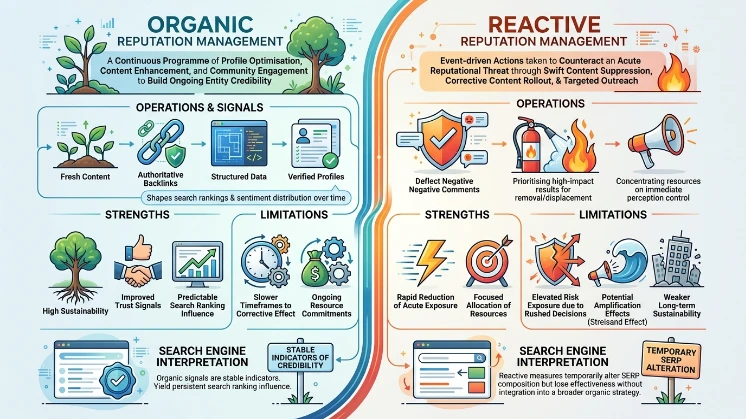
Organic reputation management is a continuous programme of profile optimisation, content enhancement, and community engagement to build ongoing entity credibility. Organic management operates by consistently generating reputation signals fresh content, authoritative backlinks, structured data, and verified profiles that shape search rankings and sentiment distribution over time. Strengths include high sustainability, improved trust signals, and predictable search ranking influence; limitations include slower timeframes to corrective effect and ongoing resource commitments.
Reactive reputation management is an event-driven set of actions taken to counteract an acute reputational threat through swift content suppression, corrective content rollout, and targeted outreach. Reactive management operates by prioritising high-impact search results for removal or displacement and by concentrating resources on immediate perception control. Strengths include rapid reduction of acute exposure and focused allocation of resources; limitations include elevated risk exposure due to rushed decisions, potential amplification effects (the Streisand effect), and weaker long-term sustainability if reactive measures lack follow-up organic reinforcement.
Search engines interpret organic signals as stable indicators of entity credibility, so organic approaches yield persistent search ranking influence; reactive measures temporarily alter SERP composition but lose effectiveness without integration into a broader organic strategy.
How effective are legal takedown methods versus technical suppression techniques for negative content?
Legal takedown is the formal use of statutory or contractual mechanisms to compel removal of content or delisting by publishers and platforms. Legal takedown operates by asserting rights—defamation law, privacy statutes, or contractual breaches to eliminate sources of negative-reputation signals. Effectiveness depends on jurisdictional clarity, clear legal grounds, and the willingness of platforms to comply; success yields definitive removal of targeted content and immediate alteration of SERP composition.
Limitations include high cost, time consumption, cross-border enforcement challenges, and the potential for counter-litigation that increases risk exposure. Technical suppression is the use of SEO and platform-specific tactics, indexing controls, robots.txt, noindex tags, canonicalisation, and negative SEO countermeasures to reduce the visibility of unwanted pages. Technical suppression operates by manipulating crawl and index behaviour or by diluting ranking signals through competing assets.
Strengths include lower cost than litigation, scalability for owned properties, and reversible controls; limitations include inability to force third-party publishers to alter content, risk of incomplete suppression (cached or mirrored pages), and limited effect on sentiment distribution if third-party coverage remains. Search ranking influence accrues differently: legal takedown removes ranked items outright where successful, whereas technical suppression adjusts ranking signals and prioritises content enhancement to displace negatives.
How do data-driven SEO strategies compare with PR-led reputation strategies in influencing trust signals?
Data-driven SEO is an analytical approach that optimises content architecture, schema markup, link profiles, and keyword targeting to measure and improve search ranking influence. Data-driven SEO operates by tracking reputation signals quantitatively organic traffic, SERP positions, backlink authority, and sentiment distribution—and iteratively refining content to enhance entity credibility. Strengths include measurable impact, replicable processes, and scalability across keywords; limitations include reduced effectiveness on non-search reputation channels and potential over-optimisation that harms perceived authenticity. PR-led reputation strategy is relationship-focused outreach that secures earned coverage, corrections, and authoritative mentions to shape public perception and third-party validation.
A PR-led strategy operates by generating high-quality reputation signals—third-party endorsements, press features, and expert citations—that increase perceived entity credibility and produce backlinks that influence search rankings. Strengths include strong trust signals from independent sources and qualification of reputation through authoritative mentions; limitations include variable measurability, editorial gatekeeping, and resource intensity for sustained media engagement. In search ecosystems, data-driven SEO directly alters on-page and technical signals for ranking advantage, while PR-led efforts create off-page signals that amplify entity credibility and complement SEO-driven content enhancement.
How do suppression (burying) tactics compare with enhancement (amplifying) tactics in terms of sustainability and risk?
Suppression is the strategic lowering of negative content visibility by promoting alternate assets to outrank undesirable results. Suppression operates by building or optimising competing pages, utilising targeted backlinks, and leveraging platform signals to push negative items off page one. Strengths include targeted SERP composition changes and focused allocation of resources; limitations include temporary effects if negative pages regain authority, high maintenance to preserve displacement, and risk exposure if suppression activities trigger scrutiny from platforms or search algorithms. Enhancement is the creation and amplification of positive, authoritative content to strengthen overall entity credibility and sentiment distribution. Enhancement operates by increasing the volume and quality of owned and earned assets—thought leadership pieces, case studies, client testimonials, and verified profiles—that collectively lift search ranking influence. Strengths include long-term sustainability, cumulative trust signal improvement, and lower legal risk; limitations include slow initial impact, resource demands for high-calibre content, and potential mismatch between content tone and legal ethical constraints for lawyers. Search engines reward sustained enhancement with stable ranking influence and improved entity credibility, while suppression achieves faster SERP composition changes with higher ongoing maintenance and risk.
How do short-term interventions compare with long-term reputation programmes for a lawyer’s online profile?
Short-term interventions are targeted actions press statements, emergency takedowns, rapid distribution of corrective content designed to alter immediate perception and SERP composition. Short-term interventions operate by concentrating resources on high-visibility assets to reduce exposure and to shape sentiment distribution quickly. Strengths include immediate impact on search visibility and limited-duration mitigation; limitations include transient results, potential amplification, and lack of persistent entity credibility improvement. Long-term programmes are sustained strategies combining content creation, technical SEO, PR, and governance to improve entity credibility and maintain positive reputation signals.
Build lasting digital credibility with professional Celebrity Reputation Management that combines immediate reputation protection with long-term authority and trust-building strategies. By strengthening positive search signals and maintaining consistent online visibility, celebrities can achieve sustainable reputation growth and greater control over SERP perception.
Dive Deeper With Our Expert Guides and Related Blog Posts:
How Solicitor Reputation Management Covers Reviews Search and Client Trust
How Law Firm Reputation Management Works Across Reviews Rankings and Press
How do various strategies influence how search engines interpret reputation signals?
Search engines interpret reputation signals through a combination of content relevance, authority metrics, user engagement, and entity consistency. Content creation and enhancement influence relevance and authority by providing high-quality pages aligned with target queries; this increases search ranking influence and stabilises entity credibility.
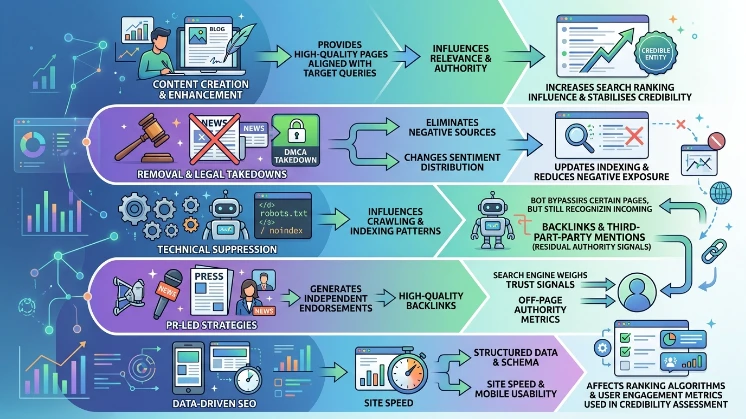
Removal and legal takedowns influence signals by eliminating sources that negatively affect sentiment distribution search engines update indexing and reduce negative exposure when removals succeed. Technical suppression influences crawling and indexing patterns to reduce visibility of specific assets but leaves backlinks and third-party mentions as residual authority signals. PR-led strategies influence off-page authority metrics by generating independent endorsements and high-quality backlinks, which search engines weigh as trust signals.
Data-driven SEO influences measurable signals structured data, site speed, mobile usability that affect ranking algorithms and user engagement metrics used in credibility assessment. Each strategy alters a distinct set of inputs search engines use to evaluate entity credibility and ranking outcomes.
What are the scalability, risk exposure, and sustainability trade-offs across reputation methods?
Content creation scales through repeatable processes content templates, pillar pages, and distribution workflows enabling predictable search ranking influence and growth. Risk exposure for content creation remains low when content adheres to ethical and factual standards; sustainability remains high because value accrues over time. Content removal exhibits low scalability due to legal complexity and publisher dependence; risk exposure remains high because takedowns can provoke countermeasures, and sustainability is limited as removed content resurfaces in new locations.
Technical suppression scales on owned properties and platform-controlled assets but does not scale across third-party publishers; risk exposure is moderate because misconfiguration can harm organic visibility, and sustainability requires ongoing maintenance. PR-led approaches scale unevenly effective for high-value placements but resource-intensive for continuous coverage—risk exposure remains moderate, with sustainability dependent on consistent relationship management. Short-term interventions scale poorly beyond initial crises and carry high risk exposure due to potential reputational backlash; sustainability is low without integration into long-term programmes.
Content creation is a sustainable mechanism for improving entity credibility and search ranking influence, while content removal provides targeted but limited suppression of specific negative signals. Organic programmes deliver durable trust signals; reactive and short-term interventions deliver immediate visibility shifts at the cost of higher risk exposure and lower longevity. Data-driven SEO provides measurable levers to adjust reputation signals; PR-led strategies supply third-party trust that amplifies search ranking influence. Strategic choices require balancing immediate risk mitigation against long-term sustainability, choosing interventions that align with legal constraints, resource capacity, and the desired composition of the SERP.
Read More to Understand Better:
Strengthen Your Lawyer Online Reputation With a Structured UK Strategy
Answers to Key Questions
What is celebrity reputation management, and how does it work?
Celebrity reputation management is the strategic process of protecting and enhancing a public figure’s digital trust through monitoring, content creation, and crisis response. It works by controlling reputation signals across search engines, social platforms, and news outlets to shape sentiment distribution and entity credibility.
How long does it take to repair a celebrity’s online reputation after a crisis?
Repair timelines vary based on crisis severity, but initial reputation suppression tactics can reduce negative visibility within 2–4 weeks. Long-term recovery typically requires 6–12 months of sustained content enhancement, PR outreach, and SEO-driven entity credibility building to restore search ranking influence.
What services are included in a celebrity reputation management strategy?
Core services include negative content suppression, positive content creation, social media monitoring, review management, PR campaign coordination, and search engine result page (SERP) control. A comprehensive strategy combines technical SEO, crisis communication, and ongoing reputation signal optimisation to maintain digital trust.
Can a reputation management PR agency remove negative search results about a celebrity?
Direct removal depends on legal grounds (e.g., defamation, privacy violations), but a reputation management PR agency can use takedown requests, legal delisting, and technical suppression to reduce visibility. For non-removable content, the agency focuses on content enhancement and SERP composition changes to displace negative results.