

Reputation management is the practice of understanding and influencing how an entity appears within search ecosystems. Online reputation refers to the aggregate of indexed signals, content, and user interactions that define an entity’s representation on search engine results pages (SERPs).
Search reputation is the measurable set of signals that define an entity’s perceived credibility and relevance across search engine indexes. Search reputation refers to an entity’s indexed profile (pages, mentions, reviews, social signals) and metadata that search engines use to construct an entity profile. Search reputation defines relevance through associations, topical authority, and historical behaviour recorded by crawlers and indexers.
Search reputation works by aggregating discrete data points: content items, backlinks, review entries, structured data, and user engagement metrics. Crawlers discover content, parse semantic markup and natural language, and assign topical labels that map to entity graphs. Indexing stores those labels and raw content; ranking algorithms evaluate them against query intent, entity prominence, and trust indicators. The result appears on SERPs as link lists, knowledge panels, snippets, and review stars, which together form the visible reputation.
Search reputation impacts perception and visibility directly. High search reputation produces prominent SERP placements, authoritative knowledge panels, and positive snippet framing. Low search reputation produces negative placements, reduced organic visibility, and amplified negative content within SERP real estate. Search engines present a synthesized entity perception based on these signals, shaping how users interpret an entity before clicking.
How is personal reputation formed in UK search results?
Personal reputation is formed through the indexed corpus of digital content that establishes associations between a person and topics, events, or attributes. Personal reputation refers to the collection of pages, mentions, media assets, and review or comment threads that search engines link to an individual entity within the index.
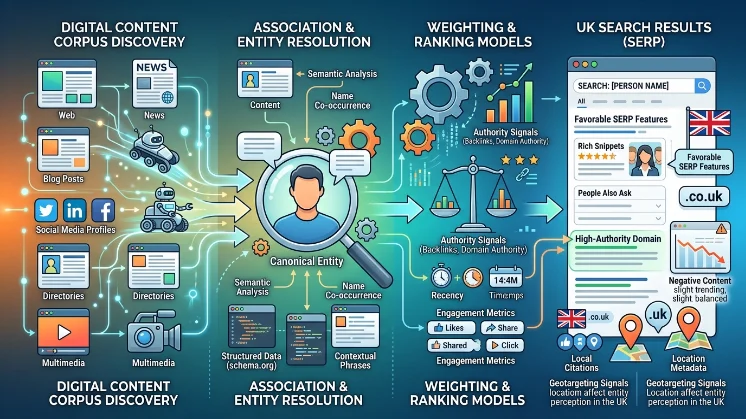
Formation occurs in three stages: discovery, association, and weighting. Discovery happens when crawlers encounter content that references the person: articles, social profiles, directories, and multimedia. Association happens when semantic analysis links those references to a canonical entity using name co-occurrence, structured data (schema.org), and contextual phrases. Weighting occurs when ranking models score those associations by authority signals (backlinks, domain authority), recency, and engagement metrics.
The mechanism determines SERP placement and snippet content. High-authority domains, repeated contextual co-occurrence, and consistent structured data increase the probability of favourable SERP features (rich snippets, people also ask). Conversely, isolated low-authority mentions or highly engaged negative content can climb rankings if algorithmic signals prioritise relevance to user queries. For UK-centric searches, geotargeting signals (ccTLDs, local citations, location metadata) also adjust entity perception and the SERP evaluation process.
How do search engines interpret trust and credibility for personal profiles?
Trust and credibility are algorithmic constructs derived from verifiable signals that search models treat as proxies for reliability. Trust refers to the presence of corroborating, authoritative sources; credibility refers to consistency and provenance of claims across indexed assets.
Search engines evaluate trust through backlink ecosystems, editorial context, and domain reputation. Backlinks from established editorial sites demonstrate corroboration; structured citations in authoritative databases supply provenance. Credibility assessment relies on consistency across content (matching biographical details, persistent identifiers), presence of schema markup identifying the entity, and absence of contradictory claims in high-authority sources.
The mechanism combines graph-based entity resolution and classifier outputs that penalise contradictory or isolated claims. When trust signals align — corroborated facts on authoritative sites, consistent structured markup — algorithms increase search visibility for those pages. When trust signals conflict — unsupported negative claims on niche sites with strong engagement — the algorithm’s relevance scoring can still elevate those claims for certain queries, affecting entity perception.
How does content influence perception and ranking within SERPs?
Content influences perception by supplying the textual and multimedia evidence search engines use to build an entity’s representation. Content refers to indexed pages, metadata, alt text, review text, and multimedia transcripts that contain signals about the entity’s attributes and roles.
Content influences ranking via topical relevance, semantic density, and entity co-occurrence. Search algorithms compute relevance by matching query intent to content semantics and by assessing topical authority through depth and coverage. Semantic signals such as named entities, relationship phrases, and schema markup guide content indexing and snippet extraction. High-quality content on recognised domains increases ranking weight; technically optimised content (correct headings, metadata, structured data) increases the likelihood of favourable SERP features.
Perception shifts when content framing emphasises particular attributes. Neutral, fact-based content with corroborating sources increases perceived credibility in SERP snippets. Content containing emotive or sensationalised language does not directly affect ranking if hosted on low-authority domains; however, high engagement with such content can alter ranking relevance and therefore perception, since engagement acts as an implicit endorsement signal.
What role do review signals and sentiment play in search reputation?
Review signals are structured or semi-structured user-generated entries that express evaluative judgements; sentiment refers to the net positive or negative polarity derived from textual content. Review signals are reviews, ratings, and aggregated sentiment on platforms indexed by search engines.
Search ecosystems treat review signals as direct reputation inputs for certain entity types. Mechanisms include structured review markup, aggregated rating displays, and review snippets in local or vertical-specific SERPs. Algorithms extract sentiment using natural language processing and integrate aggregated polarity into entity scoring models for queries that signal evaluative intent.
Impact on search visibility is strong for queries seeking evaluative information (e.g., “X reputation”, “X reviews”). Positive aggregated review signals yield richer SERP features (rating stars, review counts) and higher click-through rates. Negative review signals increase the probability of negative snippets or highlighted negative content appearing within SERPs, reducing perceived credibility. For personal profiles, review and sentiment signals from professional listings, industry forums, and local directories contribute to entity perception, particularly in verticalised search results.
How do authority and trust signals interact to shape entity perception?
Authority is the demonstrated topical expertise of content sources; trust is the corroboration and provenance that support factual claims. Authority refers to domain-level or publisher-level topical depth; trust refers to source reliability and factual alignment within the entity graph.
Interaction occurs through weighting mechanisms in ranking models. Authority amplifies the effect of content signals: content on high-authority domains receives a higher base score. Trust provides a stability modifier: corroborated claims across trusted sources reduce volatility in SERP evaluation and increase the permanence of certain snippets or knowledge panel attributes.
When authority and trust align, entity perception becomes robust: algorithms consistently present similar content, resulting in stable, favourable SERP real estate. When authority and trust diverge (high-authority domain containing uncorroborated allegations), ranking models use additional signals — recency, explicit citations, and editorial corrections — to moderate impact. For UK searches, recognised public records, reputable media and academic sources serve as higher-weight trust signals within the entity graph.
How does the digital footprint determine long-term reputation dynamics?
Digital footprint is the cumulative, indexed record of online outputs associated with an entity: published pages, social posts, archived content, and structured records. Digital footprint refers to persistent indexing and link relationships that form the long-term dataset used by search systems to model an entity.
The mechanism is cumulative: every indexed asset joins the entity graph and influences future indexing and ranking decisions. Older, high-authority content accrues backlinks and citations that stabilise entity perception; newer content can shift perception rapidly if it appears on similarly authoritative channels or receives high engagement. Search engines maintain temporal weighting factors that balance recency against historical corroboration when producing SERP evaluation.
Long-term reputation dynamics favour content that is stable, corroborated and hosted on authoritative domains. Fragmented footprints — inconsistent names, duplicate profiles, or conflicting records — increase noise in entity graphs and reduce search visibility for authoritative content. Managing footprint consistency (canonical naming, structured data) influences indexing outcomes and entity resolution within search ecosystems.
How do algorithms evaluate conflicting information and negative content?
Algorithms evaluate conflicting information by assigning probabilistic weightings to sources and claims within the entity graph. Conflicting information refers to divergence in factual claims about an entity across indexed sources.
Evaluation uses source reliability scoring, citation density, and temporal factors. Mechanisms include cross-source verification, trust scores for domains, and classifier-based contradiction detection. Algorithms prioritise claims that are corroborated by multiple high-trust sources and recently validated records. Negative content can rank highly when it matches user intent and features strong engagement or appears on a domain with substantial authority.
Strengthen digital credibility with professional Celebrity Reputation Management that helps balance negative narratives with authoritative content and trusted reputation signals. By improving search visibility, reinforcing accurate information, and building stronger entity trust, celebrities can maintain greater control over how they are perceived online.
Dive Deeper With Our Expert Guides and Related Blog Posts:
How a Lawyer’s Online Reputation Is Built and Damaged in Google Search Today
Why Solicitor Reputation Management Is Tightly Linked to SRA Compliance
How do structured data and entity markup affect SERP evaluation?
Structured data is machine-readable markup that explicitly identifies entities and attributes within content. Entity markup refers to schema elements that link content to the knowledge graph.
Structured data defines relationships for crawlers, improving entity resolution and reducing ambiguity in indexing. Mechanisms include schema.org Person, Organisation, and Review markup; linked data identifiers such as Wikidata; and consistent use of canonical tags. When markup signals align across multiple pages, search engines update the knowledge graph with structured attributes, increasing the chance of knowledge panels, rich snippets, and accurate result summarisation.
Effect on visibility is material: correctly implemented structured data increases the probability of enhanced SERP features and more accurate snippet generation. Structured data also reduces the misattribution risk that arises from ambiguous naming, improving the fidelity of entity perception in search results.
How does regional context (UK) influence reputation signals and rankings?
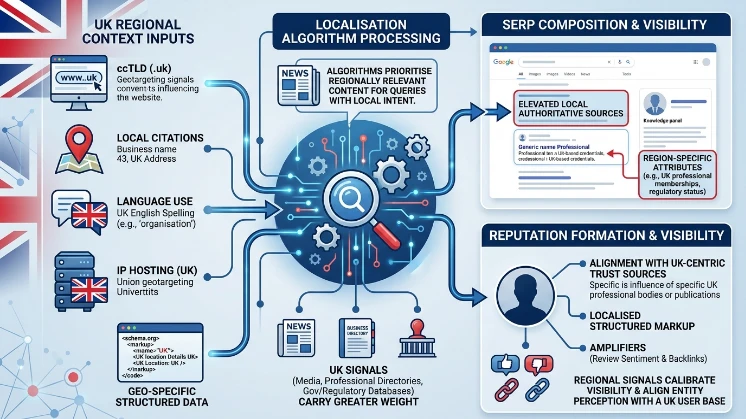
Regional context is geotargeting signals and local relevance factors that tailor SERP evaluation to an audience’s locale. Regional context refers to ccTLDs, local citations, language use, IP hosting, and geo-specific structured data.
Mechanisms involve localisation algorithms that prioritise regionally relevant content for queries with local intent. For UK audiences, signals from .uk domains, UK media, UK professional directories, and local government or regulatory databases carry greater weight in entity perception. Search engines use user location, query signals and regional content prominence to determine SERP composition.
Regional influence affects visibility by elevating local authoritative sources and surfacing region-specific attributes in knowledge panels. For personal reputation in the UK, alignment with UK-centric trust sources and consistently localised structured markup improves search visibility and aligns entity perception with a UK user base.
This analysis defines how personal reputation forms and deteriorates within UK search ecosystems by tracing the mechanics of content discovery, entity association, and ranking evaluation. Key insights: reputation is an indexable construct; search engines operationalise trust and authority through measurable signals; content and structured data shape SERP evaluation; review sentiment and backlinks act as amplifiers; and regional signals calibrate visibility for UK audiences. Understanding these system-level mechanisms clarifies which indexed signals drive perception and which interventions alter the balance of SERP representation.
Discover More Insights:
Comparing Personal Reputation Management Options Available in the UK
Answers to Key Questions
What is celebrity reputation management and why is it important?
Celebrity reputation management is the process of monitoring, improving, and protecting a public figure’s online presence across search engines, news platforms, and social media. It focuses on strengthening positive reputation signals and reducing the visibility of damaging or misleading content.
How does Reputation Management PR Agency help celebrities manage their online reputation?
Celebrity reputation management improves search results by promoting authoritative content, strengthening entity credibility, and increasing positive content visibility. This helps create greater SERP control and supports a more accurate public narrative.
Can negative online content about a celebrity be suppressed?
Negative content suppression involves increasing the prominence of trusted and relevant content so that harmful material becomes less visible in search results. This approach helps reduce reputational risk while improving search perception.
How long does celebrity reputation management take to show results?
Timelines depend on the competitiveness of search results, existing reputation challenges, and content authority levels. Most strategies focus on sustainable improvements that strengthen visibility and trust over time.