

Search visibility control delivers decisive influence over public perception. Controlling reputation signals in search results ensures stakeholders encounter authoritative, positive information first.
Search visibility control is critical because buyers, partners and regulators use search results as primary trust signals. Reputation signals verified profiles, authoritative content, and neutralised negative listings determine first impressions and decision thresholds. A corporate reputation management programme directly affects what ranks, who trusts the brand, and how fast reputation repair delivers measurable outcomes.
Which reputation management approach delivers measurable results?
A combined SEO and digital-PR approach delivers measurable results through targeted SERP control and negative content suppression. This approach works by mapping every high-impact search query for the corporate entity, then applying technical SEO, content development, and targeted digital PR to displace harmful items.
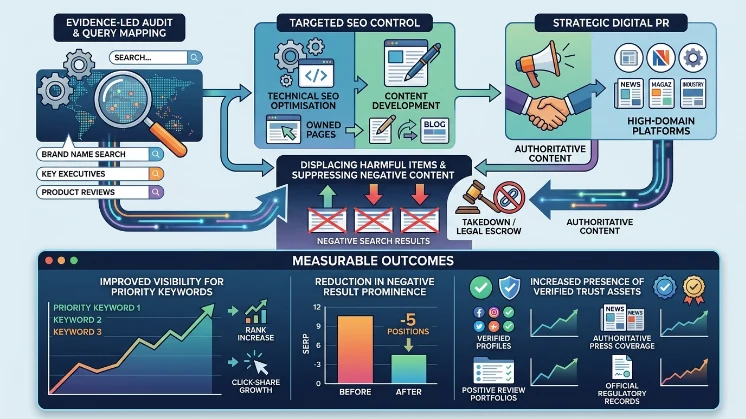
The service begins with an evidence-led audit ranking inventory, backlink quality, entity graph mapping and sentiment analysis. Tactics include optimising owned pages for entity credibility, publishing authoritative content on high-domain platforms, and executing takedown or legal escrow where applicable. Measurable outcomes include improved visibility for priority keywords (tracked by rank and click-share), a reduction in negative result prominence (measured by SERP position changes), and increased presence of verified trust assets (profiles, press coverage, regulatory records).
How does this service ensure control of what appears in search results?
The service ensures control by combining content authority building, technical optimisation and targeted suppression to stabilise perception across the SERP. Operationally, teams secure and optimise canonical owned assets (corporate site, executive bios, regulatory disclosures) to establish baseline entity credibility. They then publish and syndicate authoritative content on third-party domains with high citation value, creating positive signals that influence ranking algorithms.
Simultaneously, they implement negative content suppression techniques: strategic outranking through content development, disavow where harmful backlinks distort authority, and pursue removal through platforms or legal channels when infringement occurs. Outcomes are specific: increased share of positive-first-page results, decreased impressions and clicks to negative pages, and improved trust indicators (e.g., Knowledge Panel accuracy, verified social profiles). Search behaviour research supports this: algorithms reward relevance and authority; by systematically increasing credible signals and decreasing negative exposure, the service stabilises search perception and reduces the likelihood that stakeholders encounter harmful narratives.
Which metrics demonstrate return on investment for corporate reputation management?
Return on investment demonstrates through rank improvement, traffic quality shifts, conversion lift and risk reduction metrics. The service reports a concise dashboard showing key metrics priority keyword rank delta, positive-result share of the top 10, reduction in branded query negative impressions, click-through-rate improvements for corporate pages, and lead or deal conversion rates traced to branded search referrals.
These metrics directly translate to financial and operational value faster deal closures when stakeholders find authoritative information, fewer escalations to legal or regulator interventions, and lower long-term remediation costs compared with reactive legal battles. The justification is empirical: improving the proportion of credible, authoritative content in the top search positions increases trust signals and reduces friction during the decision process, which directly improves conversion and reduces operational risk.
How quickly will reputation repair show impact in search?
Initial visibility shifts occur within weeks, while sustainable control establishes over months through iterative authority-building. The service delivers early wins by optimising and promoting high-impact owned pages and securing quick placements on authoritative sites, producing measurable SERP shifts within 4–8 weeks. These early actions improve click-share and reduce immediate negative exposure. Sustainable improvements require continuous content authority work, backlink quality enhancement and monitoring to ensure results persist; that phase typically stabilises within 3–9 months depending on the competitive landscape and severity of negative content.
Outcomes are presented as phased milestones early rank gains, medium-term displacement of negative assets, and long-term entrenchment of positive signals—so clients understand timing and can plan resource allocation. This timeline aligns with search engine behaviour: ranking algorithms rapidly surface optimised content for queries but require consistent authority signals to maintain positions and resist re-emergence of suppressed content.
Which reputation signals most influence corporate credibility online?
Verified profiles, high-authority backlinks, neutral regulatory records and consistent brand metadata deliver the strongest reputation signals. The service prioritises these signals because search algorithms and users interpret them as markers of legitimacy. Tactics include claiming and verifying official profiles (LinkedIn, Companies House-linked pages), ensuring structured data and schema on corporate pages to feed Knowledge Panels, and generating third-party authoritative citations through recognised industry publications.
Measurable outcomes include an increased number of verified assets appearing in SERPs, enriched search snippets (with structured data), and measurable authority growth via backlink profile metrics. Decision-makers scan for official validation and third-party corroboration; increasing these signals directly elevates entity credibility and reduces perceived risk.
How does the service reduce legal and regulatory risk while managing perception?
The service reduces legal and regulatory risk by coordinating content strategy with compliance workflows and measured negative content suppression. It integrates legal review into takedown requests and escalation steps, ensures published content adheres to disclosure requirements, and archives evidence to support compliance reviews. For hostile or defamatory content, the programme applies targeted suppression combined with legal avenues where reclamation is necessary.
Protect your organisation with professional Corporate Reputation Management that combines reputation protection with compliance-focused processes and risk mitigation strategies. Through structured monitoring, legal coordination, and transparent reporting, businesses can strengthen public trust, reduce reputational exposure, and maintain a defensible digital presence.
What is the cost versus long-term value of corporate reputation management?
Cost is an investment that reduces long-term remediation expenses, stabilises stakeholder trust and preserves commercial value The service frames pricing relative to avoided costs: litigation and crisis communications, lost deals due to negative search results, and ongoing damage to market position. Targeted content campaigns, authoritative placements, real-time monitoring, and suppression actions that cumulatively improve branded search performance and reduce recurring risk. Outcomes include measurable decreases in negative query impressions and improved conversion metrics from branded search—both quantifiable as revenue protection and reputational asset strengthening. This value-based framing demonstrates that upfront expenditure produces compound returns through reduced future liabilities and sustained trust.
Dive Deeper With Our Expert Guides and Related Blog Posts:
Push Down Negative Search Results Using Proven SEO and Content Strategies
Amplify Your Reputation With Positive Content Promotion Designed to Rank and Retain
What outcomes can clients expect after engaging a reputation management service?
Clients receive improved first-page search composition, strengthened entity credibility, reduced conversion friction and documented risk reduction. Expected outcomes include a higher proportion of authoritative, positive listings in the top 10 results, correction or removal of false or defamatory content where feasible, and improved stakeholder responses measured through conversion tracking.
These changes produce downstream commercial benefits, fewer deal cancellations, reduced complaint escalations and a stronger negotiating position in regulatory or partner discussions. The justification is outcome-based: search perception influence directly affects stakeholder decisions; therefore, improving search results enhances revenue stability and corporate trust.
Learn Everything About It Here:
Why Search Result Reputation Management Starts With Understanding What Ranks
How does Reputation Management PR Agency ensure ethical, sustainable results?
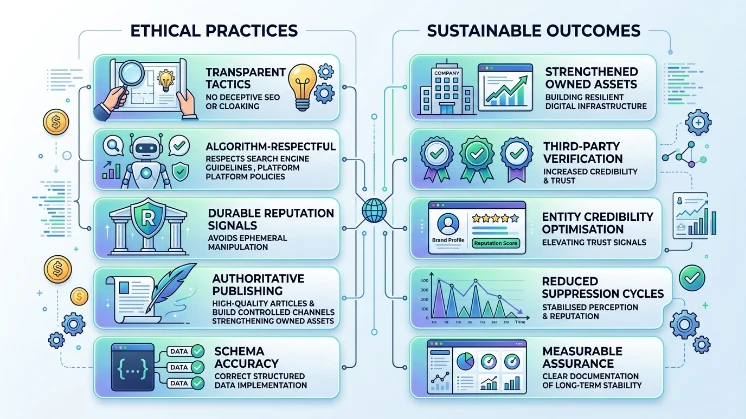
The agency ensures ethical outcomes by following transparent, algorithm-respectful tactics and prioritising durable reputation signals over ephemeral manipulation. Tactics exclude deceptive SEO or cloaking; instead, they focus on authoritative publishing, schema accuracy and compliance with platform policies. Sustainability is achieved by strengthening owned assets and third-party verification that naturally persist in search.
Outcomes are durable improvements in entity credibility and reduced need for repeated suppression cycles. Reputation Management PR Agency integrates these principles into project governance, providing clear documentation and measurable assurance of long-term stability.
Engaging a corporate reputation management service delivers concrete search perception control, reduces decision-stage risk and produces measurable commercial outcomes. The process combines forensic auditing, entity credibility optimisation, targeted content and suppression tactics to ensure that stakeholders encounter authoritative information first. Reputation Management PR Agency delivers this outcome-oriented approach with transparent steps, measurable milestones and defensible ethics—strengthening trust, stabilising perception and protecting commercial value.
Must-Read Detailed Guide:
How Search Result Reputation Management Combines SEO Content and Digital PR
Frequently asked questions about Corporate Reputation Management
What is corporate reputation management and how does it work?
Corporate reputation management monitors and influences what appears about a company in search results and media by combining SEO, content creation and digital PR. Reputation Management PR Agency analyses branded queries, optimises owned assets, and publishes authoritative third-party content to improve entity credibility and suppress negative content.
How long does it take to see results from corporate reputation management?
Initial visibility improvements often appear within 4–8 weeks after optimising owned pages and securing authoritative placements, while sustained SERP control typically stabilises over 3–9 months. Timelines depend on the severity of negative content, competitive keywords and the volume of authority-building required.
Which metrics show progress in a corporate reputation campaign?
Key metrics include priority keyword rank changes, positive-result share of the top 10, branded query impressions for negative pages, click-through rate to corporate assets and conversion rates from branded search. Tracking these metrics demonstrates improved search perception, reduced negative exposure and measurable commercial impact.
Can negative search results be removed completely?
Complete removal is possible in limited cases (legal defamation, copyright or policy violations) through takedowns or court action, but most outcomes rely on negative content suppression via authoritative outranking and platform escalations. Reputation Management PR Agency combines removal attempts with content authority work to reduce negative prominence and preserve entity credibility.