

Search result reputation management integrates SEO content creation with digital PR to directly influence what appears in search engine results pages for entity queries. Reputation management strategies differ based on whether organisations prioritise content suppression, content enhancement, or SERP composition control. Online reputation control methods are evaluated through their impact on reputation signals, entity credibility, and search ranking influence.
What Are the Core Mechanisms of Search Result Reputation Management?
Search result reputation management operates by manipulating the composition of search results through two primary mechanisms: creating optimised content that ranks positively and leveraging digital PR to suppress negative results. The mechanism combines semantic content network principles with PR distribution strategies to achieve measurable changes in sentiment distribution across SERPs.
Content creation approaches build new positive assets that rank for target queries using semantic SEO techniques. These assets include blog posts, press releases, case studies, and profile pages engineered with entity-focused optimisation. Digital PR approaches secure placements on high-authority news sites and industry publications that dominate search results for branded and entity queries.
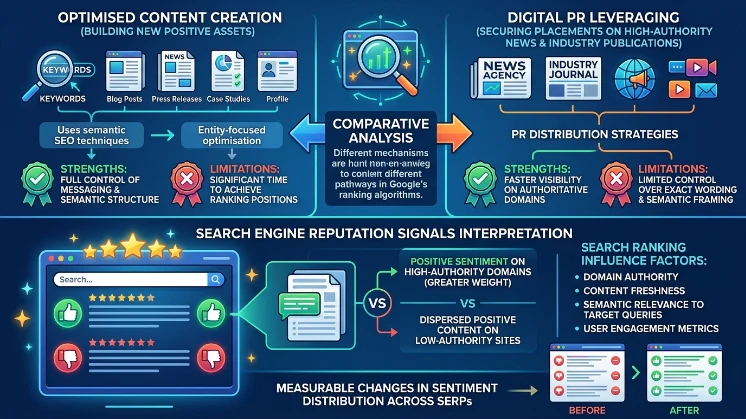
The comparative analysis reveals distinct strengths and limitations. Content creation offers full control over messaging and semantic structure but requires significant time to achieve ranking positions. Digital PR delivers faster visibility on authoritative domains but provides limited control over exact wording and semantic framing. Both mechanisms influence SERP composition through different pathways in Google’s ranking algorithms.
Search engines interpret reputation signals by analysing sentiment distribution across result pages. Positive sentiment concentrated on high-authority domains carries greater weight than dispersed positive content on low-authority sites. The search ranking influence depends on domain authority, content freshness, semantic relevance to target queries, and user engagement metrics.
How Do Content Creation Strategies Compare With Content Removal Approaches?
Content creation strategies build positive search results through systematic SEO content production, while content removal approaches attempt to eliminate negative results through legal requests, platform policies, or technical suppression. Content creation is Y sustainable for long-term reputation management whereas content removal operates as a reactive measure with limited scalability.
Content creation operates by publishing semantically optimised assets that rank for target queries. The mechanism includes generating entity-focused content with proper internal linking structures, semantic keyword coverage, and structured data implementation. These assets accumulate historical data signals that strengthen ranking positions over time.
Content removal operates through formal requests to platforms hosting negative content, legal action against publishers, or technical methods that push negative results below visible SERP positions. The mechanism relies on platform policies, copyright claims, privacy regulations, or the sheer volume of new positive content displacing negative results through ranking competition.
Content creation demonstrates superior effectiveness for scalability and sustainability. Organisations can produce unlimited positive assets with predictable resource allocation. Content removal faces fundamental limitations: many platforms refuse removal requests without legal grounds, successful removals are temporary if negative content reappears, and the approach cannot address content hosted on independent news sites with strong legal protections.
Risk exposure differs significantly between approaches. Content creation carries minimal risk with standard copyright and editorial considerations. Content removal introduces legal costs, potential backlash from perceived censorship attempts, and uncertainty regarding outcomes. The long-term impact of content creation builds cumulative entity credibility while removal approaches create recurring costs without accumulating positive reputation signals.
What Are the Differences Between Organic and Reactive Reputation Management Approaches?
Organic reputation management builds positive search results through proactive content production and sustained digital PR efforts, while reactive approaches address negative incidents through targeted suppression and damage containment. Organic approaches measure effectiveness through gradual sentiment distribution improvement whereas reactive approaches evaluate success through negative result displacement speed.
Organic approaches operate by establishing comprehensive semantic content networks covering entity attributes, values, and expertise areas. The mechanism includes publishing regular content pieces with semantic SEO optimisation, maintaining active profiles on high-authority platforms, and securing consistent digital PR placements. These activities accumulate historical data that strengthens entity credibility over time.
Reactive approaches operate through rapid deployment of counter-content following negative incidents, legal removal requests, and targeted PR campaigns addressing specific criticisms. The mechanism prioritises speed over semantic completeness, focusing on displacing negative results within visible SERP positions rather than building comprehensive positive coverage.
Organic approaches demonstrate stronger long-term impact with compounding returns on entity credibility. The sentiment distribution shifts gradually but sustainably as positive assets accumulate ranking positions. Reactive approaches achieve faster short-term results for specific incidents but require continuous investment to maintain displacement of negative content.
Scalability favours organic approaches with predictable content production workflows and PR relationships. Reactive approaches scale poorly due to incident-specific resource requirements, legal complexity, and unpredictable outcomes. Risk exposure is lower for organic approaches operating within standard editorial and copyright frameworks. Reactive approaches face higher legal costs, reputational risks from perceived censorship, and uncertainty regarding effectiveness.
How Do Short-Term and Long-Term Reputation Management Strategies Differ in Effectiveness?
Short-term reputation management strategies prioritise rapid displacement of negative results through reactive content deployment and removal requests, while long-term strategies build sustainable entity credibility through systematic semantic content network development. Short-term impact measures immediate SERP composition changes whereas long-term impact evaluates cumulative reputation signal strength and entity credibility growth.
Short-term strategies operate by publishing targeted counter-content addressing specific negative incidents, securing urgent digital PR placements on high-authority news sites, and submitting removal requests to platforms hosting damaging content. The mechanism focuses on achieving visible SERP changes within weeks rather than building comprehensive semantic coverage.
Long-term strategies operate by developing complete topical maps covering entity attributes, values, expertise areas, and industry positions. The mechanism includes systematic content production with semantic SEO optimisation, sustained internal linking structures, structured data implementation, and ongoing digital PR relationships that accumulate historical data signals.
Short-term strategies demonstrate effectiveness for immediate crisis containment with measurable SERP composition changes within 30-60 days. However, effectiveness diminishes without sustained investment as negative content reappears or new incidents emerge. Long-term strategies show slower initial impact but deliver compounding returns as entity credibility strengthens and reputation signals accumulate across the semantic content network.
Sustainability fundamentally distinguishes these approaches. Short-term strategies require continuous reactive investment with no cumulative benefits beyond immediate displacement. Long-term strategies build permanent entity credibility that resist future negative incidents through established ranking positions and strong reputation signals. Risk exposure is lower for long-term approaches operating within standard content production and PR frameworks versus short-term approaches involving legal costs and censorship perceptions.
How Do Search Engines Interpret Reputation Signals Across SERPs?
Search engines interpret reputation signals by analysing sentiment distribution, domain authority concentration, content freshness, and user engagement patterns across search result pages for entity queries. Reputation signals operate as aggregate measurements rather than individual content assessments, with high-authority domain placements carrying disproportionate influence on entity credibility calculations.
The mechanism involves Google’s systems scanning SERPs for target queries and analysing sentiment patterns across result pages. Positive sentiment concentrated on domains with strong editorial standards and high authority scores generates stronger reputation signals than dispersed positive content across low-authority sites. The system weighs recent content freshness against established historical data to balance current performance with track records.
Search ranking influence depends on multiple interacting factors. Domain authority determines baseline ranking potential for target queries. Semantic relevance to query terms and entity attributes determines content inclusion in results. User engagement metrics including click-through rates, dwell time, and bounce rates provide behavioural signals validating content quality. Structured data and internal linking structures strengthen semantic clarity for entity recognition systems.
Sentiment distribution analysis extends beyond simple positive-negative counting. The system evaluates sentiment context, including whether positive content addresses specific entity attributes versus generic praise, and whether negative content provides verifiable facts versus opinion-based criticism. Domain reputation affects sentiment weighting, with negative content from established news organisations carrying more weight than similar content from unverified sources.
Dive Deeper With Our Expert Guides and Related Blog Posts:
What Makes an SEO Strategy Effective at Pushing Down Negative Search Results
How Positive Content Promotion Works Alongside SEO and PR to Build Authority
What Factors Determine the Effectiveness of Different Reputation Management Strategies?
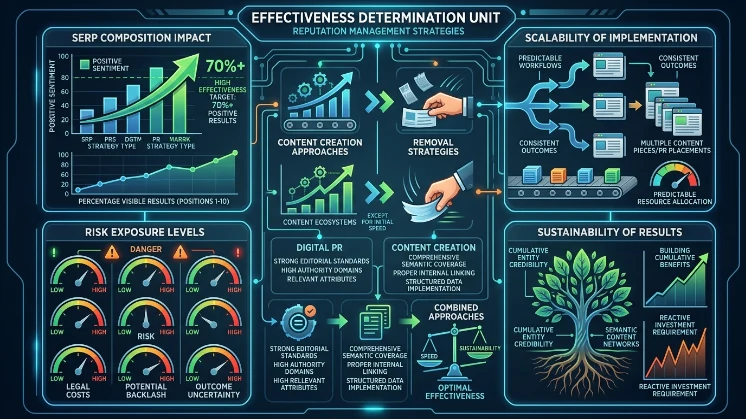
Effectiveness determination depends on four measurable criteria impact on SERP composition, scalability of implementation, risk exposure levels, and sustainability of results. High-effectiveness strategies demonstrate strong SERP composition changes with predictable resource allocation, minimal legal or reputational risks, and cumulative benefits extending beyond immediate implementation periods.
SERP composition impact measures the percentage of visible results (typically positions 1-10) that contain positive sentiment for target entity queries. Strategies achieving 70%+ positive results demonstrate high effectiveness. Scalability assesses whether strategy implementation follows predictable workflows with consistent outcomes across multiple content pieces or PR placements. Risk exposure evaluates legal costs, potential backlash, and outcome uncertainty levels.
Sustainability measures whether positive SERP composition persists without continuous reactive investment. Strategies building cumulative entity credibility through semantic content networks demonstrate superior sustainability versus those requiring ongoing reactive deployment. The comparative analysis shows content creation approaches outperform removal strategies across all four criteria except initial speed of results.
Digital PR effectiveness depends on securing placements on domains with strong editorial standards and high authority scores relevant to entity attributes. Content creation effectiveness requires comprehensive semantic coverage of entity topics with proper internal linking and structured data implementation. Combined approaches leveraging both mechanisms achieve optimal effectiveness by balancing speed with sustainability.
How Does Search Result Reputation Management Influence Corporate Reputation Management Outcomes?
Search result reputation management directly influences corporate reputation management outcomes by determining what potential stakeholders, investors, customers, and employees encounter when searching for entity information. The combination of SEO content and digital PR creates measurable changes in sentiment distribution that affect business outcomes including hiring quality, investor confidence, customer acquisition, and partner relationship development.
Organisations implementing comprehensive search result reputation management demonstrate stronger entity credibility across stakeholder touchpoints. The mechanism involves positive search results reinforcing positive media coverage, professional profiles, and business listings that stakeholders encounter during evaluation processes. This creates cumulative reputation signal strength that resists negative incidents through established ranking positions.
Strengthen stakeholder confidence with professional Corporate Reputation Management that improves search visibility, sentiment perception, and entity credibility across digital channels. By combining proactive content strategies with reputation monitoring, businesses can build stronger trust signals, enhance SERP control, and support long-term corporate growth.
Check Out the Full Article:
Reshape What Appears in Search Results With Expert UK Reputation Management
Frequently Asked Questions About Corporate Reputation Management
What is corporate reputation management and why does it matter?
Corporate reputation management is the strategic practice of monitoring, influencing, and maintaining how stakeholders perceive a business across search results, media, and review platforms. It matters because strong entity credibility directly impacts customer trust, investor confidence, hiring quality, and long-term business viability.
How does search result reputation management combine SEO content and digital PR?
Search result reputation management combines SEO content creation with digital PR placements to control what appears in SERPs for entity queries. SEO content builds semantically optimised assets that rank positively while digital PR secures high-authority news placements that suppress negative results through SERP composition control.
What are the main methods used in corporate reputation management?
The main methods include content creation strategies that publish positive SEO-optimised assets, content removal approaches that attempt to eliminate negative results, and digital PR campaigns that secure authoritative media placements. Each method operates through different mechanisms with varying effectiveness, scalability, risk exposure, and sustainability characteristics.
How long does it take to see results from corporate reputation management efforts?
Short-term reactive strategies can show SERP composition changes within 30–60 days through targeted counter-content and removal requests. Long-term organic approaches building semantic content networks typically require 6–12 months to accumulate sufficient historical data and entity credibility for sustained ranking positions.