
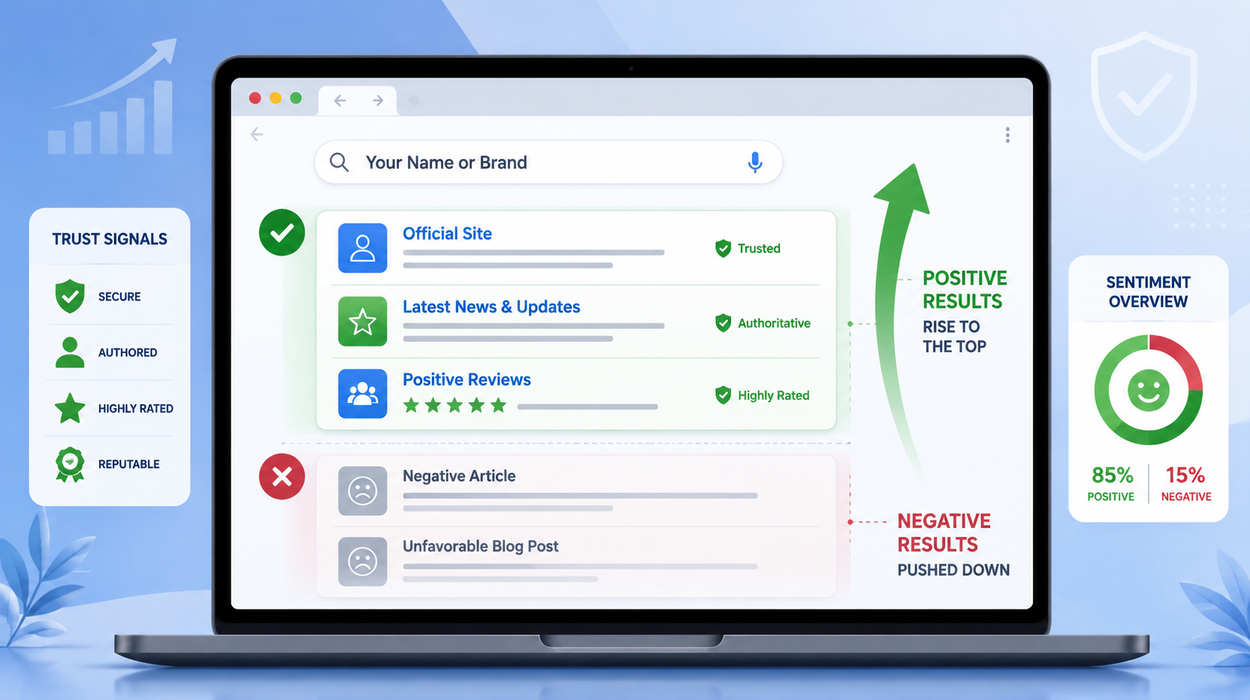
A strategy for pushing down negative search results operates through content enhancement, search ranking manipulation, and entity credibility reinforcement. Reputation management strategies differ based on whether they prioritise proactive content creation or reactive suppression. Online reputation control methods are evaluated through search visibility metrics, trust signal assessment, and SERP composition analysis.
How Do Content Creation and Removal Strategies Compare for Reputation Management?
Content creation strategies generate authoritative and relevant content to dominate search rankings. This approach operates by publishing positive articles, blog posts, press releases, and social media updates aligned with target keywords, creating new pages that compete for SERP placement. Mechanistically, search engines interpret these assets as signals of entity activity, relevance, and topical authority, which can progressively push negative listings down. The strength of this approach lies in its scalability and durability, allowing ongoing signal accumulation; however, it requires sustained content production and SEO maintenance to maintain ranking influence.
Content removal strategies focus on deleting or legally suppressing undesirable content. This approach operates through takedown requests, DMCA notices, or platform-specific moderation channels. Search engines reduce visibility of removed content due to de-indexing, which immediately clears SERP real estate. The limitation is its low predictability, as removal approval depends on third-party cooperation, and removed content may exist in cached or syndicated forms. Compared with content creation, removal provides short-term impact but lacks scalability and sustainability.
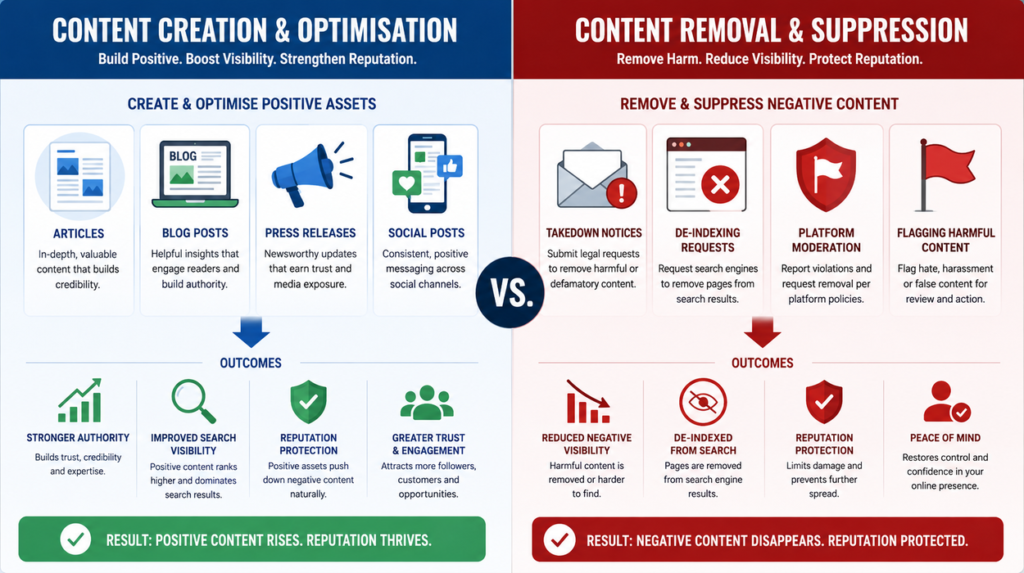
Comparatively, content creation influences sentiment distribution across search results and builds long-term entity credibility, while content removal offers immediate but potentially temporary relief. Integrating both approaches allows measured control over SERP composition, with creation establishing positive reputation signals and removal mitigating immediate negative exposure. Strategies that combine these approaches contribute directly to improving Negative Search Results SEO.
What Are the Differences Between Organic and Reactive Approaches in SERP Control?
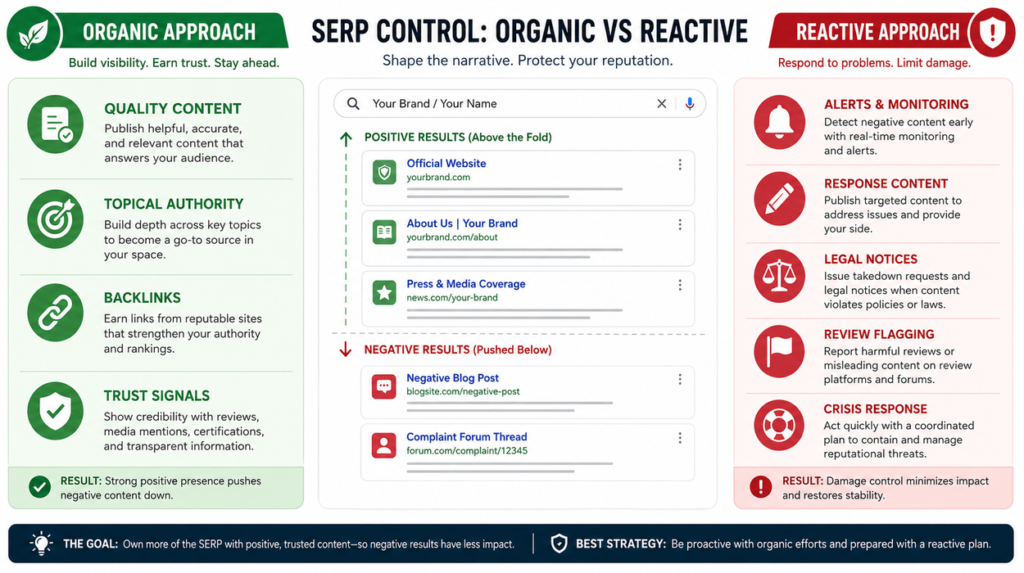
Organic approaches are preventive and operate by optimising digital assets before negative content surfaces. These strategies deploy structured SEO techniques, including keyword mapping, backlink acquisition, and metadata optimisation, to improve authoritative content visibility. Search engines interpret organic signals as indicators of entity credibility and relevance, which contribute to SERP stability. Strengths include sustainability, cumulative trust-building, and alignment with algorithmic ranking mechanisms. Limitations include delayed impact, resource intensity, and dependence on algorithmic evaluation rather than direct content suppression.
Reactive approaches respond to existing negative search results through immediate interventions such as legal requests, review flagging, or crisis content deployment. Reactive methods operate by targeting specific SERP entries and either suppressing their visibility or counterbalancing them with newly published content. Their strength is rapid mitigation of reputational threats, whereas limitations include high operational risk, reliance on third-party platforms, and potential for negative publicity if perceived as censoring. Organic strategies produce long-term positioning, while reactive methods address urgent threats, making effectiveness contingent on timing, search engine responsiveness, and content indexing cycles.
How Do Short-Term and Long-Term SEO Tactics Differ in Influencing Reputation Signals?
Short-term SEO tactics operate through rapid content deployment and tactical link-building aimed at immediate visibility changes. Examples include publishing press statements, targeted blog posts, or utilising social media amplification to capture top positions in search results. These tactics function by generating immediate entity activity signals, affecting ranking influence temporarily. Their strength is quick sentiment redistribution across SERPs, while limitations include vulnerability to algorithm updates, low durability, and high content churn.
Long-term SEO tactics involve sustained content production, domain authority development, and structured backlink accumulation. They operate by gradually establishing consistent signals of credibility and relevance that search engines use to evaluate entity authority. Long-term approaches influence search perception over months or years, creating durable SERP positions and enhanced trust signals. Limitations include slow measurable impact and resource intensiveness. Comparatively, short-term tactics provide rapid control with temporary results, whereas long-term tactics secure enduring reputational benefits and resilient SERP influence.
Explore Our Expert Guides:
Why Positive Content Promotion Is the Most Sustainable Reputation Management Tactic
How Positive Content Promotion Works Alongside SEO and PR to Build Authority
How Do Search Engines Interpret Reputation Signals Across Different Strategies?
Search engines interpret reputation signals by analysing content relevance, backlink profiles, sentiment distribution, and social engagement metrics. Content creation strategies enhance positive signals by increasing entity mentions, authoritative links, and keyword alignment, which collectively improve search ranking influence. Removal strategies influence search engines indirectly by de-indexing content, reducing negative signal presence in SERPs. Organic approaches embed signals in high-authority domains, contributing to perceived credibility, whereas reactive approaches generate event-driven signals that may trigger short-term ranking fluctuations. Algorithms weigh consistency, topical alignment, and entity authority, meaning strategy effectiveness is measured by changes in ranking position, visibility of negative results, and perception of expertise.
What Are the Mechanisms and Limitations of Content Suppression Versus Content Enhancement?
Content suppression operates by removing, de-indexing, or otherwise reducing the visibility of negative listings. It functions through legal, technical, or platform-mediated channels. Suppression achieves immediate SERP impact by reducing negative exposure, but limitations include dependency on third-party action, potential for re-indexing, and risk of negative backlash affecting trust perception.
Content enhancement focuses on publishing high-quality, authoritative content to dominate search rankings. It operates by influencing search algorithms through positive entity activity, keyword relevance, and backlink reinforcement. Strengths include long-term visibility control, accumulation of credibility signals, and measurable search ranking influence. Limitations involve high resource requirements, ongoing maintenance, and delayed effectiveness. Comparative analysis shows suppression is tactical and risk-dependent, whereas enhancement is strategic, algorithmically reinforced, and sustainable.
How Do Different Approaches Affect Trust Signals and Online Perception?
Content creation strategies improve trust signals by increasing positive mentions, consistent domain authority, and engagement metrics. Search engines and users interpret these signals as indicators of credibility, which influence perception in SERPs. Content removal temporarily reduces negative visibility but does not generate positive trust signals, which may limit perception recovery. Organic strategies cultivate enduring credibility through sustained entity activity, while reactive strategies may produce transient trust signals due to rapid intervention visibility. Evaluating effectiveness requires measuring sentiment distribution across search results, the presence of authoritative backlinks, and user engagement, indicating how each strategy shapes public and algorithmic perception.
Get More Insights:
Amplify Your Reputation With Positive Content Promotion Designed to Rank and Retain
How Effective Are Reputation Management Approaches in Scalability and Risk Exposure?
Scalability is highest in content enhancement strategies, as the production of SEO-optimised assets can be systematically expanded across domains, content formats, and keywords. Suppression strategies have low scalability due to reliance on platform compliance, legal processes, and third-party moderation. Risk exposure is minimal in organic, long-term approaches, as they align with search engine guidelines and algorithmic expectations. Reactive suppression carries higher operational and reputational risk, especially when perceived as censoring. Evaluating effectiveness requires balancing resource investment against SERP influence, visibility longevity, and public perception impact.
What Role Does Sentiment Distribution Play in SEO-Based Reputation Management?
Sentiment distribution operates as a measure of positive, neutral, and negative mentions across search engine results. Strategies that increase positive content prevalence shift sentiment distribution in favour of enhanced perception, directly influencing entity credibility and trustworthiness. Suppression strategies reduce negative signal prevalence but do not inherently enhance positive sentiment, leading to limited perception improvement. Organic approaches maintain a balanced and sustainable sentiment profile by integrating content across authoritative platforms, whereas reactive approaches generate abrupt sentiment shifts that may be unstable. Search engines interpret balanced and consistently positive sentiment as a credible reputation signal, which strengthens ranking influence and visibility.
Conclusion
Content creation versus content removal strategies exhibit distinct mechanisms and outcomes. Creation enhances long-term credibility, trust signals, and algorithmic ranking influence, while removal offers rapid mitigation with limited sustainability. Organic approaches provide enduring entity authority and SERP stability, whereas reactive approaches address immediate reputational threats with higher operational risk. Short-term tactics generate quick visibility shifts but are transient, whereas long-term tactics reinforce enduring positioning and cumulative reputation signals. Evaluating reputation management requires analysing scalability, risk exposure, sentiment distribution, and search engine interpretation to determine strategic effectiveness in controlling negative search results.
FAQs
1. How does a Reputation Management PR Agency help push down negative search results?
A Reputation Management PR Agency uses content creation, SEO optimisation, and strategic digital visibility techniques to elevate positive pages above negative search results. They focus on trust signals, backlinks, and sentiment distribution to improve overall search perception.
2. What are the key SEO strategies to suppress negative content online?
Effective strategies include publishing high-authority positive content, optimising meta and structured data, building backlinks, and de-indexing low-quality or harmful pages. These actions work together to shift SERP rankings in favour of positive content.
3. How long does it take for SEO to push down negative search results?
Timing varies depending on content volume, domain authority, and search engine responsiveness. Short-term tactics can show results in weeks, while long-term organic strategies may take several months for sustained SERP influence.
4. Can negative reviews or articles be fully removed from search engines?
Complete removal depends on legal rights, platform policies, or DMCA requests. A Reputation Management PR Agency can assist with removal or suppression, but SEO strategies often focus on pushing negative content lower rather than guaranteed deletion.
5. What metrics indicate success in suppressing negative search results?
Key metrics include improved ranking positions for positive content, reduced visibility of negative pages, increased domain authority, positive sentiment distribution, and engagement signals across trusted platforms.