

Reputation management is the systematic monitoring, shaping and maintenance of an entity’s perceived credibility within search ecosystems. Online reputation refers to the aggregate of indexed content, review signals and SERP evaluation that defines an entity’s standing for search users and algorithmic models.
Positive content promotion is the deliberate creation, optimisation and distribution of favourable, authoritative content that defines reputation signals in search ecosystems. ‘Positive content promotion’ refers to the practice of producing content assets articles, thought-leadership pages, multimedia and structured data that search engines index and associate with an entity’s digital footprint.
The mechanism functions through content indexing, internal linking and external referencing. Producers publish content optimised for entity-relevant queries and schema, enabling search crawlers to attribute topical authority and entity relationships. Distribution channels create backlinks and social signals that accelerate indexing and increase the breadth of content associated with the entity. Search engines evaluate these artefacts using ranking algorithms that combine relevance, authority and user engagement metrics.
Promoting positive content increases the volume and quality of authoritative signals that occupy SERP real estate, thereby diluting or displacing negative items. The result changes entity perception by expanding the set of sources and contexts that algorithms present to users during SERP evaluation.
How does positive content promotion work alongside SEO to influence SERP evaluation?
Positive content promotion defines a content-first approach that integrates technical SEO, on-page optimisation and entity-aware structuring to influence SERP evaluation. The practice refers to aligning content signals with query intent and search engine understanding of entities.
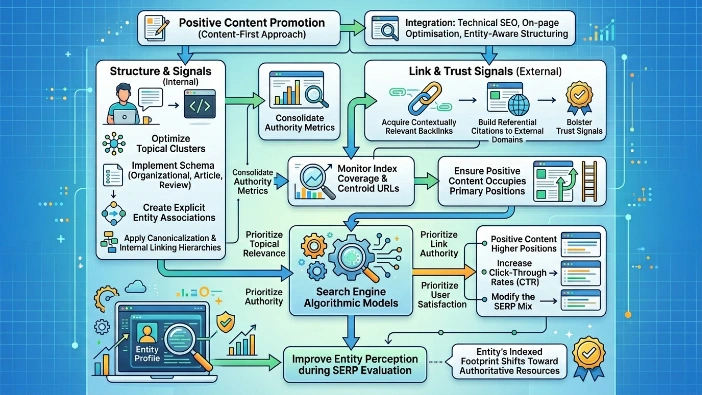
Optimise content for topical clusters and schema to create explicit entity associations. Implement canonicalisation, structured data (for organisational, article and review schemas) and internal linking hierarchies to consolidate authority metrics. Acquire contextually relevant backlinks and referential citations to external domains to bolster trust signals. Monitor index coverage and centroid URLs to ensure positive content occupies primary positions.
Algorithmic models prioritise content that demonstrates topical relevance, link authority and user satisfaction. Positive content that satisfies these ranking factors attains higher positions, increases click-through rates and modifies the SERP mix. Over time, the entity’s indexed footprint shifts toward authoritative resources, improving entity perception during SERP evaluation.
How does positive content promotion interact with PR to shape entity perception?
Positive content promotion defines a neutral bridge between editorial visibility and controlled messaging to shape entity perception at scale. The interaction refers to coordinated messaging that creates signal redundancy across editorial and owned channels.
Synchronise content themes between owned properties and earned editorial mentions. Use PR-driven placements to generate authoritative backlinks and syndication that search engines index as third-party validation. Amplify press coverage through owned content that contextualises and expands narrative elements, ensuring search crawlers encounter cohesive entity signals across sources.
Third-party editorial references increase domain authority metrics and diversify the sources associated with an entity, producing stronger reputation signals during SERP evaluation. This co-ordinated approach reduces reliance on single-channel indexing and increases resilience against negative signals by creating multiple authoritative anchors within the index.
How do search engines interpret trust and credibility from positive content?
Search engines interpret trust and credibility through quantifiable reputation signals that positive content promotion enhances. Trust is a composite metric derived from link provenance, content quality indicators, site architecture and user engagement.
Search engines evaluate backlinks for topical relevance, editorial context and authority of the linking domain. They assess on-page signals such as comprehensiveness, uniqueness, structured markup and page experience metrics. User engagement metrics—dwell time, pogo-sticking rates and click-through data—provide behavioural evidence of relevance. Algorithms correlate these signals with historical entity behaviour and cross-source consistency to form credibility assessments.
Content that generates high-quality backlinks, consistent structured data and positive engagement patterns increases a site’s trust score within ranking models. Higher trust scores influence SERP placement and entity snippets, which alters user-facing entity perception and the prominence of authoritative content in results.
What role do review signals and sentiment interpretation play in positive content promotion strategies?
Review signals are explicit data points within search ecosystems that define reputation via structured feedback sentiment interpretation is the algorithmic classification of language and patterns in reviews and unstructured content. Both elements respond to positive content promotion by shifting outcome distributions in indexed materials.
Positive content promotion does not directly alter independent review platforms but influences the relative weight and visibility of review signals within the overall indexed footprint. Content that documents customer success, product transparency and policy explanations provides context that search algorithms use during SERP aggregation. Sentiment analysis models parse lexical polarity and semantic features across reviews and content to produce sentiment indices associated with the entity.
When high-quality positive content increases the contextual framing around reviews, search engines present a more balanced representation in SERP features (knowledge panels, review snippets). The presence of corroborating positive content reduces the relative prominence of isolated negative reviews during algorithmic aggregation, improving overall entity perception.
How does content indexing and internal linking consolidate authority for reputation outcomes?
Content indexing and internal linking define the structural process by which search ecosystems aggregate topic authority and distribute ranking signals across an entity’s digital footprint. Indexing refers to the inclusion and classification of content in search engine databases; internal linking is the on-site mechanism that channels authority between pages.
Create a content architecture that organises topics into pillar pages and supporting clusters, using internal links to signal hierarchical importance. Implement clear canonical tags and sitemap entries to ensure indexing of priority assets. Use anchor text that reflects entity-relevant keywords to strengthen semantic associations and guide crawlers to authoritative resources.
Strengthen search visibility and authority with professional Corporate Reputation Management that leverages strategic content indexing, internal linking, and entity-focused SEO. By consolidating authority signals across key assets, businesses can improve SERP performance, reinforce credibility, and maintain stronger control over online reputation.
How does positive content promotion affect entity perception through digital footprint expansion?
Positive content promotion defines a deliberate expansion of the digital footprint by increasing the quantity and diversity of authoritative assets linked to an entity. ‘Digital footprint’ refers to the cumulative, indexed traces pages, mentions, metadata and multimedia that define an entity’s presence.
Publish content across multiple, domain-diverse channels and formats to create redundancy and contextual dispersion. Use metadata, structured data and consistent NAP (name, address, phone) or entity attributes to reinforce identity across sources. Generate cross-platform citations and canonical references to reduce ambiguity in entity resolution during algorithmic processing.
A broader digital footprint increases the number of touchpoints that search engines evaluate during entity resolution, improving consistency signals and lowering the proportional impact of negative items. Index redundancy ensures that positive content appears across SERP features, knowledge graphs and universal results, strengthening overall entity perception.
What authority and trust signals must positive content promotion target for durable reputation outcomes?
Positive content promotion defines authority and trust targets as verifiable signals that algorithms prioritise in long-term ranking models. Authority refers to link provenance and domain reputation; trust refers to content accuracy, provenance transparency and technical integrity.
Secure backlinks from topically relevant, authoritative domains; include references and citations to verifiable data sources; publish content with clear authorship, update timestamps and contact metadata; maintain HTTPS, structured data and fast page performance. Use transparent editorial policies and correction mechanisms to demonstrate provenance and reduce information decay.
Consistent demonstration of authority and trust increases long-term ranking stability and reduces volatility from algorithm updates. Search engines reward transparency and verifiability by elevating content in SERP features that reflect entity credibility, thereby increasing visibility of positive assets.
Dive Deeper With Our Expert Guides and Related Blog Posts:
Why Reputation Management Pricing Varies So Much Across UK Agencies
What Factors Determine the True Cost of Managing Your Reputation Online
How do algorithms balance relevance, authority and recency when ranking positive content?
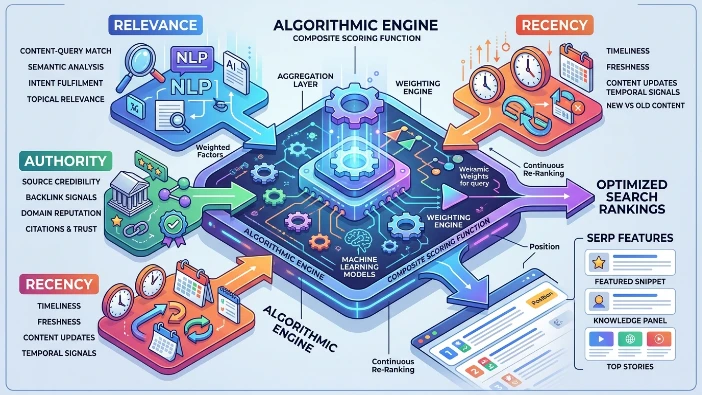
Algorithms balance relevance, authority and recency via composite scoring functions that reflect intent fulfilment, source credibility and temporal relevance. Relevance assesses topical match to query intent; authority measures provenance and link signals; recency evaluates timeliness for queries sensitive to time.
Ranking models compute relevance using semantic matching of content to query embeddings and structured data. Authority signals feed into ranking weightings via backlink analysis and domain reputation metrics. Recency factors update ranking when query patterns or content lifecycles demand current information. Aggregated scores determine token placement and SERP features.
Positive content optimised for relevance and authority with periodic updates secures durable ranking positions. Time-sensitive assets require refresh cycles to maintain visibility evergreen authoritative content provides sustained reputation signals across algorithmic updates and query variations.
How does positive content promotion reduce reputational risk within search ecosystems?
Positive content promotion defines a risk mitigation strategy by creating authoritative redundancy that lowers the search prominence of undesirable content. Reputational risk within search ecosystems is the probability that negative, misleading or inaccurate content attains high SERP prominence.
Increase the signal-to-noise ratio of positive, authoritative content through volume, relevance and link equity. Monitor SERPs and indexing status to identify emergent negative items and allocate promotion resources to elevate countervailing assets. Use structured data and explicit disambiguation to reduce entity confusion and misattribution.
Elevated positive assets suppress the ranking potential of negative content by occupying prime SERP real estate and influencing snippet selection. The resulting distribution reduces the likelihood of high-impact negative exposures during user searches and stabilises entity perception.
Positive content promotion is a systems-based tactic that defines reputation through indexed signals, authoritative links and structured entity data. It explains how content creation, technical SEO and PR co-operate to influence SERP evaluation, how algorithms interpret trust and sentiment, and how indexing and internal linking consolidate authority. By expanding a coherent digital footprint and targeting measurable authority signals, positive content promotion produces durable improvements in search visibility and entity perception without relying on ephemeral interventions.
Discover More Insights:
How Positive Content Promotion Works Alongside SEO and PR to Build Authority
Common questions about corporate reputation management
What is corporate reputation management and why does it matter?
Corporate reputation management is the practice of monitoring and shaping an organisation’s public standing across search ecosystems and media channels. It impacts search visibility, stakeholder trust and regulatory perception by influencing which indexed content and reputation signals users and algorithms encounter.
How does corporate reputation management use SEO and PR together?
Corporate reputation management integrates SEO and PR by creating authoritative content, securing editorial backlinks and optimising entity signals (schema, canonical tags) so search engines index favourable assets. This combined approach improves SERP evaluation and broadens the entity’s trusted footprint.
How long does it take for corporate reputation management actions to affect search results?
Changes in search visibility typically appear within weeks for content promotion and backlink gains, while durable shifts in entity perception require several months of consistent content indexing and authority-building. Algorithms update continuously, so sustained publication and link acquisition produce measurable results over time.
Can corporate reputation management reduce negative reviews or press in SERPs?
Corporate reputation management cannot remove third-party negative reviews but can reduce their relative prominence by promoting high-quality, authoritative content and increasing contextual positive signals. Index redundancy and strategic internal linking lower the SERP impact of isolated negative items.