

Positive content promotion suppresses negative search results by publishing and optimising high-authority assets that rank above harmful content, while SEO ensures those assets meet technical ranking requirements and PR provides third-party validation through media coverage. Reputation management strategies differ based on whether organisations prioritise reactive suppression or proactive authority building, and online reputation control methods are evaluated through their impact on SERP composition, sentiment distribution, and entity credibility over time.
Content suppression operates by pushing negative results off the first page through volume-driven positive content publication, whereas content enhancement strengthens existing positive assets through optimisation and link-building to improve their ranking position.
How does content suppression mechanics function in search ecosystems?
Content suppression publishes new positive assets targeting branded and near-branded keywords, then builds backlinks to increase domain authority until negative content drops to page two or beyond. This approach relies on Google’s ranking algorithm prioritising fresh, relevant content with strong backlink profiles, meaning suppression succeeds when positive assets accumulate sufficient ranking signals. The mechanism requires continuous content creation because suppression is not permanent negative content can resurface if positive asset maintenance stops or if algorithm updates reweight ranking factors.
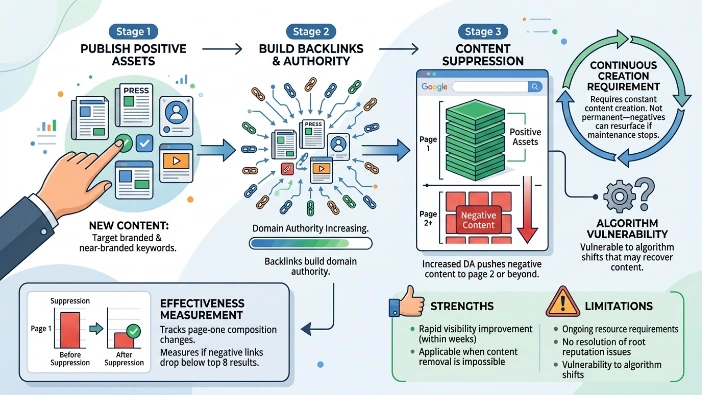
Suppression measures effectiveness through page-one composition changes, tracking whether negative links move below the first eight results. Strengths include rapid visibility improvement within weeks and applicability when content removal is impossible. Limitations involve ongoing resource requirements, no resolution of root reputation issues, and vulnerability to algorithm shifts that may recover suppressed content.
How does content enhancement mechanics function in search ecosystems?
Content enhancement identifies existing positive assets—such as official website pages, press coverage, or review profiles—and optimises them through keyword targeting, technical SEO improvements, and authoritative backlink acquisition. This approach increases the ranking strength of controlled assets rather than creating new content, making it more sustainable when positive foundations already exist. Enhancement succeeds when optimised assets accumulate enough ranking signals to outrank negative content naturally.
Enhancement measures effectiveness through ranking position improvements for targeted assets and sustained page-one dominance. Strengths include lower long-term costs than suppression, stronger entity credibility through optimised owned properties, and resilience against algorithm updates. Limitations involve dependency on existing asset quality, slower initial results than suppression, and ineffectiveness when positive assets lack sufficient foundational authority.
How do organic proactive approaches compare with reactive suppression approaches?
Organic proactive approaches build authority through consistent content creation and relationship development before reputation crises occur, while reactive suppression approaches deploy intensive content campaigns only after negative content appears, prioritising speed over sustainability.
What characterises organic proactive reputation building?
Organic proactive reputation building publishes thought leadership, maintains active social profiles, encourages genuine reviews, and secures regular media coverage as standard business operations. This approach operates by accumulating reputation signals continuously, creating a dense digital footprint that search engines interpret as entity credibility. Proactive building influences SERP composition by ensuring page one is dominated by owned properties and positive third-party coverage before negative content emerges.
Proactive effectiveness is measured through baseline sentiment distribution, branded search volume growth, and page-one ownership percentage. Strengths include crisis resilience because strong foundations suppress negative content naturally, scalability through standardised processes, and lower risk exposure since tactics avoid manipulative patterns. Limitations involve delayed results requiring 6–12 months for topical authority, higher initial investment without immediate crisis pressure, and difficulty measuring direct reputation impact versus general marketing outcomes.
What characterises reactive suppression deployment?
Reactive suppression deployment launches targeted content campaigns within days of negative content discovery, focusing exclusively on branded keywords where harm appears. This approach operates by emergency asset creation and aggressive link-building to override negative ranking signals quickly. Reactive suppression influences SERP composition by forcibly rearranging page-one results through volume and authority manipulation rather than organic merit.
Reactive effectiveness is measured through negative content displacement speed and page-one recovery percentage within 30–90 days. Strengths include rapid crisis mitigation protecting immediate conversions, focused resource allocation on specific harm, and applicability when proactive foundations are absent. Limitations involve high per-campaign costs, ethical concerns around manipulative tactics, sustainability risks requiring ongoing maintenance, and potential algorithm penalties if patterns resemble black-hat SEO.
How do short-term suppression impacts differ from long-term authority building?
Short-term suppression delivers immediate page-one rearrangement within weeks but requires continuous investment to maintain, whereas long-term authority building establishes sustainable ranking dominance through topical authority that persists without intensive maintenance.
What defines short-term suppression impact duration?
Short-term suppression impact lasts 3–6 months before negative contentrecoveres unless positive asset maintenance continues through new content publication and backlink refresh. This duration operates because suppression does not remove negative content—it only outranks it temporarily until ranking signal decay or algorithm updates rebalance results. Short-term impact influences search visibility through rapid improvement but creates dependency cycles where reputation protection requires perpetual campaign deployment.
Short-term scalability is limited by resource intensity, as each crisis demands fresh content creation and link-building investment. Risk exposure is elevated because manipulative patterns may trigger algorithm scrutiny, and sustainability is low since suppression lacks foundational authority. Organizations using only short-term suppression face recurring costs and never achieve stable reputation control.
What defines long-term authority building duration?
Long-term authority building establishes lasting SERP dominance through topical authority—comprehensive content coverage around brand entities that search engines recognise as knowledge-domain authority sources. This approach operates by accumulating historical data and trust signals that withstand algorithm updates, creating ranking stability that persists without intensive maintenance. Long-term impact influences search visibility through organic merit rather than manipulation, ensuring positive assets rank because they demonstrate genuine expertise.
Long-term scalability is superior because standardised content frameworks enable efficient expansion across topics and formats. Risk exposure is minimal since tactics align with Google’s quality guidelines, and sustainability is high because authority compounds over time. Organizations achieving topical authority maintain page-one dominance with reduced ongoing investment, transforming reputation management from crisis response to standard business operation.
How do search engines interpret reputation signals across different sources?
Search engines interpret reputation signals by aggregating review quality and volume, review responses, NAP consistency, citations, brand mentions, backlinks, and website trust indicators into composite credibility assessments that influence ranking decisions.
What reputation signals carry highest ranking influence?
Google reviews carry the highest ranking influence because they combine volume, recency, quality, and response engagement into a single trust signal that directly impacts local and organic visibility. Reviews operate as primary reputation signals because Google confirmed that responding to reviews signals engagement and trustworthiness, making review management essential for search ranking influence. Branded search volume carries secondary influence as an implied reputation signal, where direct brand searches indicate public trust and recognition.
Review quality measures through average rating targets of 4.5 or higher, while volume requires steady consistent growth rather than suspicious spikes. Response engagement measured through reply percentage to all reviews, especially negative ones, demonstrates accountability. NAP consistency across Google Business Profile, social media, directories, and website footer weakens credibility signals when inconsistencies exist even at minor levels like “St” versus “Street”.
How do third-party citations and backlinks affect entity credibility?
Third-party citations from Yelp, BBB, industry directories, and Apple Maps act as digital endorsements where accurate data across trustworthy sources strengthens reputation footprint. Backlinks from trusted media outlets and industry publications improve domain authority and ensure positive content ranks higher than negative ones through authoritative link signals. Citations operate by validating business existence and consistency, while backlinks operate by transferring authority from established sources to brand assets.
Enhance digital trust with professional Corporate Reputation Management that strengthens third-party citations, authoritative backlinks, and entity credibility across search ecosystems. Strategic reputation management helps businesses build stronger trust signals, improve SERP visibility, and reinforce long-term brand authority through verified external references.
What strategic considerations determine approach selection for corporate reputation management?
Approach selection depends on crisis severity, existing digital foundation, resource availability, and timeline requirements, with severe crises requiring immediate suppression while organisations with strong foundations benefiting from enhancement-focused strategies.
Dive Deeper With Our Expert Guides and Related Blog Posts:
How to Compare Reputation Management Pricing Without Getting Misled
Understanding UK Reputation Management Cost Ranges Before You Budget
How does crisis severity influence method selection?
High-severity crises featuring first-page negative results with significant conversion impact require immediate suppression deployment to protect revenue within days. Moderate-severity crises with second-page negative content or limited visibility allow enhancement-focused approaches that strengthen existing assets without emergency content creation. Low-severity situations with minimal negative visibility enable proactive building without reactive intervention.
Severity measures through search result position, click share of negative content, sentiment distribution negative percentage, and business impact metrics like conversion rate decline. Method selection aligns with severity thresholds where high severity mandates suppression, moderate severity permits enhancement, and low severity enables proactive strategies.
How does existing digital foundation influence method selection?
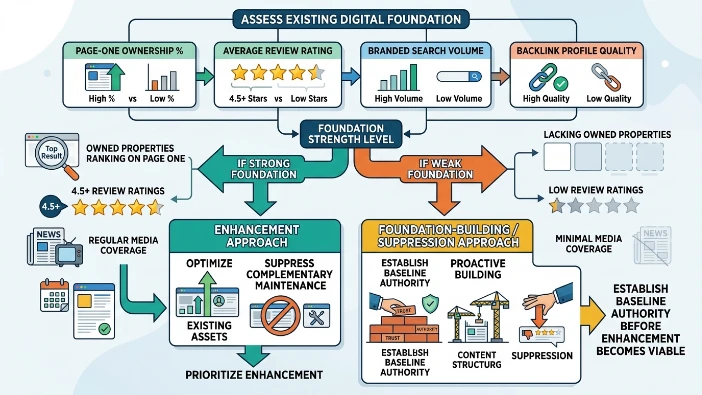
Organisations with strong digital foundations featuring owned properties ranking on page one, 4.5+ review ratings, and regular media coverage benefit from enhancement approaches that optimise existing assets. Organisations with weak foundations lacking owned properties, low review ratings, or minimal media coverage require suppression or proactive building to establish baseline authority before enhancement becomes viable.
Foundation strength measures through page-one ownership percentage, average review rating, branded search volume, and backlink profile quality. Method selection prioritises enhancement for strong foundations suppressing complementary maintenance, while weak foundations require foundation-building through suppression or proactive approaches before enhancement optimisation.
For More Details, Explore:
Amplify Your Reputation With Positive Content Promotion Designed to Rank and Retain
Key differences separate suppression’s rapid but temporary results from enhancement’s slower but sustainable outcomes, with proactive building offering crisis resilience through accumulated authority. Strategic considerations require assessing crisis severity, digital foundation strength, resource availability, and timeline requirements to select approaches matching organisational context and reputation objectives.
Frequently Asked Questions About Corporate Reputation Management
What is corporate reputation management and why is it important for businesses?
Corporate reputation management is the practice of monitoring, influencing, and maintaining how stakeholders perceive a business online and in search results. It protects entity credibility by ensuring positive content ranks higher than negative mentions, which directly impacts customer trust and search ranking influence.
How does positive content promotion work alongside SEO and PR for reputation building?
Positive content promotion publishes optimised assets that rank above negative results, while SEO ensures technical ranking requirements are met and PR provides third-party validation through media coverage. This combination builds authority by improving sentiment distribution and strengthening reputation signals across search ecosystems.
What is the difference between content suppression and content enhancement in reputation management?
Content suppression pushes negative results off page one by publishing new positive content, whereas content enhancement optimises existing positive assets to rank higher naturally. Suppression delivers faster results but requires ongoing maintenance, while enhancement provides sustainable long-term authority with lower risk exposure.
How do search engines interpret reputation signals when ranking branded content?
Search engines aggregate review quality, volume, responses, NAP consistency, citations, brand mentions, and backlinks into composite credibility assessments that influence ranking decisions. Strong reputation signals increase entity credibility and improve search visibility for branded queries and near-branded keywords.