

Reputation management pricing in the UK ranges from £200 to £250,000 per month, with corporate reputation management typically costing £5,000–£25,000 monthly for retainers. Pricing varies because providers bundle different services, use different engagement models, and measure success using different metrics.
Reputation management strategies differ based on whether organisations need reactive crisis response, proactive brand building, or long-term entity credibility development. Online reputation control methods are evaluated through their impact on search ranking influence, sentiment distribution across SERP real estate, and the sustainability of reputation signals over time. Understanding these mechanisms prevents costly misalignment between pricing and actual business outcomes.
What Distinguishes Monthly Retainer Pricing From Project-Based Fees?
Monthly retainer pricing charges a fixed recurring fee for ongoing reputation management services, while project-based fees charge a one-time amount for defined deliverables with clear start and end dates.
Monthly retainer models operate by securing agency time and capability for continuous monitoring, content creation, and response management. These retainers typically run 6–24 month minimum commitments in the UK market. The agency commits staff hours across reputation monitoring, content production, review response, and crisis readiness. Clients commit to monthly payment regardless of fluctuating workload. Industry estimates suggest monthly retainers for corporate reputation management generally range from £5,000 to £25,000, with premium agencies charging £50,000+ for enterprise-level coverage.
Project-based pricing charges fixed fees for specific interventions such as reputation repair campaigns, content removal initiatives, or one-off PR announcements. These projects typically run 4–16 weeks with defined scope and deliverables. The agency commits to producing agreed outputs rather than providing ongoing availability. Project fees for reputation repair range from £500 to £5,000 for basic interventions, scaling to £10,000–£50,000 for comprehensive campaigns.
| Dimension | Monthly Retainer | Project-Based |
|---|---|---|
| Commitment | 6–24 months minimum | Single project duration |
| Cost structure | Even monthly billing | Upfront or milestone payments |
| Best for | Ongoing monitoring, continuous content creation, crisis readiness | One-off repairs, defined campaigns, testing agencies |
| Value per hour | Lower (spread senior expertise over time) | Higher (context reset each project) |
| Strategic depth | Builds historical data and topical authority | Limited by project timeframe |
Invest in long-term brand protection with professional Corporate Reputation Management that provides continuous monitoring, strategic content development, and proactive reputation support. Ongoing reputation management helps businesses maintain positive search visibility, strengthen trust signals, and respond effectively to emerging reputation risks.
How Do Content Suppression Strategies Compare To Content Enhancement Approaches?
Content suppression pushes negative search results off the first page by publishing positive content, while content enhancement improves the quality and ranking of existing positive assets without directly targeting negative content.
Content suppression tactics operate by creating high-authority positive content and building backlinks to outrank negative results. White hat suppression includes creating blog posts, news articles, press releases, and optimised social media profiles on platforms with strong domain authority. These tactics leverage Web 2.0 properties (Medium, LinkedIn, YouTube) that rank well for branded searches. Suppression is the most common and effective strategy when content cannot be removed or deindexed, such as old media articles, arrest records, or review site content that won’t cooperate.
Content enhancement strategies focus on optimising existing positive assets through SEO, structured data, and content refreshes. This approach updates your website, blog, or press release content with better SEO targeting for branded keywords like ‘[Brand] reviews’ or ‘About [Brand]’. Enhancement improves entity credibility by strengthening the Knowledge Graph association and building topical authority around your brand entity. This method operates by decreasing search engine cost of retrieval for positive content while increasing relevance signals.
| Aspect | Content Suppression | Content Enhancement |
|---|---|---|
| Mechanism | Pushes negative content to page 2+ through competition | Improves ranking of existing positive content |
| Time to results | 3–6 months for page 1 displacement | 6–12 months for sustained authority |
| Sustainability | Requires continuous content production | Builds long-term topical authority |
| Risk exposure | Lower (white hat tactics) | Lowest (organic growth) |
| Scalability | High (bulk production methodology) | Moderate (quality thresholds apply) |
Suppression is often a short-term solution to specific issues, while content enhancement has longer-lasting impact through building and maintaining positive reputation over time. Search engines interpret reputation signals differently: suppression creates temporary ranking shifts, whereas enhancement builds historical data that signals trust.
What Are The Limitations Of Performance-Based Pricing Models?
Performance-based pricing ties costs to achieved results such as improved search rankings or removed negative reviews, but this model creates ambiguity in success metrics and often involves higher total costs when targets are met.
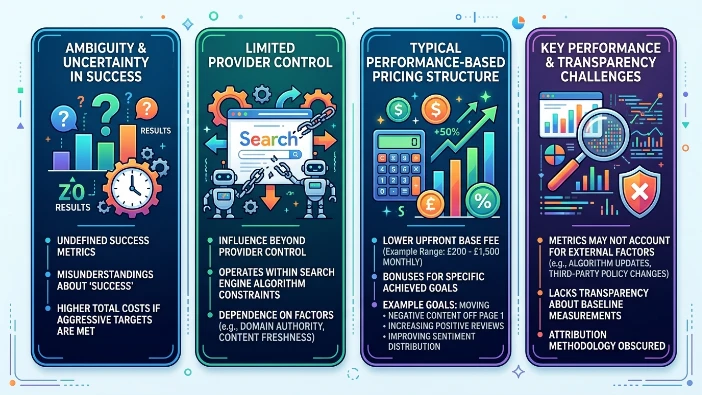
Performance-based mechanisms charge a lower upfront fee plus bonuses for achieving specific goals like moving negative content off page 1, increasing positive review volume, or improving sentiment distribution. Providers align incentives with client goals by receiving payment only when measurable outcomes occur. However, clients must clearly define performance metrics to avoid misunderstandings about what constitutes success.
Limitations emerge because reputation management operates within search engine algorithm constraints that providers cannot fully control. Performance agreements often involvePayment structures ranging from £200–£1,500 monthly base fees plus performance bonuses. The model can motivate providers to deliver results but may lead to higher total costs if aggressive targets are achieved. Performance metrics may not account for external factors like competitor activity, algorithm updates, or third-party platform policy changes that affect SERP composition.
Critical evaluation requires understanding that search ranking influence depends on factors beyond provider control, including domain authority of competing sites, freshness of content, and Google’s interpretation of reputation signals. Performance-based pricing may appear attractive but often lacks transparency about baseline measurements and attribution methodology.
Dive Deeper With Our Expert Guides and Related Blog Posts:
Understanding UK Reputation Management Cost Ranges Before You Budget
Understanding How Reputation Management Works Before You Invest
How Does Pricing Transparency Vary Across Service Tiers?
Pricing transparency decreases as service complexity increases, with basic monitoring tools offering clear subscriptions while comprehensive corporate reputation management packages often require custom quotes that obscure deliverable breakdowns.
Entry-tier pricing (£200–£1,000 monthly) typically includes software access for monitoring mentions across review sites and social media, automated review solicitation, and basic reporting. These tiered service packages provide clear feature lists at around £100–£1,000 per month for basic services. Transparency is high because deliverables are standardised and measurable.
Mid-tier pricing (£1,000–£10,000 monthly) bundles monitoring with content creation, review management, and moderate crisis response. Pricing often becomes less transparent as providers customise packages. Monthly subscription plans in this range can vary widely depending on complexity of services and business size. Clients frequently report concerns about hidden fees or unexpected charges that arise during service periods.
Enterprise-tier pricing (£10,000–£250,000 monthly) for corporate reputation management involves custom strategies, dedicated teams, and 24/7 crisis readiness. Maltin PR UK reports corporate reputation management retainers range from £5,000 to £250,000 per month depending on requirements. At this level, pricing transparency is lowest because scope is highly customised and involves strategic consulting beyond standard deliverables.
Pricing opacity creates risk because providers may bundle reputation work into broader agency retainers without clear itemisation. One provider may mainly give software access while another offers managed service with follow-through handled completely. These are not equivalent comparisons despite sitting under the same label.
What Factors Determine Long-Term Cost Effectiveness?
Long-term cost effectiveness depends on sustainability of results, scalability as reputation signals evolve, and risk exposure from strategy choices rather than monthly price alone.
Sustainability analysis reveals that content enhancement and retainer-based approaches build historical data that search engines use to classify entity credibility. This creates compounding value over 12–24 months as topical authority increases. One-time service fees for project-based interventions may appear cheaper initially (£500–£5,000) but require repeat investments as reputation signals decay without ongoing maintenance.
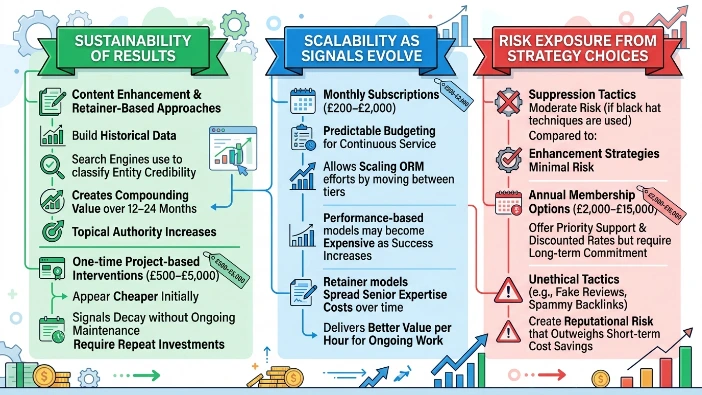
Scalability evaluation shows that monthly subscriptions ranging £200–£2,000 provide predictable budgeting for continuous service. These plans allow businesses to scale ORM efforts by moving between tiers as needed. Performance-based models may become expensive as success increases, while retainer models spread senior expertise costs over time, delivering better value per hour for ongoing work.
Risk exposure assessment considers that suppression tactics carry moderate risk if black hat techniques are used, while enhancement strategies carry minimal risk. Annual membership options (£2,000–£15,000) offer priority support and discounted rates but require long-term commitment. Providers using unethical tactics like fake reviews or spammy backlinks create reputational risk that outweighs short-term cost savings.
Search engines interpret reputation signals by analysing third-party reviews, news reports, and Knowledge Graph associations to judge entity credibility. Strategies that build genuine entity recognition in the Knowledge Graph create defensible competitive advantages that software-only solutions cannot replicate. This explains why corporate reputation management pricing varies so dramatically between providers.
Understanding these mechanisms enables accurate comparison of reputation management pricing without getting misled by headline figures. The most cost-effective approach depends on whether your organisation needs immediate crisis containment, sustained reputation building, or both sequentially.
Check the Complete Explanation:
Request a Custom Reputation Management Pricing Plan for Your Business
Frequently Asked Questions About Corporate Reputation Management
What is corporate reputation management and why does it matter for UK businesses?
Corporate reputation management is the strategic practice of shaping how a company is perceived across search engines, review platforms, and media outlets. For UK businesses, it directly influences entity credibility, search ranking influence, and customer trust signals that drive revenue decisions.
How much does corporate reputation management cost for small to medium businesses in the UK?
Corporate reputation management pricing typically ranges from £5,000 to £25,000 per month for retainer-based services, while project-based interventions cost £500–£50,000 depending on scope. Entry-tier monitoring tools start at £200 monthly, but comprehensive corporate reputation management requires custom pricing based on business size and risk exposure.
What’s the difference between content suppression and content enhancement in reputation management?
Content suppression pushes negative search results off page 1 by publishing positive content on high-authority platforms, while content enhancement optimises existing positive assets through SEO and structured data. Suppression delivers results in 3–6 months but requires continuous investment, whereas enhancement builds long-term topical authority over 6–12 months with lower risk exposure.
How long does it take to see results from corporate reputation management services?
Initial visibility improvements typically appear within 4–8 weeks for content suppression campaigns, while sustainable reputation signals and entity credibility take 6–12 months to establish. Monthly retainer models provide continuous monitoring and faster crisis response compared to project-based approaches that reset context each time.