

Positive content promotion delivers measurable SERP control and strengthens entity credibility immediately. Controlling search visibility and reputation signals determines buying decisions and stabilises public perception.
Positive content promotion delivers measurable results by creating and optimising owned content that outranks negative content and strengthens reputation signals. The service works by auditing existing search results, mapping high-value queries and stakeholders, creating optimised content assets (bylines, case studies, video, landing pages), and applying targeted promotion and backlink strategies to increase authority. Measurable outcomes include improved rank share for branded queries, reduced visibility of negative URLs (measured as percentage of first-page slots captured), and uplift in entity credibility metrics such as review sentiment and citation quality.
Search behaviour research shows most decision-makers click results on page one and trust authoritative, frequently updated sources; positive content promotion directly increases first-page coverage and perceived authority, which controls search perception influence. By focusing on reputation signals (authoritativeness, backlinks, citation consistency, structured data), the approach reduces risk of reputational damage and ensures long-term visibility gains rather than short-lived suppression.
Which tactical mix ensures the fastest reduction of negative content visibility?
A combined SEO and PR-led promotion delivers the fastest reduction of negative content visibility because it raises authoritative alternatives and accelerates re-indexing and de-ranking of harmful results. The process initiates with an urgency triage identify high-impact negative assets, prioritise queries by traffic and conversion value, and deploy content that targets those queries with strong on-page optimisation and publisher placements.
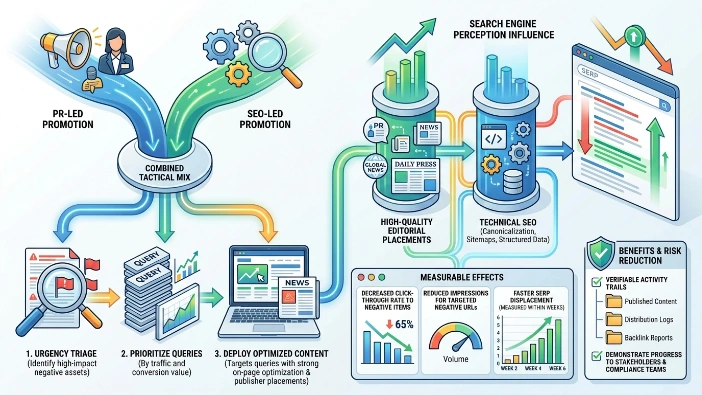
Measurable effects include decreased click-through rate to negative items, reduced impressions for targeted negative URLs, and faster SERP displacement measured within weeks for high-authority placements. Search engines prioritise relevance and authority; therefore coupling high-quality editorial placements with technical SEO (canonicalisation, sitemaps, structured data) ensures search perception influence shifts rapidly and sustainably. This approach reduces risk by providing verifiable activity trails published content, distribution logs, and backlink reports—that demonstrate progress to stakeholders and compliance teams.
Which reputation signals most influence corporate decision-makers?
Entity credibility and authoritative backlinks deliver the most influence on corporate decision-makers because they appear in the signals search engines and audiences use to assess trust. The service builds these signals through targeted thought leadership, verified author profiles, and high-quality editorial links from industry publications. Measurable outcomes include increased domain authority for owned assets, improved author-level credibility metrics, and a rise in positive review prominence. Search behaviour studies indicate stakeholders weight source credibility and recency; therefore updating content regularly and maintaining consistent citation data ensures persistent trust signals. By stabilising these metrics, the service strengthens negotiation positions, preserves investor confidence, and lowers reputational risk during critical decision windows.
Which measurement framework proves ROI for reputation management?
An outcome-driven measurement framework proves ROI by combining SERP metrics with business impact indicators and risk-reduction KPIs. The framework includes baseline and ongoing measurement of first-page control (percentage of branded first-page slots), organic traffic to owned reputation pages, sentiment-adjusted conversion rate, and reduction in visibility for negative URLs. The service implements automated reporting and a dashboard that links search perception influence to lead quality and conversion events, enabling board-level justification of spend. Measurable returns present as increased qualified enquiries originating from branded queries, decreased crisis response costs, and improved partner and consumer trust scores. Demonstrating these outcomes reduces perceived cost risk and positions reputation management as an investable, sustainable function rather than a discretionary expense.
Demonstrate measurable business value with professional Corporate Reputation Management that tracks SERP performance, sentiment trends, and conversion-focused reputation KPIs. A data-driven reputation strategy helps businesses quantify ROI, strengthen stakeholder trust, and achieve sustainable improvements in search visibility and brand perception.
Which process ensures legal and compliance-safe reputation outcomes?
A process that integrates legal review with transparent editorial standards ensures compliance-safe outcomes while preserving SEO effectiveness. The operational flow establishes approval checkpoints: content claims verification, defamation risk review, and data protection checks before publication and promotion. Measurable assurances include a documented audit trail for each content item, legal sign-off timestamps, and content takedown procedures for sensitive material. Search engines prioritise stable, verifiable content, so combining legal rigor with SEO-friendly structures (authorited schema, verified profiles) both reduces litigation risk and improves entity credibility. This process reduces operational risk and ensures sustained improvements in search visibility without exposing organisations to regulatory penalties.
Which cost structure balances speed and long-term value?
A phased cost structure delivers both rapid impact and sustainable value by combining an initial high-velocity phase with an ongoing maintenance phase. Phase one focuses on triage, high-authority placements, and technical fixes that produce quick SERP shifts; phase two focuses on content refreshes, sustained outreach, and monitoring that lock in gains. Measurable outcomes include immediate displacement of negative results within target queries and a stabilised percentage of positive first-page entries over 6–12 months. This model reduces total cost of ownership by converting crisis spend into an ongoing asset-building programme, ensuring positive content remains authoritative and resistant to new negative material. Presenting this structure clarifies investment rationale and aligns budget decisions with business risk appetite.
Dive Deeper With Our Expert Guides and Related Blog Posts:
Request a Custom Reputation Management Pricing Plan for Your Business
Transparent Reputation Management Pricing Built Around Your UK Goals
Which client controls and transparency features reduce decision risk?
Comprehensive transparency features reduce decision risk by giving clients real-time visibility into tactics and outcomes. The service provides campaign roadmaps, a live reporting dashboard showing SERP control metrics, content calendars, and backlink provenance lists. Measurable trust signals include signed editorial agreements with publishers, timestamped content publication logs, and indexed-URL tracking reports proving search perception influence. These controls ensure clients verify activity and attribute outcomes to specific tactics, which reduces procurement friction and strengthens ongoing governance. Clear evidence of work and measurable improvements increase confidence in the solution and simplify internal approvals.
Which reputation outcomes are sustainable long-term?
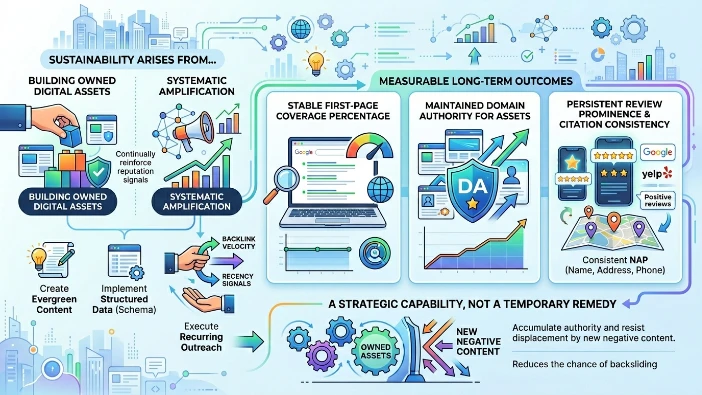
Sustainability arises from building owned digital assets and systematic amplification that continually reinforce reputation signals. The service creates evergreen content, implements structured data, and executes recurring outreach to maintain backlink velocity and recency signals. Measurable long-term outcomes include stable first-page coverage percentage, maintained domain authority for reputation assets, and persistent improvements in review prominence and citation consistency. This approach reduces the chance of backsliding because owned assets accumulate authority and resist displacement by new negative content. Emphasising sustainability demonstrates that reputation management is a strategic capability rather than a temporary remedy.
For tactical validation and deeper learning, consult the informational article:
Why Positive Content Promotion Is the Most Sustainable Reputation Management Tactic
For practical integration with content and outreach workflows, see:
How Positive Content Promotion Works Alongside SEO and PR to Build Authority.
Choose a reputation management partner that delivers quantifiable SERP control, strengthens reputation signals, and reduces decision risk with transparent processes. A focused positive content promotion programme both displaces harmful content and builds durable authority, turning search visibility into a strategic asset rather than a liability. Reputation Management PR Agency provides the documented processes, measurement framework and publishing relationships required to ensure those outcomes.
Frequently asked questions about corporate reputation management
What is corporate reputation management and how does it work?
Corporate reputation management is the process of controlling search visibility and public perception by creating, optimising and promoting authoritative content. The service audits SERPs, identifies high-impact queries, then publishes bylines, case studies and landing pages to improve reputation signals and reduce negative content visibility.
How long does it take for corporate reputation management to affect search results?
Initial SERP shifts appear within weeks for high-authority placements, with stabilised first-page control typically achieved over 3–6 months. Ongoing content and backlink maintenance ensures sustained visibility and continued improvement in entity credibility.
What measurable outcomes should I expect from a corporate reputation management service?
Expect measurable outcomes such as increased percentage of branded first-page slots, reduced impressions and CTR for negative URLs, higher organic traffic to reputation pages and improved trust signals (authoritative backlinks, review prominence). These KPIs link search perception influence directly to conversion and risk reduction.
How does corporate reputation management work with legal and compliance teams?
The service integrates legal review and approval checkpoints into the content lifecycle, including claims verification, defamation checks and audit trails before publication. This ensures compliance-safe content that still meets SEO requirements and strengthens entity credibility.