

Personal reputation management in the UK operates through three core approaches content enhancement, content suppression, and entity remediation, each with distinct mechanisms and effectiveness levels. Reputation management strategies differ based on the severity of damage, the entity’s digital footprint size, and the search ecosystem’sinterpretation of reputation signals. Online reputation control methods are evaluated through their impact on SERP composition, sentiment distribution, and long-term entity credibility.
How do content creation and content removal strategies compare for personal reputation repair?
Content creation operates by generating positive, authoritative material that search engines index and prioritise in SERPs, while content removal functions by eliminating negative assets through legal or platform-based deletion mechanisms. Content enhancement strategies build entity credibility through semantic relevance and topical authority accumulation. Content suppression strategies reduce visibility of negative entities without addressing their underlying existence.
Content creation delivers sustainable long-term impact through reputation signal accumulation. New content establishes positive semantic associations that search engines interpret as entity credibility indicators. This approach measures effectiveness through ranking influence on branded queries and sentiment distribution across search results. Content creation requires sustained investment and produces results over 6–18 months depending on topical authority development.
Content removal provides immediate short-term impact through rapid SERP composition changes. Removal mechanisms include GDPR requests for personal data, defamation claims for false content, and platform-specific appeals for policy violations. This approach exhibits limited scalability because negative content often exists across multiple domains and platforms. Removal creates risk exposure through potential content resurgence if deletion proves incomplete or temporary.
The comparative analysis reveals content creation outperforms removal for sustainability. Content enhancement builds defensible reputation signals that resist algorithmic fluctuations. Content removal creates vulnerability through empty SERP slots that negative content can reoccupy. UK-specific mechanisms include Information Commissioner’s Office GDPR enforcement for data removal and High Court defamation proceedings for false content deletion. Content creation aligns with Google’s Helpful Content System by providing genuine value rather than manipulation attempts.
What are the differences between organic and reactive reputation management approaches?
Organic reputation management operates through proactive, sustained content development and reputation signal building before damage occurs. Reactive reputation management functions through immediate damage response following negative events, search result degradation, or public exposure. Organic approaches measure effectiveness through baseline entity credibility establishment and reputation signal density. Reactive approaches evaluate success through damage containment speed and SERP composition recovery.
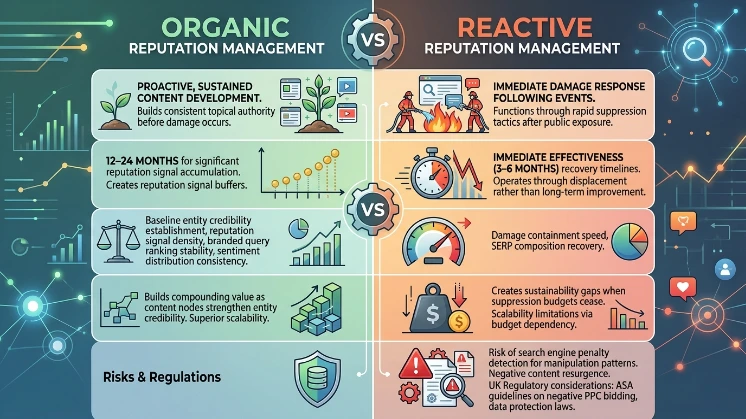
Organic approaches establish entity credibility through consistent topical authority development across semantically related content nodes. This mechanism creates reputation signal buffers that search engines interpret as entity stability indicators. Organic management measures long-term impact through branded query ranking stability and sentiment distribution consistency. The approach requires 12–24 months for significant reputation signal accumulation but provides defensible positioning against algorithmic updates.
Reactive approaches deploy immediate suppression tactics including press release distribution, negative content PPC bidding, and rapid content creation targeting negative keywords. This mechanism operates through search engine impression displacement rather than reputation signal improvement. Reactive management exhibits short-term effectiveness with 3–6 month recovery timelines but creates sustainability gaps when suppression budgets cease. Risk exposure includes search engine penalty detection for manipulation patterns and negative content resurgence.
Organic approaches demonstrate superior scalability through systematic reputation signal accumulation. The mechanism builds compounding value as each content node strengthens entity credibility. Reactive approaches face scalability limitations through budget dependency and diminishing suppression effectiveness over time. UK regulatory considerations include Advertising Standards Authority guidelines on PPC bidding for negative terms and data protection laws affecting rapid content deployment.
How does short-term suppression compare to long-term enhancement for reputation sustainability?
Short-term suppression operates through rapid SERP composition manipulation using content displacement, PPC bidding, and removal requests. Long-term enhancement functions through systematic reputation signal building via content creation, backlink acquisition, and entity credibility development. Suppression measures effectiveness through immediate negative content visibility reduction. Enhancement evaluates success through sustained positive ranking influence and sentiment distribution improvement.
Short-term suppression delivers immediate results within 1–4 weeks through negative content ranking displacement. Mechanisms include press release distribution targeting negative keywords, negative term PPC bidding to occupy SERP slots, and rapid content removal requests. This approach exhibits high risk exposure through search engine manipulation detection and negative content resurgence when suppression budgets terminate. Sustainability remains low as suppression creates no defensible reputation signals.
Long-term enhancement produces delayed results within 6–18 months through systematic reputation signal accumulation. Mechanisms include topical map development, semantic content network creation, and entity-attribute-relation structure building. This approach demonstrates low risk exposure through alignment with search engine quality guidelines and compounding value accumulation. Sustainability remains high as enhancement creates defensible reputation signals resistant to algorithmic updates.
The comparative analysis shows enhancement outperforms suppression for UK personality reputation management. Suppression creates vulnerability through empty SERP slots inviting negative content reoccupation. Enhancement builds protection through dense positive signal networks that resist algorithmic volatility. Short-term suppression costs £500–£3,000 monthly with zero residual value. Long-term enhancement costs £1,000–£5,000 monthly with compounding returns over time.
How do different strategies influence SERP composition for branded queries?
SERP composition for branded queries operates through content type distribution, ranking slot allocation, and sentiment clustering patterns. Content enhancement strategies populate SERPs with positive owned content including websites, social profiles, and press releases. Content suppression strategies create SERP gaps through negative content removal without positive replacement. Strategy influence measures through positive content percentage occupying top 10 slots and sentiment distribution across result types.
Content enhancement influences SERP composition through owned content ranking dominance. Websites, LinkedIn profiles, and press releases occupy 6–8 of top 10 slots for strong entities. This mechanism creates sentiment clustering with 80% positive results in top positions. Enhancement strategies measure success through branded query ranking stability and negative content displacement to slots 11–20. UK entities benefit from .uk domain ranking preference and local business result integration.
Improve branded search visibility with professional Celebrity Reputation Management that strengthens positive content assets, authoritative profiles, and trusted digital signals. By increasing positive SERP occupancy and reducing the prominence of negative results, celebrities can build stronger online credibility and maintain greater control over their search presence.
The comparative analysis reveals enhancement creates stable SERP composition while suppression creates volatile composition. Enhancement builds defensible slot occupation through quality signals and topical authority. Suppression creates vulnerability through dependency on continuous budget investment and removal request success rates. UK branded query SERPs show 70% owned content dominance for enhanced entities versus 30% for suppressed entities. Long-term enhancement costs provide 3–5 year SERP stability while short-term suppression requires monthly budget continuation.
Dive Deeper With Our Expert Guides and Related Blog Posts:
What Shapes a Lawyer Online Reputation Beyond Reviews and Directory Listings
How Solicitor Reputation Management Covers Reviews Search and Client Trust
What are the effectiveness limitations of each reputation management approach?
Content enhancement effectiveness limitations include time dependency requiring 6–18 months for significant results, resource intensity demanding £1,000–£5,000 monthly investment, and topical authority prerequisites requiring existing domain authority. Enhancement mechanisms fail for entities with zero digital footprint or severe negative content dominance exceeding 90% SERP coverage. The approach measures limitation through diminishing returns when topical authority saturation occurs.
Content removal effectiveness limitations include incomplete deletion spanning multiple domains, legal cost barriers requiring £5,000–£50,000 for High Court proceedings, and platform policy dependency varying by jurisdiction. Removal mechanisms fail for anonymous content, foreign-hosted material, and historical archives beyond GDPR scope. The approach measures limitation through resurgence rates exceeding 60% within 6 months post-removal.
Organic approach effectiveness limitations include vulnerability during active negative events requiring immediate response, competitive disadvantage against entities using suppression tactics, and measurement difficulty through long-term attribution challenges. Organic mechanisms fail for entities facing imminent career damage requiring 24–48 hour response windows. The approach measures limitation through damage containment speed compared to reactive alternatives.
Reactive approach effectiveness limitations include budget dependency requiring continuous investment, search engine penalty risk for manipulation patterns, and sustainability gaps when suppression ceases. Reactive mechanisms fail for entities with limited budgets or long-term reputation rebuild requirements. The approach measures limitation through negative content resurgence within 3 months post-budget termination. UK-specific limitations include Advertising Standards Authority restrictions on negative term PPC bidding and Information Commissioner’s Office GDPR enforcement variability.
Strategic considerations for choosing reputation management approaches in the UK
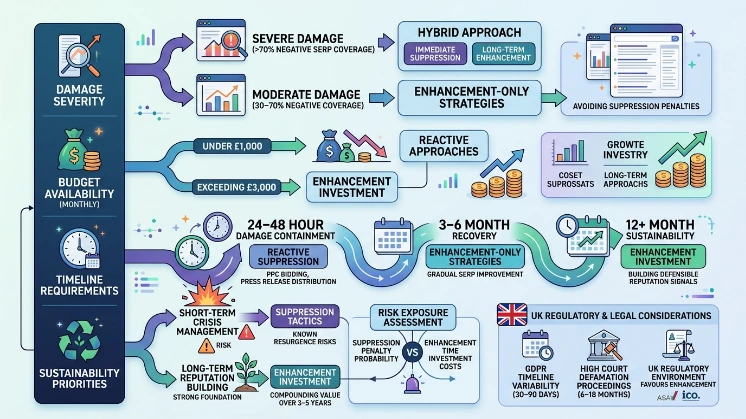
Reputation management approach selection depends on damage severity, budget availability, timeline requirements, and sustainability priorities. Severe damage exceeding 70% negative SERP coverage requires hybrid approaches combining immediate suppression with long-term enhancement. Moderate damage between 30–70% negative coverage benefits from enhancement-only strategies avoiding suppression penalties. Budget constraints under £1,000 monthly favour reactive approaches while budgets exceeding £3,000 support enhancement investment.
Timeline requirements determine approach viability through recovery speed expectations. 24–48 hour damage containment requires reactive suppression with PPC bidding and press release distribution. 3–6 month recovery accepts enhancement-only strategies with gradual SERP composition improvement. 12+ month sustainability priorities mandate enhancement investment building defensible reputation signals. UK entities face additional considerations through GDPR timeline variability (30–90 days) and High Court defamation proceedings (6–18 months).
Sustainability priorities distinguish short-term crisis management from long-term reputation building. Crisis management accepts suppression tactics with known resurgence risks. Reputation building invests enhancement creating compounding value over 3–5 years. Risk exposure assessment weighs suppression penalty probability against enhancement time investment costs. The UK regulatory environment favours enhancement through alignment with Advertising Standards Authority and Information Commissioner’s Office guidelines.
Check Out the Full Article:
Get Confidential Personal Reputation Management From a UK Specialist
Answers to Key Questions
What is celebrity reputation management and how does it work?
Celebrity reputation management is a strategic process that protects and enhances a public figure’s online image through content creation, SEO, and crisis response. At Reputation Management PR Agency, this involves monitoring search results, suppressing negative content, and building positive narratives that rank for branded queries.
How much does celebrity reputation management cost in the UK?
Celebrity reputation management costs vary based on damage severity, typically ranging from £1,000–£5,000 monthly for enhancement strategies or £500–£3,000 for short-term suppression. Reputation Management PR Agency tailors pricing to specific needs like crisis response, content creation, or long-term SERP control.
What strategies are used for celebrity reputation repair after a crisis?
Effective celebrity reputation repair combines rapid crisis response with long-term content enhancement, including press releases, owned media, and SEO-driven positive content. Reputation Management PR Agency uses content suppression for immediate relief while building entity credibility through semantic content networks for sustainable recovery.
How long does it take to recover a celebrity’s online reputation?
Short-term suppression delivers results in 1–4 weeks, while long-term enhancement requires 6–18 months for significant reputation signal accumulation. Reputation Management PR Agency recommends hybrid approaches for severe damage, combining immediate PPC bidding and removal requests with 12+ months of topical authority development.