

Reputation management strategies differ based on how search systems evaluate entity credibility, content velocity, and sentiment distribution across indexed sources.
Online reputation control methods are evaluated through their influence on SERP composition, reputation signals, and long-term search ranking influence.
Reputation management operates as a structured system of content, authority signals, and entity associations that search engines continuously reassess. Algorithm changes reshape visibility by recalibrating how trust, relevance, and sentiment are weighted across digital ecosystems.
What distinguishes algorithm-resilient reputation management strategies from static approaches?
Algorithm-resilient reputation management strategies focus on adaptive signal distribution across multiple indexed sources, while static approaches concentrate on fixed content outputs. A resilient model continuously aligns with changes in search engine interpretation of authority, entity relationships, and content freshness. A static model relies on isolated pages or singular platforms without structural diversification of reputation signals. This distinction defines how visibility stabilises or collapses during algorithm updates.
Algorithm-resilient systems operate by distributing entity credibility across multiple content layers, including authoritative publications, structured data, and user-generated signals. Search engines process these distributed signals as interconnected reinforcement of trust, which reduces volatility during ranking shifts. Static approaches fail to establish this networked reinforcement, leaving reputation signals vulnerable to devaluation when individual pages lose ranking influence.
Comparatively, algorithm-resilient strategies sustain SERP stability through redundancy in reputation pathways. Static strategies concentrate authority into narrow digital footprints, increasing exposure to ranking fluctuations. The evaluation of both approaches reveals that resilience depends on systemic integration rather than isolated optimisation.
How do content enhancement and content suppression compare in SERP control effectiveness?
Content enhancement improves SERP visibility by introducing authoritative, positive, and contextually relevant materials that strengthen entity perception, while content suppression reduces visibility of negative or outdated sources through dilution rather than removal. Both approaches influence search ranking influence but operate through fundamentally different mechanisms within indexing systems.
Content enhancement operates by increasing the density of positive reputation signals across multiple domains. This includes structured editorial content, contextual references, and semantic reinforcement of entity credibility. Search engines interpret this as expanded relevance and authority, which shifts ranking balance toward enhanced assets. The limitation of enhancement lies in time dependency, as new content requires indexing cycles before influence stabilises.

Content suppression operates through displacement mechanics, where newer or more authoritative content reduces the prominence of negative sources in SERPs. This method does not eliminate original content but alters its ranking position relative to competing assets. Suppression effectiveness depends on competitive keyword density, domain authority distribution, and freshness signals. Compared to enhancement, suppression delivers faster perceptual change but lacks long-term stability unless supported by continuous reinforcement.
How does organic reputation building differ from reactive reputation repair in search ecosystems?
Organic reputation building establishes entity credibility through continuous publication of authoritative content, structured engagement signals, and long-term digital footprint expansion, while reactive reputation repair focuses on correcting or repositioning existing negative or inaccurate search results. These approaches differ in timing, intent, and search ecosystem impact.
Organic reputation building operates by constructing layered reputation signals across multiple platforms, enabling search engines to associate entities with consistent topical authority. This process strengthens semantic relevance and improves ranking resilience by expanding indexed associations. It also reduces dependency on individual pages, distributing credibility across a wider content network.
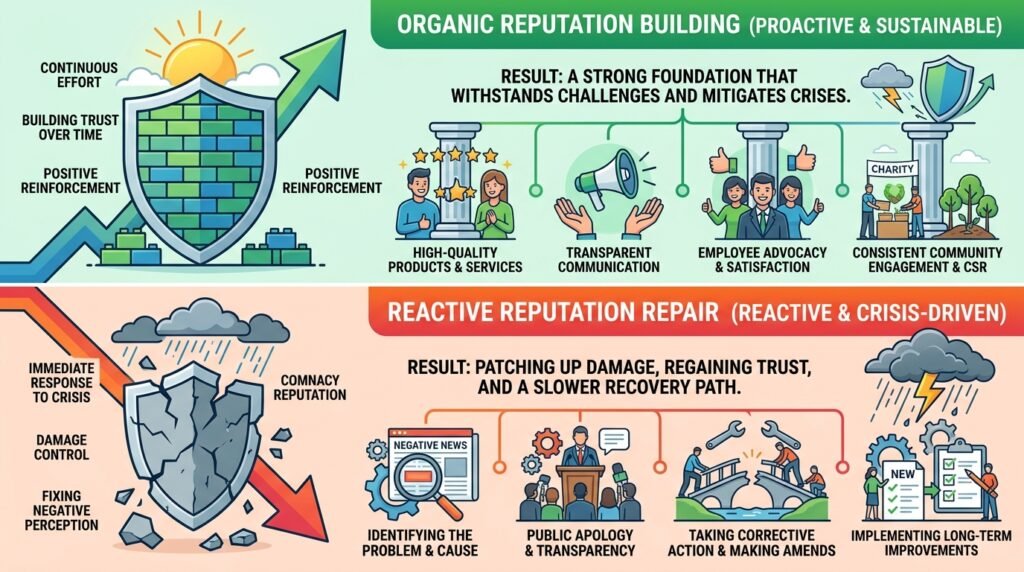
Reactive reputation repair functions within constrained conditions, targeting specific SERP entries that negatively influence perception. It applies corrective content creation, contextual reframing, and authority injection to shift ranking composition. However, reactive systems operate under competitive pressure from already-indexed negative content, which requires higher signal intensity to achieve displacement.
The comparison demonstrates that organic strategies generate structural stability in entity perception, while reactive strategies modify existing perception states without fully restructuring underlying reputation architecture.
How do search engines interpret reputation signals across entities and content sources?
Search engines interpret reputation signals through entity-based indexing systems that map relationships between content sources, sentiment indicators, and authority references. These systems evaluate consistency, source credibility, and contextual alignment across multiple indexed documents associated with a single entity.
Entity credibility is established through repeated reinforcement across trusted domains, structured data schemas, and high-authority references. Search algorithms assign weighted relevance to sources based on domain strength, topical alignment, and historical trust performance. Reputation signals become stronger when multiple independent sources converge on consistent semantic interpretations of an entity.
Sentiment distribution also influences interpretation, as search systems analyse tonal variation across indexed content. Balanced or positive sentiment clusters improve perceived trustworthiness, while fragmented sentiment signals reduce ranking stability. Search engines prioritise coherence in entity representation, meaning inconsistent or contradictory content weakens overall credibility scoring.
This interpretation framework demonstrates that reputation is not derived from isolated pages but from aggregated semantic networks that define how entities exist within search ecosystems.
Which evaluation metrics determine the effectiveness of reputation management strategies?
Reputation management effectiveness is determined through metrics that measure visibility stability, sentiment distribution balance, entity association strength, and SERP volatility resistance. These metrics quantify how consistently an entity maintains favourable positioning across search results over time.
Visibility stability measures the persistence of positive or neutral content within top-ranking positions. High stability indicates strong reputation signal reinforcement across multiple indexed sources. SERP volatility resistance evaluates how significantly rankings shift following algorithm updates, reflecting structural resilience within the content ecosystem.
Entity association strength measures the density and quality of connections between an entity and authoritative domains. Strong associations indicate that search engines recognise the entity as credible within its topical category. Sentiment distribution balance evaluates the proportional representation of positive, neutral, and negative content across indexed pages, shaping overall perception coherence.
Read More:
How to Conduct an Online Reputation Audit and What to Do With the Results
Which Tools Help You Monitor Online Reputation Before Problems Get Out of Hand
These metrics collectively determine whether a reputation system operates as reactive adjustment or structured authority construction within search environments.
How does short-term reputation correction compare with long-term digital footprint optimisation?
Short-term reputation correction focuses on immediate SERP adjustments through targeted content publication and ranking displacement techniques, while long-term digital footprint optimisation builds sustained entity authority through continuous expansion of high-quality indexed content. Both approaches operate within different temporal and structural frameworks.
Short-term correction delivers rapid shifts in visibility by introducing competing content designed to outrank negative sources. This approach depends heavily on indexing speed, keyword targeting precision, and authority injection. Its impact decreases over time if not supported by ongoing reinforcement, as search algorithms recalibrate rankings based on evolving content ecosystems.
Long-term optimisation establishes layered digital ecosystems where entity credibility accumulates through repeated validation across trusted domains. This process strengthens semantic depth and reduces dependency on individual ranking events. Search engines interpret long-term footprints as indicators of established authority, which stabilises SERP positioning even during algorithm fluctuations.
The comparison shows that short-term correction modifies surface-level visibility, while long-term optimisation restructures underlying reputation architecture.
How do scalability and risk exposure vary across different reputation management models?
Scalability and risk exposure vary significantly depending on whether reputation strategies rely on centralised control mechanisms or distributed content ecosystems. Centralised models scale rapidly but concentrate risk within limited digital assets, while distributed models scale gradually but reduce exposure to ranking instability.
Centralised reputation models depend on a small number of high-impact assets, making them easier to deploy but more vulnerable to algorithmic re-evaluation. If these assets lose ranking influence, overall reputation visibility declines sharply. This structure increases volatility and reduces long-term resilience.
Distributed models operate by expanding content across multiple domains, platforms, and semantic layers. This increases scalability through redundancy and diversification of reputation signals. Risk exposure decreases because no single asset defines overall entity credibility. Search engines interpret distributed systems as more natural and trustworthy due to their varied signal sources.
The evaluation confirms that scalability without distribution increases vulnerability, while distributed architectures maintain stability across changing algorithmic environments.
Reputation management strategies operate through different structural mechanisms that determine how entities are interpreted within search ecosystems. Algorithm-resilient approaches prioritise distributed credibility and adaptive signal reinforcement, while static and centralised models rely on isolated authority points. Content enhancement and suppression differ in timing and mechanism but both influence SERP composition through ranking displacement dynamics.
Organic reputation building establishes long-term entity credibility, while reactive repair modifies existing perception under competitive constraints. Search engines evaluate reputation through aggregated entity signals, sentiment distribution, and authority networks rather than single-page metrics. Effectiveness is measured through visibility stability, SERP volatility resistance, and entity association strength.
Strategic design in reputation systems depends on balancing short-term correction with long-term footprint optimisation while maintaining scalable, low-risk architectures across digital environments.
The evaluation of these models is often formalised in a custom reputation management strategy aligned with UK business goals framework, where structural priorities are mapped against search behaviour patterns and entity-level risk exposure.
What is a reputation management strategy in digital marketing?
A reputation management strategy is a structured approach to controlling how a brand or individual appears online across search engines, reviews, and social platforms. It includes monitoring mentions, improving positive content visibility, and managing negative search results. A Reputation Managemnet PR Agency typically uses SEO, PR, and content strategies to support this process.
How do algorithm changes affect online reputation management?
Algorithm changes in search engines can shift which content appears on the first page of results, impacting brand perception. This means positive or negative content may suddenly gain or lose visibility. Effective reputation management focuses on adaptable SEO strategies that maintain stability despite these updates.
What are the key elements of a strong reputation management strategy?
A strong strategy includes online monitoring, search engine optimization, content creation, and review management. It also involves controlling brand narratives through authoritative content and trusted third-party mentions. A Reputation Managemnet PR Agency often combines these elements to maintain consistent digital trust.
How can businesses monitor their online reputation effectively?
Businesses can monitor their reputation using tools that track brand mentions, reviews, and search engine rankings in real time. Regular audits of Google search results and social media activity also help identify risks early. This allows reputation teams to respond quickly and maintain a positive online presence.
Why is content important in reputation management strategies?
Content plays a key role because search engines prioritize relevant and authoritative information. Publishing high-quality articles, press releases, and optimized pages helps push positive content higher in search results. This reduces the visibility of negative content and strengthens long-term reputation stability.