

Employer branding vs employer reputation represents two distinct but interconnected systems that shape how organisations are evaluated within search ecosystems. Employer branding defines the controlled narrative created by an organisation about itself, while employer reputation reflects the aggregated perception formed through external signals across digital platforms.
Reputation management is the structured analysis of how information about an organisation is created, distributed, interpreted, and ranked within search engines and digital environments. It focuses on entity perception, SERP evaluation, content indexing, and reputation signals that determine how trust is constructed in algorithmic systems.
What is the difference between employer branding and employer reputation in search ecosystems?
Employer branding refers to the controlled communication system that defines how an organisation presents itself across owned channels. Employer reputation refers to the external evaluation system formed through aggregated third-party signals within search ecosystems.
Employer branding operates as a content production framework. It defines messaging, career narratives, workplace descriptions, and organisational identity through structured publishing. This system functions through planned content distribution across websites, social platforms, and recruitment materials.
Employer reputation operates as an interpretation framework within search engines. It defines how algorithms aggregate external signals such as reviews, mentions, sentiment, and authoritative references to construct entity-level trust.
The distinction exists in control versus interpretation. Employer branding is controlled and internally structured, while employer reputation is externally generated and algorithmically assessed. Search engines evaluate both systems differently through ranking mechanisms that prioritise credibility signals over intended messaging.
In SERPs, employer branding contributes indexed content that shapes narrative visibility. Employer reputation contributes ranking signals derived from independent sources that influence trust scoring. These two systems combine to form overall employer perception within digital environments, but they function through separate informational inputs.
How is employer reputation formed within search engine results pages (SERPs)?
Employer reputation is formed through the aggregation and ranking of external content that search engines interpret as trust signals. SERPs act as the evaluation layer where digital reputation is constructed through indexed documents and authority signals.
Search engines collect employer-related information from review platforms, news articles, forums, and professional databases. These sources generate entity references that define how an organisation is represented within search results. Each indexed page contributes to the cumulative reputation profile of the employer entity.
Ranking systems evaluate these inputs using relevance, authority, and consistency. High-authority sources influence employer perception more strongly due to stronger trust signals within the algorithmic model. Repeated mentions across multiple domains reinforce entity recognition and stabilise reputation signals.
Read More:
The Hidden Cost of Negative Glassdoor Reviews
What Candidates Really Research Before Accepting a Job Offer
SERPs structure this information into ranked layers. Top positions reflect higher perceived credibility, while lower positions reflect weaker or less authoritative signals. Employer reputation emerges from the distribution of sentiment and authority across these layers.
Search engines also evaluate temporal signals. Recent content influences perception more strongly when it reflects ongoing employer activity or workforce sentiment. This dynamic ensures that employer reputation remains fluid within SERP structures rather than static.
What defines employer branding as an intentional content system?
Employer branding is defined as a structured content system designed to control organisational identity across digital channels. It functions through planned messaging, curated narratives, and consistent publication strategies that define how an organisation is presented to external audiences.
This system operates through owned media channels where content is published directly by the organisation. These channels include career pages, corporate websites, recruitment content, and structured social media communication. Each content asset contributes to a unified narrative framework.
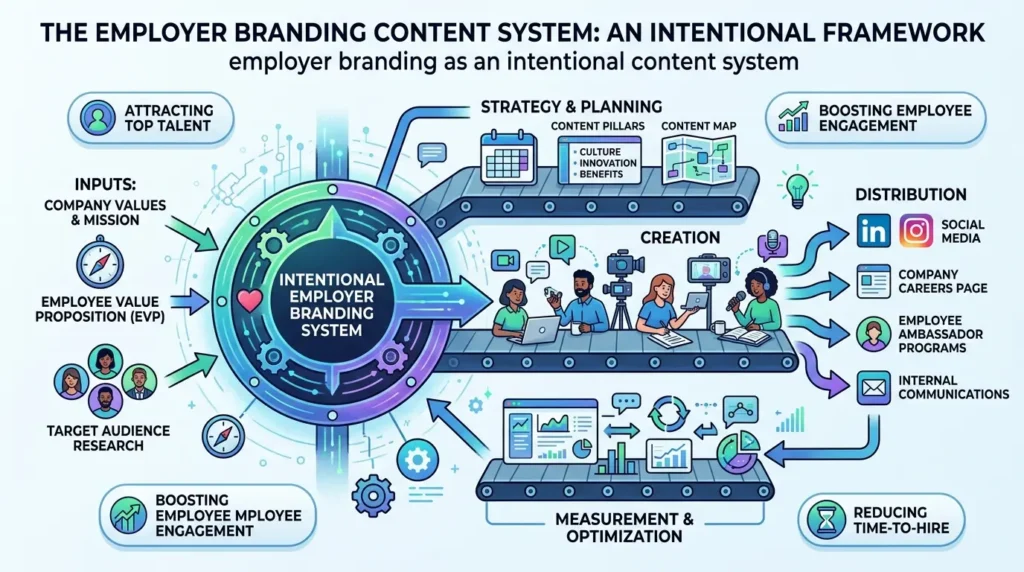
Employer branding relies on message consistency. Consistency ensures that search engines index uniform descriptions of organisational identity, values, and workplace structure. This structured repetition strengthens entity association within search indexes.
Search engines interpret employer branding as first-party content. First-party content establishes baseline identity signals but does not independently determine reputation. It contributes to indexing rather than external validation.
Employer branding influences perception indirectly through content availability. The more structured and semantically aligned the content is, the more effectively search engines map organisational identity within knowledge graphs. However, it does not override external reputation signals derived from third-party evaluations.
How do search engines interpret employer reputation signals and trust indicators?
Search engines interpret employer reputation through structured trust signals derived from external content ecosystems. These signals define how algorithms evaluate credibility, authority, and sentiment across indexed sources.
Reputation signals include review scores, sentiment polarity, citation frequency, and domain authority. Each signal contributes to the algorithmic assessment of employer trustworthiness. High-frequency positive signals reinforce credibility within entity models.
Search engines apply weighting mechanisms to different sources. Authoritative domains contribute stronger trust signals than low-authority platforms. This weighting ensures that employer reputation reflects credible evaluation rather than isolated commentary.
Entity recognition systems identify repeated references to organisations across multiple platforms. These references strengthen entity confidence scores within search indexes. Strong entity confidence increases visibility and stabilises SERP positioning.
Sentiment analysis systems interpret linguistic patterns within content to classify employer perception. Positive, neutral, and negative signals are aggregated to construct a composite reputation profile. This profile directly influences how employer entities are represented in search outputs.
Trust indicators are reinforced through consistency across sources. Inconsistent signals reduce algorithmic confidence and fragment employer reputation across SERP structures. Search engines prioritise alignment between multiple independent data sources when constructing reputation models.
How do employer branding and employer reputation interact in digital footprint formation?
Employer branding and employer reputation interact through the combined structure of digital footprint formation within search ecosystems. The digital footprint represents the total indexed presence of an organisation across all searchable platforms.
Employer branding contributes structured, predictable content that defines baseline identity. This content establishes semantic anchors that assist search engines in entity classification and indexing.
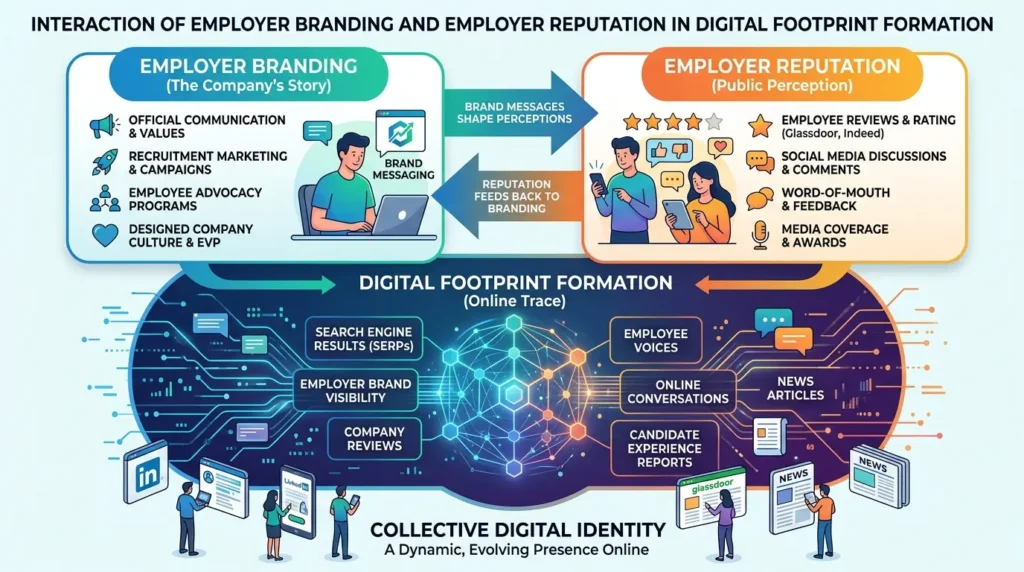
Employer reputation contributes external validation signals that influence how this identity is evaluated. These signals originate from third-party platforms and independent content creators, shaping perception beyond controlled narratives.
Search engines merge both inputs into a unified entity model. This model determines how an employer is represented across SERPs, knowledge panels, and related queries. The interaction between controlled and uncontrolled content defines overall search visibility.
When employer branding and employer reputation align, digital footprint stability increases. Alignment strengthens entity coherence and improves ranking consistency. When divergence occurs, search engines detect inconsistency in reputation signals, leading to fragmented SERP representation.
Digital footprint formation depends on continuous indexing cycles. New content updates both branding inputs and reputation signals, ensuring that employer perception evolves within algorithmic systems over time.
What role do reviews, sentiment, and user-generated content play in employer reputation?
Reviews, sentiment, and user-generated content form the primary external inputs that construct employer reputation within search ecosystems. These elements generate unstructured data that search engines process into structured reputation signals.
Reviews function as explicit feedback mechanisms. Each review contributes a measurable sentiment value that is aggregated into overall employer evaluation. High volumes of reviews increase statistical reliability within reputation models.
Sentiment represents the linguistic interpretation of opinion-based content. Search engines evaluate sentiment polarity to classify employer perception as positive, neutral, or negative. This classification influences how entities are ranked and displayed.
User-generated content extends reputation formation beyond formal review systems. Forum discussions, social commentary, and public mentions introduce additional semantic signals into search indexes. These signals expand the breadth of reputation evaluation.
Search engines integrate these inputs into entity-level scoring systems. The aggregated sentiment determines trust positioning within SERPs. Consistent positive sentiment strengthens employer visibility, while negative sentiment reduces perceived credibility.
The distribution of user-generated content across platforms also influences authority weighting. Content appearing on high-authority domains contributes stronger reputation signals than isolated or low-visibility sources.
How does content indexing influence employer perception in search visibility?
Content indexing defines how employer-related information is stored, categorised, and retrieved within search engine systems. It directly influences how employer perception is constructed through visibility patterns.
Search engines index content by analysing semantic relevance, entity relationships, and contextual meaning. Employer-related pages are classified based on structured data and keyword associations that define organisational identity.
Indexed content determines which information appears in SERPs. High-ranking indexed pages shape user perception by controlling exposure to specific narratives. Visibility hierarchy influences how employer reputation is cognitively interpreted.
Search engines prioritise content that demonstrates authority and relevance. Indexed pages with strong backlinks, consistent entity references, and structured metadata receive higher ranking positions.
Content freshness also impacts indexing relevance. Recently updated pages influence perception more strongly due to increased algorithmic weighting for current information.
Employer perception emerges from the interaction between indexed content layers. Each layer contributes to the overall visibility structure that defines how organisations are interpreted in search results.
Why does entity perception determine employer reputation outcomes in search systems?
Entity perception determines employer reputation outcomes because search engines operate on entity-based indexing models. These models classify organisations as identifiable entities rather than isolated content sources.
Entity perception refers to how an organisation is recognised, categorised, and evaluated within search knowledge systems. It defines the consistency and clarity of identity signals across indexed content.
Search engines construct entity profiles using aggregated data from multiple sources. These profiles include references, sentiment signals, and contextual associations that define employer reputation.
Strong entity perception results in stable SERP representation. Consistent references across authoritative sources reinforce entity confidence and improve ranking reliability.
Weak or fragmented entity perception leads to inconsistent search representation. Inconsistent signals reduce algorithmic confidence and disrupt visibility stability across search results.
Entity-based systems ensure that employer reputation is not dependent on single content pieces but on aggregated digital identity structures. This mechanism defines how organisations are understood within modern search ecosystems.
Employer branding and employer reputation operate as distinct systems within search ecosystems. Employer branding defines controlled identity construction through structured content, while employer reputation defines externally generated perception formed through aggregated signals.
Search engines evaluate both systems through indexing, ranking, and entity recognition mechanisms. SERPs function as the interpretive layer where reputation signals are structured into visible outcomes.
Digital footprint formation depends on the interaction between controlled messaging and external evaluation. Entity perception, sentiment signals, content indexing, and authority weighting collectively determine employer reputation within search environments.
What is the difference between employer branding and employer reputation?
Employer branding is the company’s planned effort to shape how it wants to be seen as a workplace, including messaging, culture, and recruitment marketing. Employer reputation is how employees, candidates, and the public actually perceive the company based on real experiences and reviews.
Why is employer reputation important for hiring talent?
Employer reputation directly affects how candidates view trust, culture, and job satisfaction before applying. A strong reputation improves application rates, while a negative one can reduce interest even if employer branding is strong.
How does employer branding influence employer reputation?
Employer branding sets expectations through campaigns, job posts, and communication about company values. If real employee experiences match these expectations, it strengthens reputation; if not, it can damage trust.
What factors affect employer reputation in the workplace?
Key factors include employee reviews, leadership style, workplace culture, pay fairness, and career growth opportunities. Online platforms and social media also play a major role in shaping public perception.
How can a Reputation Management PR Agency improve employer reputation?
A Reputation Management PR Agency helps monitor feedback, manage negative reviews, and highlight positive employee experiences. It also supports consistent messaging to align employer branding with real workplace perception.