

Candidates research employer reputation signals across search engines, review platforms, and professional networks before accepting a job offer.
Reputation management is the systematic control and interpretation of how an employer entity is represented across search ecosystems, including SERPs, indexed content, sentiment signals, and authority-driven digital references.
What information do candidates analyse in search results before accepting a job offer?
Candidates analyse structured and unstructured reputation data in search results to evaluate employer credibility, workplace conditions, and long-term career risk. This process focuses on how information appears across SERPs, not isolated content sources.
Search engines aggregate employer-related content from news pages, review platforms, recruitment sites, and professional discussions. Candidates interpret this aggregated visibility as a composite reputation profile. The ranking position of each result influences perceived importance, with top-ranked pages shaping immediate judgement frameworks.
The primary categories of analysed information include employer reviews, salary data, leadership references, workplace culture indicators, and historical employment disputes. These elements form a semantic layer of employer perception within search ecosystems. Each data type contributes to entity-level reputation scoring in the candidate’s evaluation process.
Search interpretation also depends on repetition frequency across indexed sources. When similar themes appear across multiple domains, search engines reinforce them as stable reputation signals. Candidates rely on this repetition to validate consistency in employer behaviour and organisational identity.
How do search engines construct employer reputation in SERPs?
Search engines construct employer reputation in SERPs by aggregating, ranking, and contextualising entity-related content into a unified visibility structure. This structure defines how an employer is perceived at the moment of search.
Search engines use entity recognition systems to identify an employer as a distinct informational object. Once identified, all associated content—reviews, news coverage, career pages, and forum discussions—is linked to that entity. This process enables search engines to generate a consolidated reputation profile within SERPs.

Ranking algorithms prioritise authority, relevance, and recency when displaying employer-related content. High-authority domains such as established publications or verified review platforms receive stronger ranking weight. This hierarchy determines which reputation signals are most visible to candidates during evaluation.
SERP composition also reflects query intent segmentation. Informational queries trigger explanatory content, while evaluative queries surface comparative and review-based results. This dynamic influences how employer reputation is framed depending on the candidate’s search behaviour and intent stage.
How do review platforms influence employer credibility perception?
Review platforms influence employer credibility perception by acting as structured sentiment repositories that search engines index and integrate into SERP evaluation systems. These platforms provide standardised feedback signals that directly impact employer reputation visibility.
Each review contributes sentiment-weighted data, including ratings, textual feedback, and categorical assessments. Search engines process this data to identify recurring themes such as management quality, compensation structure, and workplace environment. These themes become semantic indicators of employer performance.
Aggregation of reviews produces reputation clustering, where consistent positive or negative signals form dominant perception narratives. When clustered feedback aligns across multiple entries, search engines interpret this as stabilised sentiment, increasing its influence on ranking outcomes.
Review recency also affects credibility weighting. Recent reviews carry stronger influence in reputation evaluation because they reflect current organisational conditions. This temporal weighting ensures that outdated signals do not dominate employer perception in SERPs.
What role does sentiment analysis play in employer reputation evaluation?
Sentiment analysis plays a central role in employer reputation evaluation by converting unstructured text into structured reputation signals that search engines can interpret and rank.
Sentiment systems classify textual data into positive, negative, or neutral categories based on linguistic patterns, contextual phrasing, and keyword associations. This classification enables automated interpretation of employer-related narratives across large datasets.
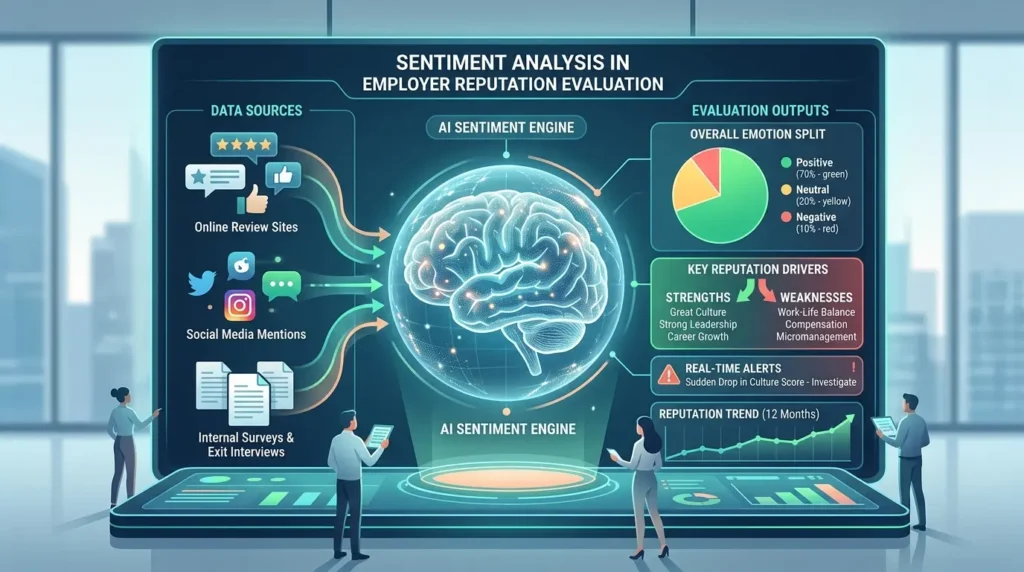
Search engines apply sentiment scoring to detect reputation polarity trends across indexed content. When negative sentiment clusters around specific employer attributes, such as management or workload, these signals influence SERP positioning and visibility distribution.
Sentiment analysis also supports comparative reputation modelling. Employers are evaluated not only in isolation but also relative to similar entities within the same industry. This comparative structure influences how trustworthiness is established across search ecosystems.
How do digital footprints shape employer trust signals across indexed content?
Digital footprints shape employer trust signals by creating a cumulative record of all employer-related content indexed across the web. This includes official pages, third-party references, media coverage, and user-generated content.
Search engines evaluate digital footprints as longitudinal reputation evidence. A consistent footprint across time indicates organisational stability, while fragmented or contradictory footprints introduce uncertainty in entity perception. This affects how trust signals are weighted in SERPs.
Read More:
How Employer Reputation Impacts Recruitment Costs and Employee Retention
Indexed content contributes to footprint depth. Employers with broader content distribution across authoritative domains generate stronger trust associations. Each indexed page acts as a reinforcement node within the employer’s reputation network.
Digital footprints also influence click behaviour signals. When users consistently engage with certain types of employer-related content, search engines interpret this as behavioural validation of relevance, reinforcing trust-based ranking adjustments.
How do authority and entity signals affect employer ranking in search ecosystems?
Authority and entity signals affect employer ranking by determining how strongly an employer is recognised and validated within search engine knowledge systems. These signals define structural credibility beyond individual content pieces.
Authority signals are derived from domain strength, backlink quality, and citation frequency across reputable sources. High-authority references increase the perceived legitimacy of employer-related content, improving visibility within SERPs.
Entity signals refer to how clearly an employer is identified as a distinct conceptual object within search systems. Strong entity recognition allows search engines to connect diverse content sources into a unified reputation profile.
When authority and entity signals align, search engines stabilise employer ranking positions. This stabilisation reduces volatility in SERP presentation and strengthens long-term reputation consistency across indexed environments.
How is employer reputation interpreted within decision-making frameworks for candidates?
Employer reputation is interpreted within candidate decision-making frameworks as a structured risk evaluation model based on search-visible trust signals, sentiment distribution, and content consistency.
Candidates assess reputation by comparing SERP data against expected employment standards, including workplace stability, career progression, and organisational transparency. These comparisons form cognitive benchmarks derived from search exposure.
Decision-making frameworks prioritise consistency across multiple digital sources. When employer signals align across reviews, news coverage, and professional references, perceived reliability increases within candidate evaluation systems.
Search-driven reputation interpretation also incorporates anomaly detection. Conflicting or highly polarised information reduces perceived trust stability, prompting deeper information verification across additional indexed sources.
Employer reputation within search ecosystems is constructed through layered interactions between indexed content, sentiment analysis, authority signals, and entity recognition systems. Candidates interpret this structured information as a unified credibility profile before making employment decisions.
Search engines consolidate diverse reputation inputs into ranked SERP outputs, where visibility, repetition, and sentiment consistency determine perceived employer trustworthiness. Review platforms, digital footprints, and authority signals collectively define how employer entities are evaluated at scale.
This system demonstrates that employer reputation is not a static attribute but a continuously updated semantic construct shaped by indexed information, algorithmic interpretation, and search-driven perception dynamics.
How do candidates research a company before accepting a job offer?
Candidates typically review online reputation signals such as employee reviews, company website content, and social media presence. They also check employer branding, news mentions, and platforms like LinkedIn to understand workplace culture and stability.
Why is online reputation important in job acceptance decisions?
Online reputation helps candidates judge trust, management quality, and long-term career growth potential. A strong or weak digital presence can directly influence whether a candidate accepts or rejects a job offer.
What role do employee review sites play in candidate decision-making?
Sites like Glassdoor and Indeed provide insights into salary expectations, management style, and workplace culture. Candidates use these reviews to validate whether the employer’s claims match real employee experiences.
How does social media affect employer reputation during hiring?
Social media shows how a company communicates, handles public feedback, and presents its culture. Candidates often assess consistency between official branding and real employee or customer interactions.
How can companies improve their reputation for attracting better candidates?
Companies often work with a Reputation Management PR Agency or similar services to manage search visibility and address negative content. Improving transparency, responding to reviews, and publishing positive workplace content also strengthens employer perception.