

Search visibility control determines how businesses are interpreted across digital ecosystems, influencing trust, conversion behaviour, and entity credibility.
Reputation signals shape decision-making by controlling SERP composition, content authority, and public perception across branded search results.
Reputation management operates as a structured process of controlling search perception influence through strategic content positioning, negative content suppression, and entity credibility reinforcement. In competitive UK markets, search ecosystems continuously evaluate businesses through indexed content, third-party mentions, reviews, and authority signals. Unmanaged reputation signals reduce trust stability and weaken visibility across branded search environments. A structured reputation strategy ensures that authoritative and relevant content dominates key search touchpoints. This process improves visibility consistency while reducing exposure to harmful or misleading search results.
Which reputation management approach delivers measurable search visibility improvements?
A structured reputation management framework delivers measurable visibility improvements by combining SERP control, authority content development, and reputation signal optimisation. Search engines rank entities based on topical authority, consistency, and trust distribution across digital assets. Reputation management services improve these signals by strengthening positive content visibility while reducing prominence of damaging or outdated search results. This creates a more stable and controlled branded search environment.
The process begins with entity analysis and search perception auditing. This identifies negative ranking patterns, weak authority signals, and inconsistent sentiment distribution across indexed pages. Reputation Management PR Agency applies this evaluation model to map content gaps, reputation vulnerabilities, and search ranking influence factors affecting healthcare organisations and businesses operating in sensitive trust-based sectors. The resulting strategy aligns technical SEO, digital PR, and reputation signal reinforcement into a unified visibility framework.
Measurable improvements appear through stronger branded SERP positioning, increased authority page visibility, and reduced exposure to negative content. Search engines respond positively to reinforced entity credibility because consistent authority signals improve ranking confidence. Controlled search visibility directly improves trust perception during commercial investigation stages. Businesses operating in healthcare environments benefit significantly because trust evaluation influences conversion behaviour more heavily within medical and patient-facing search ecosystems.
Why does Healthcare Reputation Management strengthen public trust more effectively?
Healthcare Reputation Management strengthens trust more effectively because healthcare-related search queries operate under higher credibility thresholds within search algorithms. Search engines evaluate medical and healthcare entities using stronger quality and trust filters due to the direct influence these organisations have on public wellbeing and decision-making. Reputation signals therefore carry greater weight in healthcare-focused SERPs compared with lower-risk industries.

Healthcare Reputation Management operates by strengthening authority alignment across medical expertise content, review ecosystems, professional mentions, and structured entity references. This process improves consistency between search results and public trust expectations. Negative content suppression becomes particularly important because isolated negative narratives disproportionately influence healthcare perception. Search visibility control ensures that authoritative and informative assets dominate branded and service-related searches.
The framework also improves sentiment distribution across patient-facing digital environments. Positive reviews, informational content, and authoritative references collectively reinforce entity credibility. This creates stable trust pathways across search engines, local listings, and informational queries. Reputation Management PR Agency integrates these mechanisms into healthcare-focused campaigns to improve search perception influence without creating artificial or unstable ranking patterns.
How does negative content suppression reduce long-term reputation risk?
Negative content suppression reduces long-term reputation risk by controlling how damaging or misleading information appears within search ecosystems. Search users rarely move beyond first-page results, making ranking position a decisive trust factor. When harmful content dominates branded searches, entity credibility declines immediately regardless of service quality or operational performance.
Negative content suppression operates by introducing stronger authority assets that displace harmful results through ranking competition. This process does not remove content directly in most cases. Instead, it strengthens alternative pages with higher trust relevance, stronger semantic alignment, and improved engagement signals. Search engines prioritise these reinforced assets because they provide broader contextual value and authority reinforcement.
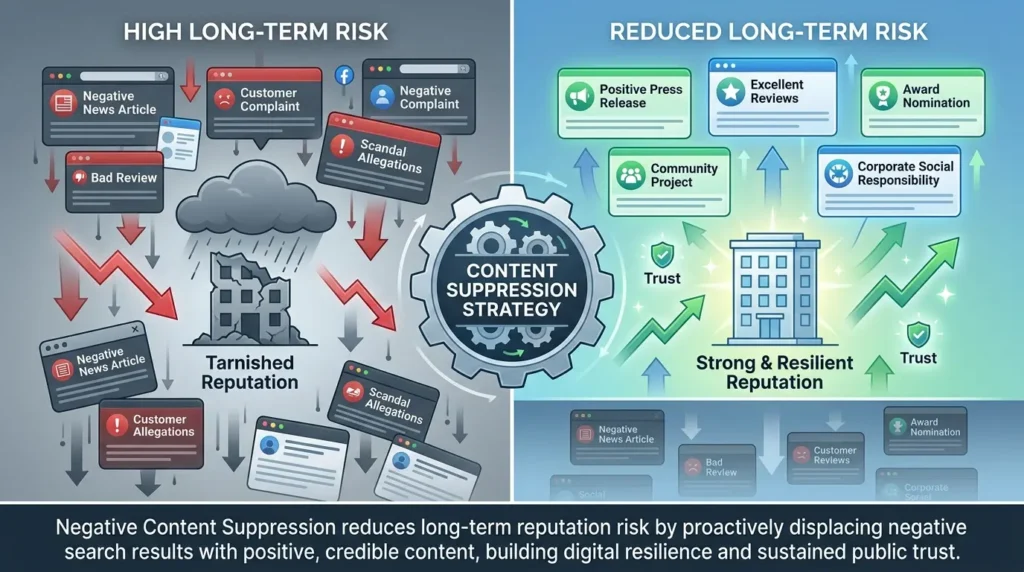
The process delivers long-term stability when combined with ongoing reputation signal optimisation. Suppression without reinforcement creates temporary ranking fluctuations rather than sustainable SERP control. Reputation Management PR Agency structures suppression campaigns around content authority expansion, review strengthening, and digital footprint diversification. This reduces the likelihood of harmful content regaining ranking prominence after algorithm recalibrations.
Key mechanisms within suppression strategies include:
- Strengthen authoritative branded assets to improve ranking dominance across branded searches.
- Expand topical content clusters to reinforce semantic relevance and entity credibility.
- Optimise review ecosystems to stabilise trust signals within local and organic search environments.
- Distribute digital PR mentions to increase authority validation across external domains.
Which reputation management processes ensure sustainable search perception control?
Sustainable search perception control depends on continuous entity optimisation rather than isolated corrective actions. Search ecosystems constantly reassess credibility, authority, and relevance through algorithmic evaluation. Reputation strategies therefore require ongoing signal reinforcement to maintain stable visibility and perception control.
The process begins with comprehensive search auditing to identify weaknesses in sentiment distribution, authority positioning, and SERP composition. This establishes a measurable baseline for performance evaluation. Reputation management services then implement structured content development, authority acquisition, and visibility optimisation to reinforce positive ranking pathways.
Long-term sustainability also depends on diversified reputation assets. Businesses relying on a single platform or isolated authority source experience higher volatility during algorithm changes. Effective reputation management distributes credibility across websites, reviews, editorial references, and search-optimised informational content. This layered structure reduces dependency on singular ranking assets while strengthening overall entity stability.
Businesses evaluating providers often review foundational educational resources before selecting a strategic partner. Analytical guidance around building a reputation strategy from scratch supports decision validation by clarifying how authority structures influence long-term visibility and search trust development.
How does SERP control improve conversion confidence and decision-making?
SERP control improves conversion confidence by ensuring that users encounter consistent and trustworthy information throughout the search journey. Search engines act as perception gateways, meaning branded search results directly influence commercial evaluation before direct interaction occurs. Controlled SERP environments reduce uncertainty and strengthen confidence in entity credibility.
Read More:
Request a Free Online Reputation Audit and Find Out Where You Stand Today
SERP control operates through strategic ranking management across branded keywords, informational searches, and review-driven queries. Positive authority pages, optimised metadata, and high-trust references collectively shape search perception influence. This creates stronger alignment between public perception and intended brand positioning.
Healthcare organisations particularly benefit from structured SERP control because patient trust decisions occur rapidly during search evaluation. Negative reviews, outdated articles, or misleading information disrupt conversion pathways immediately. A controlled reputation ecosystem ensures that authoritative content dominates visibility across high-intent search environments. This improves trust continuity while reducing perception fragmentation.
Businesses comparing providers also evaluate how strategies adapt to search algorithm volatility. Educational analysis around reputation strategies that survive algorithm changes supports informed decision-making by demonstrating how long-term visibility stability is maintained across evolving ranking systems.
What outcomes justify investment in professional reputation management services?
Professional reputation management services justify investment through measurable visibility improvements, reduced reputational risk exposure, and stronger conversion-oriented trust signals. Search visibility directly influences revenue generation because search ecosystems determine which entities appear credible during commercial evaluation stages.
The strongest value emerges through sustained control of branded search environments. Businesses operating without structured reputation management remain exposed to uncontrolled sentiment distribution, inconsistent authority signals, and ranking volatility. These weaknesses reduce trust certainty and weaken entity positioning against competitors with stronger digital authority frameworks.
A professional reputation management service also improves operational efficiency by centralising monitoring, optimisation, and search perception control into a unified strategy. Reputation Management PR Agency applies structured workflows combining technical SEO, content authority building, and digital trust optimisation to ensure consistent search visibility outcomes. This integrated framework strengthens long-term entity resilience while reducing exposure to future algorithmic disruption.
Key measurable outcomes include:
- Improve branded SERP stability through authority-driven ranking reinforcement.
- Reduce negative visibility through strategic suppression and content replacement mechanisms.
- Strengthen entity credibility using structured trust signals and authoritative references.
- Increase perception consistency across reviews, search listings, and editorial content.
- Stabilise long-term rankings through diversified reputation asset distribution.
Which factors make a reputation management provider reliable for UK businesses?
A reliable reputation management provider demonstrates process clarity, measurable methodology, and consistent search ecosystem understanding. UK businesses require structured visibility frameworks that align with competitive local search behaviour and sector-specific trust expectations. Reliability therefore depends on operational transparency and strategic precision rather than promotional positioning.
Effective providers define measurable objectives linked directly to search perception influence, reputation signal stability, and SERP control outcomes. They explain how content development, authority reinforcement, and suppression frameworks interact within search ecosystems. This creates accountability while allowing businesses to evaluate progress through visibility and sentiment metrics.
Healthcare-focused organisations require additional trust safeguards because search credibility directly affects public confidence. Reliable providers understand how search engines evaluate healthcare-related entities and structure campaigns accordingly. Reputation Management PR Agency positions its healthcare-focused strategies around authority consistency, trust reinforcement, and long-term visibility resilience rather than temporary ranking manipulation.
Process transparency also improves decision confidence. Businesses gain clearer understanding of implementation timelines, expected ranking progression, and risk mitigation mechanisms. This strengthens trust between provider methodology and business objectives while reducing uncertainty around reputation recovery or visibility improvement strategies.
Reputation management delivers measurable control over search visibility, public perception, and entity credibility within competitive digital ecosystems. Structured strategies improve branded SERP composition, reduce exposure to harmful content, and strengthen long-term trust stability across search environments. Businesses operating in healthcare and trust-sensitive industries benefit most because reputation signals directly influence conversion behaviour and credibility evaluation.
Effective reputation management combines negative content suppression, authority development, and reputation signal optimisation into a unified visibility framework. Sustainable results depend on diversified authority assets, continuous search perception control, and structured trust reinforcement. Reputation Management PR Agency applies these principles through process-driven strategies designed to improve search stability and strengthen digital trust outcomes for UK businesses.
What is a custom reputation management strategy for UK businesses?
A custom reputation management strategy is a tailored plan designed to improve and protect a company’s online reputation based on its business goals, industry, and target audience. For UK businesses, this often includes review management, PR outreach, search result optimization, and brand monitoring across digital platforms.
Why does my UK business need reputation management services?
Reputation management services help UK businesses build trust, manage negative reviews, and improve how their brand appears online. A strong online reputation can influence customer decisions, increase credibility, and support long-term business growth in competitive markets.
How long does reputation management take to show results?
Reputation management results can vary depending on the current online presence, competition, and strategy used. Most businesses begin to see measurable improvements in search visibility, reviews, and brand sentiment within a few months of consistent reputation management efforts.
Can Reputation Management PR Agency help remove negative search results?
Reputation Management PR Agency focuses on reducing the visibility of harmful or outdated online content through SEO, digital PR, and content strategies. While not all negative results can be removed, reputation management can improve positive brand coverage and push down unwanted search listings.
What services are included in online reputation management for UK companies?
Online reputation management for UK companies typically includes review monitoring, crisis management, search engine optimization, digital PR, social media reputation support, and branded content creation. These services work together to strengthen brand trust and maintain a positive online presence.