

Reputation management is the structured process of defining, monitoring, and influencing how an entity is interpreted across digital search ecosystems. Online reputation refers to the collection of indexed signals, content assets, review data, and entity associations that shape perception within search engine results pages (SERPs).
A strong reputation management strategy built from scratch defines how information is created, interpreted, and ranked across search environments. Within healthcare reputation management, the strategy focuses on trust signals, authority validation, factual consistency, and sentiment interpretation because healthcare-related queries fall under high-trust search categories that influence public confidence and information credibility.
What Is a Reputation Management Strategy Within Search Ecosystems?
A reputation management strategy is a structured framework for controlling how entities appear and are evaluated within search environments. The strategy defines how reputation signals are created, distributed, indexed, and interpreted by algorithms. Search engines analyse entity relationships, content consistency, authority indicators, and behavioural engagement to evaluate credibility. Reputation management therefore operates as a search interpretation system rather than a communications activity.
Search ecosystems interpret reputation through connected data points. These include review sentiment, website content, structured metadata, citation consistency, backlinks, and third-party references. Each signal contributes to entity perception because search engines evaluate patterns rather than isolated content pieces. Reputation formation depends on how these signals reinforce topical authority and trustworthiness across multiple indexed sources.
Within healthcare reputation management, search engines apply stricter evaluation standards because healthcare content affects public wellbeing and informational reliability. Algorithms evaluate expertise indicators, factual consistency, and source credibility with greater scrutiny. Reputation management strategies therefore prioritise accuracy, transparency, and authoritative signal alignment within healthcare-related SERPs.
How Is Online Reputation Formed in Search Engines?
Online reputation is formed through the continuous indexing and interpretation of digital signals connected to an entity. Search engines collect information from websites, reviews, directories, news sources, social platforms, and user interactions. Algorithms then organise these signals into entity profiles that define relevance, trustworthiness, and authority within SERPs.
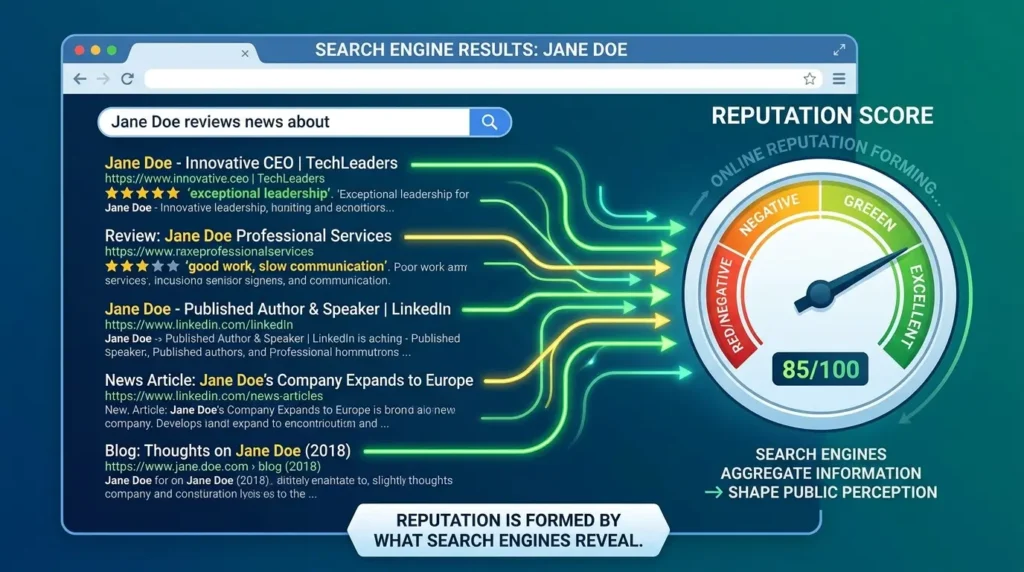
Search engines interpret reputation using entity-based indexing systems. An entity refers to a recognised person, organisation, service category, or concept connected through contextual relationships. Reputation formation depends on how frequently positive authority signals appear alongside the entity within trusted environments. Consistent terminology, verified references, and topical relevance strengthen entity confidence during indexing.
Content freshness also influences reputation formation because algorithms continuously reassess relevance and accuracy. Newly indexed information updates entity understanding within search systems. Negative sentiment, inconsistent data, or contradictory information weakens trust signals because algorithms identify instability across content ecosystems. Reputation management therefore involves maintaining semantic consistency across all indexed assets.
User behaviour contributes additional reputation signals. Click-through rates, dwell time, engagement patterns, and review interactions indicate perceived value and trust. Search engines analyse these behavioural indicators to refine SERP evaluation processes. Reputation is therefore partially defined by how users interact with indexed information.
Why Do Reputation Signals Influence Search Visibility?
Reputation signals influence search visibility because search engines prioritise trustworthy entities during ranking evaluation. Reputation signals refer to measurable indicators of credibility, authority, expertise, and reliability. Algorithms use these indicators to determine whether content deserves prominent placement within SERPs.
Search visibility depends on signal alignment across multiple digital environments. Reviews, citations, backlinks, content quality, and structured data collectively demonstrate authority. When these signals remain consistent, algorithms interpret the entity as reliable and relevant. Strong alignment improves indexing confidence and supports higher visibility positions within competitive search categories.
Healthcare reputation management relies heavily on trust evaluation because healthcare-related searches fall within high-risk informational categories. Search systems evaluate factual reliability, author expertise, and source transparency more aggressively within healthcare ecosystems. Inconsistent or unverified signals reduce perceived authority and weaken search visibility because algorithms prioritise information integrity.
Sentiment analysis also affects reputation-driven visibility. Search engines analyse language patterns within reviews, articles, and public discussions to interpret positive, neutral, or negative associations. Positive sentiment patterns reinforce credibility signals, while persistent negative associations reduce entity trust evaluation. Reputation management therefore includes sentiment monitoring alongside content optimisation.
What Role Does Content Play in Reputation Management?
Content is the primary mechanism through which search engines interpret reputation and authority. Content defines entity context, topical relevance, and semantic relationships across digital ecosystems. Every indexed page contributes to the search engine’s understanding of credibility and expertise.
Search algorithms evaluate content using relevance, depth, consistency, and trustworthiness metrics. High-quality informational content demonstrates topical expertise because it explains concepts clearly and maintains semantic alignment with user intent. Thin, duplicated, or inconsistent content weakens reputation signals because algorithms interpret low informational value as reduced authority.
How Does Semantic Consistency Affect Entity Reputation?
Semantic consistency refers to the stable use of terminology, themes, and contextual relationships across indexed content. Search engines analyse repeated patterns to confirm entity identity and topical authority. Consistent semantic structures strengthen entity recognition because algorithms detect reliable thematic associations.
In healthcare reputation management, semantic consistency supports expertise validation. Healthcare-related content requires accurate terminology, factual alignment, and authoritative contextual framing. Contradictory language patterns weaken trust evaluation because algorithms identify uncertainty within the entity profile. Consistent informational structures therefore improve reputation signal stability.
How Does Content Indexing Shape Public Perception?
Content indexing shapes public perception because indexed pages become accessible through SERPs and discovery systems. Search engines prioritise indexed information based on perceived relevance and trustworthiness. The visibility of specific content therefore directly influences how users interpret entity credibility.
Indexed content establishes narrative dominance within search environments. Informational pages, reviews, FAQs, articles, and external references collectively define public understanding. Search engines reinforce frequently referenced themes because repeated indexing patterns indicate perceived relevance. Reputation management therefore involves controlling informational consistency across indexable assets.
How Do Reviews Affect Reputation Evaluation?
Reviews function as direct reputation signals because they contain sentiment indicators, behavioural feedback, and trust-related language patterns. Search engines analyse reviews to evaluate service quality, reliability, and public confidence. Review ecosystems therefore contribute significantly to entity perception within SERPs.
Read More:
What an Online Reputation Audit Reveals About How You Appear to Others Online
How to Conduct an Online Reputation Audit and What to Do With the Results
Algorithms interpret reviews using sentiment analysis models. Positive reviews strengthen trust associations because they reinforce reliability signals across search ecosystems. Negative reviews influence entity perception differently depending on frequency, consistency, and contextual severity. Search systems identify recurring themes to determine whether criticism reflects isolated dissatisfaction or systematic credibility concerns.

Review diversity also affects reputation interpretation. Search engines evaluate distribution patterns across platforms because concentrated review activity appears less natural. Consistent reviews from multiple trusted environments strengthen authority signals and improve confidence during SERP evaluation. Sparse or irregular review activity weakens entity legitimacy because algorithms interpret limited engagement as reduced credibility.
Healthcare reputation management places additional emphasis on review integrity because healthcare-related decisions involve trust-sensitive evaluation. Search systems therefore assess authenticity, recency, and sentiment stability more rigorously within healthcare-related review environments.
What Is the Relationship Between Authority and Reputation?
Authority refers to the recognised expertise and trustworthiness of an entity within a defined topical ecosystem. Reputation refers to the cumulative perception created by indexed authority signals, sentiment indicators, and behavioural interactions. Search engines connect authority and reputation because authoritative entities generally produce stronger trust signals.
Authority is established through consistent informational quality, trusted references, citation networks, and topical relevance. Search engines evaluate whether authoritative domains associate positively with the entity. Backlinks, mentions, and references from recognised informational sources strengthen authority because algorithms interpret these relationships as validation signals.
Reputation expands beyond authority by incorporating public sentiment and behavioural interpretation. An entity can demonstrate expertise while maintaining unstable sentiment associations. Search systems therefore analyse authority alongside review quality, engagement patterns, and content perception to produce broader reputation evaluations.
How Do Backlinks Influence Reputation Signals?
Backlinks function as relational trust indicators within search ecosystems. Search engines analyse backlinks to determine whether trusted domains associate with the entity. Relevant backlinks strengthen authority signals because they indicate contextual endorsement within topical environments.
Low-quality or manipulative backlinks weaken reputation evaluation because algorithms detect unnatural linking behaviour. Search systems prioritise contextual relevance, source authority, and semantic alignment during backlink interpretation. Reputation management therefore focuses on link quality rather than link quantity.
How Does Structured Data Support Reputation Interpretation?
Structured data refers to machine-readable information that defines entities, relationships, and content categories. Search engines use structured data to interpret organisational identity, authorship, reviews, and topical relevance. Structured information improves indexing accuracy because algorithms receive clearer contextual signals.
Healthcare reputation management benefits from structured data because healthcare-related content requires precise entity interpretation. Search systems evaluate credentials, reviews, FAQs, and organisational details more effectively when structured data supports semantic clarity. This strengthens trust evaluation within healthcare-related SERPs.
Why Does Digital Footprint Consistency Matter?
Digital footprint refers to the total collection of indexed information associated with an entity across digital environments. This includes websites, profiles, reviews, mentions, directories, articles, and multimedia assets. Search engines evaluate digital footprint consistency to determine credibility and informational reliability.
Consistent digital footprints strengthen entity recognition because algorithms identify stable data relationships. Identical naming structures, contact information, topical themes, and authority references reinforce trust signals during indexing. Inconsistent information creates ambiguity because search systems struggle to confirm entity identity across environments.
Search visibility depends on digital footprint cohesion. Fragmented or contradictory information weakens SERP evaluation because algorithms interpret inconsistency as reduced reliability. Reputation management strategies therefore maintain alignment across all publicly indexed assets to strengthen semantic clarity.
Healthcare reputation management requires especially precise footprint consistency because healthcare entities operate within high-trust informational ecosystems. Search engines evaluate healthcare-related entity stability rigorously to minimise misinformation risks and improve search result reliability.
How Do Algorithm Changes Affect Reputation Management?
Algorithm changes redefine how search engines evaluate trust, relevance, and authority signals. Reputation management strategies therefore depend on adaptive informational structures rather than isolated ranking tactics. Search systems continuously refine evaluation models to improve content quality assessment and entity interpretation.
Core algorithm updates frequently target content credibility, spam detection, user experience, and trust evaluation. Reputation strategies built solely around technical manipulation lose visibility when search systems update ranking priorities. Sustainable reputation management instead relies on informational consistency, authority validation, and semantic relevance.
Search engines increasingly prioritise entity-based indexing over keyword-based interpretation. Algorithms analyse contextual relationships, sentiment stability, and authority networks to understand reputation more accurately. Strategies that focus on entity clarity and trust signals therefore remain more resilient during ranking adjustments.
Within healthcare reputation management, algorithm changes often intensify trust evaluation requirements because healthcare content affects decision-making reliability. Search engines strengthen scrutiny around expertise validation, factual consistency, and informational transparency within healthcare-related SERPs.
What Does a Sustainable Reputation Management Framework Include?
A sustainable reputation management framework includes monitoring systems, content governance, authority validation, sentiment evaluation, and digital footprint consistency. Each component contributes to long-term search visibility and stable entity perception.
Define Entity Identity
Define entity identity through consistent naming structures, topical themes, and semantic relationships. Search engines require clear entity recognition signals to evaluate authority accurately. Stable identity frameworks improve indexing confidence and strengthen reputation interpretation.
Establish Content Governance
Establish content governance by maintaining factual consistency, structured publishing standards, and topical relevance. Search systems evaluate information quality continuously. Governance structures therefore protect semantic consistency across indexed assets.
Monitor Sentiment Signals
Monitor sentiment signals through reviews, public references, and behavioural engagement metrics. Search engines analyse sentiment patterns to evaluate trustworthiness. Stable positive sentiment improves entity perception within SERPs.
Maintain Authority Validation
Maintain authority validation through trusted references, high-quality backlinks, and accurate citation networks. Algorithms interpret authoritative associations as credibility indicators. Strong validation frameworks support sustainable search visibility.
Evaluate SERP Representation
Evaluate SERP representation by analysing indexed pages, review visibility, and entity associations within search results. Reputation management depends on understanding how algorithms present information to users. Continuous evaluation identifies inconsistencies that weaken trust signals.
How Does a Reputation Strategy Survive Algorithm Changes?
A reputation strategy survives algorithm changes by prioritising informational integrity over ranking manipulation. Search engines continuously evolve toward entity understanding, trust evaluation, and contextual interpretation. Sustainable strategies therefore focus on semantic clarity and authority consistency rather than temporary optimisation methods.
Search resilience depends on stable reputation signals. High-quality content, trustworthy references, consistent digital footprints, and balanced sentiment profiles maintain value regardless of ranking model adjustments. Algorithms continue rewarding entities that demonstrate credibility through measurable informational patterns.
Healthcare reputation management requires especially adaptive structures because healthcare search environments receive frequent trust-focused algorithm refinements. Strategies built around factual accuracy, expertise demonstration, and structured authority signals remain stable during ranking transitions. This approach aligns directly with How to Build a Reputation Management Strategy That Survives Algorithm Changes because algorithm resilience depends on maintaining trusted entity relationships across evolving search ecosystems.
A strong reputation management strategy built from scratch defines how entities are interpreted within search ecosystems through content indexing, authority validation, sentiment analysis, and digital footprint consistency. Reputation formation depends on interconnected trust signals rather than isolated ranking factors. Search engines evaluate credibility by analysing semantic relevance, behavioural indicators, review ecosystems, and authority relationships across indexed environments.
Healthcare reputation management demonstrates the importance of trust-focused evaluation because healthcare-related queries require stronger credibility assessment within SERPs. Sustainable reputation strategies therefore prioritise informational consistency, entity clarity, and authority reinforcement. Algorithm changes continue refining how search systems interpret trust and relevance, but stable reputation signals remain central to long-term search visibility and entity perception.
What is a reputation management strategy?
A reputation management strategy is a structured plan businesses use to monitor, improve, and protect their online reputation across search engines, review platforms, social media, and news coverage. A strong strategy typically includes brand monitoring, review management, PR outreach, crisis response, and SEO-driven content creation.
Why is reputation management important for businesses?
Reputation management helps businesses build trust, improve customer confidence, and maintain a positive online presence. Strong brand reputation can influence purchasing decisions, search visibility, customer retention, and long-term business growth.
How do you build a reputation management strategy from scratch?
Building a reputation management strategy starts with auditing your current online presence, identifying reputation risks, and setting clear brand messaging goals. Businesses then create a plan for review generation, negative feedback handling, search engine optimization, and ongoing reputation monitoring.
How does SEO support online reputation management?
SEO supports online reputation management by helping positive, authoritative content rank higher in search results. This can improve brand visibility, suppress harmful or outdated content, and strengthen trust signals associated with the business name.
What services does a reputation management PR agency provide?
A reputation management PR agency typically offers online reputation monitoring, crisis communication, media relations, review management, and digital PR services. Agencies may also help businesses improve branded search results through content strategy and search optimization.