

Reputation management is the process of evaluating, interpreting, and influencing how entities appear within digital environments and search ecosystems. Online reputation refers to the collection of indexed content, reputation signals, and search-visible information that defines public perception across search engine results pages (SERPs).
What Is an Online Reputation Audit?
An online reputation audit is a structured evaluation of how an entity appears across indexed search environments. The audit analyses search visibility, content positioning, review sentiment, entity associations, and trust indicators that influence digital perception. Within search ecosystems, reputation audits function as diagnostic frameworks that reveal how algorithms interpret credibility and relevance. The process evaluates the relationship between published content, third-party references, and user-generated signals across SERPs. Search engines continuously interpret these signals to construct entity perception and determine ranking priority. An online reputation audit therefore defines how searchable information shapes external interpretation and digital trust.
The audit process examines both owned and non-owned digital assets. Owned assets include websites, profiles, knowledge panels, and authored content. Non-owned assets include reviews, directory listings, discussion forums, news references, and independent mentions. Search engines compare these signals to evaluate consistency, authority, and contextual relevance. Inconsistent information weakens entity clarity and reduces search confidence. Strong alignment between indexed sources strengthens trust evaluation and improves search visibility. The audit reveals these relationships by analysing how information appears, ranks, and connects across search systems.
How Do Search Engines Form Online Reputation Profiles?
Search engines form online reputation profiles by aggregating and interpreting entity-related signals from indexed content sources. Reputation signals include reviews, backlinks, author references, structured data, engagement metrics, and semantic associations. Algorithms evaluate these signals to determine credibility, topical authority, and relevance within specific query contexts. Search engines use entity recognition systems to associate content with identifiable organisations, professionals, and topics. These systems analyse consistency across digital sources to define entity trustworthiness. Reputation therefore becomes a machine-interpreted construct formed through content indexing and signal evaluation.

Search engines evaluate relationships between content sources to identify corroboration and authority alignment. When multiple trusted sources reference the same entity using consistent terminology, the search ecosystem interprets the entity as credible and well-defined. Contradictory or fragmented information reduces confidence and weakens ranking stability. SERP evaluation systems prioritise information that demonstrates clarity, expertise, and contextual relevance. Review platforms, directory listings, and editorial references all contribute to this interpretive framework. The resulting reputation profile influences visibility across branded and non-branded search queries.
How Does Entity Perception Influence Search Visibility?
Entity perception refers to the way search systems interpret the identity, authority, and trustworthiness of a person, organisation, or topic. Search engines construct entity perception through semantic relationships between indexed content sources. The interpretation process evaluates topical consistency, citation frequency, and contextual alignment. Strong entity perception increases the probability of stable SERP positioning and enhanced visibility. Weak entity perception produces fragmented search representation and inconsistent rankings.
Search engines rely on structured relationships to interpret entity meaning accurately. Schema markup, profile consistency, review alignment, and citation accuracy strengthen entity recognition. Disconnected or contradictory references weaken semantic understanding and reduce confidence in search evaluation systems. Online reputation audits therefore analyse whether search engines interpret the entity consistently across digital environments. This analysis reveals how perception influences indexing quality, visibility, and search prominence.
What Does an Online Reputation Audit Measure?
An online reputation audit measures the visibility, accuracy, sentiment, and authority of indexed information associated with an entity. The process evaluates search results positioning, review signals, content sentiment, backlink quality, and reputation consistency. Each measurement reveals how search systems interpret credibility within SERPs. The audit also analyses whether authoritative sources dominate visibility or whether low-quality references influence perception. Reputation measurement therefore combines technical search evaluation with semantic interpretation.
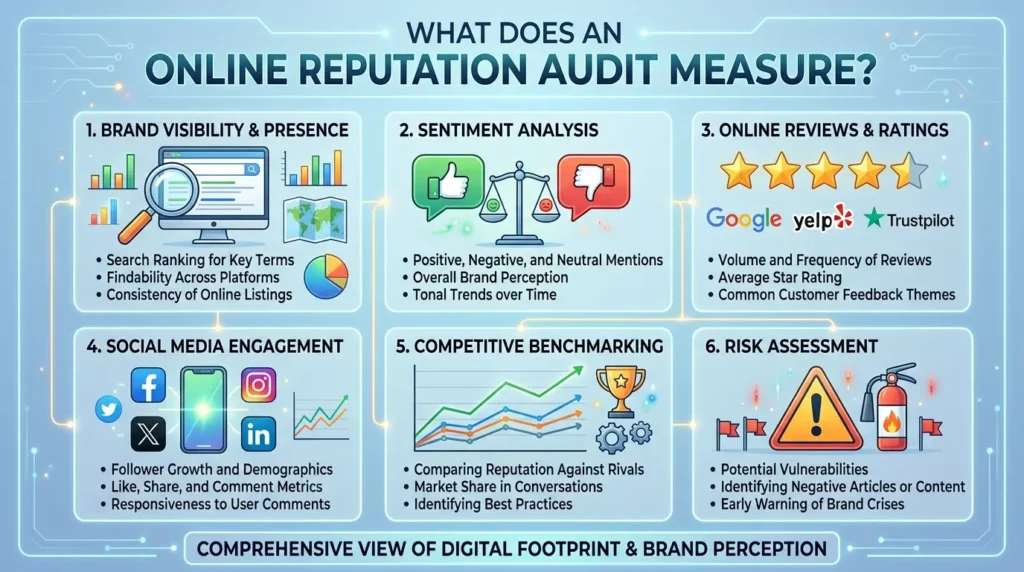
Search visibility analysis examines which pages rank for branded and reputation-related queries. This evaluation identifies dominant narratives within indexed search results. Positive authority signals strengthen trust interpretation, while low-quality references weaken perceived credibility. Review sentiment analysis evaluates recurring themes, polarity patterns, and contextual language associated with the entity. Search algorithms interpret review patterns as behavioural indicators linked to trust and expertise. These interpretations directly affect local visibility, click behaviour, and SERP evaluation.
A detailed framework explaining How to Conduct an Online Reputation Audit and What to Do With the Results expands this process by analysing how indexed content, review sentiment, and authority signals influence entity perception across search ecosystems. The methodology evaluates ranking behaviour, citation consistency, and trust alignment to identify how search systems interpret credibility within digital environments. This type of analysis also demonstrates how audit findings connect directly to content indexing quality, search visibility patterns, and reputation signal distribution. Structured evaluation frameworks strengthen interpretive clarity because they organise reputation indicators into measurable search-based categories. Search engines prioritise entities with consistent informational architecture and stable authority associations. Reputation audits therefore function as analytical models that explain how digital trust forms through indexed search relationships.
How Are Review Signals Interpreted During Reputation Analysis?
Review signals are behavioural and sentiment-based indicators that search engines use to evaluate public trust and service credibility. Search ecosystems interpret review volume, frequency, sentiment polarity, and linguistic consistency to assess entity reliability. Reviews contribute to both local search visibility and broader reputation evaluation frameworks. Positive sentiment combined with consistent engagement strengthens credibility signals. Negative sentiment associated with repeated thematic concerns weakens trust interpretation and influences click perception.
Search engines also evaluate review authenticity and behavioural patterns. Sudden review spikes, duplicated language, or inconsistent reviewer activity trigger quality assessments within algorithmic systems. Structured review data contributes to visibility features such as snippets and local pack rankings. Reputation audits analyse review distribution across platforms to determine whether search engines receive consistent trust indicators. This evaluation reveals how review ecosystems shape online credibility and perception dynamics.
Why Does Search Visibility Influence Public Perception?
Search visibility influences public perception because SERPs function as information-filtering environments. Users interpret ranking position as an indicator of relevance, authority, and credibility. Content that appears prominently within search results gains interpretive dominance over lower-ranking information. Search engines therefore influence perception through ranking structures and visibility prioritisation. An online reputation audit evaluates which information receives dominant exposure and how that exposure shapes entity interpretation.
SERPs organise information hierarchically according to algorithmic evaluation. Top-ranking pages receive greater user attention and stronger trust association. Featured snippets, knowledge panels, review summaries, and authoritative references all contribute to perceived legitimacy. Negative or inaccurate content appearing prominently affects entity perception because visibility increases interpretive weight. Reputation audits identify these visibility relationships and analyse their impact on digital trust structures.
Read More:
How to Monitor Your Online Reputation Across Search Reviews and Social Channels
What It Means to Bury Negative Search Results and How Long It Takes
Search behaviour also reinforces ranking influence through interaction signals. Higher click-through rates, engagement consistency, and behavioural satisfaction strengthen ranking stability. Search ecosystems therefore create feedback loops where visible content gains additional authority signals. Reputation management analysis focuses on understanding these loops and identifying the factors that shape search prominence. Visibility analysis consequently reveals how perception becomes embedded within algorithmic ranking systems.
How Does Content Indexing Shape Reputation?
Content indexing shapes reputation by determining which information becomes retrievable within search ecosystems. Indexed content forms the searchable record associated with an entity. Search engines crawl, categorise, and evaluate content according to relevance, authority, and semantic alignment. Indexed pages contribute to entity perception by defining what information users encounter during SERP evaluation. Reputation therefore depends heavily on the quality and contextual framing of indexed material.
Search engines evaluate indexed content using semantic relevance and authority frameworks. Content containing clear topical focus, structured organisation, and authoritative references gains stronger visibility potential. Thin, duplicated, or contradictory content weakens indexing quality and reduces interpretive trust. Reputation audits analyse indexed assets to determine whether search systems associate the entity with authoritative and contextually relevant information. This evaluation reveals how indexing patterns shape long-term digital perception.
How Does Duplicate Information Affect Reputation Signals?
Duplicate information weakens reputation signals because search engines prioritise canonical clarity and informational uniqueness. Multiple inconsistent versions of the same entity data create semantic ambiguity within indexing systems. Ambiguity reduces confidence in entity interpretation and weakens ranking efficiency. Search ecosystems therefore favour consolidated and clearly structured information sources.
Duplicate directory listings, inconsistent profile descriptions, and repeated low-value content reduce trust evaluation strength. Search engines struggle to determine authoritative versions of information when inconsistencies persist across indexed assets. Reputation audits identify these fragmentation issues by analysing citation accuracy and content duplication patterns. Correcting these inconsistencies strengthens entity coherence and improves search interpretation stability.
What Trust Signals Influence Online Credibility?
Trust signals are measurable indicators that search engines use to evaluate authority, reliability, and authenticity. Online credibility depends on the consistency and quality of these signals across indexed environments. Trust signals include authoritative backlinks, verified profiles, review consistency, secure domains, structured data implementation, and expert references. Search ecosystems interpret these indicators collectively rather than individually. Strong trust alignment improves search visibility and strengthens entity perception.
Authority signals influence how algorithms prioritise information within SERPs. High-quality citations from trusted domains reinforce credibility evaluation and semantic relevance. Structured data improves interpretive accuracy by helping search systems identify entity relationships and contextual meaning. Review engagement patterns also function as trust indicators because behavioural interaction reflects user confidence. Reputation audits evaluate these signals to determine how effectively search engines interpret credibility.
Trust evaluation also includes temporal consistency. Search engines favour entities that maintain stable informational accuracy across time. Frequent inconsistencies or abrupt content shifts weaken confidence in authenticity and reliability. Reputation analysis therefore examines historical indexing patterns and long-term signal alignment. This process reveals whether search ecosystems interpret the entity as stable, authoritative, and contextually trustworthy.
How Does Digital Footprint Analysis Reveal Reputation Patterns?
Digital footprint analysis examines the total collection of searchable references associated with an entity across online ecosystems. A digital footprint includes websites, profiles, reviews, media references, social mentions, directory listings, and indexed documents. Search systems use these references to construct entity relationships and contextual understanding. Reputation patterns emerge from the consistency, authority, and sentiment associated with these references. Online reputation audits therefore analyse digital footprints to identify visibility strengths and interpretive weaknesses.
Search ecosystems evaluate digital footprints through semantic association mapping. Repeated references connected to expertise, credibility, and authority strengthen positive entity perception. Negative sentiment clusters, inaccurate information, or fragmented references weaken search confidence and distort contextual interpretation. Digital footprint analysis identifies these patterns by evaluating indexed relationships and ranking distribution. This process reveals how perception forms through interconnected information systems.
How Does Healthcare Reputation Management Depend on Digital Trust?
Healthcare reputation management refers to the evaluation and maintenance of credibility signals associated with healthcare entities within search ecosystems. Digital trust in healthcare environments depends on accuracy, expertise signals, review credibility, and informational consistency. Search engines apply heightened trust evaluation standards to healthcare-related content because these topics affect user wellbeing and decision-making. Authority and expertise therefore function as critical ranking and perception signals.
Healthcare-related SERPs prioritise expertise indicators such as professional credentials, authoritative references, and consistent review sentiment. Inaccurate or low-authority information weakens visibility and damages interpretive trust. Online reputation audits within healthcare contexts evaluate whether indexed content aligns with expertise expectations and credibility standards. This analysis reveals how digital trust frameworks influence healthcare-related entity perception and search visibility.
What Does Reputation Analysis Reveal About Search Ecosystems?
Reputation analysis reveals that search ecosystems function as interpretive systems rather than passive indexing environments. Search engines actively evaluate content relationships, behavioural signals, authority indicators, and semantic consistency to construct entity perception. Online reputation therefore emerges from interconnected ranking mechanisms and informational trust structures. Reputation audits expose how these systems prioritise, interpret, and display information within SERPs.
Search ecosystems continuously reassess content relevance and authority through algorithmic updates and behavioural analysis. Reputation signals evolve according to indexing changes, review patterns, and authority development. Visibility therefore reflects ongoing evaluation rather than static positioning. Reputation analysis demonstrates how trust, authority, and perception interact within search infrastructures to shape digital credibility.
Understanding these mechanisms improves conceptual clarity around online reputation formation. Search visibility, entity perception, review interpretation, and content indexing all contribute to the way digital identities are constructed and evaluated. Online reputation audits reveal these relationships by analysing how search ecosystems organise and prioritise information. The audit process therefore provides a structured understanding of how searchable information defines credibility, authority, and public interpretation within digital environments.
What is an online reputation audit?
An online reputation audit is a detailed review of how a person or business appears across search engines, social media, review sites, and online mentions. It helps identify negative content, outdated information, brand inconsistencies, and areas that may affect online credibility and public perception.
Why is an online reputation audit important for businesses?
An online reputation audit helps businesses understand how customers, clients, and search engines view their brand online. It can reveal negative reviews, poor search visibility, or inaccurate information that may impact trust, conversions, and brand authority.
What does an online reputation audit include?
A typical online reputation audit includes search engine results analysis, review monitoring, social media evaluation, brand mention tracking, and competitor comparisons. Reputation Management PR Agency also examines content performance and online sentiment to identify reputation risks and improvement opportunities.
How often should you conduct an online reputation audit?
Most businesses should conduct an online reputation audit at least every 3 to 6 months. Regular audits help track changes in customer sentiment, identify emerging reputation issues early, and maintain a strong digital presence.
Can an online reputation audit improve search engine results?
Yes, an online reputation audit can help improve search engine results by identifying harmful or low-quality content affecting brand visibility. It also supports SEO strategies by highlighting opportunities to strengthen positive content, optimize branded search results, and improve online trust signals.