

UK Review Sites
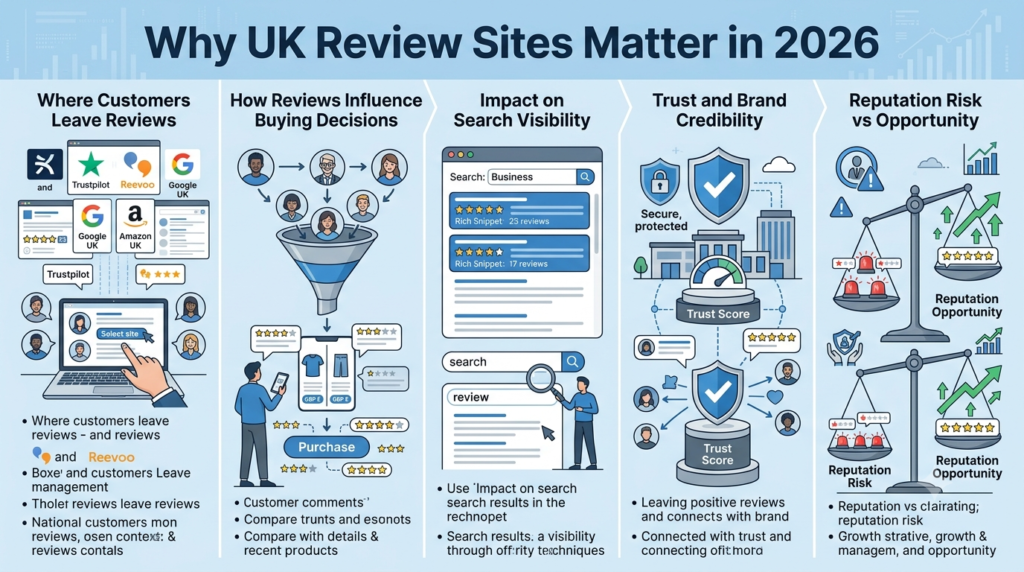
Knowing where your customers are actually leaving feedback matters just as much as encouraging them to leave it in the first place. Spreading effort thinly across every review platform rarely works as well as focusing on the handful of UK review sites that genuinely influence buying decisions, local search visibility, and increasingly, AI-generated recommendations. A focused approach to online reviews and customer feedback tends to outperform a scattered one.
Here is a practical breakdown of where UK customers leave reviews in 2026, and why each platform earns its place on the list.
Google Business Profile: The Top UK Review Site for Local SEO
Google remains the foundation of any UK review strategy. Google commands over 93% of the UK search market, which means Google reviews directly shape a business’s visibility in both Google Search and Google Maps. For most UK businesses, this is the single most important platform to prioritise, since it is often the first thing a potential customer sees.
It is worth noting that attempting to buy or manufacture Google reviews violates Google’s policies and risks suspension of the entire listing, so building a steady, genuine flow of feedback is the only sustainable approach.
Trustpilot: A Leading UK Review Site for Customer Trust
Trustpilot has built a strong reputation across the UK and Europe as an open, transparent review platform. It allows any customer to leave a review for any company, creating a public record of customer experience that helps build consumer confidence. Businesses can display their TrustScore and recent reviews directly on their own site, which supports both trust building and conversion.
Feefo
Feefo takes a different approach by focusing purely on verified purchasers. Only customers who have completed a transaction are invited to leave a review, which effectively eliminates fake or unverified feedback. This closed-loop model makes it particularly valuable for e-commerce businesses that want to demonstrate authenticity.
REVIEWS.io
REVIEWS.io is a UK-born platform offering a modern approach to collecting product, company, and local reviews, including video reviews and SMS invitations. It tends to suit small and medium-sized e-commerce businesses looking for feature-rich tools without enterprise-level pricing.
Yell
Yell remains a well-known UK business directory that combines reviews with contact details and local advertising tools, making it a useful supporting platform alongside Google and Trustpilot for general visibility.
Checkatrade, TrustATrader, and MyBuilder
For trade and home service businesses specifically, these three platforms carry particular weight. They focus on vetted tradespeople, verified customer ratings, and reliable service comparisons, making them essential for builders, electricians, plumbers, and similar trades operating across the UK.
Which? Trusted Traders
This consumer-backed directory features businesses that have been rigorously assessed against quality standards, giving it a strong trust signal for service-based businesses aiming to reach a more cautious, research-driven customer base.
Bark and Yelp UK
Bark connects businesses with customers through a mix of reviews, quotes, and lead generation, making it useful for service providers seeking direct enquiries. Yelp UK, while smaller in the UK market than in the US, still contributes to a business’s overall review footprint, particularly for hospitality and retail.
Why UK Review Sites Matter More Than Ever in 2026
Reviews are no longer just a trust signal for human readers. AI-driven search engines, including Google’s AI Overviews, Gemini, ChatGPT, and Perplexity, now generate direct business recommendations in response to queries like “best dentist in Manchester” or “most trusted estate agent in Birmingham.” These systems synthesise review sentiment, listing accuracy, and brand mentions from across the web to decide which businesses to surface.
This means a consistent, accurate presence across the right UK review sites no longer just helps local search rankings. It increasingly determines whether a business appears in AI-generated answers at all, making review strategy a genuinely cross-channel priority rather than a single-platform task.
How to Prioritise Your Effort
Rather than trying to be active everywhere at once, most UK businesses get the best return by focusing on Google Business Profile first, adding either Trustpilot or Feefo depending on business model, and layering in one or two industry-specific platforms relevant to their sector. Consistency and response speed across a smaller number of platforms tends to outperform a thin presence spread across many. This is the core of effective review management, and it applies whether you are handling it internally or through a dedicated reputation management partner.
Frequently Asked Questions
Which review platform matters most for UK local search rankings?
Google Business Profile has the strongest direct impact, given Google’s dominant share of UK search traffic and its influence on both Search and Maps visibility.
Is Trustpilot better than Google reviews for UK businesses?
They serve different purposes. Google reviews influence local search visibility directly, while Trustpilot builds a transparent, portable reputation that can be displayed independently on a business’s own website.
Do industry-specific platforms like Checkatrade matter if I already have Google reviews?
Yes, particularly for trade and service businesses, since customers in these sectors often check specialist platforms specifically for vetting and verification before making contact.
Can AI search tools really affect which businesses get recommended?
Increasingly, yes. AI-generated answers now draw on review sentiment and listing consistency across multiple platforms, meaning a strong, accurate review presence can influence whether a business appears in these responses at all.
Should I focus on getting more reviews or responding to existing ones?
Both matter, but consistent, timely responses often carry more weight with potential customers than review volume alone, since they demonstrate active engagement and accountability.