
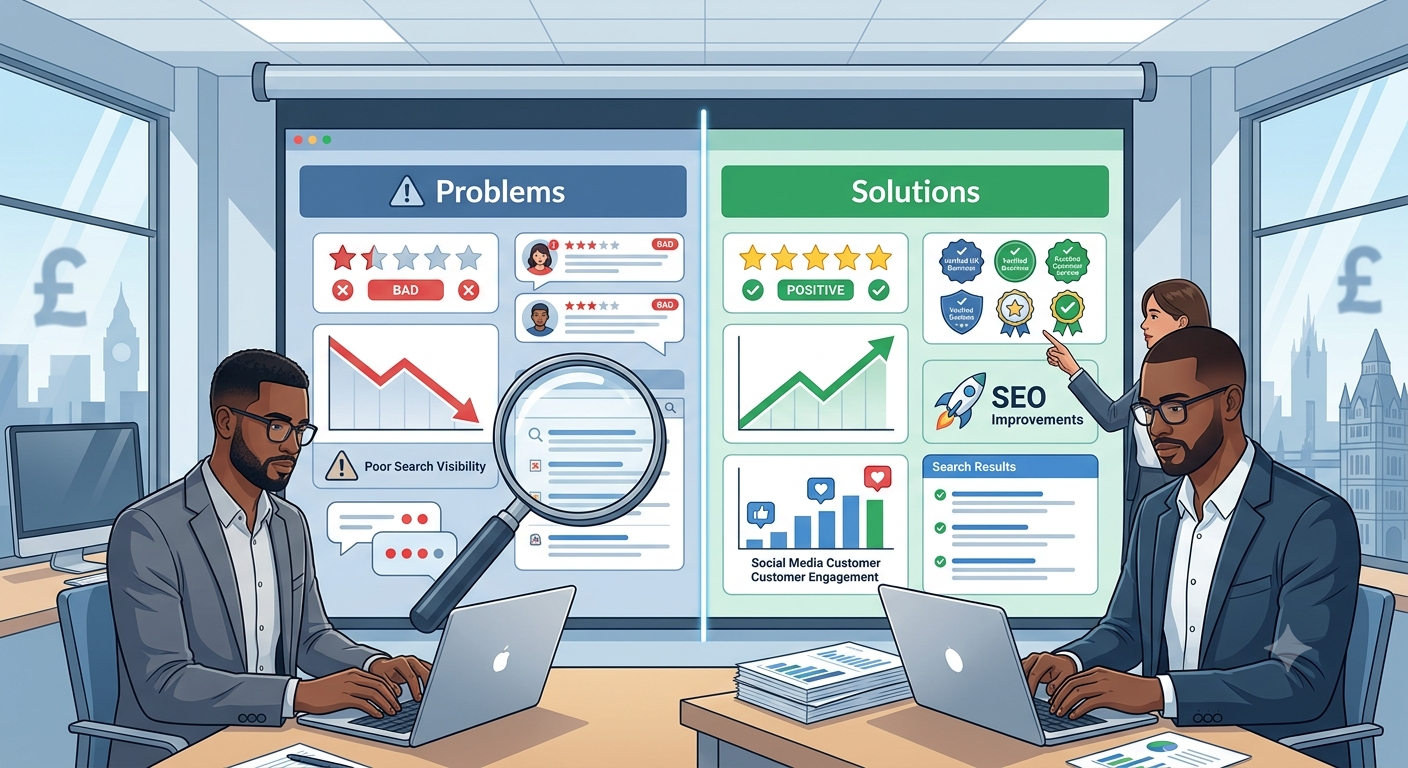
Business Reputation Suffering
There’s a particular kind of unease that sets in when a business owner searches their own company name and doesn’t like what they find. Bookings have slowed. Enquiries feel harder to close than they used to. Something has shifted, and the search results, once you actually look, usually explain why.
Business reputation suffering rarely comes from one dramatic event. More often, it’s the accumulation of several smaller issues that quietly compound until the pattern becomes impossible to ignore. Understanding which cause is actually driving the decline is the difference between a fix that works and months spent addressing the wrong problem.
The Question Every Struggling Business Eventually Asks
At some point, most business owners land on the same question: is this a marketing problem, a reputation problem, or an operational problem wearing a reputation problem’s clothes? The honest answer is usually a mix of all three, but they require different diagnoses. A marketing problem means people aren’t finding you. A reputation problem means people are finding you and not liking what they see. And an operational problem means the reputation issue is actually a symptom of something happening inside the business itself.
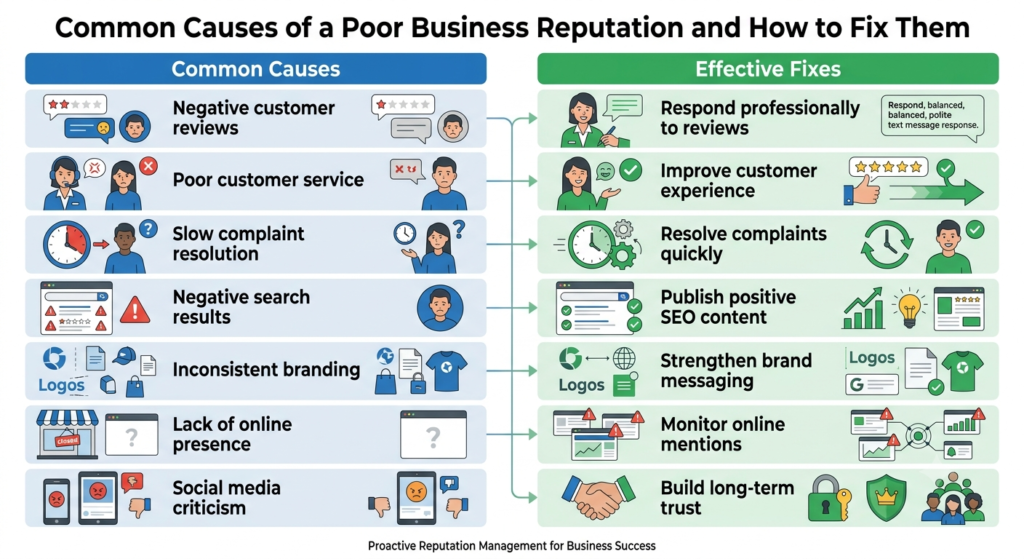
Six Common Causes, How They Show Up, and the Fix
| Cause | How It Shows Up Online | The Fix |
|---|---|---|
| Unanswered negative reviews | A cluster of low ratings with no business response | Respond promptly and professionally to every review, positive and negative |
| Inconsistent customer service | Reviews mentioning the same specific complaint repeatedly | Address the operational root cause, not just the online symptom |
| A single unmanaged crisis | One viral complaint or incident dominating search results | Build a structured crisis response plan before the next one happens |
| Weak or outdated online presence | An old website, inactive social profiles, thin content | Refresh core content and keep listings and profiles current |
| Poor employer reputation | Negative Glassdoor reviews affecting hiring and public trust | Treat employee experience as part of the reputation strategy, not separate from it |
| No active monitoring | Issues discovered weeks or months after they started | Set up regular search and review alerts to catch problems early |
Why These Problems Rarely Stay Isolated
A single unanswered negative review is manageable. Left alone for months, it becomes a pattern, and patterns are what search engines and prospective customers both notice. This is the part most business owners underestimate: reputation issues compound. An unresolved customer service complaint becomes three similar reviews. Three reviews become a visible trend on the first page of Google. That trend then starts influencing hiring, since candidates read customer reviews too, and slowly it becomes a business-wide problem rather than a single review.
Working Out Which Cause Applies to You
Before fixing anything, it helps to separate what you’re actually looking at. Search your business name and ask a few honest questions. Are the negative reviews concentrated around one specific issue, or scattered across many different complaints? Did the visibility problem start suddenly, pointing to a single incident, or has it built gradually over months? Is the criticism coming primarily from customers, or increasingly from current and former employees as well?
The answers usually point clearly toward one or two of the six causes above, rather than all of them at once, which makes the fix far more targeted than trying to address everything simultaneously.
Fixing the Root Cause, Not Just the Symptom
It’s tempting to treat every reputation issue as a search visibility problem alone, since that’s the part that’s visible. But if the underlying cause is genuinely operational, inconsistent service, slow response times, unclear policies, no amount of content strategy will hold long term. The reviews will simply keep coming. Real business reputation recovery starts by fixing what’s actually broken, then using search and review strategy to reflect that improvement accurately once it’s real.
For businesses further along the “am I even at risk” stage, our 10-point UK checklist for signs your business needs reputation management is worth reviewing to confirm how serious the pattern actually is.
When the Problem Runs Deeper Than Search Results
If the audit reveals multiple causes overlapping at once, negative reviews, an outdated site, and a recent viral incident, this usually means the reputation issue has been building for a while without active management. In these cases, a full strategic approach, covering search visibility, review management, and genuine operational fixes together, tends to work far better than tackling each symptom individually. Our complete guide to fixing a damaged online reputation walks through that fuller process step by step.
How Long Recovery Actually Takes, Depending on the Cause
Timelines vary significantly depending on which cause is actually driving the decline, and setting realistic expectations early prevents businesses from abandoning a strategy too soon or expecting an overnight fix that was never realistic to begin with.
Unanswered reviews tend to respond fastest. Once a business starts consistently responding and encouraging new feedback, the visible tone of a review profile can shift within a matter of weeks, particularly if the underlying service issue has genuinely been resolved. Outdated online presence issues, stale websites, inactive listings, sit somewhere in the middle, since refreshed content needs time to be indexed and gain traction, typically a month or two before meaningful movement appears.
Crisis-driven damage and poor employer reputation both tend to take longer, often several months, because they involve rebuilding trust with two different audiences at once, customers and either the public or prospective employees, rather than a single feedback loop. And in cases where multiple causes have been compounding for a long time without any active management, a realistic recovery timeline usually runs six months to a year, since this involves fixing operational issues, rebuilding review sentiment, and re-establishing search visibility all at once.
The businesses that recover fastest, regardless of which cause applies, are consistently the ones that treat this as an ongoing operational habit rather than a one-off project completed and then forgotten.
Getting a Second Opinion on Your Diagnosis
Business owners are often too close to their own situation to diagnose it clearly. A negative review that feels catastrophic in the moment might actually be a minor, easily addressed issue, while a slower, quieter decline in enquiry quality might be masking a much larger reputation problem that hasn’t fully surfaced yet. Getting an outside perspective, whether from a trusted colleague, an industry peer, or a reputation management specialist, often reveals patterns that are difficult to see from inside the business itself.
This is particularly true when several of the six causes above appear to overlap. In those cases, it is easy to spend months addressing the most emotionally significant issue, a single harsh review, for example, while a quieter, more damaging pattern, like inconsistent employer reviews affecting hiring, continues unnoticed in the background.
Frequently Asked Questions
How do I know if my business reputation problem is serious?
If negative content appears on the first page of Google for your business name, or if multiple reviews mention the same recurring complaint, these are strong signals that the issue needs active attention rather than passive monitoring.
Can a business reputation recover after a bad run of reviews?
Yes. Recovery is realistic in most cases, though the timeline depends on how entrenched the negative content is and whether the underlying operational cause has genuinely been fixed.
Is it worth responding to old negative reviews, or only new ones?
Responding to older, still-visible reviews is still worthwhile, since prospective customers read historical reviews too, and a thoughtful response shows accountability even after the fact.
Does employee experience really affect business reputation?
Yes. Increasingly, jobseekers and even customers check employer review sites like Glassdoor, meaning poor employee experience can influence both hiring and general public perception.
What’s the fastest way to identify what’s actually causing the problem?
A direct search audit of your business name, sorted by whether issues are customer facing, employee facing, or content-based, usually reveals the dominant cause within a single sitting.