
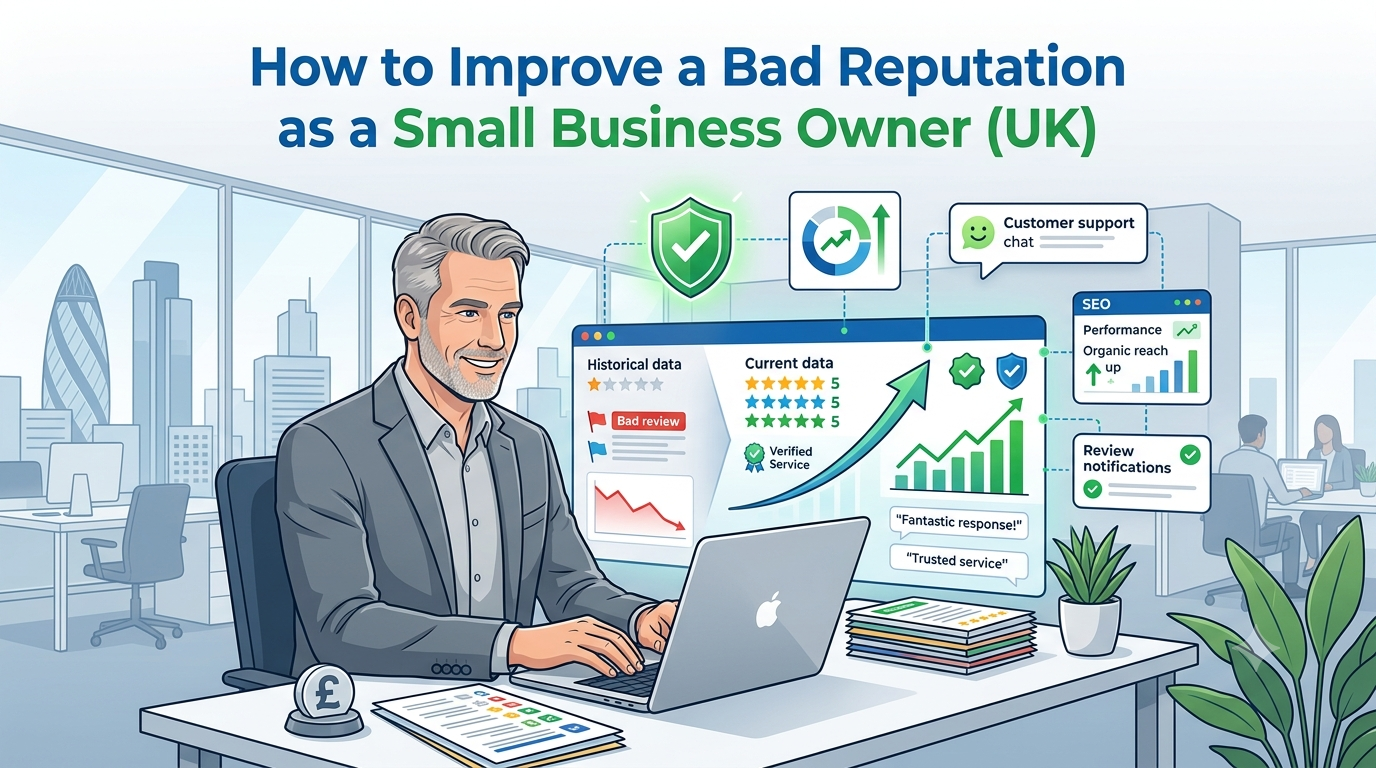
Small Business Owner (UK)
Running a small business means your name and your company’s name are often practically the same thing in customers’ minds. When the reputation takes a hit, whether from a rough patch of reviews, a public complaint, or simply falling behind on managing your online presence, it feels personal, because in many ways it is. The good news is that small business reputation UK owners are dealing with tends to be more recoverable, and often faster to fix, than the same problem at a larger company, precisely because there’s usually a direct relationship with customers to rebuild.
Here’s a practical, honest look at what actually moves the needle.
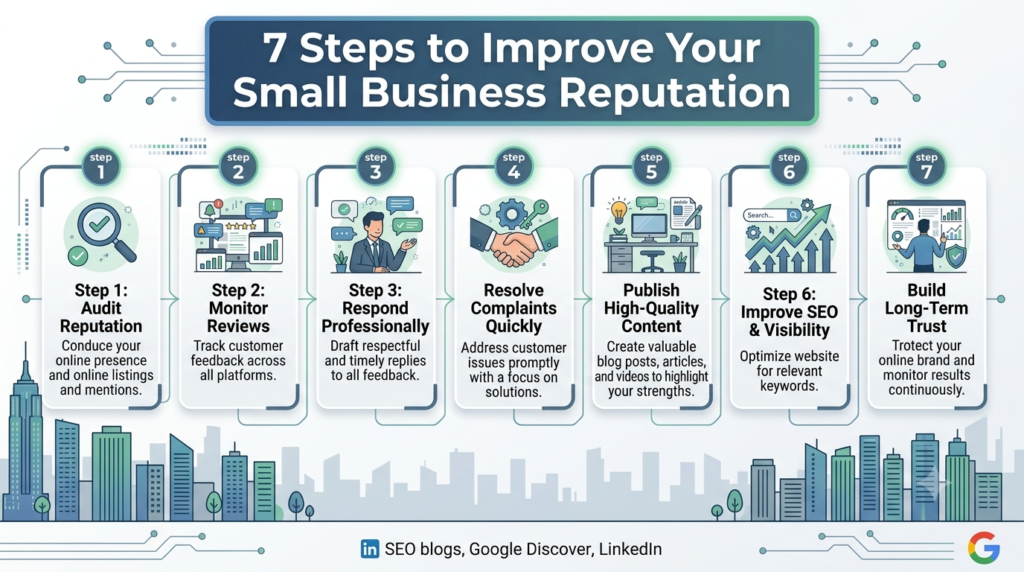
Start With an Honest Audit, Not a Reaction
Before responding to anything, search your business name and see exactly what a prospective customer would see. Note what’s accurate but negative, what’s outdated, and what’s simply missing, like a lack of recent reviews or an incomplete Google Business Profile. Reacting to the most emotionally loud problem first, usually a single harsh review, often means missing a bigger pattern sitting just underneath it.
The Core Steps to Rebuilding Trust
| Step | What It Involves | Typical Timeframe |
|---|---|---|
| Audit your current presence | Search your name, document what appears, sort by severity | 1 day |
| Respond to every review | Address negative and positive reviews professionally | Ongoing |
| Fix the underlying issue | Resolve whatever operational problem is driving complaints | Days to weeks |
| Refresh your online listings | Update Google Business Profile, directories, and website | 1 to 2 weeks |
| Actively request new reviews | Ask satisfied customers directly and consistently | Ongoing |
| Monitor going forward | Set up alerts so new issues are caught early | Ongoing |
Respond to Every Review, Not Just the Bad Ones
It’s tempting to only engage with negative reviews defensively and ignore the rest. A more effective approach treats every review as a chance to demonstrate how the business actually operates. A thoughtful, specific response to a negative review often reassures future customers more than a wall of five-star ratings alone, since it shows there’s a real person accountable for the experience.
Fix What’s Actually Driving the Complaints
If multiple reviews mention the same issue, slow replies, inconsistent service, unclear pricing, no amount of review management will hold up long term without addressing that root cause directly. Local business reputation tends to recover fastest when the fix is genuine rather than cosmetic, since small communities and repeat customers notice the difference quickly.
For a deeper diagnostic on identifying which specific cause is driving your situation, our breakdown of common causes and fixes is a useful next step before committing to a full strategy.
Make It Easy for Happy Customers to Speak Up
Most satisfied customers simply don’t think to leave a review unless asked. A short, direct request, in person, by text, or through a follow-up email, consistently outperforms passive hope that reviews will accumulate naturally. This is one of the highest-leverage, lowest-cost actions available to a small business owner working on business reputation recovery, since it directly counterbalances any negative reviews already visible.
Strengthen Your Local Search Presence
For most small businesses, local SEO reputation and general reputation are deeply connected. A complete, accurate Google Business Profile, consistent business details across directories, and location-specific content all help both local search rankings and the overall trustworthiness of what a customer sees when researching you. Neglecting this foundation is one of the most common, and most fixable, gaps small business owners overlook. Our guide to the UK review platforms that matter most covers where to prioritise this effort.
Be Patient, But Stay Consistent
Reputation recovery for a small business rarely happens overnight, but it also doesn’t require the scale of effort a larger company would need. A steady, honest routine, responding to reviews, requesting new ones, keeping listings current, tends to produce visible movement within weeks rather than months, provided the underlying issue driving the complaints has genuinely been resolved.
When to Get Outside Help
Most small business reputation issues can be handled directly by the owner with consistency and the right routine. If the situation involves a viral complaint, a defamatory review, or a pattern that hasn’t improved despite genuine effort over several months, it may be time to bring in outside support. Our 10-point UK checklist for signs your business needs reputation management is a useful way to check where you currently stand.
Frequently Asked Questions
How quickly can a small business recover from a bad reputation?
Visible improvement often begins within a few weeks of consistent effort, though full recovery depends on how entrenched the negative content is and whether the underlying issue has genuinely been fixed.
Should I respond to negative reviews personally or through a staff member?
Either can work, but responses should sound genuine and specific to the situation rather than generic or templated, since customers can usually tell the difference.
Is it worth paying for reviews or incentivising customers to leave them?
No. Incentivised or fake reviews risk platform penalties and further reputational damage if discovered, and most review platforms actively police this.
What’s the single most effective first step for a small business owner?
Conducting an honest audit of what currently appears in search results, rather than reacting only to the most recent or most visible complaint.
Can one bad review really damage a small business long term?
On its own, rarely. The risk comes from a pattern of unaddressed reviews accumulating over time, which is why consistent response and monitoring matter more than any single review.