

Real Estate Reputation Management UK
Buying, selling, letting, or renting a property is one of the most stressful financial decisions most people make, and trust is the deciding factor in who they choose to guide them through it. Real estate reputation management UK agents rely on has quietly become as important as location or listing quality, because in a market this competitive, the agent with the strongest visible trust signals is often the one who wins the instruction before a single viewing takes place.
If you’re an estate or letting agent wondering whether this is worth the investment, the honest answer is that it already affects your pipeline, whether you’re actively managing it or not.
Why This Matters More Than Ever Right Now
Property portals like Rightmove and Zoopla now display agent reviews prominently alongside listings, meaning a prospective seller comparing three local agents is often comparing their review profiles as much as their marketing packages. Real estate reputation management UK-wide has become genuinely urgent because this comparison now happens before an agent ever gets the chance to pitch in person. A weak or thin review profile can quietly cost instructions to a competitor with a stronger one, even when the underlying service quality is comparable or better.
What Real Estate Reputation Management Actually Covers
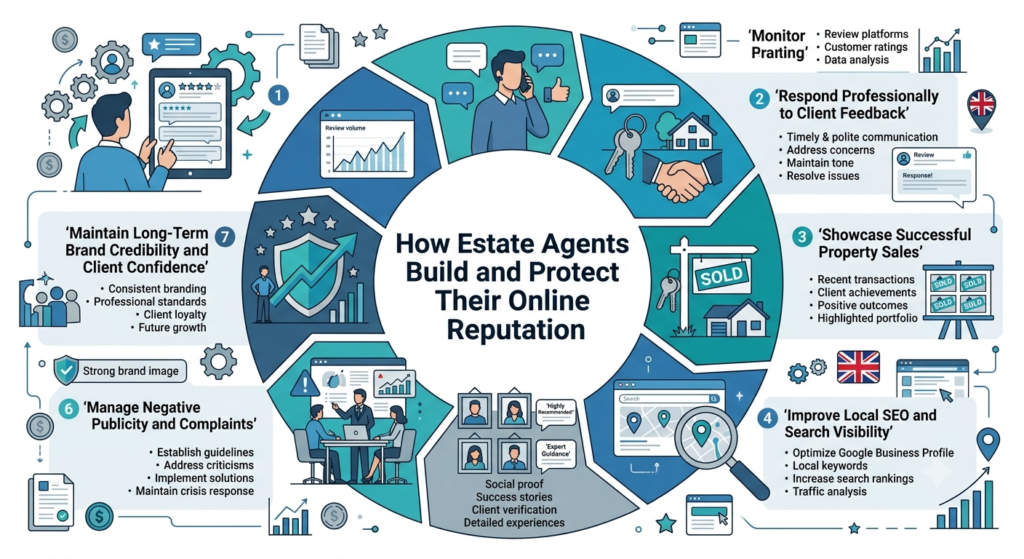
A proper strategy spans several connected areas: review management across Rightmove, Zoopla, and Google, consistent and accurate agency listings and branch information, individual agent visibility for negotiators and branch managers who deal directly with clients, and proactive handling of the specific disputes this industry generates, from valuation disagreements to tenancy deposit disputes.
Treating this as just “getting more five-star reviews” misses most of what actually protects an agency’s reputation long term.
Common Reputation Risks Specific to Estate Agents
• Rightmove and Zoopla reviews have significant influence: Reviews on property platforms are displayed alongside listings, allowing potential clients to form opinions about an agency while actively searching for properties.
• Landlord and tenant disputes can damage reputation: Issues involving deposits, maintenance concerns, or tenancy disagreements often lead to detailed and emotionally driven reviews.
• Valuation disagreements may result in negative feedback: Sellers who are unhappy with a property’s valuation or sale outcome may express their frustration through public reviews.
• Negative publicity can have long-term effects: Adverse media coverage or controversy surrounding specific property transactions can remain visible in search results for years.
• Local market reputation is especially important: In smaller communities, word-of-mouth, online reviews, and local press coverage can significantly influence an agency’s credibility and future business opportunities.
• Public perception directly impacts client decisions: Buyers, sellers, landlords, and tenants often research agencies online before making contact, making reputation management an essential part of business growth.
Building Trust Signals That Actually Convert
Real estate reputation management UK strategy works best when it focuses on trust signals a prospective client can verify quickly, since property decisions are made under real time pressure. This includes a consistent, recent flow of genuine client reviews rather than a cluster from years ago, transparent, professional responses to any negative feedback that demonstrate accountability rather than defensiveness, and visible individual agent profiles that let clients see who they’ll actually be working with before making contact.
This last point matters more in real estate than most industries, since clients are hiring a specific person’s judgement and negotiation skill as much as the agency brand itself.
Managing Landlord and Tenant Disputes Without Damaging Trust
Deposit and maintenance disputes are uniquely difficult to manage publicly, since agents are often bound by confidentiality around specific tenancy details even when a review feels unfair. A calm, general response acknowledging the situation without confirming specifics protects both the agency’s professionalism and its ongoing legal position. Letting agent reputation work benefits enormously from having a clear, consistent internal policy for how these situations are handled publicly, agreed in advance rather than improvised under pressure during an active dispute.
Strengthening Property Listing Trust Signals
Beyond reviews, property listing trust signals, accurate branch details, professional agent photos and bios, and consistent information across every portal and directory, quietly reinforce credibility every time a prospective client encounters your listings. Inconsistent or outdated information across platforms creates small doubts that accumulate, even when no single issue looks serious on its own.
For agencies wanting a fuller picture of where to prioritise review efforts specifically, our guide to the UK review platforms that matter most breaks down where clients are actually reading and leaving feedback.
Turning Reputation Into an Ongoing Advantage, Not a One-Off Fix
The agencies that benefit most from real estate reputation management UK-wide treat it as a continuous habit rather than a project completed once and forgotten. Property reputation management works best as part of a broader content and trust strategy, the same core principle covered in our guide to building a positive content strategy, applied specifically to the property sector’s faster, more comparison-driven buying cycle.
If you’re unsure whether your agency has reached the point where a more structured approach is worth the investment, our 10-point UK checklist for signs your business needs reputation management is a useful way to check where you currently stand before committing resources.
When to Bring in Specialist Support
Most estate agents can handle routine review management internally with consistency and the right process. A single branch with a manageable review volume, a designated staff member checking Rightmove, Zoopla, and Google regularly, and a simple, agreed approach to responding, this is often enough to maintain a healthy reputation without any outside help at all.
Specialist support becomes genuinely worthwhile in a handful of specific situations:
- A negative review pattern hasn’t improved despite real, sustained effort. The agency has already been responding consistently and requesting genuine feedback, but the overall picture still isn’t shifting after several months. This usually signals either a deeper operational issue that needs addressing before reputation work can succeed, or a competitive local market where a more strategic approach is needed to stand out.
- A dispute has escalated toward legal territory. Particularly anything involving allegations that go beyond genuine customer opinion into potentially false statements of fact. At this point, reputation strategy alone isn’t enough, and coordinating with legal advice becomes necessary alongside any ongoing search or review work.
- The business is expanding into new branches or markets. Maintaining consistent reputation standards across locations gets genuinely difficult without dedicated oversight, since each new branch effectively starts its own review history from zero while still representing the same overall brand. Without a coordinated approach, it’s easy for one strong, well-established branch to carry a reputation that a newer, less-reviewed branch hasn’t yet earned, creating inconsistency that savvy clients often notice when comparing locations.
- Branch managers handle reviews inconsistently across a franchise or multi-branch agency. Individual managers often have different levels of comfort or consistency in handling reviews. Centralising guidance, or bringing in outside support to establish a consistent standard across every location, often resolves this more effectively than leaving each branch to develop its own informal approach over time.
In each of these cases, the value of specialist support isn’t just extra hands managing reviews. It’s the strategic layer, knowing which battles are worth fighting publicly, which are better handled quietly, and how to build a search presence that holds up under genuine competitive pressure rather than just responding to whatever appears most recently.
Frequently Asked Questions
Do Rightmove and Zoopla reviews actually affect how many instructions an agency gets?
Yes. Reviews on these platforms sit directly alongside listings, meaning prospective sellers and landlords frequently compare agent review profiles as part of choosing who to instruct, often before ever speaking with an agent directly.
How should an agency respond to a negative review about a deposit dispute?
With a calm, general acknowledgement that avoids confirming specific tenancy details, since confidentiality obligations and ongoing legal positions both need protecting even when a review feels unfair.
Should individual agents have their own online presence, or is the agency brand enough?
Both matter significantly in real estate specifically, since clients are choosing a person’s judgement and negotiation skill as much as the agency name, making individual agent visibility a genuine trust factor.
How quickly can an estate agency improve a weak review profile?
Consistent responses and active review requests can shift the visible tone within weeks, though a genuinely strong, resilient profile typically builds over several months of sustained effort.
Is reputation management only relevant for larger estate agency chains?
No. Independent and smaller agencies often benefit even more, since they typically have fewer existing reviews overall, meaning each new review has a proportionally larger impact on how the agency appears to prospective clients.