

Reputation Management ROI
“Is this actually working?” is the question every client eventually asks, and it’s a fair one. Unlike a paid ads campaign with a direct cost per click and conversion trail, reputation management ROI can feel harder to pin down, since the value shows up as prevented losses and gradual trust building as much as immediate, countable wins. That doesn’t mean it’s unmeasurable. It means it requires the right KPIs and honest reporting, not vanity metrics dressed up as proof.
Why Reputation Management ROI Is Genuinely Different to Measure
Most marketing ROI follows a straightforward path: spend, click, convert. Reputation management ROI works differently because a meaningful share of its value is defensive, deals that didn’t fall through, candidates who didn’t withdraw, customers who didn’t churn after reading a negative review, rather than purely additive. This doesn’t make it unmeasurable, but it does mean the right reporting framework has to capture both the visible wins and the quieter, harder-to-attribute protective value.
The Core KPIs That Actually Matter
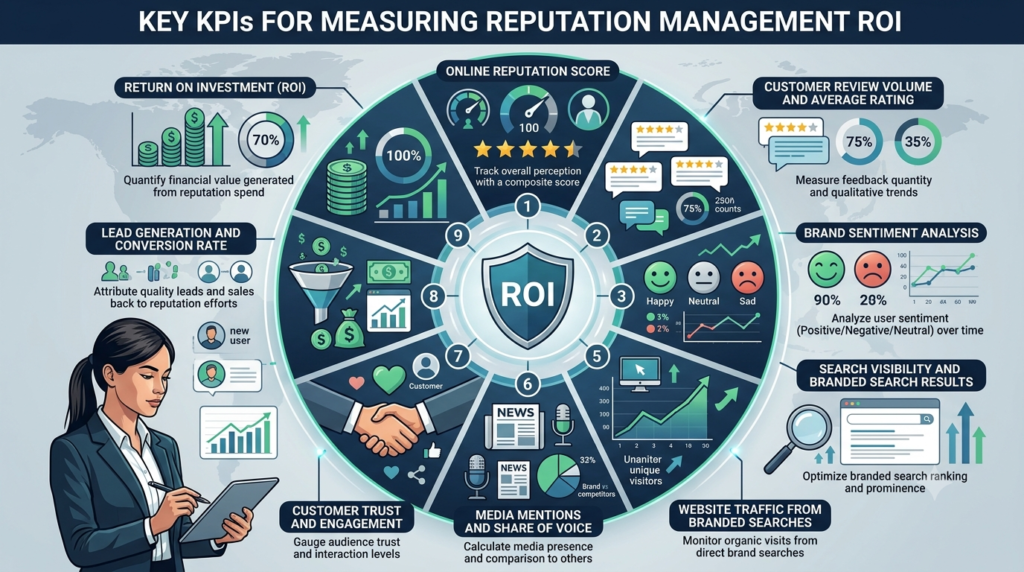
A genuine measurement framework tracks several distinct categories, not just one headline number.
| KPI Category | What It Measures | Why It Matters |
|---|---|---|
| Search visibility | Ranking position and sentiment of top results for your name | Shows whether accurate, positive content is winning the search page |
| Review metrics | Average rating, review volume, and response rate | Directly influences conversion and local search performance |
| Sentiment trend | Positive vs. negative mentions over time across platforms | Reveals whether public perception is genuinely shifting, not just search results |
| Share of voice | Your brand’s visibility relative to competitors for relevant terms | Contextualises whether gains are absolute or just relative |
| Conversion correlation | Enquiry or application quality against reputation improvements | Connects reputation work to actual business outcomes, not just metrics |
Search Visibility: The Most Direct Signal
Tracking how your top search results for branded terms change over time is the clearest, most direct reputation management ROI signal available. This means monitoring not just whether you rank, but what the ranking pages actually say, since a page one full of accurate, positive, current information represents genuine progress even if search volume itself hasn’t changed. Our guide to building a positive content strategy covers the work that actually drives this metric upward over time.
Review Metrics: Simple Numbers, Real Business Impact
Average star rating, total review volume, and response rate are straightforward to track and directly tied to business outcomes, particularly for local and consumer-facing businesses. A rising average rating combined with growing review volume signals genuine reputation improvement, while a static rating despite active management effort often points to an underlying operational issue that reputation work alone can’t fix. Response rate matters as its own metric too, since consistent, timely responses are themselves a visible trust signal independent of the rating itself.
Sentiment Tracking: Going Beyond the Star Rating
A star rating tells you the outcome. Sentiment tracking tells you why, by analysing the actual language used across reviews, social mentions, and news coverage over time. This is where reputation management analytics genuinely earns its value, catching a shift in tone or a recurring theme well before it shows up as a measurable rating decline, giving you time to respond proactively rather than reactively.
Share of Voice: Understanding Relative Position
Absolute improvement matters less if competitors are improving faster. Tracking your visibility and sentiment relative to comparable businesses in your sector gives essential context that isolated metrics miss entirely. A business that’s improved 15% but whose competitors have improved 30% is losing relative ground even while its own numbers look positive in isolation.
Building a Reporting Framework That Actually Tells the Truth
Honest reputation management reporting UK clients can actually trust means presenting the full picture, including metrics that haven’t moved as much as hoped, not just the wins. A credible report ties specific actions to specific metric movements where a genuine causal link exists, and is honest about the metrics where the connection is more indirect or still developing. Our guide to choosing a reputation management company covers what to expect from a provider’s reporting cadence and transparency more broadly, useful context if you’re currently evaluating whether your own reporting measures up.
Common Measurement Mistakes to Avoid
A few patterns consistently undermine otherwise good reputation work: chasing a single vanity metric, like overall star rating alone, while ignoring review volume or sentiment trend, measuring only short-term movement and missing the slower, compounding value that builds over several months, comparing your metrics against no meaningful baseline, and treating every metric as equally important regardless of what actually matters most for your specific business and industry.
Connecting Reputation Metrics to Actual Business Outcomes
The most convincing reputation management ROI case connects search and sentiment improvements to real business signals: enquiry volume, application quality for employer reputation work, conversion rate from organic search traffic, or reduced customer service escalations. This requires coordinating reputation reporting with your existing business metrics rather than treating reputation as an isolated marketing function reporting only on its own numbers. Our complete guide to reputation management pricing is a useful companion reference when weighing measured ROI against ongoing investment.
How Often You Should Actually Review These Metrics
Search visibility and sentiment shift gradually, so monthly reporting typically captures meaningful movement without over-reacting to normal short-term noise. Review metrics can be checked more frequently, weekly is reasonable for an actively managed profile, since response timeliness matters in the moment. A deeper quarterly review, comparing trend lines across all KPI categories together, is where the genuine strategic picture and true reputation management ROI actually becomes clear.
Frequently Asked Questions
What’s the single best KPI for measuring reputation management ROI?
There isn’t one. Search visibility, review metrics, and sentiment trend each capture a different dimension, and relying on just one gives an incomplete, sometimes misleading picture of genuine progress.
How long before reputation management ROI becomes measurable?
Foundational metrics like review response rate can show movement within weeks. Search visibility and sentiment shifts typically take a few months to show clear, sustained trends rather than short-term noise.
Can reputation management ROI really be tied to revenue?
Indirectly but meaningfully, by correlating reputation metric improvements with enquiry volume, conversion rate, or hiring quality over the same period, even without a single direct attribution line like a paid ad click.
Should I be worried if one metric improves while another stays flat?
Not necessarily. Different KPIs move at different speeds, review response rate often improves quickly while broader sentiment shift takes longer, so uneven progress across metrics is normal rather than a sign of failure.
How often should I expect reporting from a reputation management provider?
Monthly reporting is a reasonable standard for most engagements, with a more detailed quarterly review of overall trends, though this should be agreed clearly at the start of any engagement rather than assumed.